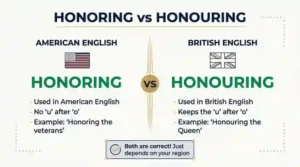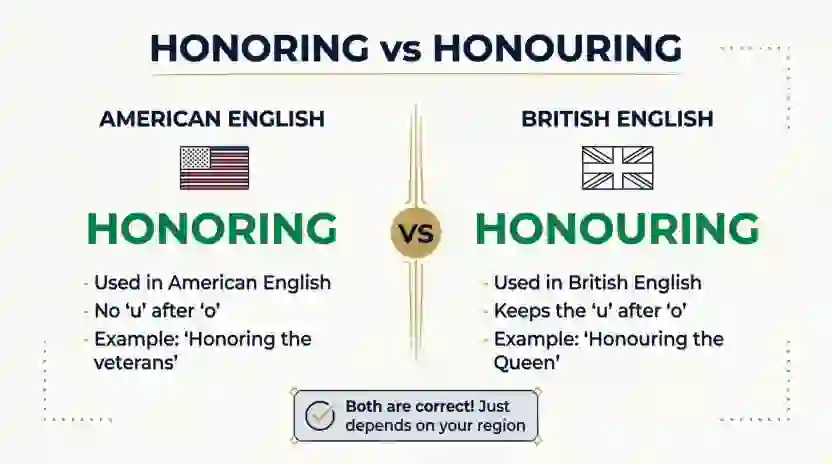
If you are wondering if honoring or honouring is correct, both spellings are correct, but the choice depends mainly on the variety of English you are using. Honoring is the standard American English spelling, while honouring is the standard British English spelling.
This difference can be confusing because the two words have the same meaning, pronunciation, and grammatical role. The only major difference is the spelling, especially the presence of u. The same pattern appears in words such as color/colour, favor/favour, and behavior/behaviour.
If you are writing for a US audience, use honoring. If your audience follows British English, use honouring. Canada commonly uses both conventions, although British-style honouring is generally preferred. Australia also commonly follows British spelling conventions.
In this guide, you will learn what honoring and honouring mean, where each spelling is used, how the forms developed, and how to choose the right version for academic, business, and everyday writing.
Honoring or Honouring: Featured Snippet & AI Overview
Honoring and honouring are both correct spellings of the present participle of honor/honour. Standard in American English, while honouring is standard in British English.
Both mean showing respect, celebrating someone, or fulfilling a promise or obligation. Choose the spelling that matches the English variety used in your document.
Honoring or Honouring: Quick Answer
The short answer is simple:
- Honoring = American English
- Honouring = British English
- Both are grammatically correct.
- Both have the same meaning.
- The difference is mainly regional spelling.
- Canadian English commonly accepts both forms, with honouring often preferred.
- Australian English generally follows British-style spelling.
Examples
American English:
We are honoring our teachers today.
British English:
We are honouring our teachers today.
American English:
The ceremony is honoring local volunteers.
British English:
The ceremony is honouring local volunteers.
So, neither spelling is simply “wrong.” Your choice should match your audience and your overall spelling style.
What Does Honoring or Honouring Mean?
Honoring and honouring are the present participle forms of the verbs honor and honour.
The verb can mean to show respect or recognition toward a person, group, tradition, achievement, or memory. It can also mean keeping a promise, agreement, or obligation. Cambridge gives examples of honour involving respect as well as keeping an agreement.
Meaning 1: Showing respect
The school is honoring its retired teachers.
This means the school is showing respect or recognition to the teachers.
Meaning 2: Remembering someone
The community is honouring the victims with a memorial.
Here, honouring means remembering and showing respect.
Meaning 3: Keeping a promise or agreement
The company is honoring the original agreement.
In this context, the verb means fulfilling or respecting an obligation. Oxford gives honour this formal sense, including keeping an agreement or promise.
The spelling changes, but the meaning does not.
The Origin of Honoring and Honouring
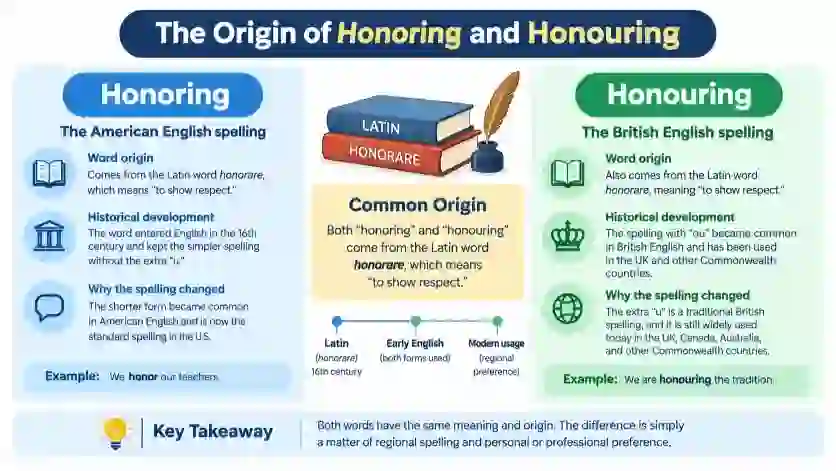
The words honor and honour have a long history in English.
The noun can be traced through Anglo-French and Old French forms to the Latin honor and honorem. The English word appeared around the early 13th century, with meanings connected to dignity, respect, reputation, and distinction. The verb developed from related French and Latin forms.
For a long period, honor and honour were both used in English. According to the historical record summarized by Etymonline, the -our spelling became preferred in England, while the -or spelling became established in the United States, with Noah Webster’s influence playing a role in American spelling conventions.
This is part of a larger pattern:
| British English | American English |
| colour | color |
| favour | favor |
| behaviour | behavior |
| honour | honor |
| honouring | honoring |
So honouring vs honoring is not a difference in meaning. It is part of the wider British-American spelling difference.
British English vs American English
The clearest distinction is regional.
| British English | American English | Example |
| honouring | honoring | They are honouring/honoring her work. |
| honoured | honored | She was honoured/honored for her service. |
| honour | honor | It was an honour/honor to meet him. |
| honours | honors | He graduated with honours/honors. |
| honourable | honorable | She is an honourable/honorable person. |
Cambridge identifies honour as the UK form and honor as the US form. Oxford also lists honoring as the American -ing form and honouring as the British form.
Why does British English keep the “u”?
British spelling preserves the -our pattern in words such as honour, colour, and favour. American spelling commonly uses the shorter -or forms.
The same difference continues when suffixes are added:
- honour → honouring
- honor → honoring
- honour → honoured
- honor → honored
The important point is consistency.
Which Version Should You Use?
Your audience should determine your spelling choice.
United States
Use honoring.
Examples:
- honoring veterans
- honoring a tradition
- honoring an agreement
- honoring someone’s achievements
American English uses honor as the standard spelling. Cambridge and Oxford both identify honor as the US form.
United Kingdom
Use honouring.
Examples:
- honouring a tradition
- honouring a respected teacher
- honouring an agreement
- honouring someone’s contribution
UK English uses honour and related forms with -our.
Canada
Canadian English can use both British and American spelling patterns. The University of Toronto notes that Canadians generally prefer the British -our spelling in words such as honour and colour, while the American -or forms are also acceptable.
For a Canadian audience, honouring is therefore a natural choice, especially if the rest of the document uses Canadian or British-style spelling.
Australia
Australian English generally follows British spelling conventions. Australian government-related style material, for example, uses British-Australian forms such as honourable.
Honouring is therefore the natural choice for Australian English.
International Writing
If your audience is international, either form can work.
The most important rule is consistency.
Do not write:
We are honouring the winners and honoring their achievements.
Instead, choose one spelling system and use it throughout the document.
Academic Writing
Follow your institution, publisher, or required style guide.
If your institution uses American English, choose honoring.
If it uses British English, choose honouring.
Consistency matters more than choosing one form universally.
Business Writing
Match the spelling style used by your company, client, or target market.
For a US company:
We are honoring our long-term customers.
For a UK company:
We are honouring our long-term customers.
Common Mistakes
Mistake 1: Treating one spelling as universally correct
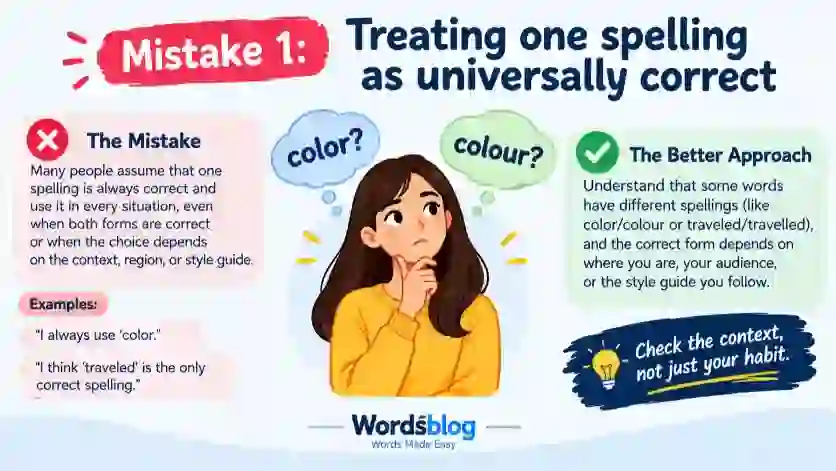
Incorrect assumption:
Honouring is always wrong because American English uses honoring.
Better understanding:
Honouring is correct in British English.
The reverse is also true. Honoring is standard American English.
Mistake 2: Mixing spelling systems
Inconsistent:
We are honoring our customers and using British colour guidelines.
This may be acceptable in a mixed-context document, but a normal document should usually follow one consistent style.
Better:
We are honoring our customers and using American color guidelines.
Or:
We are honouring our customers and using British colour guidelines.
Mistake 3: Adding an extra “u” in American English
Incorrect for standard American English:
We are honouring our employees.
Standard American form:
We are honoring our employees.
Mistake 4: Removing the “u” in British English
Less suitable for standard British English:
We are honoring our employees.
Standard British form:
We are honouring our employees.
Memory Tip
Think of the base word first:
US: honor → honoring
UK: honour → honouring
If you remember honor = US and honour = UK, the related forms become much easier.
Everyday Examples
The choice becomes clearer when you see both forms in real writing situations.
Emails
US:
We are honoring your request and will process the order today.
UK:
We are honouring your request and will process the order today.
Business Writing
US:
The company is honoring its commitment to customers.
UK:
The company is honouring its commitment to customers.
News Headlines
US:
City honors local volunteers.
UK:
City honours local volunteers.
Headlines often use short forms, but the same regional spelling applies.
Blogs
US:
This article explains why we are honoring an important tradition.
UK:
This article explains why we are honouring an important tradition.
Social Media
US:
Today, we’re honoring the people who helped our community.
UK:
Today, we’re honouring the people who helped our community.
Academic Writing
US:
The study examines how communities are honoring historical figures.
UK:
The study examines how communities are honouring historical figures.
Daily Conversation
US:
We are honoring our grandparents this weekend.
UK:
We are honouring our grandparents this weekend.
The pronunciation and meaning remain essentially the same. The visible spelling changes with the English variety.
Google Trends & Modern Usage
People often search honoring or honouring because search results, books, websites, and editing software expose them to different English varieties.
A reader in the United States may regularly see honoring, while a reader in the United Kingdom may encounter honouring. International readers can see both forms, especially when reading material from different countries.
Google Trends can be used to explore search interest by location and over time, but the public Trends interface does not by itself establish that one spelling is universally “correct” or preferred in every context. Google describes Trends as a way to explore what people are searching for and how search interest varies.
For this spelling question, the most useful conclusion comes from established dictionaries and language references: honoring is the US spelling, while honouring is the UK spelling.
The search itself is common because people want to know if the extra u is a spelling error. It is not. It signals a different spelling convention.
Quick Comparison Table
| Version | Meaning | Correct? | Region | Example |
| Honoring | Showing respect or fulfilling an obligation | Yes | US English | We are honoring our guests. |
| Honouring | Showing respect or fulfilling an obligation | Yes | UK English | We are honouring our guests. |
| Honoring | Present participle of honor | Yes | American English | They are honoring her work. |
| Honouring | Present participle of honour | Yes | British English | They are honouring her work. |
Key Takeaways
- Honoring is standard American English.
- Honouring is standard British English.
- Both forms are correct.
- They have the same meaning.
- The main difference is the spelling of the base verb.
- Canadian English commonly accepts both forms, with honouring often preferred.
- Australian English generally follows British-style spelling.
- Use the spelling required by your audience, institution, or publication.
- Most importantly, remain consistent within the same document.
FAQs About Honoring or Honouring
1. Is honoring or honouring correct?
Both honoring and honouring are correct. Honoring is the standard American English spelling, while honouring is the standard British English spelling. The two forms have the same meaning and grammatical function. The difference is a regional spelling convention, similar to color/colour and favor/favour.
2. Is honoring American or British English?
Honoring is the standard American English spelling. American English normally drops the u found in the British form honour. The related forms follow the same pattern: honored, honoring, and honorable in American English.
3. Is honouring British English?
Yes. Honouring is the standard British English spelling. British English uses honour as the base verb and keeps the u in related forms such as honouring and honoured.
4. Does honoring and honouring mean the same thing?
Yes. Honoring and honouring have the same meaning. Both can mean showing respect or recognition, remembering someone, or fulfilling an agreement or obligation. The difference is spelling rather than meaning. Your choice should depend on the English variety used by your audience.
5. Should I use honoring in the United States?
Yes. For standard American English, use honoring. This spelling matches the American base form honor. For example: The organization is honoring its volunteers. If you are writing for a US audience, keeping this spelling consistent throughout your document is the safest approach.
6. Should I use honouring in the UK?
Yes. Honouring is the standard British English form. For example: The organization is honouring its volunteers. If your document follows British English, it is best to use related forms such as honour, honoured, and honourable consistently.
7. Do Canadians use honoring or honouring?
Canadian English uses both British and American spelling patterns. The University of Toronto notes that Canadians generally prefer the British -our ending in words such as honour and colour, while American -or forms are also acceptable. Consistency within a document is important.
8. Is honouring wrong in American English?
It is not necessarily meaningless or unintelligible in American English, but honoring is the standard American spelling. If you are deliberately writing in American English, use honoring rather than honouring to maintain the expected spelling style.
9. Is honoring wrong in British English?
It is not the standard British spelling. British English normally uses honouring. If you are writing specifically for a British audience or publication that follows British English, use honouring and other British forms consistently.
10. How do I remember honoring vs honouring?
Use this simple memory rule: US = honor → honoring and UK = honour → honouring. Think of the u as part of the British spelling pattern. The same idea appears in color/colour and favor/favour. Once you remember the base word, the related forms are easier to spell.
Conclusion
Honoring and honouring are both correct. The difference is mainly regional spelling, not meaning or grammar. Honoring is the standard American English form, while honouring is the standard British English form.
The word describes actions such as showing respect, recognizing an achievement, remembering someone, or fulfilling a promise or agreement. Oxford and Cambridge both document these uses for honor/honour.
For US writing, choose honoring. For UK and generally British-style writing, choose honouring. Canadian English can use either, although British-style honouring is commonly preferred, while Australian English generally follows British spelling conventions.
The most important rule is consistency. Once you choose an English variety, keep the same spelling system throughout your article, essay, email, or business document.
Remember: honoring is American, honouring is British, and both are correct.
If you are unsure about another confusing spelling, check the word against the English variety your audience expects.
Read more about!
- Equaling or Equalling: Which One Should You Use?
- TTF or OTF: Which Font Format Is Better?
- Emphasising or Emphasizing: Which Spelling Is Correct?
- Bacon or Sausage: Which One Should You Choose?

I’m Olivia Parker, a grammar and English writing enthusiast passionate about making English simple and easy to understand. Through Wordsblog, I share clear explanations, useful grammar tips, and practical writing guidance to help readers write with confidence. My goal is to make learning English easier, one word at a time.