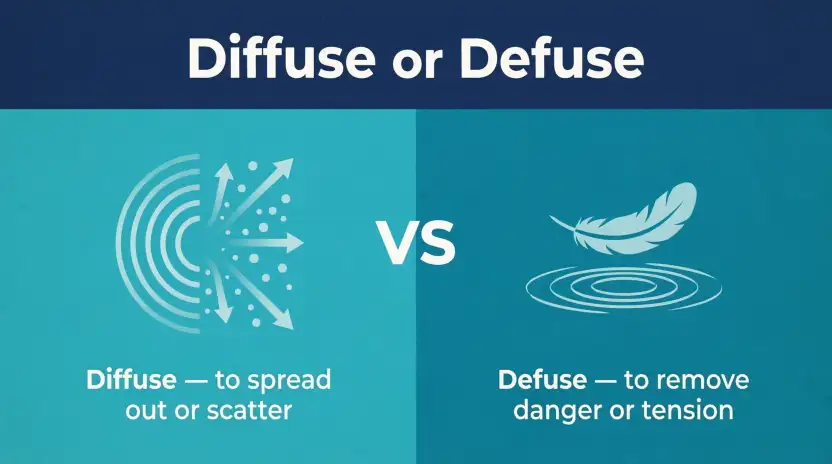
Diffuse and defuse are different words, and the correct choice depends on what you mean. Use diffuse when something spreads, scatters, or becomes less concentrated. Use defuse when you remove the danger from a bomb or make a tense situation calmer.
The confusion is easy to understand. Both words sound almost identical, and both can relate to making something less intense. For example, you can diffuse light by spreading it over an area, while you can defuse tension by calming a difficult situation. In some contexts, especially when talking about emotions or conflict, the difference can be easy to miss.
Knowing the distinction matters in emails, essays, business writing, news reports, and everyday conversation. A wrong choice can change the meaning of your sentence.
This guide explains diffuse or defuse, including their meanings, origins, common mistakes, examples, regional usage, and an easy memory trick. By the end, you will know exactly which word to use.
Featured Snippet + AI Overview
Diffuse or defuse? Use diffuse when something spreads or becomes less concentrated, such as light, gas, information, or smoke. Use defuse when you remove the danger from something or make a tense situation calmer, such as defusing a bomb or defusing an argument. They sound similar but have different meanings.
Diffuse or Defuse: Quick Answer
The simplest way to remember the difference is:
- Diffuse = spread out
- Defuse = make less dangerous or tense
Examples of diffuse
The clouds diffused the sunlight.
Here, the sunlight is spread out.
The smell of coffee diffused through the room.
The smell moved and spread across the room.
Examples of defuse
The manager tried to defuse the argument.
The manager tried to make the conflict calmer.
The technician safely defused the device.
The technician removed its ability to explode.
Cambridge defines diffuse as spreading in many directions and also uses it for physical processes such as gases or liquids spreading through another substance. Defuse means preventing a bomb from exploding or making a difficult situation calmer.
What Does Diffuse or Defuse Mean?
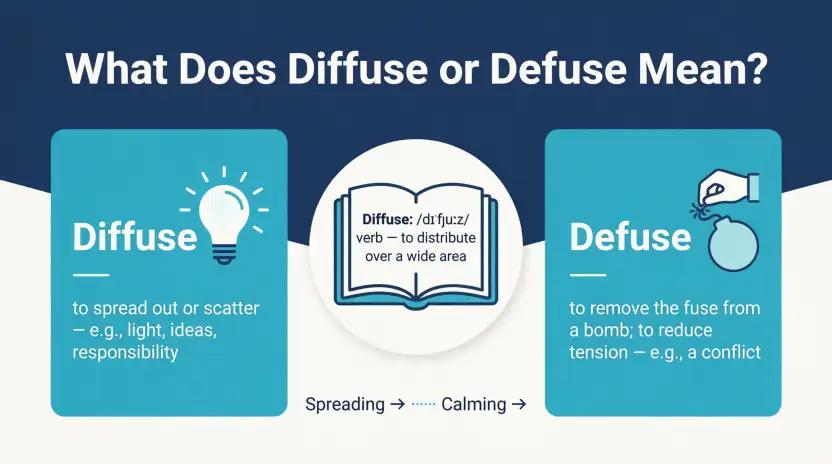
Although diffuse and defuse sound alike, they are not interchangeable.
What does “diffuse” mean?
Diffuse is mainly about spreading something out.
As a verb, it can mean to spread something in different directions or to cause something to spread. It is used for physical things such as light, gas, liquid, and smoke, but it can also describe ideas, knowledge, or influence spreading more widely.
Examples:
- The curtains diffused the bright sunlight.
- The scent diffused through the kitchen.
- Social media can diffuse information quickly.
- The gas diffused into the surrounding air.
Diffuse can also be an adjective.
The room had diffuse light.
Here, the light is spread out rather than focused in one strong beam.
It can also describe writing or ideas that are unclear or too spread out.
What does “defuse” mean?
Defuse means to remove danger or reduce tension.
Its literal meaning is connected with bombs or explosives. If someone defuses a bomb, they prevent it from exploding. The word is also commonly used in a figurative sense for arguments, conflicts, tension, and difficult situations.
Examples:
- Police experts defused the bomb.
- She tried to defuse the conflict.
- A calm response helped defuse the situation.
- The joke helped defuse the tension.
The key difference
Think about the action:
Diffuse spreads something out. Defuse takes danger or tension away.
That one distinction will solve most cases of diffuse vs defuse.
The Origin of Diffuse or Defuse
The two words have different histories, even though their modern pronunciations can sound very similar.
Origin of “diffuse”
Diffuse comes from Latin diffusus, the past participle of diffundere, meaning to pour out or spread. The word entered English with meanings connected to spreading or scattering.
This history fits the modern meaning well.
Imagine pouring liquid onto a surface. Instead of staying in one place, it spreads outward. That basic idea is behind diffuse.
The related noun diffusion also refers to spreading in different directions. Cambridge uses the term for the spreading of gases and liquids and for the spread of ideas, information, and technology.
Origin of “defuse”
Defuse has a much more direct connection to the word fuse.
The verb was recorded in the 1940s with the literal meaning of removing the fuse from an explosive device. Its figurative use for tensions and conflicts developed later.
That explains why defuse is the right word for situations involving danger or tension.
A useful way to remember it is:
DEFUSE → remove the FUSE
If you can connect the word to a fuse, you will usually remember its meaning.
British English vs American English
There is no major British-American spelling difference between diffuse and defuse. Both forms are standard in British and American English.
| Meaning | British English | American English | Example |
| Spread or scatter | diffuse | diffuse | The smoke diffused through the room. |
| Spread information | diffuse | diffuse | The report helped diffuse the information. |
| Make less tense | defuse | defuse | She tried to defuse the argument. |
| Make a bomb safe | defuse | defuse | Experts defused the device. |
| Spread out as an adjective | diffuse | diffuse | The room had diffuse lighting. |
The main issue is therefore meaning, not regional spelling.
Both British and American speakers use diffuse for spreading and defuse for removing danger or reducing tension. Cambridge lists the same core meanings for both varieties.
For writers, the important point is simple: changing from British English to American English does not normally require changing diffuse to defuse, or vice versa.
Which Version Should You Use?

The correct word depends on the meaning rather than the country where you are writing.
United States
Use diffuse for spreading and defuse for calming tension or removing danger.
The photographer used a screen to diffuse the light.
The manager tried to defuse the disagreement.
United Kingdom
The same distinction applies in British English.
The fog diffused the light.
His response helped defuse the situation.
Canada
Canadian English follows the same basic distinction.
Choose diffuse for spreading and defuse for danger or tension.
Australia
Australian English also uses both words according to their meanings.
The substance diffused through the water.
She tried to defuse the dispute.
International writing
For international readers, choose the word based on the intended action.
Ask:
Is something spreading? Use diffuse.
Is something dangerous or tense being made calmer? Use defuse.
Academic writing
Both words are useful in academic writing.
Diffuse often appears in science, medicine, physics, biology, communication, and social science.
Oxygen can diffuse across a membrane.
Defuse may appear in research about conflict, communication, negotiation, or crisis management.
Effective communication can help defuse conflict.
Business writing
Business writers often use defuse when discussing workplace conflict.
The supervisor intervened to defuse tensions between the two teams.
Use diffuse when discussing the spread of information, influence, or a physical substance.
The campaign helped diffuse information about the new service.
Common Mistakes
Mistake 1: Using “diffuse” for an argument
Incorrect:
She tried to diffuse the argument.
Better:
She tried to defuse the argument.
If the goal is to calm or reduce conflict, defuse is the natural choice.
Mistake 2: Using “defuse” for spreading
Incorrect:
The smell defused through the room.
Correct:
The smell diffused through the room.
The smell is spreading, so diffuse is correct.
Mistake 3: Confusing “diffuse tension” and “defuse tension”
You may occasionally see diffuse used with tension because diffuse can mean to make something less concentrated or less intense. Cambridge’s American Dictionary even gives an example of diffuse meaning to make something less noticeable or weaker.
However, defuse tension is the clear and widely recognized expression when the idea is to calm a tense situation.
The mediator helped defuse the tension.
Mistake 4: Choosing by sound
Because the words sound very similar, pronunciation is not a reliable memory tool.
Instead, focus on meaning:
Diffuse = spread.
Defuse = calm or disarm.
Memory tip
Use this simple trick:
Diffuse = spread.
Defuse = remove the fuse.
If something is spreading, choose diffuse.
If something is dangerous or tense and you want to make it safer or calmer, choose defuse.
Everyday Examples
Seeing the words in different contexts makes the distinction easier to remember.
Emails
I hope this message helps defuse some of the tension.
The new policy should help diffuse information across the organization.
Business writing
The director spoke with both teams to defuse the dispute.
The training program helped diffuse knowledge throughout the company.
News headlines
Officials Work to Defuse Tensions After Dispute
New Technology Helps Diffuse Heat More Efficiently
Headlines often remove articles and other small words, but the difference between the verbs remains the same.
Blogs
Soft curtains can diffuse harsh sunlight.
A friendly tone can defuse a heated discussion.
Social media
Humor can sometimes defuse an awkward moment.
The image uses soft colors to diffuse the light.
Academic writing
Molecules diffuse from areas of higher concentration to areas of lower concentration.
Mediation may help defuse interpersonal conflict.
Daily conversation
Can you open the curtains? They diffuse the sunlight nicely.
He told a joke to defuse the awkward situation.
Google Trends & Modern Usage
People often search diffuse or defuse because the two words are pronounced similarly and both can appear in contexts involving things becoming less intense.
The confusion is especially common with phrases involving tension, conflict, arguments, light, information, and physical substances.
Modern English uses diffuse broadly for spreading. It appears in scientific, technical, educational, business, and general writing. Cambridge gives examples involving knowledge, gases, liquids, light, and unclear writing.
Defuse is especially common when the subject involves conflict, tension, crisis, or explosives. Cambridge gives both the literal bomb meaning and the figurative meaning of making a difficult situation calmer.
Exact search-volume or Google Trends figures should not be assumed without checking current Google Trends data for a defined region and time period. The general usage distinction, however, is stable: diffuse relates to spreading, while defuse relates to reducing danger or tension.
Quick Comparison Table
| Version | Meaning | Correct? | Typical Context | Example |
| Diffuse | Spread or scatter | Yes | Light, gas, liquid, information | The smoke diffused through the room. |
| Diffuse | Make less concentrated | Yes | Light, heat, substances | The shade diffused the sunlight. |
| Diffuse | Spread widely | Yes | Ideas, knowledge, influence | The article helped diffuse the information. |
| Defuse | Remove a fuse or prevent an explosion | Yes | Bombs, explosives | Experts defused the bomb. |
| Defuse | Make calmer | Yes | Tension, conflict, arguments | She tried to defuse the conflict. |
| Defuse | Reduce danger or intensity | Yes | Crisis, difficult situations | His calm words defused the crisis. |
| Difuse | Intended as “diffuse” | No | Common spelling mistake | Use diffuse. |
| Defuse for spreading | No | Incorrect context | The smell diffused, not defused. |
Key Takeaways
- Diffuse means to spread, scatter, or become less concentrated.
- Defuse means to remove danger or make a tense situation calmer.
- Use diffuse for light, gases, liquids, information, ideas, and similar things that spread.
- Use defuse for bombs, arguments, conflict, tension, and difficult situations.
- British and American English use the same spellings.
- Defuse is connected to the idea of removing a fuse.
- Diffuse comes from a Latin root associated with pouring or spreading.
- When in doubt, ask if something is spreading or being calmed/disarmed.
FAQs
1. What is the difference between diffuse and defuse?
Diffuse means to spread something out or cause it to spread in different directions. Defuse means to remove the danger from an explosive or make a tense situation calmer. For example, sunlight can diffuse through a curtain, while a mediator can defuse an argument.
2. Is it “diffuse tension” or “defuse tension”?
Defuse tension is the standard choice when you mean to make a tense situation calmer. For example: “The manager tried to defuse tension between the employees.” The word diffuse can have meanings related to making something weaker or less concentrated, but defuse tension clearly expresses the idea of calming conflict.
3. Is it “diffuse an argument” or “defuse an argument”?
Use defuse an argument when you mean to calm or reduce the conflict. For example: “She remained calm to defuse the argument.” Think of defuse as removing the explosive force from a dangerous or heated situation.
4. Is “diffuse” the same as “spread”?
Often, yes. As a verb, diffuse can mean to spread something in many directions. It is commonly used for light, gases, liquids, information, knowledge, and ideas. Cambridge defines it as spreading or causing something to spread in many directions.
5. Is “defuse” only used for bombs?
No. Defuse originally referred to removing a fuse from an explosive, but it is now also widely used figuratively. You can defuse tension, defuse a conflict, defuse an argument, or defuse a crisis by making a difficult situation calmer.
6. How do you remember diffuse vs defuse?
Use two simple memory clues. Diffuse = spread. Think of something moving outward in different directions. Defuse = remove the fuse. Think of making a bomb safe or taking the danger out of a tense situation.
7. Are diffuse and defuse pronounced the same?
As verbs, they are pronounced very similarly, which is one reason they are often confused. Their meanings are different, though. Diffuse relates to spreading, while defuse relates to removing danger or reducing tension. This is why checking the meaning is more useful than relying on sound.
8. Is “diffuse” correct for light?
Yes. Diffuse is commonly used to describe light that is spread out rather than concentrated in one direction. For example: “The curtains diffused the sunlight.” The adjective diffuse can also describe light that is spread out and not directed at one point.
9. Is “defuse the situation” correct?
Yes. Defuse the situation means to make a difficult, dangerous, or tense situation calmer. For example: “The teacher spoke quietly to defuse the situation.” It is a common and natural use of defuse.
10. Which is correct: diffuse or defuse?
Both are correct words, but they are used in different situations. Choose diffuse when something spreads or becomes less concentrated. Choose defuse when you make something dangerous or tense safer and calmer. The sentence’s meaning, not the region, determines the correct word.
Conclusion
The difference between diffuse or defuse becomes simple once you focus on the action. Diffuse is about spreading, scattering, or making something less concentrated. Defuse is about removing danger or reducing tension.
Use diffuse for things such as light, smoke, gases, liquids, information, ideas, and knowledge. Use defuse for bombs, arguments, conflicts, crises, and tense situations.
There is no major British-American spelling difference here. Both varieties of English use the same two words with the same basic distinction.
When editing your writing, ask one quick question: Is something spreading, or am I trying to calm or disarm something? If it is spreading, choose diffuse. If it is being made safer or calmer, choose defuse.
Keep this memory trick in mind: Diffuse spreads; defuse disarms.
Once you remember that contrast, you will rarely confuse these two words again.
Read more about!
- Honoring or Honouring: Which Spelling Is Correct?
- Apartment or House: Which One Is Better for You?
- Resignate or Resonate: Which Word Is Correct?

I’m Olivia Parker, a grammar and English writing enthusiast passionate about making English simple and easy to understand. Through Wordsblog, I share clear explanations, useful grammar tips, and practical writing guidance to help readers write with confidence. My goal is to make learning English easier, one word at a time.