A single extra “s” can make a word look wrong, even when it is completely correct. “Emphasising” and “emphasizing” are both correct spellings, but the preferred form depends on the variety of English you are using. British English generally uses emphasising, while American English normally uses emphasizing.
This spelling difference comes from a broader pattern in English. British English often keeps -ise/-ising, while American English commonly uses -ize/-izing. However, the choice is not simply about right versus wrong. Your audience, publication style, school requirements, and chosen style guide can all matter.
If you are writing for an international audience, either form may be understood easily. The most important rule is to stay consistent throughout your document. In this guide, you will learn the meaning, origin, regional differences, common mistakes, practical examples, and the best spelling to use in academic, business, and everyday writing.
Featured Snippet + AI Overview: Emphasising or Emphasizing?
Emphasising and emphasizing are both correct spellings of the present participle of “emphasize.”
Emphasising” is more common in British English, while “emphasizing” is the standard American English spelling. Choose the spelling that matches your audience or style guide, and use it consistently.
Emphasising or Emphasizing – Quick Answer
The short answer is simple: both “emphasising” and “emphasizing” are correct.
The difference is mainly regional spelling.
- Emphasising = British English spelling
- Emphasizing = American English spelling
- Both mean giving extra importance, attention, or stress to something
- Neither spelling is inherently incorrect
- Your choice should match the English variety you are using
Examples
British English:
The teacher is emphasising the importance of clear writing.
American English:
The teacher is emphasizing the importance of clear writing.
Both sentences have the same meaning.
The same difference appears in other words, such as organising/organizing, recognising/recognizing, and realising/realizing.
What Does Emphasising or Emphasizing Mean?
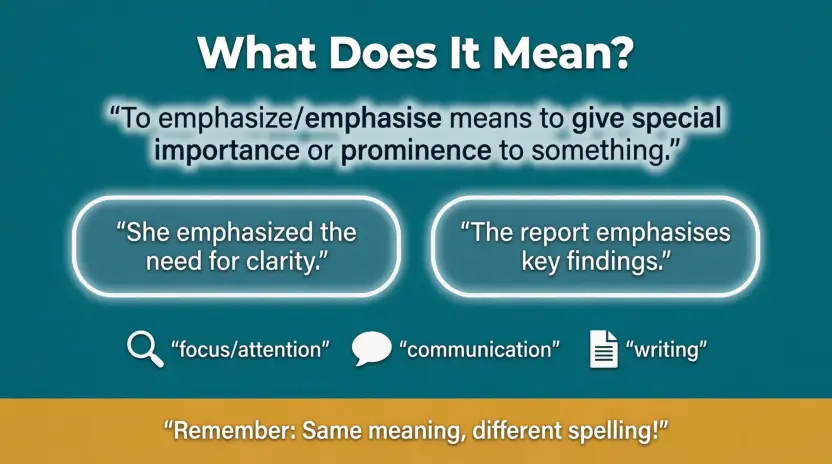
Emphasising and emphasizing are forms of the verb emphasize.
To emphasize something means to give it special importance or attention. A speaker, writer, teacher, manager, or editor may emphasize an idea to make sure people notice it.
Simple definition
Emphasize: to give special importance or attention to something.
For example:
The teacher emphasized the importance of practice.
This means the teacher gave special attention to the importance of practice.
What does “emphasising” mean?
Emphasising is the British English spelling.
She is emphasising the main point.
What does “emphasizing” mean?
Emphasizing is the American English spelling.
She is emphasizing the main point.
The meaning does not change when the spelling changes.
The difference is only in the spelling of the ending:
emphasising → -ising
emphasizing → -izing
This is why searches such as “emphasising or emphasizing,” “emphasising vs emphasizing,” and “is emphasizing correct” are common. Writers often know the word but are unsure which regional spelling fits their text.
The Origin of Emphasising and Emphasizing
The English verb emphasize is related to emphasis, a word that ultimately comes from Greek. English developed the verb from the noun and adopted spelling conventions that later differed between varieties of English.
The modern spelling difference is part of a wider -ise/-ize variation.
British English uses both -ise and -ize forms in different contexts and style traditions. The -ise spelling is very common in British everyday writing, while -ize is also accepted by some British dictionaries and style guides.
American English generally favors -ize.
That gives us forms such as:
| British-style spelling | American spelling |
| emphasising | emphasizing |
| organising | organizing |
| recognising | recognizing |
| realising | realizing |
| standardising | standardizing |
It is important not to assume that every British publication must use -ise. Individual publishers, dictionaries, universities, and style guides can have their own preferences.
The key lesson is to follow the style required by your audience or publication.
British English vs American English
The clearest difference appears in the spelling of the verb ending.
| British English | American English | Example |
| emphasising | emphasizing | She is emphasising the key point. / She is emphasizing the key point. |
| emphasised | emphasized | The report emphasised the issue. / The report emphasized the issue. |
| emphasise | emphasize | We should emphasise this point. / We should emphasize this point. |
British English
Emphasising is widely used in British English.
Example:
The article is emphasising the need for better communication.
American English
Emphasizing is the usual American spelling.
Example:
The article is emphasizing the need for better communication.
What about Canada and Australia?
English spelling in Canada and Australia can follow British-influenced conventions, but actual usage varies by institution, publisher, and style guide.
This means you should not treat a country’s spelling preferences as an absolute rule. When writing for a specific organization, check its editorial guidelines.
Which Version Should You Use?
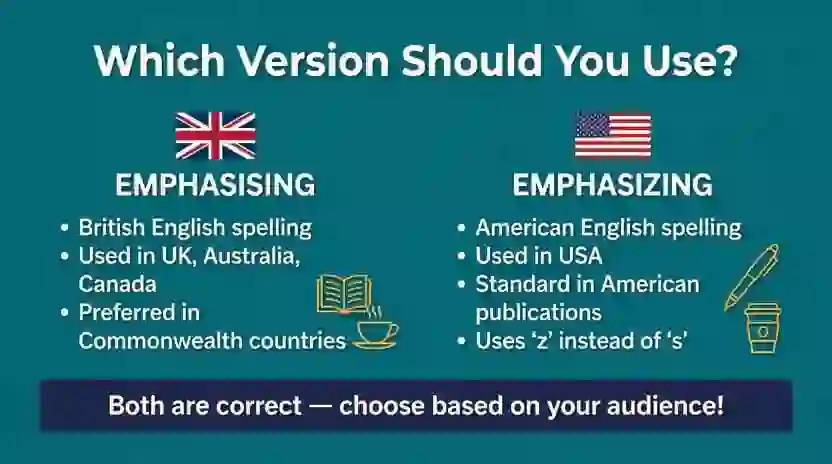
Your choice should depend on your audience and the style guide you are following.
United States
Use emphasizing for standard American English.
Example:
The professor is emphasizing the importance of research.
United Kingdom
Emphasising is a natural choice in many British English contexts.
Example:
The professor is emphasising the importance of research.
If your publisher or institution specifies -ize spellings, follow that guide instead.
Canada
Canadian English contains both British and American influences. Check the style guide used by your school, employer, publisher, or organization.
Australia
Australian English often follows British spelling conventions, so emphasising is commonly suitable. However, institutional style guides can differ.
International writing
For an international audience, either form can work.
The most important point is consistency. Do not switch randomly between emphasising and emphasizing in the same article.
Academic writing
Follow your university, journal, professor, or required style guide.
Academic writing values consistency more than personal spelling preference.
Business writing
Match the spelling to the English variety used by your company and customers.
For an American company, emphasizing is usually appropriate. For a British organization, emphasising may be preferred.
Common Mistakes
Mistake 1: Thinking one spelling is always wrong
Incorrect assumption:
“Emphasising” is wrong because American English uses “emphasizing.”
Correct understanding:
Both forms are legitimate. The preferred spelling depends on the English variety and style guide.
Mistake 2: Mixing spelling systems
For example:
The report is emphasising the problem and organizing the data.
This mixes -ise and -ize spellings.
It may not always be considered grammatically incorrect, but it can create an inconsistent editorial style.
A consistent British-style version would be:
The report is emphasising the problem and organising the data.
An American-style version would be:
The report is emphasizing the problem and organizing the data.
Mistake 3: Changing the meaning
The spelling does not change the meaning.
Emphasising does not mean something different from emphasizing.
Memory Tip
Think:
British: emphasising
American: emphasizing
When in doubt, check the style guide for your audience.
Everyday Examples
Understanding real examples makes the difference easier to remember.
Emails
British English:
I am emphasising the deadline because the project must be completed this week.
American English:
I am emphasizing the deadline because the project must be completed this week.
Business Writing
British English:
The report is emphasising the need for better customer service.
American English:
The report is emphasizing the need for better customer service.
News Headlines
British-style publication:
Government Report Emphasising Need for Reform
American-style publication:
Government Report Emphasizing Need for Reform
Headlines may omit some grammatical words, but the spelling difference remains.
Blogs
This guide is emphasizing the most common grammar mistakes.
Or, in British English:
This guide is emphasising the most common grammar mistakes.
Social Media
We are emphasizing the importance of clear communication.
A British writer might use:
We are emphasising the importance of clear communication.
Academic Writing
The study is emphasizing the role of language in education.
Or:
The study is emphasising the role of language in education.
Always follow the required academic style.
Daily Conversation
She keeps emphasizing the same point.
British English:
She keeps emphasising the same point.
The pronunciation and meaning remain essentially the same.
Google Trends & Modern Usage
Search interest in “emphasising or emphasizing” reflects a common spelling question rather than a difference in meaning. People often encounter one form online and wonder if the other is a spelling error.
Modern English usage continues to reflect regional spelling preferences.
American websites, educational materials, and publications commonly use emphasizing. British English sources commonly use emphasising, although some British style systems also accept or prefer -ize spellings.
Search engines may therefore show both versions as legitimate forms.
There is no need to change one spelling into the other simply because you see a different form online. Instead, identify the English variety used by your target publication or audience.
For SEO writers, this distinction is especially useful. You can understand both search variants while maintaining one consistent spelling throughout the article.
Quick Comparison Table
| Version | Meaning | Correct? | Region | Example |
| Emphasising | Giving special importance | Yes | British English and related usage | She is emphasising the main idea. |
| Emphasizing | Giving special importance | Yes | American English | She is emphasizing the main idea. |
| Emphasise | Give special importance | Yes | British-style spelling | We should emphasise this point. |
| Emphasize | Give special importance | Yes | American spelling | We should emphasize this point. |
| Emphasised | Gave special importance | Yes | British-style spelling | He emphasised the issue. |
| Emphasized | Gave special importance | Yes | American spelling | He emphasized the issue. |
Key Takeaways
- Emphasising and emphasizing are both correct.
- Emphasising is commonly associated with British English.
- Emphasizing is the standard American English spelling.
- Both words have exactly the same basic meaning.
- The difference comes from regional spelling conventions.
- Some British style guides also use -ize spellings.
- Always follow your publisher, school, employer, or style guide when one is provided.
- Most importantly, keep your spelling consistent throughout the same piece of writing.
FAQs
1. Is emphasising or emphasizing correct?
Both emphasising and emphasizing are correct. “Emphasising” is commonly used in British English, while “emphasizing” is standard in American English. The two forms have the same meaning and grammatical function. Your choice should depend on your audience, region, or the style guide you are following.
2. Is emphasising British or American English?
Emphasising is generally associated with British English. It uses the -ising spelling pattern. American English normally uses emphasizing, with -izing. However, British publications are not completely uniform, and some British style guides prefer or allow -ize spellings.
3. Is emphasizing American English?
Yes. Emphasizing is the standard spelling used in American English. It is the present participle of emphasize. For example: “The teacher is emphasizing the importance of practice.” American English commonly uses -ize endings in words of this type.
4. What is the difference between emphasising and emphasizing?
There is no difference in meaning. The difference is spelling. Emphasising uses the British-style -ising form, while emphasizing uses the American -izing form. Both mean giving special importance, attention, or stress to something.
5. Should I use emphasising in British English?
You can use emphasising in British English, and it is widely familiar to British readers. However, check the style guide if you are writing for a university, publisher, newspaper, or professional organization because some British editorial systems prefer -ize spellings.
6. Should I use emphasizing in American English?
Yes. Emphasizing is the normal American English spelling. If your document follows American English conventions, use emphasizing, along with related forms such as emphasize and emphasized.
7. Can I use emphasising and emphasizing in the same article?
It is better to avoid switching between them without a reason. Choose the spelling that matches your selected English variety or style guide, then use it consistently. Consistency makes professional, academic, and online writing look more polished.
8. Is emphasising spelled with an S?
Yes. Emphasising is spelled with an s before the -ing ending. It comes from the British-style spelling emphasise. The American form is emphasizing, which comes from emphasize and uses a z.
9. Is emphasizing grammatically correct?
Yes. Emphasizing is grammatically correct. It is the present participle and gerund form of emphasize. For example, “She is emphasizing the main point” uses the word correctly in a progressive verb construction.
10. Which spelling is better for SEO?
Neither spelling is universally “better” for SEO. Search engines can understand both forms, but your content should match the language variety and audience you are targeting. If your website primarily uses American English, emphasizing is a natural choice. For British English content, emphasising may fit better.
Conclusion
Emphasising and emphasizing are both correct spellings, and the main difference is regional spelling convention. Emphasising is commonly used in British English, while emphasizing is the normal American English form.
The meaning does not change. Both forms describe giving extra importance, attention, or stress to an idea, action, or subject.
For US readers, emphasizing is usually the natural choice. For UK readers, emphasising is commonly used, although some British style guides prefer -ize forms. Canadian and Australian usage can vary, so an organization or publication’s style guide should take priority.
For academic and business writing, consistency matters most. Do not switch between emphasising and emphasizing simply because you see both forms online.
The easiest rule to remember is this: choose the spelling that matches your English variety, then use it consistently. If you found this comparison useful, explore other commonly confused English spellings and word choices on your grammar site.
Read more about!
- Buried or Cremated: What Is the Difference?
- Dose or Dosage: What Is the Difference?
- Fabric or Forge: What Is the Difference?

I’m Olivia Parker, a grammar and English writing enthusiast passionate about making English simple and easy to understand. Through Wordsblog, I share clear explanations, useful grammar tips, and practical writing guidance to help readers write with confidence. My goal is to make learning English easier, one word at a time.





1 thought on “Emphasising or Emphasizing: Which Spelling Is Correct?”