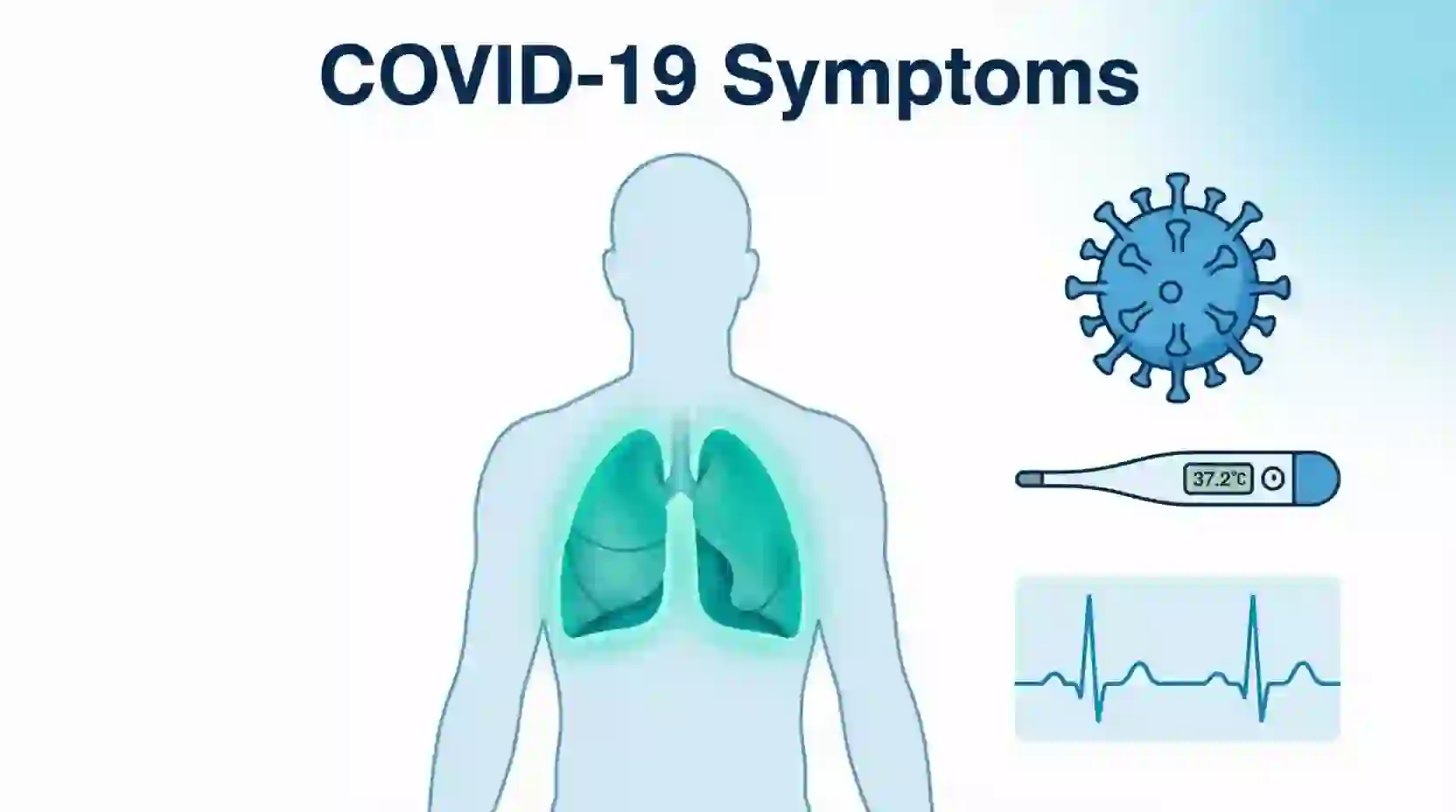
A stuffy nose, headache, cough, or tired feeling can make you wonder: is it a sinus infection or COVID-19? The short answer is that either one can cause congestion, headache, cough, and changes in smell, so symptoms alone may not give you a definite answer.
COVID-19 is caused by the SARS-CoV-2 virus, while sinusitis is inflammation or infection of the sinuses.
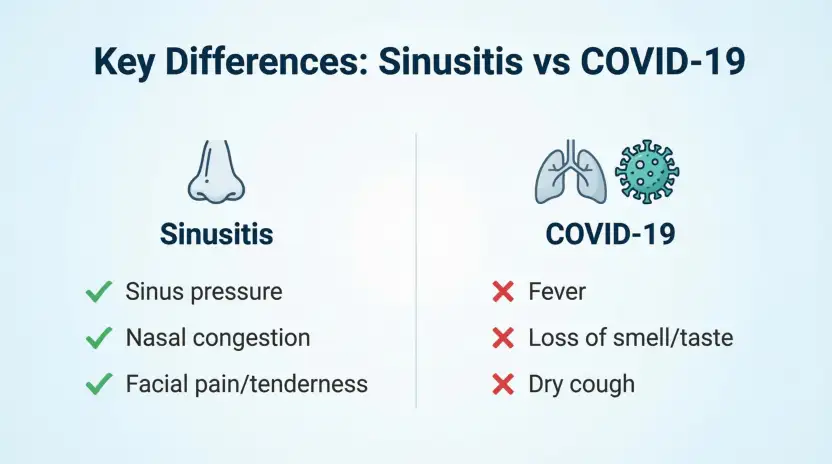
This is why people often search for “sinuses or COVID” when they suddenly feel sick. The two conditions can look similar at first, but some symptoms and patterns can provide useful clues. Strong facial pressure, pain around the cheeks or forehead, and thick nasal drainage are more typical of sinusitis. COVID-19 can cause congestion and a runny nose too, but it may also cause sore throat, fatigue, body aches, fever, cough, nausea, or diarrhea.
In this guide, you will learn the key differences, common symptoms, warning signs, and when testing or medical care may be appropriate.
Sinuses or COVID: Featured Snippet & AI Overview
Sinusitis and COVID-19 can share symptoms such as congestion, runny nose, headache, cough, and reduced smell. Sinusitis is more strongly associated with facial pressure, sinus pain, and nasal drainage, while COVID-19 may also cause fever, fatigue, sore throat, body aches, or gastrointestinal symptoms. Symptoms alone cannot reliably confirm COVID-19, so testing may be needed.
Sinuses or COVID: Quick Answer
If you are trying to decide between sinuses or COVID, look at the overall pattern rather than one symptom.
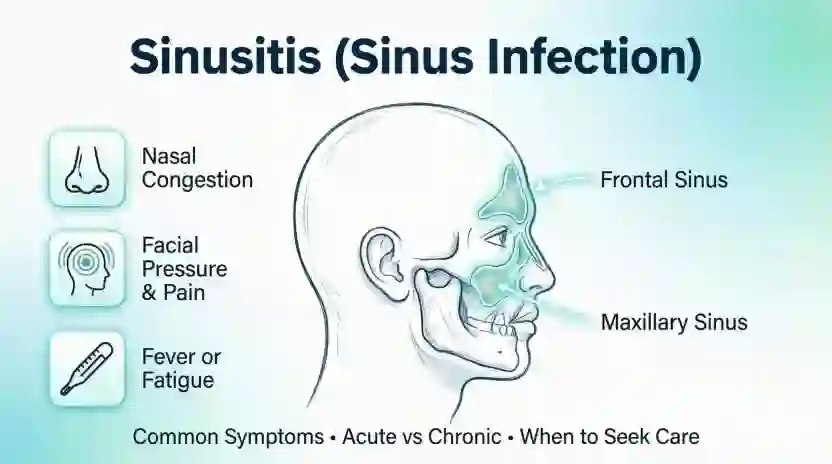
Sinusitis is more likely to involve:
- Facial pressure or pain
- Pain around the cheeks, eyes, nose, or forehead
- A blocked nose
- Thick nasal mucus
- Postnasal drip
- Reduced sense of smell
- Tooth or facial pain
- Symptoms that become worse after initially improving
COVID-19 can involve:
- Congestion or a runny nose
- Sore throat
- Cough
- Fever or chills
- Fatigue
- Headache
- Muscle or body aches
- Shortness of breath
- Nausea, vomiting, or diarrhea
- Changes in taste or smell
There is significant overlap. A person with COVID-19 can have strong nasal symptoms, and a person with sinusitis can have a cough or headache.
The important point: symptoms cannot always tell you which illness you have. If COVID-19 is a concern, testing is a more useful way to check for the infection.
Example 1
You have strong pressure around your cheeks and forehead, a blocked nose, and thick nasal drainage. That pattern can fit sinusitis.
Example 2
You have congestion along with fever, fatigue, sore throat, body aches, and cough. COVID-19 is one possible cause, so testing may be appropriate.
Example 3
You have congestion and facial pressure after a cold, but you are otherwise feeling well. A sinus problem may be more likely, although symptoms can overlap with other respiratory infections.
What Does “Sinuses or COVID” Mean?
The phrase “sinuses or COVID” is not the name of a medical condition. It is a common way of asking if symptoms are caused by a sinus problem or COVID-19.
What are the sinuses?
The sinuses are air-filled spaces around the nose, cheeks, forehead, and eyes. When their lining becomes swollen, mucus may not drain normally.
This can lead to congestion, pressure, facial pain, headache, and nasal discharge.
What is sinusitis?
Sinusitis means inflammation of the sinuses. It may happen after a viral respiratory infection, and bacteria can cause some cases.
A sinus infection is not automatically a bacterial infection. Many sinus infections are caused by viruses and improve without antibiotics.
What is COVID-19?
COVID-19 is a respiratory illness caused by infection with SARS-CoV-2.
It can affect the upper and lower respiratory system and may cause symptoms ranging from mild congestion to more serious breathing problems.
Why is the difference confusing?
Both conditions can affect the nose and upper airways.
For example, both may cause:
- Stuffy nose
- Runny nose
- Headache
- Cough
- Reduced smell
- Tiredness
- Sore throat
That overlap is the main reason a symptom-by-symptom diagnosis is difficult.
The Origin of the Terms “Sinusitis” and “COVID-19”
The two terms come from very different backgrounds.
Sinusitis
The word sinusitis is built around sinus, referring to a cavity or hollow space, and the medical suffix -itis, which means inflammation.
So, in simple terms, sinusitis means inflammation of the sinuses.
The term is used broadly for inflammation involving the sinus passages. Causes can include viral infections, bacterial infections, allergies, and other factors.
COVID-19
COVID-19 is an abbreviation for coronavirus disease 2019.
The disease was identified after a new coronavirus began causing an outbreak in late 2019. The virus responsible is called SARS-CoV-2.
Unlike sinusitis, COVID-19 refers to a specific infectious disease rather than inflammation of a particular body structure.
This difference is useful to remember:
Sinusitis describes a condition involving the sinuses. COVID-19 describes a viral disease.
British English vs American English
The terminology is largely the same in British and American English. Unlike spelling comparisons such as “color” and “colour,” sinusitis and COVID-19 do not have a major British-versus-American spelling difference.
| Term | British English | American English | Example |
| Sinusitis | Sinusitis | Sinusitis | “She has symptoms of sinusitis.” |
| Sinus infection | Sinus infection | Sinus infection | “He thinks he has a sinus infection.” |
| COVID-19 | COVID-19 | COVID-19 | “She tested positive for COVID-19.” |
| Sinuses | Sinuses | Sinuses | “My sinuses feel blocked.” |
| Nasal congestion | Nasal congestion | Nasal congestion | “Nasal congestion can occur with both.” |
The main differences you may notice are in general medical vocabulary and style rather than in the terms sinusitis and COVID-19 themselves.
For formal writing, use the standard spelling COVID-19 and avoid informal variations when clarity matters.
Which Version Should You Use?
There is no “version” that is correct in the same way as a spelling choice. The useful question is which term accurately describes the situation.
United States
Use sinusitis or sinus infection when discussing inflammation or infection of the sinuses.
Use COVID-19 when discussing the disease caused by SARS-CoV-2.
United Kingdom
The same terms are standard. Sinusitis and COVID-19 are both widely understood.
Canada
Canadian medical and general writing also uses sinusitis, sinus infection, and COVID-19.
Australia
The same standard terms apply. Regional differences do not normally change these disease names.
International writing
For a global audience, sinus infection can be easier for general readers, while sinusitis is the more specific medical term.
If you are discussing COVID-19, use the official term COVID-19 rather than vague phrases such as “the coronavirus” when precision matters.
Academic writing
Use precise medical terminology and define technical terms when writing for a general audience.
For example:
“Acute sinusitis is inflammation of the sinuses that can cause nasal congestion and facial pressure.”
Business writing
Keep medical references simple and factual.
For example:
“I am experiencing symptoms and will work from home today.”
Avoid trying to diagnose yourself or someone else in workplace communication.
Common Mistakes
Mistake 1: Assuming congestion means COVID-19
Incorrect:
“Because my nose is blocked, I must have COVID.”
Correct:
“Congestion can occur with COVID-19, sinusitis, colds, and other conditions.”
Explanation:
A blocked nose is not specific to COVID-19.
Memory tip:
One symptom does not equal one diagnosis.
Mistake 2: Assuming facial pressure automatically means a sinus infection
Incorrect:
“My forehead hurts, so I definitely have a sinus infection.”
Correct:
“Facial pressure can occur with sinus problems, but other causes are possible.”
Explanation:
Facial pain is a common sinus symptom, but it should be considered alongside the rest of your symptoms.
Memory tip:
Think about the whole pattern, not one symptom.
Mistake 3: Thinking yellow or green mucus proves a bacterial infection
Incorrect:
“My mucus is green, so I need antibiotics.”
Correct:
“Colored mucus can occur during respiratory infections and does not by itself prove that antibiotics are needed.”
Explanation:
Many sinus infections are viral and improve without antibiotics.
Memory tip:
Color alone does not tell you the cause.
Mistake 4: Treating COVID and sinusitis as the same condition
Incorrect:
“COVID is just another name for a sinus infection.”
Correct:
“COVID-19 and sinusitis are different conditions, although they can cause some of the same symptoms.”
Explanation:
COVID-19 is caused by SARS-CoV-2. Sinusitis involves inflammation of the sinuses and can have several causes.
Sinuses or COVID: Everyday Examples
Emails
“I have respiratory symptoms today, so I will work from home.”
This is safer and more professional than claiming a diagnosis you have not confirmed.
Business writing
“I am experiencing congestion and fatigue and may need to take a sick day.”
Keep health information brief unless more detail is required.
News headlines
News writing may use phrases such as:
“COVID-19 symptoms can overlap with other respiratory illnesses.”
Or:
“Sinusitis can cause facial pressure and nasal congestion.”
Blogs
A health blog might explain:
“Sinusitis and COVID-19 can both cause nasal congestion, which makes them easy to confuse.”
Social media
Informal wording might look like:
“Not sure if this is a sinus issue or COVID, so I’m getting tested.”
Academic writing
“COVID-19 and sinusitis may present with overlapping upper respiratory symptoms.”
Academic writing should avoid claiming that symptoms prove a diagnosis.
Daily conversation
“My sinuses feel really blocked.”
or:
“I have congestion and a sore throat, so I’m going to take a COVID test.”
The second example is more appropriate when COVID-19 is a concern because it does not assume the result before testing.
Google Trends & Modern Usage
People search “sinuses or COVID” because the symptoms of respiratory illnesses can overlap.
Search intent is usually practical. A person may be experiencing congestion, headache, facial pressure, fatigue, cough, or changes in smell and want to know what those symptoms could mean.
Modern health information also tends to use more precise language. Instead of treating every respiratory symptom as COVID-19, reliable sources distinguish COVID-19 from sinusitis, colds, flu, allergies, and other respiratory conditions.
There is no single symptom that reliably separates sinusitis from COVID-19.
For current illness, the most useful approach is to consider:
- Your full set of symptoms.
- When the symptoms began.
- If they improved or worsened.
- If you had a known exposure.
- If COVID-19 testing is appropriate.
- If you have risk factors for severe illness.
Search popularity can change over time, so exact Google Trends numbers should be checked directly for a specific country and date range rather than assumed.
Quick Comparison Table
| Version | Meaning | Correct? | Region | Example |
| Sinuses | Air-filled spaces around the nose and face | Yes | International | “My sinuses feel blocked.” |
| Sinusitis | Inflammation of the sinuses | Yes | International | “Sinusitis can cause facial pressure.” |
| Sinus infection | Common term for an infection involving the sinuses | Yes | International | “He has a sinus infection.” |
| COVID-19 | Disease caused by SARS-CoV-2 | Yes | International | “She tested positive for COVID-19.” |
| COVID | Common shortened form of COVID-19 | Yes, informal | International | “I tested for COVID.” |
| Sinuses = COVID | Treating both as the same condition | No | None | “COVID is a sinus infection.” |
The key distinction is that sinusitis and COVID-19 describe different things. They can produce some similar symptoms, but they should not be treated as interchangeable terms.
Key Takeaways
- Sinusitis and COVID-19 are different conditions.
- Both can cause congestion, headache, cough, and changes in smell.
- Facial pressure and sinus pain are common features of sinusitis.
- COVID-19 can also cause fever, fatigue, sore throat, body aches, and gastrointestinal symptoms.
- Symptoms alone cannot reliably confirm COVID-19.
- A COVID-19 test can help determine if SARS-CoV-2 infection is present.
- Many sinus infections are viral and do not require antibiotics.
- Severe or worsening symptoms should receive medical attention.
- Trouble breathing, persistent chest pain or pressure, new confusion, or difficulty staying awake require urgent medical attention.
FAQs About Sinuses or COVID
1. Can a sinus infection feel like COVID?
Yes. Sinusitis can cause congestion, headache, cough, fatigue, and reduced smell, which can overlap with COVID-19. COVID-19 can also cause nasal congestion and a runny nose. Because of this overlap, symptoms alone may not tell you which condition is responsible.
2. How can I tell if it is sinusitis or COVID?
Look at the overall symptom pattern, but do not rely on symptoms alone. Facial pressure, sinus pain, nasal blockage, and thick drainage are common with sinusitis. COVID-19 may include congestion plus cough, sore throat, fever, fatigue, body aches, or gastrointestinal symptoms. Testing can help identify COVID-19.
3. Does COVID cause sinus pressure?
COVID-19 can cause congestion and a runny nose, which may make the nose and sinus area feel uncomfortable or pressured. However, strong facial pressure is also a common symptom of sinusitis. Sinus pressure alone cannot establish if COVID-19 is present.
4. Is a stuffy nose more likely to be a sinus infection or COVID?
A stuffy nose can occur with both. It is also common with colds and allergies. Therefore, congestion by itself does not reliably distinguish sinusitis from COVID-19. Consider your other symptoms and, when appropriate, use COVID-19 testing rather than trying to diagnose the cause from congestion alone.
5. Can COVID turn into a sinus infection?
A respiratory illness can be followed by sinus symptoms because infections can cause inflammation and congestion in the nasal and sinus passages. However, having COVID-19 does not automatically mean that you have a bacterial sinus infection. Persistent, worsening, or severe sinus symptoms should be evaluated by a healthcare professional.
6. Does green mucus mean I have a bacterial sinus infection?
No. Green or yellow mucus does not by itself prove that a sinus infection is bacterial. Viral infections can also produce colored mucus. Other factors, including how long symptoms last and if they improve or worsen, help healthcare professionals decide if further evaluation is needed.
7. Can loss of smell happen with both sinusitis and COVID?
Yes. Sinus inflammation and nasal congestion can reduce the sense of smell. COVID-19 can also cause a new loss or change in smell. Because both conditions can affect smell, this symptom alone cannot reliably distinguish them.
8. Should I take a COVID test if I have sinus symptoms?
If you have symptoms that could be COVID-19, testing can help determine if SARS-CoV-2 infection is present. This can be especially important if you have risk factors for severe illness or have had a known exposure. Follow current testing guidance in your location.
9. When should I see a doctor for sinus symptoms?
Seek medical care if symptoms are severe, worsen after improving, last longer than expected without improvement, or are otherwise concerning. Severe headache or facial pain, prolonged fever, and repeated sinus infections are reasons to seek professional advice.
10. When is COVID-19 an emergency?
Seek emergency medical help for serious warning signs such as trouble breathing, persistent chest pain or pressure, new confusion, inability to wake or stay awake, or other severe symptoms. Emergency symptoms require prompt medical attention rather than trying to decide at home if they are caused by sinusitis or COVID-19.
Conclusion
When comparing sinuses or COVID, the most important point is that the two are not interchangeable. Sinusitis involves inflammation of the sinuses and commonly causes nasal congestion, facial pressure, headache, and nasal drainage. COVID-19 is a viral disease caused by SARS-CoV-2 and can cause congestion too, along with symptoms such as cough, sore throat, fever, fatigue, body aches, and gastrointestinal problems.
The difficulty is that there is no perfect symptom checklist. Someone with COVID-19 may mainly have upper-respiratory symptoms, while someone with sinusitis may also have a cough or tiredness.
If you are worried about COVID-19, testing is more useful than trying to identify the illness from one symptom. If symptoms are severe, persistent, or getting worse, contact a healthcare professional. Emergency symptoms such as serious breathing difficulty or persistent chest pressure require urgent care.
The easiest rule to remember is this: sinusitis affects the sinuses, COVID-19 is a viral disease, and overlapping symptoms mean testing and professional advice may be needed.
Read more about!
- Honoring or Honouring: Which Spelling Is Correct?
- Apartment or House: Which One Is Better for You?
- Resignate or Resonate: Which Word Is Correct?

I’m Olivia Parker, a grammar and English writing enthusiast passionate about making English simple and easy to understand. Through Wordsblog, I share clear explanations, useful grammar tips, and practical writing guidance to help readers write with confidence. My goal is to make learning English easier, one word at a time.