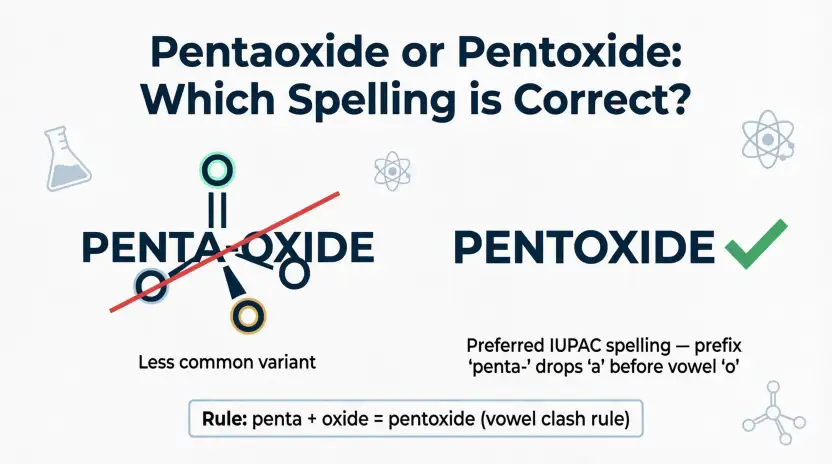
If you are wondering if pentaoxide or pentoxide is the correct spelling, the answer depends on the naming system you are using. Pentaoxide is the form used in modern IUPAC systematic nomenclature, while pentoxide is an established traditional form that remains common in textbooks, dictionaries, and scientific literature.
This small spelling difference causes confusion because both forms can refer to chemical compounds containing five oxygen atoms. The difference is not simply a matter of adding or removing one letter. It comes from different conventions for handling numerical prefixes in chemical names.
For example, the compound with the formula N₂O₅ is called dinitrogen pentaoxide in IUPAC-oriented sources. NIST also lists “dinitrogen pentoxide” as the main displayed name and “dinitrogen pentaoxide” as another name, showing why both forms appear in reliable scientific sources.
In this guide, you will learn what pentaoxide and pentoxide mean, why the spellings differ, which form to use in academic and scientific writing, and how British and American usage compare.
Featured Snippet + AI Overview
Pentaoxide and pentoxide are both found in chemistry, but they reflect different naming conventions. “Pentaoxide” follows modern IUPAC systematic nomenclature, while “pentoxide” is a long-established traditional form. For formal chemical naming, follow the nomenclature system required by your course, journal, institution, or style guide.
Pentaoxide or Pentoxide – Quick Answer
The safest short answer is:
- Pentaoxide: the modern IUPAC-style systematic form.
- Pentoxide: an established traditional form used widely in English chemistry.
- Both forms can appear in reliable scientific sources.
- The difference is mainly about chemical nomenclature convention, not a difference in the number of oxygen atoms.
For example:
- Dinitrogen pentaoxide = N₂O₅
- Dinitrogen pentoxide = N₂O₅
- Phosphorus pentoxide is a familiar traditional name.
- Pentaoxide preserves the full penta- numerical prefix.
So, if your instructor asks for the IUPAC systematic name, pentaoxide may be the expected form. If you are reading general chemistry material, pentoxide may be the form you encounter.
What Does Pentaoxide or Pentoxide Mean?
The words are connected to the chemical prefix penta-, which means five.
The second part, oxide, refers to a compound or chemical species involving oxygen.
So the basic idea is:
penta- + oxide → pentaoxide
The term is used in chemical names when five oxygen atoms are represented by the numerical prefix.
For example:
N₂O₅ → dinitrogen pentaoxide
The name tells us that the molecule contains:
- di- = two nitrogen atoms
- penta- = five oxygen atoms
- oxide = oxygen-based compound naming
The spelling becomes confusing because older or conventional chemical naming often uses pentoxide, dropping the “a” from penta-.
That gives us:
pentaoxide → pentoxide
The two forms therefore look different, but the underlying numerical idea is the same.
Is “pentoxide” a real word?
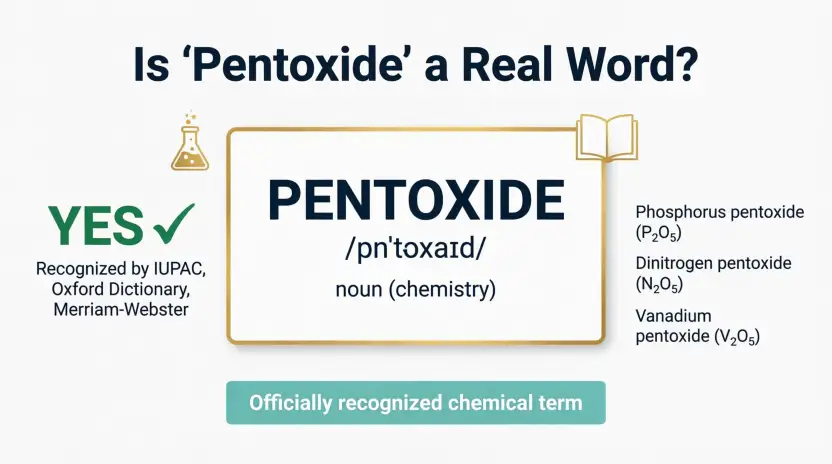
Yes.
Pentoxide is a well-established English chemistry term. Major dictionary sources define it as an oxide containing five oxygen atoms.
That means it would be misleading to treat every occurrence of “pentoxide” as a simple spelling mistake.
The Origin of Pentaoxide and Pentoxide
The difference comes from the history of chemical nomenclature.
Chemical names often use numerical prefixes such as:
| Number | Prefix |
| 1 | mono- |
| 2 | di- |
| 3 | tri- |
| 4 | tetra- |
| 5 | penta- |
| 6 | hexa- |
| 7 | hepta- |
| 8 | octa- |
| 9 | nona- |
| 10 | deca- |
These prefixes help identify the number of atoms represented in a compound name.
Older naming conventions often shortened some prefixes when they came before another word beginning with a vowel. This is why forms such as monoxide and pentoxide became familiar in English chemistry.
However, modern IUPAC recommendations changed the approach to multiplicative prefixes. The 2005 IUPAC recommendations list N₂O₅ as dinitrogen pentaoxide, retaining the final “a” in penta-.
The Canadian government’s terminology database also identifies dinitrogen pentaoxide as the IUPAC-recommended form and lists dinitrogen pentoxide as an older form.
This is why modern chemistry references can appear inconsistent at first glance.
British English vs American English
There is not a simple British-versus-American spelling rule that explains pentaoxide vs pentoxide.
The bigger difference is between nomenclature traditions and scientific style, rather than national English spelling.
| British English | American English | Example |
| Pentaoxide may appear in IUPAC-style naming | Pentaoxide may appear in IUPAC-style naming | dinitrogen pentaoxide |
| Pentoxide is also encountered | Pentoxide is also encountered | dinitrogen pentoxide |
| Scientific context determines preferred form | Scientific context determines preferred form | N₂O₅ |
| Formal naming may follow current IUPAC rules | Textbooks may use established conventional names | phosphorus pentoxide |
Dictionary evidence also shows pentoxide in both British and American English. Collins defines the term in both varieties of English.
In other words, you should not assume:
British = pentaoxide
American = pentoxide
That distinction is too simple.
Instead, check the naming standard being followed.
Which Version Should You Use?
The best form depends on your purpose.
United States
For general chemistry writing, you may encounter pentoxide frequently, especially in established compound names such as dinitrogen pentoxide.
If a professor, textbook, laboratory manual, or journal specifies a naming convention, follow that convention.
United Kingdom
The same basic principle applies. Use the nomenclature system required by your course, institution, or publication.
Do not change the spelling simply because the writing is British English.
Canada
Canadian terminology resources provide a useful example of the distinction. The Government of Canada’s TERMIUM Plus identifies dinitrogen pentaoxide as the IUPAC-recommended form and dinitrogen pentoxide as an older form.
Australia
For Australian academic or scientific writing, follow the naming standard used by the relevant institution, textbook, laboratory, or publication.
International Writing
For international scientific communication, consistency is more important than choosing a spelling based on ordinary English regional preference.
If you are using modern IUPAC systematic nomenclature, pentaoxide is the safer choice.
Academic Writing
In chemistry assignments, use the convention taught in your course.
If your textbook consistently uses pentoxide, switching forms without explanation may create unnecessary inconsistency.
If the assignment specifically asks for IUPAC nomenclature, use the current IUPAC convention.
Business and General Writing

If you are writing for a general audience, use the terminology your readers are most likely to recognize.
For example, dinitrogen pentoxide is widely recognizable because it has a long history of use.
Common Mistakes
Mistake 1: Assuming “pentoxide” is always wrong
Incorrect assumption:
“Pentoxide is simply misspelled.”
Better understanding:
Pentoxide is an established chemistry term and appears in reputable dictionaries and scientific literature.
Mistake 2: Assuming “pentaoxide” is always wrong
Incorrect assumption:
“The extra a must be a spelling error.”
Better understanding:
Modern IUPAC systematic nomenclature uses pentaoxide for N₂O₅.
Mistake 3: Mixing naming systems
Example:
A student follows one nomenclature rule for one compound and another rule for the next compound.
Better approach:
Use one naming convention consistently, especially in an academic assignment.
Mistake 4: Treating the difference as ordinary English spelling
This is not simply like choosing between two everyday spellings.
The distinction comes from chemical naming conventions.
Memory Tip
Remember:
Penta = five.
If you are following modern IUPAC systematic nomenclature, keep the full prefix:
penta + oxide = pentaoxide
If you are reading older or conventional chemistry material, you may see:
pentoxide
Everyday Examples
These terms are most likely to appear in scientific or educational writing rather than ordinary conversation.
Emails
Please check if the assignment requires the IUPAC name dinitrogen pentaoxide.
A chemistry department email may use either form depending on its naming convention.
Business Writing
A chemical supplier or technical company may use a standardized chemical name in product documentation.
The important point is consistency with the relevant chemical standard.
News Headlines
A science news article might use a familiar form such as:
Researchers study reactions involving dinitrogen pentoxide.
News writing often favors terms that are recognizable to a broad audience.
Blogs
A chemistry education blog may explain the distinction directly:
Pentaoxide follows the modern IUPAC naming convention, while pentoxide remains a common traditional form.
Social Media
Informal science posts may use either spelling.
However, if the post is educational, adding the chemical formula can remove ambiguity:
Dinitrogen pentaoxide, N₂O₅
Academic Writing
Academic chemistry writing should follow the required style.
For example:
Dinitrogen pentaoxide, N₂O₅, contains two nitrogen atoms and five oxygen atoms.
If your course uses the traditional form, you may instead encounter:
Dinitrogen pentoxide, N₂O₅.
Daily Conversation
Most people do not use either word in everyday conversation.
These terms mainly occur in:
- Chemistry classes
- Laboratory reports
- Scientific papers
- Chemical databases
- Textbooks
- Technical documentation
Google Trends & Modern Usage
Search interest around pentaoxide or pentoxide is understandable because both spellings appear online and in scientific resources.
The main source of confusion is that readers can find dinitrogen pentoxide in older or conventional chemistry material while encountering dinitrogen pentaoxide in IUPAC-oriented resources.
Modern authoritative sources illustrate this split clearly.
NIST’s Chemistry WebBook displays dinitrogen pentoxide as the main name while also listing dinitrogen pentaoxide as another name.
The Government of Canada’s terminology database takes a different naming perspective and identifies dinitrogen pentaoxide as the IUPAC-recommended systematic form while marking dinitrogen pentoxide as obsolete in that particular terminology record.
This shows why a simple “right versus wrong” answer can be misleading.
For searchers, the practical lesson is simple:
The correct form depends on the chemical naming convention and context.
Do not treat every occurrence of pentoxide as an error.
Quick Comparison Table
| Version | Meaning | Correct? | Region | Example |
| Pentaoxide | Chemical naming form indicating five oxygen atoms | Yes, in modern IUPAC systematic nomenclature | International | Dinitrogen pentaoxide |
| Pentoxide | Established traditional form for an oxide containing five oxygen atoms | Yes, as an established conventional form | British, American, and international usage | Dinitrogen pentoxide |
| Pentaoxide | Full penta- + oxide construction | Preferred in the cited IUPAC systematic convention | International scientific writing | N₂O₅ |
| Pentoxide | Older/conventional shortened form | Still widely recognized | English chemistry | Phosphorus pentoxide |
Key Takeaways
- Pentaoxide and pentoxide are both found in chemistry.
- Pentaoxide follows the modern IUPAC systematic convention.
- Pentoxide is a long-established traditional English chemistry form.
- The difference is mainly about nomenclature, not meaning.
- Dinitrogen pentaoxide refers to N₂O₅.
- Dinitrogen pentoxide is also widely documented for N₂O₅.
- Do not assume the difference is simply British versus American English.
- For formal work, follow the naming system required by your instructor, journal, or institution.
FAQs
1. Is pentaoxide or pentoxide correct?
Both forms occur in chemistry, but they represent different naming conventions. Pentaoxide is the form used in modern IUPAC systematic nomenclature, while pentoxide is an established traditional form. For formal chemistry work, follow the nomenclature system specified by your course, institution, or publication.
2. Is pentaoxide the IUPAC spelling?
Yes, for the systematic name dinitrogen pentaoxide, the modern IUPAC recommendations retain the final “a” in the penta- prefix. The 2005 IUPAC nomenclature recommendations list N₂O₅ as dinitrogen pentaoxide.
3. Is pentoxide a misspelling?
No. Pentoxide is an established English chemistry word. Major dictionary sources define it as an oxide containing five oxygen atoms. It is also found in scientific publications, including articles published by the American Chemical Society.
4. Which is correct: dinitrogen pentaoxide or dinitrogen pentoxide?
Both names are encountered for N₂O₅. Dinitrogen pentaoxide is the IUPAC-style systematic form, while dinitrogen pentoxide is a well-established traditional form. NIST currently lists dinitrogen pentoxide as the main name and dinitrogen pentaoxide as another name.
5. Why do people spell it pentoxide?
Pentoxide comes from the long-established convention of shortening numerical prefixes before certain vowel-starting terms. This form became common in chemistry education and scientific literature. That historical usage explains why pentoxide remains familiar even though current IUPAC recommendations use pentaoxide in systematic nomenclature.
6. Does pentaoxide mean five oxygen atoms?
Yes, in the relevant chemical naming context, penta- indicates five. For example, N₂O₅ contains five oxygen atoms, and its systematic prefix-based name is dinitrogen pentaoxide. The prefix di- identifies two nitrogen atoms, while penta- identifies five oxygen atoms.
7. Is phosphorus pentoxide correct?
Yes, phosphorus pentoxide is a well-established conventional chemical name. Chemical naming can be more complicated than simply applying one spelling rule, so the exact name should be chosen according to the nomenclature system and context being used.
8. Is there a difference between pentaoxide and pentoxide in meaning?
Usually, the important difference is the naming convention rather than the underlying chemical idea. Both forms can refer to compounds whose names indicate five oxygen atoms. However, the precise chemical name should always be checked against the applicable nomenclature standard.
9. Should students use pentaoxide or pentoxide?
Students should use the form required by their chemistry course or textbook. If an assignment specifically asks for modern IUPAC systematic nomenclature, pentaoxide is appropriate. If the course uses conventional names, pentoxide may be expected.
10. Is pentoxide British or American English?
Pentoxide is not limited to either British or American English. It is found in both varieties. The difference between pentaoxide and pentoxide is primarily related to chemical naming conventions rather than a normal regional spelling difference.
Conclusion
The choice between pentaoxide or pentoxide can look like a simple spelling question, but it is really a question about chemical nomenclature. Both forms have a documented history in chemistry, which is why you may encounter both when reading textbooks, dictionaries, scientific papers, and online resources.
For modern systematic naming, pentaoxide is the important form to know. The IUPAC recommendations list dinitrogen pentaoxide for N₂O₅, and Canadian terminology resources also identify it as the IUPAC-recommended form.
At the same time, pentoxide remains a well-established term. NIST uses dinitrogen pentoxide as its displayed name and lists dinitrogen pentaoxide as another name.
So, do not assume that one spelling is simply a careless error. Instead, check the naming convention being used.
The easiest rule to remember is: pentaoxide is the modern systematic form, while pentoxide is a familiar traditional form.
When in doubt, follow the style required by your chemistry course, institution, journal, or scientific reference.
Read more about!
- Honoring or Honouring: Which Spelling Is Correct?
- Apartment or House: Which One Is Better for You?
- Resignate or Resonate: Which Word Is Correct?

I’m Olivia Parker, a grammar and English writing enthusiast passionate about making English simple and easy to understand. Through Wordsblog, I share clear explanations, useful grammar tips, and practical writing guidance to help readers write with confidence. My goal is to make learning English easier, one word at a time.