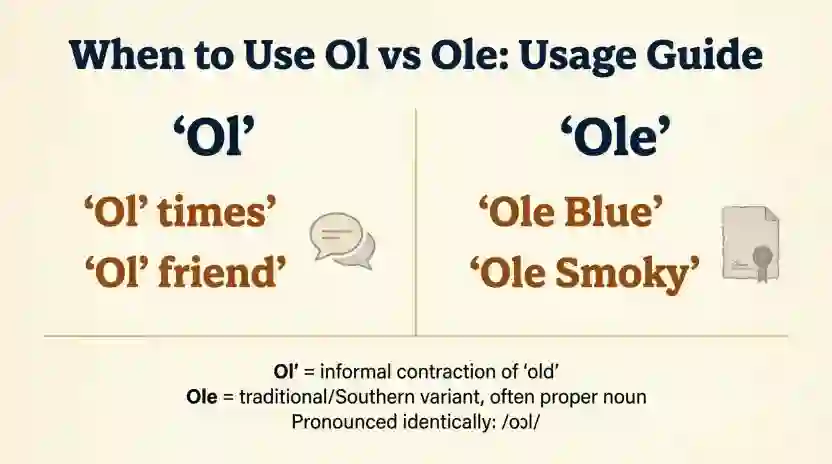
When choosing between ol or ole, the safest choice depends on what you mean. If you are trying to write the informal pronunciation of old, ole is a recognized informal spelling, while ol’ is another common way to show that the final d has been dropped.
Plain ol is less clear because it can also function as an abbreviation with unrelated meanings.
This is why phrases such as good ole days, good ol’ days, and my ole car can look confusing. They may sound almost the same when spoken, but they do not carry exactly the same writing style.
The word ole is mainly informal and is especially associated with American English. Cambridge defines it as an informal way of saying and writing old, while Oxford describes it as a written form used to represent how some people pronounce the word.
In this guide, you will learn what ol and ole mean, how they differ from old, when to use each form, which spelling works best in formal writing, and how to avoid common mistakes.
Ol or Ole: Featured Snippet & AI Overview
Ole is a recognized informal spelling of old, especially in American English. Ol’ is also used to represent the casual pronunciation of old. Plain ol is less suitable when you mean old because it can be an abbreviation or have another meaning. For formal writing, use old. For casual or dialect-style writing, ole or ol’ may fit the context.
Ol or Ole: Quick Answer
If you are asking, “Should I write ol or ole when I mean old?”, the answer depends on your purpose.
- old = standard spelling
- ole = informal spelling representing the pronunciation of old
- ol’ = informal spelling that shows the final d has been dropped
- ol = can be an abbreviation and is less clear when used by itself
Examples
Standard English:
We visited our old neighborhood.
Informal style:
We visited our good ole neighborhood.
Another informal style:
We visited our good ol’ neighborhood.
The spelling ole is specifically recognized by major dictionaries. Cambridge labels it mainly US and informal, while Oxford describes it as a written representation of how some people say old.
So, if your question is strictly “Is ole a word?”, yes. It is an established informal form.
If your question is “Which should I use in formal writing?”, choose old.
What Does Ol or Ole Mean?
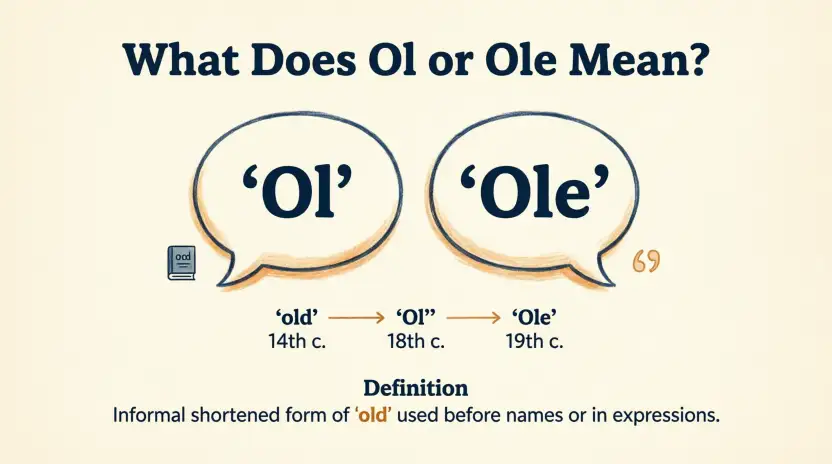
The meaning changes depending on which form you use.
What does “old” mean?
Old is the normal English word. It can describe something that has existed for a long time, someone who has lived for many years, or something from an earlier period.
Examples:
- an old house
- an old friend
- an old book
- an old tradition
This is the form you should normally use in school, academic writing, business documents, reports, and professional communication.
What does “ole” mean?
Ole is an informal spelling of old. It is often used to make written language sound more like casual speech. Cambridge lists it as mainly US informal, and Oxford identifies it as a written representation of the pronunciation of old.
Examples include:
- good ole days
- good ole friend
- that ole house
- my ole car
The spelling can give writing a relaxed, nostalgic, folksy, or conversational tone.
What does “ol’” mean?
Ol’ also represents the casual pronunciation of old. The apostrophe signals that letters have been omitted.
For example:
good ol’ friend
The apostrophe makes the shortened form more obvious.
What about “ol”?
Plain ol is different. It may appear as an abbreviation in some contexts, but it is not the clearest general-purpose replacement for old.
Dictionary entries show that OL can have several abbreviation meanings, including Old Latin, while other forms such as Ol. may have specialized meanings.
That is why ol by itself can create confusion.
The Origin of Ol or Ole
The informal spelling ole developed as a way to represent pronunciation rather than as a completely separate everyday word with a different meaning.
Oxford dates ole to the mid-19th century and explains its origin as a representation of pronunciation.
This is important because English often uses spelling to imitate speech. Writers may alter a standard word to show that a speaker is using a relaxed, regional, humorous, or dialect-style pronunciation.
For example:
My ole man used to work there.
Here, ole is not introducing a new meaning. It is representing a spoken form of old. Oxford gives this type of example in its dictionary entry.
The form ol’ follows a slightly different visual strategy. The apostrophe indicates that part of the original word has been left out.
So you may see:
good ole days
or:
good ol’ days
Both can communicate an informal version of good old days, but they create slightly different visual styles.
One important warning is that olé is a different word. It is a Spanish-derived exclamation associated with approval, excitement, or performance, and it should not be confused with the informal English ole.
British English vs American English
The biggest regional difference is not that one country uses a completely different meaning. Instead, ole is particularly associated with informal American English.
| Feature | British English | American English | Example |
| Standard form | old | old | an old friend |
| Informal ole | Less common | Commonly recognized | a good ole friend |
| Informal ol’ | Possible in informal or dialect writing | Commonly recognized | good ol’ days |
| Formal writing | old | old | an old building |
| Casual speech representation | old / dialect forms | ole / ol’ | that ole car |
Cambridge labels ole as mainly US informal, while Oxford provides an American English entry as well as a general dictionary entry.
This does not mean that every American writer uses ole, or that British readers cannot understand it. It simply means the spelling is strongly associated with informal usage, particularly in American English.
What style guides mean for writers

Professional style usually favors clarity. If you are writing an article, report, academic paper, business document, or formal email, old is normally the better choice.
Informal spellings can be useful when you deliberately want to reproduce a voice, quotation, character, dialect, or conversational tone.
Which Version Should You Use?
The best choice depends on your audience and the type of writing.
United States
Use old for standard and formal writing.
Use ole or ol’ when you intentionally want an informal, conversational, nostalgic, or folksy tone.
United Kingdom
Use old in normal writing. Readers will generally understand ole, but it may feel strongly informal or American-influenced.
Canada
Use old for standard writing. Informal forms can appear in dialogue, advertising, humor, or casual content when the style calls for them.
Australia
Use old for standard English. Use ole or ol’ only when the informal style is intentional.
International Writing
For an international audience, old is the clearest option.
If your website serves ESL learners, students, or readers from many countries, avoid using ole as the default spelling.
Academic Writing
Use old.
Avoid ole, ol’, and other conversational spellings unless you are quoting a source or analyzing language.
Business Writing
Use old in reports, emails, proposals, presentations, and professional documents.
For example:
Better:
We updated the old system.
Too informal for most business writing:
We updated the ole system.
The informal version may work in marketing or creative copy, but context matters.
Common Mistakes
Mistake 1: Using “ole” in formal writing
Incorrect for most formal contexts:
The company replaced the ole software.
Better:
The company replaced the old software.
Why?
Ole is informal. Old is the standard spelling.
Memory tip:
Formal = old. Casual voice = ole or ol’.
Mistake 2: Treating “ol” as the normal spelling
Less clear:
We went back to the ol house.
Better informal form:
We went back to the ole house.
Another option:
We went back to the ol’ house.
Plain ol does not clearly tell the reader that you are representing the pronunciation of old.
Mistake 3: Confusing “ole” with “olé”
These are not the same.
ole = informal form of old
olé = an exclamation associated with Spanish usage and expressions of approval or excitement
For example:
We talked about the good ole days.
But:
The crowd shouted, “Olé!”
The accent and meaning matter.
Mistake 4: Using informal spelling without a reason
Informal spelling should usually have a purpose.
If you are writing an academic essay, use old.
If you are writing dialogue for a character who says ole, using ole may help create the intended voice.
Everyday Examples
Emails
Formal email:
We need to replace the old equipment.
Casual email:
I still remember our good ole office days.
The first is suitable for professional communication. The second has a friendly, nostalgic tone.
Business Writing
The company has updated its old website.
Use old in ordinary business writing.
News Headlines
A news report would normally use the standard spelling:
Local business restores old theater.
An informal feature, quotation, or deliberately playful headline might use ole.
Blogs
Blogs have more freedom.
Remember those good ole summer days?
This style can sound friendly and conversational.
Social Media
Informal spellings are common in social media because posts often imitate natural speech.
Missing the good ole days!
The spelling adds a casual feeling.
Academic Writing
Researchers examined the effects of the old policy.
Avoid:
Researchers examined the effects of the ole policy.
Unless you are directly discussing the spelling or quoting someone, old is the appropriate choice.
Daily Conversation
People may pronounce old in a way that sounds closer to ole, especially in casual speech.
Writing, however, does not have to reproduce every pronunciation difference. In ordinary writing, simply use old.
Google Trends & Modern Usage
Searches for ol or ole often come from people who have encountered informal expressions such as good ole days, good ole boy, or ole man and want to know if the spelling is correct.
The important point is that ole is not simply a spelling mistake. Major dictionaries recognize it as an informal representation of old. Cambridge specifically labels it mainly US informal, and Oxford describes it as a written representation of pronunciation.
At the same time, modern search results can be confusing because ol and ole have other meanings and uses.
For example, dictionary sources list OL as an abbreviation in some contexts, while ole can also appear in technical terms or other words unrelated to the informal spelling of old.
Therefore, when people search “ol or ole”, they may actually be asking one of several questions:
- Is ole a real word?
- Is ole correct or should I use old?
- Should it be ol’ or ole?
- What does good ole days mean?
- Is ole formal or informal?
- Is ole American English?
- Can I use ole in an essay?
The answer depends heavily on context.
Quick Comparison Table
| Version | Meaning | Correct? | Region | Example |
| old | Standard word meaning old | Yes | International | an old house |
| ole | Informal spelling of old | Yes, informal | Mainly US | good ole days |
| ol’ | Informal representation of old | Yes, informal | Various English contexts | good ol’ friend |
| ol | Can be an abbreviation or context-specific form | Context-dependent | Varies | OL may have specialized meanings |
| olé | Exclamation expressing approval or excitement | Yes, different word | Spanish/international use | Olé! |
The key difference is purpose. Old is the normal spelling. Ole and ol’ are informal forms used to represent speech or create a particular style. Ol should not automatically be treated as a shortened spelling of old.
Key Takeaways
- Old is the standard spelling for normal English writing.
- Ole is a recognized informal spelling of old.
- Ol’ is another informal form that shows the dropped d.
- Ole is especially associated with informal American English.
- Ol by itself can have other abbreviation meanings.
- Use old in academic and professional writing.
- Use ole or ol’ when an informal or conversational style is intentional.
- Ole and olé are different words.
- Context matters more than simply asking which spelling “looks right.”
- When in doubt, choose old.
FAQs About Ol or Ole
1. Is “ole” a correct word?
Yes. Ole is a recognized informal spelling of old. Cambridge lists it as mainly US informal, while Oxford describes it as a written representation of how some people pronounce old. It is appropriate when you intentionally want an informal, conversational, nostalgic, or dialect-style tone.
2. Should I write “ol” or “ole”?
If you mean the informal pronunciation of old, ole is clearer than plain ol. You can also use ol’, which shows the missing d. For standard writing, however, use old. Plain ol can be an abbreviation and may have meanings unrelated to old.
3. Is “ole” the same as “old”?
They have the same basic meaning when ole is being used as the informal spelling of old. The difference is style. Old is standard English, while ole represents an informal pronunciation and is mainly associated with informal American usage.
4. Is “ol’” better than “ole”?
Neither is universally better. Ol’ clearly shows that letters have been omitted, while ole is an established informal spelling. Both can appear in casual writing. If you are not trying to reproduce an informal voice, use the standard form old.
5. Can I use “ole” in an academic essay?
Usually, no. Academic writing normally favors standard vocabulary and clear formal style. Use old unless ole appears in a quotation, a title, a historical source, or a discussion about language. If you are writing about informal English itself, then explaining ole can be appropriate.
6. Is “good ole days” correct?
Yes, good ole days is an informal expression. The standard version is good old days. You may also see good ol’ days. The informal versions create a more conversational or nostalgic tone, while good old days works in standard writing.
7. Is “ole” American English?
Ole is especially associated with informal American English. Cambridge labels it mainly US informal, and Oxford includes it in its American English dictionary resources. It can be understood elsewhere, but writers should consider audience and tone.
8. Is “ole” the same as “olé”?
No. Ole without an accent is an informal spelling of old. Olé is a different word and an exclamation associated with Spanish usage, often expressing approval, excitement, or enthusiasm. The two should not be treated as alternative spellings.
9. What is the formal version of “ole”?
The formal and standard version is old. For example, write old friend, old building, or old tradition in formal documents. Use ole only when you intentionally want an informal style or need to represent a particular way of speaking.
10. Why do people write “ole” instead of “old”?
Writers use ole to represent a pronunciation or create a casual, folksy, humorous, or nostalgic voice. Dictionaries recognize this use. It does not mean that ole has replaced old in standard English. Instead, it serves a different stylistic purpose.
Conclusion
When comparing ol or ole, the most important point is that neither should normally replace the standard word old in formal writing. Old is the correct everyday spelling and is suitable for academic work, business writing, professional emails, and international audiences.
Ole, however, is a real and recognized informal spelling. It represents a way some speakers pronounce old and can add a casual, nostalgic, folksy, or conversational feeling to writing. Major dictionaries such as Cambridge and Oxford recognize this use.
You may also see ol’, which uses an apostrophe to show that the final d has been dropped. This form is useful when the writer wants to make the shortened pronunciation obvious.
Plain ol needs more caution because it can function as an abbreviation with other meanings.
The simple rule is easy to remember: use “old” for standard English, and use “ole” or “ol’” only when the informal style is intentional.
When in doubt, choose “old.”
Read more about!
- Honoring or Honouring: Which Spelling Is Correct?
- Apartment or House: Which One Is Better for You?
- Resignate or Resonate: Which Word Is Correct?

I’m Olivia Parker, a grammar and English writing enthusiast passionate about making English simple and easy to understand. Through Wordsblog, I share clear explanations, useful grammar tips, and practical writing guidance to help readers write with confidence. My goal is to make learning English easier, one word at a time.