What does “bike” mean?
Hemiparesis and hemiplegia both affect one side of the body, but they are not the same. Hemiparesis means weakness on one side of the body, while hemiplegia means paralysis or near-complete loss of movement on one side. The difference is mainly about the degree of muscle weakness or loss of movement.
People often search for hemiparesis or hemiplegia because the terms sound similar and are sometimes used in the same medical context. Both can affect an arm, leg, and sometimes the face on one side, often after a stroke or another neurological condition. However, choosing the right term matters when describing symptoms, medical records, or rehabilitation needs.
This guide explains the difference in simple language. You will learn what each term means, where the words come from, how they are used, common mistakes, and examples in everyday and medical writing. Because these are medical terms, the article focuses on language and meaning rather than diagnosing any individual condition.
Hemiparesis or Hemiplegia: Quick Answer
The simplest way to remember the difference is:
- Hemiparesis = one-sided weakness
- Hemiplegia = one-sided paralysis or profound loss of movement
For example, a person who can lift their right arm but has very little strength may have right-sided hemiparesis. A person who cannot voluntarily move the right arm because of paralysis may be described as having right-sided hemiplegia.
The terms describe the severity of movement impairment, not two completely unrelated conditions.
Simple examples
Example 1:
“She has left-sided hemiparesis and can still move her left arm, but it is weak.”
2:
“He developed right-sided hemiplegia after a neurological injury and has severe loss of movement on that side.”
3:
“Physical therapy may be part of rehabilitation for people with hemiparesis or hemiplegia.”
The exact medical meaning can depend on the clinical context, so medical professionals should determine which term best describes a person’s condition.
What Does Hemiparesis or Hemiplegia Mean?
What is hemiparesis?
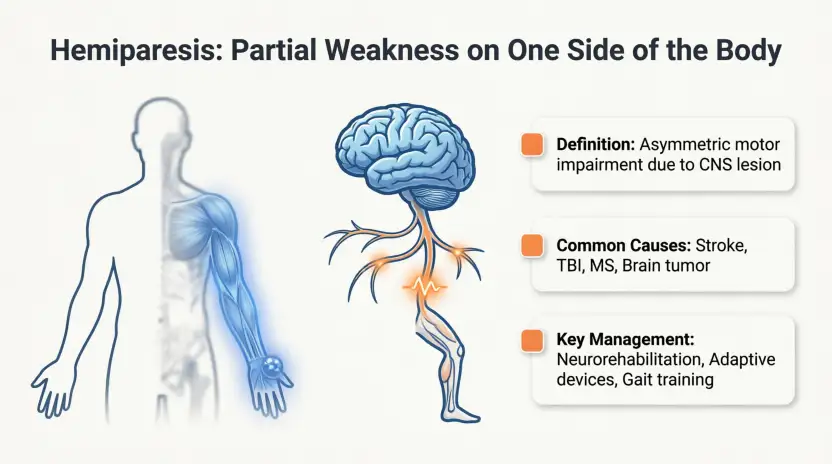
Hemiparesis refers to weakness affecting one side of the body.
The prefix hemi- means half or one side. Paresis refers to weakness or partial loss of voluntary movement.
A person with hemiparesis may still be able to move the affected arm or leg, but the movement may be weaker, slower, less coordinated, or harder to control.
Hemiparesis can affect:
- The arm
- The leg
- The face
- More than one area on the same side
For example, left hemiparesis means weakness affecting the left side of the body.
What is hemiplegia?
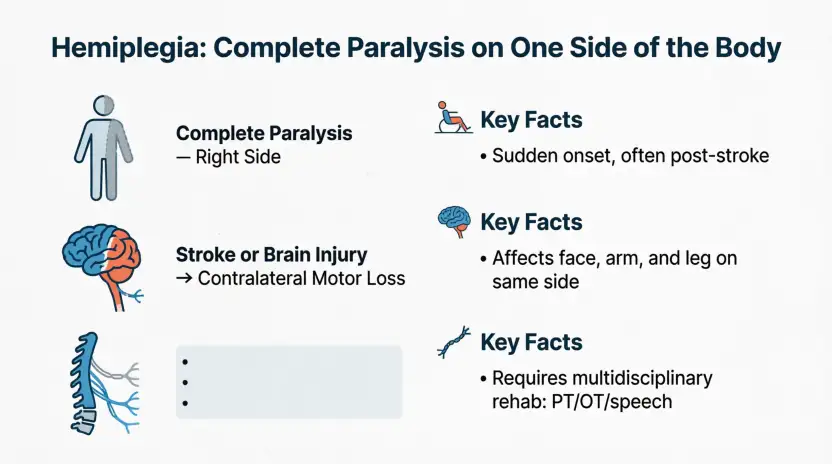
Hemiplegia refers to paralysis or severe loss of voluntary movement affecting one side of the body.
The word contains hemi-, meaning half or one side, and -plegia, which relates to paralysis.
Compared with hemiparesis, hemiplegia generally describes a much more severe loss of movement.
However, medical terminology is not always used in exactly the same way by every source or clinician. The patient’s actual neurological findings are more important than the label alone.
The Origin of Hemiparesis and Hemiplegia
Both words are built from medical terms with Greek roots.
Hemi- comes from Greek and means half. In these terms, it refers to one side of the body.
Paresis is associated with Greek paresis, referring to a relaxation or weakening of function. In modern medical language, it commonly refers to weakness or partial loss of voluntary movement.
-plegia comes from Greek plēgē, meaning a blow or stroke, and became associated with paralysis in medical terminology.
The distinction between paresis and plegia therefore helps explain the modern difference:
- Paresis → weakness or partial impairment
- Plegia → paralysis or profound loss of movement
These terms are also related to other neurological words, such as paraparesis, paraplegia, quadriparesis, and quadriplegia. The prefixes help indicate which parts of the body are affected.
British English vs American English
Unlike spelling pairs such as colour and color, hemiparesis and hemiplegia do not represent a British-versus-American spelling difference.
The same medical terms are used in both British and American English.
| British English | American English | Example |
| hemiparesis | hemiparesis | The patient has left-sided hemiparesis. |
| hemiplegia | hemiplegia | The patient developed right-sided hemiplegia. |
| left hemiparesis | left hemiparesis | Left hemiparesis affected movement. |
| right hemiplegia | right hemiplegia | Right hemiplegia caused severe movement loss. |
Medical journals, hospitals, universities, and healthcare professionals in both regions use these terms.
The main issue is therefore meaning, not regional spelling.
Which Version Should You Use?
Choose the term based on what you are describing, rather than on the country where you are writing.
United States
Use hemiparesis when describing weakness on one side and hemiplegia when describing paralysis or profound loss of movement.
United Kingdom
The same basic distinction applies. British medical writing uses both terms.
Canada
Canadian medical and academic writing also uses hemiparesis and hemiplegia according to the clinical meaning.
Australia
Australian healthcare writing follows the same general distinction.
International writing
For international readers, define the term the first time you use it.
For example:
“Hemiparesis, or weakness affecting one side of the body, can interfere with walking and hand movement.”
This makes the article easier to understand for readers who are not familiar with medical terminology.
Academic writing
Use the term that accurately matches the source or clinical description. Avoid treating hemiparesis and hemiplegia as exact synonyms when the degree of impairment matters.
Business writing
If you are writing for a general audience, avoid using either term without explanation.
Instead of:
“The patient experienced hemiparesis.”
You could write:
“The patient experienced weakness on one side of the body, known as hemiparesis.”
That approach is clearer for non-medical readers.
Common Mistakes
| Incorrect or unclear example | Better example | Explanation | Memory tip |
| “Hemiparesis means paralysis.” | “Hemiparesis means weakness.” | Paresis generally refers to weakness or partial impairment. | Paresis = partial weakness |
| “Hemiplegia and hemiparesis are exactly the same.” | “Both affect one side, but hemiplegia indicates a much greater loss of movement.” | The severity differs. | Plegia = paralysis |
| “Hemiparesis is a British spelling.” | “Hemiparesis is used in both British and American English.” | This is not a regional spelling pair. | Think meaning, not spelling. |
| “Left hemiparesis means the left side of the brain is weak.” | “Left hemiparesis means weakness affects the left side of the body.” | The term describes the affected side of the body. | Left = body side described |
| “Hemiplegia always means absolutely zero movement.” | “Hemiplegia generally describes paralysis or profound loss of voluntary movement.” | Medical terminology can vary by context. | Focus on the degree of impairment. |
Easy memory trick
Think of the endings:
-paresis → weakness
-plegia → paralysis
This simple distinction can help you remember which term to use.
Everyday Examples
These terms appear most often in medical, rehabilitation, educational, and health-related writing.
Emails
“The rehabilitation team is monitoring her left-sided hemiparesis.”
For a general reader, you could add an explanation:
“She has left-sided hemiparesis, meaning weakness on the left side of her body.”
Business writing
If you work in a healthcare setting, clarity is important:
“The report notes right-sided hemiparesis following the neurological event.”
For non-medical audiences, explain the term rather than assuming the reader knows it.
News headlines
A health article might use wording such as:
“Patient Begins Rehabilitation After Developing Hemiparesis”
A general news story may explain the term in the first paragraph.
Blogs
A health blog could write:
“Hemiparesis can make everyday tasks harder because one side of the body may feel weak or difficult to control.”
Social media
A short educational post could say:
“Hemiparesis means weakness on one side of the body. Hemiplegia refers to paralysis or profound loss of movement on one side.”
Academic writing
“The study examined functional recovery in participants with post-stroke hemiparesis.”
Academic writing should preserve the terminology used by the research source and define specialized terms when needed.
Daily conversation
Most people would probably say:
“He has weakness on his right side.”
rather than:
“He has right hemiparesis.”
The medical term is more precise, but the everyday description may be easier for a general audience.
Google Trends & Modern Usage
Searches for hemiparesis or hemiplegia are likely driven by people trying to understand medical terminology after encountering it in a diagnosis, rehabilitation document, medical article, or educational resource.
The two terms are closely related, so users may search them together when they want to know whether they mean the same thing.
There is no reason to treat this as a British-versus-American spelling issue. Both terms are established medical vocabulary used across English-speaking healthcare systems.
Search interest can also be influenced by broader interest in conditions that may cause one-sided weakness or paralysis, including stroke and other neurological disorders. However, the presence of a symptom or term alone does not establish a diagnosis.
For health-related searches, readers should use reputable medical sources and speak with a qualified healthcare professional when they need advice about their own symptoms.
Quick Comparison Table
| Version | Meaning | Correct? | Region | Example |
| Hemiparesis | Weakness on one side | Yes | International | “She has left hemiparesis.” |
| Hemiplegia | Paralysis or profound loss of movement on one side | Yes | International | “He developed right hemiplegia.” |
| Hemiparesis or hemiplegia | Comparison of one-sided weakness and paralysis | Yes | International | “What is the difference between hemiparesis and hemiplegia?” |
| Left hemiparesis | Weakness affecting the left side | Yes | International | “Left hemiparesis affected his walking.” |
| Right hemiplegia | Paralysis or profound movement loss affecting the right side | Yes | International | “Right hemiplegia affected his arm and leg.” |
Key Takeaways
- Hemiparesis means weakness on one side of the body.
- Hemiplegia means paralysis or profound loss of voluntary movement on one side.
- Both terms can affect an arm, leg, face, or several areas on one side.
- They are not British-versus-American spelling variants.
- The main difference is the degree of movement impairment.
- Paresis is a useful memory cue for weakness or partial impairment.
- Plegia is a useful memory cue for paralysis.
- For general readers, explain the medical term the first time you use it.
FAQs
1. What is the main difference between hemiparesis and hemiplegia?
Hemiparesis refers to weakness affecting one side of the body, while hemiplegia refers to paralysis or a profound loss of voluntary movement on one side. A person with hemiparesis may still move the affected arm or leg, although movement can be weak or difficult. Hemiplegia generally describes a much more severe movement impairment.
2. Is hemiparesis worse than hemiplegia?
Generally, hemiplegia describes a more severe loss of movement than hemiparesis. Hemiparesis means weakness, while hemiplegia indicates paralysis or profound loss of voluntary movement. However, medical terminology can vary by context, so a person’s actual neurological examination and functional abilities are more important than the word alone.
3. Can hemiparesis turn into hemiplegia?
A person’s degree of weakness or paralysis can change depending on the underlying neurological condition and recovery process. It is therefore not accurate to assume that hemiparesis will always progress to hemiplegia. Anyone experiencing new or worsening one-sided weakness or loss of movement should seek appropriate medical evaluation.
4. Is hemiparesis the same as one-sided weakness?
Yes. Hemiparesis is the medical term commonly used for weakness affecting one side of the body. The weakness may involve an arm, leg, face, or several areas on the same side. In everyday language, “one-sided weakness” is often easier for people to understand.
5. Is hemiplegia the same as paralysis?
Hemiplegia specifically refers to paralysis or profound loss of voluntary movement affecting one side of the body. The word hemi- indicates one side. Therefore, hemiplegia is a more specific term than the general word “paralysis,” which can describe many different patterns of movement loss.
6. Are hemiparesis and hemiplegia used in British English?
Yes. Both hemiparesis and hemiplegia are used in British English. They are not spelling alternatives like colour and color. The same basic medical terms are also used in American, Canadian, Australian, and international medical writing.
7. What does left-sided hemiparesis mean?
Left-sided hemiparesis means that weakness affects the left side of the body. It may involve the left arm, left leg, face, or more than one area. The phrase describes the side affected by weakness. It does not simply mean that the left side of the brain is weak.
8. What does right-sided hemiplegia mean?
Right-sided hemiplegia describes paralysis or profound loss of voluntary movement affecting the right side of the body. The exact pattern and severity can vary between individuals. Because hemiplegia is a medical term, the person’s healthcare team should explain what the term means in their specific clinical situation.
9. Which is more severe, hemiparesis or hemiplegia?
In general, hemiplegia describes a more severe movement impairment than hemiparesis. Hemiparesis indicates weakness with some preserved movement, while hemiplegia indicates paralysis or profound loss of voluntary movement. The terms should still be interpreted alongside the person’s examination and functional abilities.
10. Can a stroke cause hemiparesis or hemiplegia?
Yes. A stroke can cause weakness or paralysis affecting one side of the body, and healthcare professionals may describe these findings as hemiparesis or hemiplegia. The exact symptoms depend on the neurological injury. Sudden one-sided weakness, facial drooping, or difficulty speaking can be signs of a medical emergency and require immediate emergency care.
Conclusion
Hemiparesis and hemiplegia are related terms, but they are not identical. Hemiparesis generally means weakness affecting one side of the body, while hemiplegia refers to paralysis or a profound loss of voluntary movement on one side.
The difference is not based on British or American English. Both terms are used internationally in medical and rehabilitation settings. The key is to choose the word that best matches the degree of movement impairment being described.
For general readers, the easiest memory rule is simple: paresis means weakness, while plegia refers to paralysis. If you are writing for a non-medical audience, define the term in plain English when you first introduce it.
When reading a medical report, remember that terminology should be understood in its full clinical context rather than in isolation. And if new one-sided weakness or paralysis appears suddenly, seek emergency medical attention.
Remember: hemiparesis is weakness on one side, while hemiplegia is paralysis or profound movement loss on one side.
Read more about!
- Triple or Tripple: Which Spelling Is Correct?
- Trailor or Trailer: Which Spelling Is Correct?
- Mucinex or Robitussin: Which Is Better?

I’m Olivia Parker, a grammar and English writing enthusiast passionate about making English simple and easy to understand. Through Wordsblog, I share clear explanations, useful grammar tips, and practical writing guidance to help readers write with confidence. My goal is to make learning English easier, one word at a time.