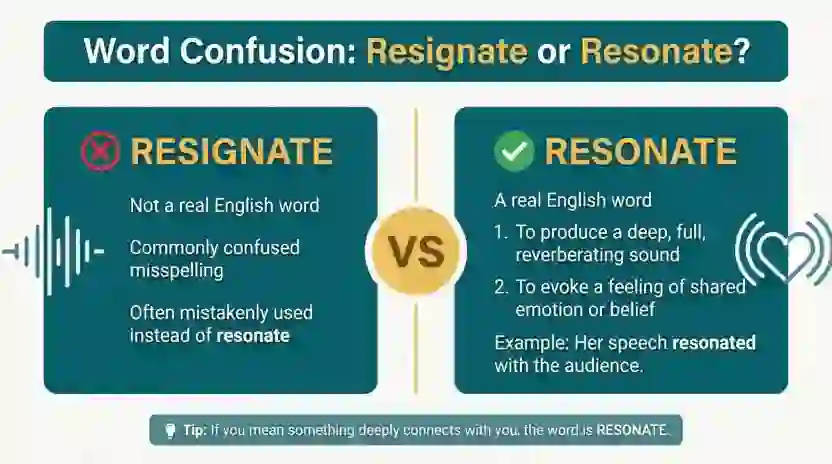
Have you ever written “resignate” when you meant “resonate”? In standard modern English, resonate is the correct word for describing something that creates a deep sound, has a strong effect, or connects with someone’s feelings or ideas. Resignate is not the standard word for these meanings.
This confusion is understandable because the two words look and sound similar. The ending -ate appears in many English verbs, so it is easy to assume that resignate is a normal form related to resignation or resign.
However, dictionaries do not treat resignate as the standard alternative to resonate. Collins currently lists resignate as a user-submitted “New Word Suggestion,” rather than as an established dictionary headword.
In this guide, you will learn the difference between resignate and resonate, what resonate means, where it comes from, how to use it correctly, and which form works best in American, British, Canadian, Australian, academic, and business writing.
Featured Snippet + AI Overview: Resignate or Resonate?
Resonate is the correct standard English word when you mean “to produce a deep sound,” “to have a strong effect,” or “to connect emotionally or intellectually.” Resignate is not normally used with these meanings. For example, say, “Her message resonated with me,” not “Her message resignated with me.”
Resignate or Resonate: Quick Answer
The short answer is simple:
- Resonate = the standard English word.
- Resignate = not the standard word for emotional connection, influence, or sound.
- Use resonate in everyday, academic, professional, and creative writing.
- The common phrase is “resonate with someone.”
- The past tense is resonated, not resignated.
Examples
Correct:
Her story resonated with many readers.
Correct:
The music resonated through the concert hall.
Incorrect in standard usage:
Her story resignated with many readers.
Correct replacement:
Her story resonated with many readers.
Merriam-Webster defines resonate as a verb that can mean to produce or exhibit resonance, respond as if by resonance, or affect or appeal to someone personally or emotionally.
What Does Resonate Mean?
Resonate is a verb with several related meanings.
1. To produce or carry sound
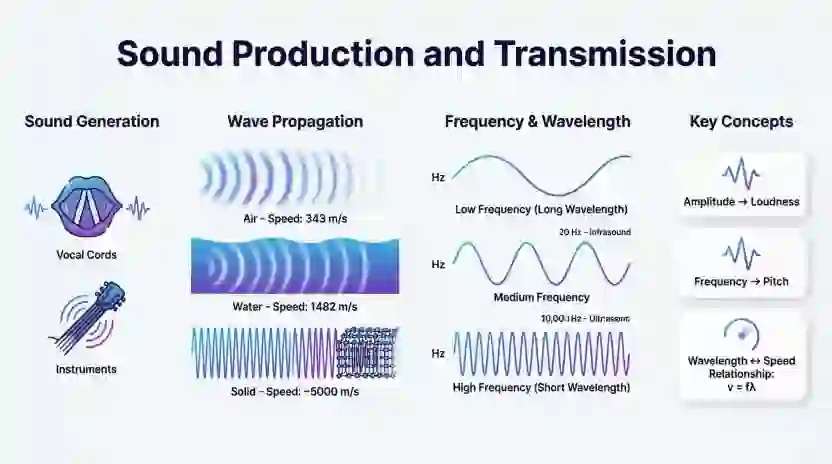
The original sense is connected with sound and vibration.
The singer’s voice resonated throughout the hall.
The bell resonated through the building.
Cambridge defines resonate as producing, increasing, or filling a space with sound through vibration.
2. To have a strong emotional effect
This is one of the most common modern uses.
Her story resonated with me.
This means her story created a strong personal or emotional connection.
3. To connect with an idea or belief
Resonate can also describe an idea that feels meaningful or familiar to someone.
The message resonated with young readers.
His argument resonated with the audience.
Oxford gives this sense as reminding someone of something or being similar to what someone thinks or believes.
Common expressions with resonate
Some useful patterns are:
- resonate with someone
- resonate with an audience
- resonate deeply
- resonate strongly
- resonate emotionally
- resonate with readers
- resonate across generations
- resonate throughout a room
The phrase “resonate with” is especially important when talking about feelings, experiences, ideas, books, messages, or stories.
The Origin of Resonate
The history of resonate helps explain why the word is connected with sound.
Oxford traces resonate to the Latin verb resonare, meaning “to sound again.” It is related to re-, expressing repetition or intensity, and sonare, meaning “to sound.”
Etymonline dates the verb resonate to the 19th century in English, with its early use connected to anatomy and sound. Its figurative sense involving feelings and emotions developed later.
The basic idea is easy to remember:
sound → vibration → echo → strong effect or emotional connection
That explains how resonate developed beyond literal sound. Today, something can “resonate” without producing any physical sound at all.
For example:
That childhood memory still resonates with her.
There is no literal sound here. The word describes a continuing emotional or personal effect.
What about “resignate”?
Resignate is sometimes encountered online, but it is not the normal standard-English replacement for resonate. Collins lists a user-submitted proposal for resignate with a specialized proposed meaning related to engineering an employee’s resignation. That is different from the ordinary meanings of resonate.
So if you are writing a normal sentence about an idea, story, message, or feeling, resonate is the form to use.
British English vs American English
There is no major British-versus-American spelling difference between resonate and resignate. Standard English uses resonate in both varieties.
| British English | American English | Example |
| resonate | resonate | The message resonated with readers. |
| resonated | resonated | Her speech resonated with the audience. |
| resonating | resonating | The story is still resonating today. |
| resonance | resonance | The poem has emotional resonance. |
Oxford provides both British and American entries for resonate, with the same core spelling and meanings.
The difference you may notice is usually related to surrounding spelling or style rather than the word itself.
For example:
- British: theatre
- American: theater
But:
- British: resonate
- American: resonate
So you do not need to change resonate when switching between British and American English.
Which Version Should You Use?
United States
Use resonate.
The campaign message resonated with the audience.
American dictionaries recognize resonate as the standard verb.
United Kingdom
Use resonate.
Her story resonated with thousands of readers.
British dictionaries such as Cambridge and Oxford list resonate with its literal and figurative meanings.
Canada
Use resonate in standard Canadian English. There is no need to use resignate simply because of regional variation.
Australia
Use resonate and follow your chosen Australian dictionary or organizational style guide consistently. The Australian Government Style Manual advises writers to use an appropriate Australian dictionary and keep spelling consistent.
International writing
Resonate is the clearest choice for international readers.
It is widely recognized and has a straightforward meaning.
Academic writing
Use resonate when the meaning fits the context.
The findings resonate with previous research.
However, academic writers should avoid using resonate simply to sound sophisticated. Choose a more precise word such as support, align with, reflect, or correspond to when that is what you actually mean.
Business writing
Resonate is common in marketing and communication.
The new message resonates with our target audience.
It works well when discussing customer reactions, brand messages, ideas, or communication.
Common Mistakes
The main mistake is adding -ign- to resonate because of the familiar word resign.
| Incorrect | Correct | Why? |
| The message resignated with me. | The message resonated with me. | Use resonated for the past tense of resonate. |
| Her story resignates with readers. | Her story resonates with readers. | The present-tense form is resonates. |
| His speech was resignating with the audience. | His speech was resonating with the audience. | The -ing form is resonating. |
| The idea will resignate with people. | The idea will resonate with people. | Use resonate after “will.” |
Memory tip
Think:
resonate → resonance → sound
If you mean that an idea, story, or message connects with someone, choose resonate.
Everyday Examples
Emails
I think this approach will resonate with our customers.
Your explanation really resonated with me.
Business writing
The new campaign is designed to resonate with younger consumers.
News headlines
Local Story Resonates With Readers
Community Message Resonates Across the City
Blogs
This advice may resonate with anyone who has struggled with procrastination.
Social media
This quote really resonated with me.
Who else can resonate with this experience?
Academic writing
The findings resonate with earlier studies on language learning.
For formal academic work, make sure the word accurately describes the relationship rather than using it as a vague synonym for “agree.”
Daily conversation
That really resonates with me.
I can relate to that.
Her experience resonated with me.
The first sentence is natural and common in modern English.
Google Trends & Modern Usage

People often search “resignate or resonate” because the two forms look similar. The confusion becomes especially likely when writers hear resonate in conversation and try to spell it from memory.
Modern dictionaries consistently document resonate as the standard verb. Cambridge includes both its sound-related and emotional meanings, while Oxford documents its use for ideas or experiences that remind someone of something or match their beliefs.
There is also a useful reason people may invent or encounter forms such as resignate. English has many verbs ending in -ate, and resign is already a familiar word. That can make resignate look plausible even when the intended word is resonate.
The safest approach is not to rely on how a word looks. Check the dictionary form and meaning.
For modern writing, especially websites, emails, school assignments, professional documents, and published content, resonate is the reliable standard choice.
Quick Comparison Table
| Version | Meaning | Correct? | Region | Example |
| resonate | Produce sound or create a strong effect/connection | Yes | International | The message resonated with readers. |
| resonated | Past tense of resonate | Yes | International | Her story resonated with me. |
| resonating | -ing form of resonate | Yes | International | The idea is resonating with people. |
| resonates | Third-person present form | Yes | International | The message resonates with students. |
| resignate | Not the standard form for these meanings | No in ordinary standard usage | Not a standard regional alternative | Avoid it when you mean resonate. |
| resignated | Not the standard past tense of resonate | No | Not a standard alternative | Use resonated. |
Key Takeaways
- Resonate is the standard English word.
- Resignate is not the normal alternative to resonate.
- Resonate can refer to sound, vibration, emotional impact, or connection with an idea.
- The common expression is resonate with someone.
- The past tense is resonated.
- The third-person form is resonates.
- The -ing form is resonating.
- British and American English both use resonate.
- Use resonate in academic, business, online, and everyday writing.
- If you mean “connect emotionally,” resonate is the word you want.
FAQs
1. Is “resignate” a correct word?
Resignate is not the standard English word when you mean “to have an emotional effect,” “to connect with someone,” or “to produce resonance.” For those meanings, use resonate. Collins currently shows resignate as a user-submitted new-word suggestion rather than treating it as the ordinary dictionary equivalent of resonate.
2. Is it “resignate with me” or “resonate with me”?
The standard phrase is “resonate with me.” For example: “Her story really resonated with me.” It means the story created a strong emotional or personal connection. “Resignate with me” should be avoided in standard English when you mean this idea.
3. What does “resonate with me” mean?
“Resonate with me” means that something feels personally meaningful, familiar, or emotionally relevant to you. For example, if someone shares an experience that reminds you of your own life, you might say, “That really resonates with me.” Cambridge gives this emotional and personal-connection meaning for resonate.
4. What is the past tense of resonate?
The past tense of resonate is resonated. For example: “The speaker’s message resonated with the audience.” The forms are resonate, resonates, resonated, resonating. Oxford lists these standard verb forms in its dictionary entry.
5. Can you say “I resonate with that”?
Yes. “I resonate with that” is used in modern English to say that an idea, experience, or statement feels true or meaningful to you. Cambridge specifically gives examples of resonate with being used when something feels true or has personal meaning.
6. Is resonate formal or informal?
Resonate works in both formal and everyday English, although some uses can sound more polished or abstract. It is suitable for professional writing, essays, journalism, and conversation. In formal writing, use it when it expresses the exact relationship you mean rather than using it simply as a fashionable substitute for “agree.”
7. Is “resonate” used in British English?
Yes. Resonate is used in British English as well as American English. Oxford and Cambridge both document the word and its meanings. There is no British spelling such as resignate that replaces resonate.
8. What is the difference between resonate and resound?
Both words can describe sound, but they are not identical in every context. Resonate can also describe an emotional or intellectual connection, such as “The message resonated with readers.” Resound is more strongly associated with sound filling or echoing through a place. Context determines which word is more precise.
9. Can an idea resonate with someone?
Yes. This is one of the common modern uses of resonate. An idea can resonate with someone when it feels meaningful, familiar, or consistent with that person’s experience or beliefs. For example: “The idea of flexible work resonated with many employees.” Oxford documents this sense of resonate with.
10. How can I remember resonate vs resignate?
Use this simple memory link: resonate → resonance → sound or connection. If you are talking about a message, story, feeling, idea, or sound that has a strong effect, use resonate. If you are about to write resignate, stop and check if resonate is the word you need.
Conclusion
When choosing between resignate or resonate, use resonate in standard English. It is the established verb for describing sound, vibration, emotional impact, and the way an idea or experience connects with someone. Dictionaries such as Cambridge, Oxford, and Merriam-Webster all document these uses.
The word works across British, American, Canadian, Australian, and international English. You can use it in everyday conversation, emails, business writing, academic work, blogs, journalism, and social media.
The most useful pattern to remember is “resonate with.” For example, “Her story resonated with me” means her story created a strong personal connection.
Resignate may occasionally appear online, but it should not be used as a casual replacement for resonate. Collins currently treats one specialized use as a submitted new-word suggestion, which is different from the established standard meaning of resonate.
Remember: when an idea, story, sound, or message connects strongly, it resonates.
Read more about!
- Equaling or Equalling: Which One Should You Use?
- TTF or OTF: Which Font Format Is Better?
- Emphasising or Emphasizing: Which Spelling Is Correct?
- Bacon or Sausage: Which One Should You Choose?

I’m Olivia Parker, a grammar and English writing enthusiast passionate about making English simple and easy to understand. Through Wordsblog, I share clear explanations, useful grammar tips, and practical writing guidance to help readers write with confidence. My goal is to make learning English easier, one word at a time.