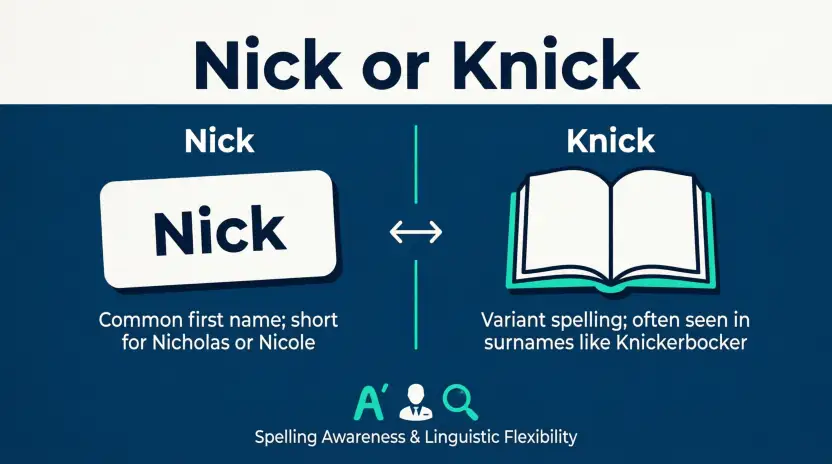
If you mean a small cut, notch, or mark, nick is the correct spelling. Knick is not the normal spelling of this common English word, although it appears in words such as knick-knack and in some rare or specialized uses.
Major dictionaries list nick for meanings such as a small cut or notch, while knick is not normally used as its everyday equivalent.
People often search “nick or knick” because the two words sound the same and English has several familiar words beginning with kn-. This can make knick look like a possible spelling of nick. The confusion is especially easy to understand when you already know words such as knick-knack.
In this guide, you will learn what nick means, when knick can appear, the difference between the two forms, common mistakes, regional usage, and examples you can use in everyday writing.
Nick or Knick: Featured Snippet & AI Overview
Nick is the correct spelling when you mean a small cut, notch, chip, or mark on a surface. Knick is not the standard spelling for this common meaning. For example, “There is a nick in the table” is correct. Knick mainly appears in words such as knick-knack or in rare, specialized terminology.
Nick or Knick: Quick Answer
The short answer is simple:
- Nick = the standard spelling for a small cut, notch, chip, or mark.
- Knick = generally not the standard spelling of this everyday word.
- Knick-knack = a separate established word for a small decorative object.
- Nick can also be a verb meaning to make a small cut.
- In British informal English, nick has several additional meanings, including “steal” and “arrest.”
Examples
There is a small nick in the edge of the table.
I got a nick on my finger while shaving.
Be careful not to nick the paint.
These are all standard uses of nick.
What Does Nick Mean?
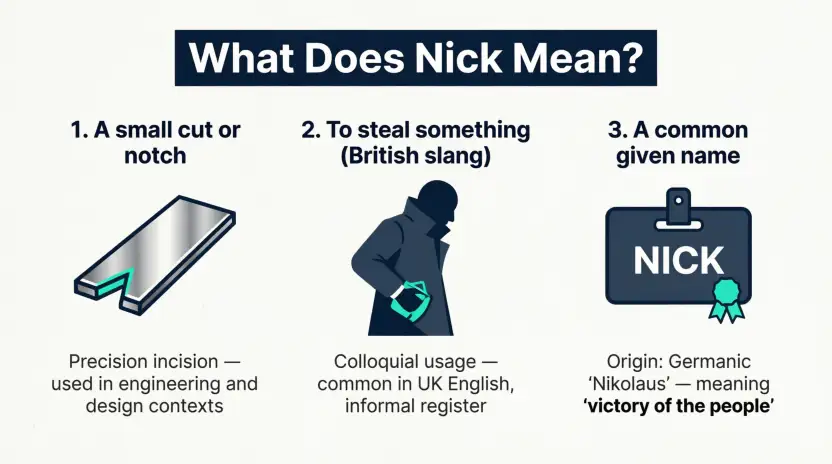
Nick has several meanings in English, but one of its most common meanings is a small cut, notch, chip, or indentation in a surface.
It can be used as both a noun and a verb.
Nick as a noun
As a noun, nick refers to a small cut or damaged spot.
Examples:
- There is a nick in the glass.
- The knife left a nick in the wooden board.
- I noticed a small nick on the car door.
Cambridge defines nick as a small cut in a surface or edge. Oxford also gives the meaning of a small cut in the edge or surface of something.
Nick as a verb
As a verb, nick means to make a small cut.
Examples:
- I nicked my finger while opening the package.
- He nicked the table with the tool.
- Be careful not to nick the surface.
Oxford lists this meaning as making a small cut in something or yourself.
Other meanings of nick
Depending on context, nick can mean other things.
In British informal English, nick can mean:
- to steal something
- to arrest someone
- a prison or police station
- someone’s condition or state
For example, British English has the expression “in good nick,” meaning in good condition.
There is also the familiar phrase “in the nick of time,” meaning just in time.
The Origin of Nick and Knick
The history of nick is older than the modern spelling confusion might suggest.
Oxford lists nick as a Late Middle English word and says its origin is unknown. Collins gives an earlier form and connects the word with older forms related to notch.
This is important because the spelling knick is not simply a British or American spelling variation of everyday nick.
English contains many words where a silent k appears at the beginning, such as knife, knee, and know. That pattern may make knick seem plausible to English learners.
However, spelling patterns do not always predict individual words. For the ordinary noun meaning “a small cut or notch,” dictionaries use nick.
What about knick-knack?
Knick-knack is a genuine English word.
It means a small decorative object or ornament. Cambridge lists knick-knack as a noun for a small decorative object, while Collins traces the word to a reduplicated form related to knack.
So these are different:
- nick = a small cut or notch
- knick-knack = a small decorative object
- knick = not the normal everyday spelling of nick
British English vs American English
There is no normal British-versus-American spelling difference between nick and knick for the meaning “small cut.”
Both major varieties use nick.
| Meaning | British English | American English | Example |
| Small cut or notch | nick | nick | There is a nick in the table. |
| Make a small cut | nick | nick | I nicked my finger. |
| Steal, informal | nick | Less common in this sense | Someone nicked my phone. |
| Arrest, informal | nick | Mainly British | The police nicked him. |
| Decorative object | knick-knack | knick-knack | She collects knick-knacks. |
Cambridge marks several additional meanings of nick, such as “steal” and “catch,” as informal or British uses.
Does British English use “knick”?
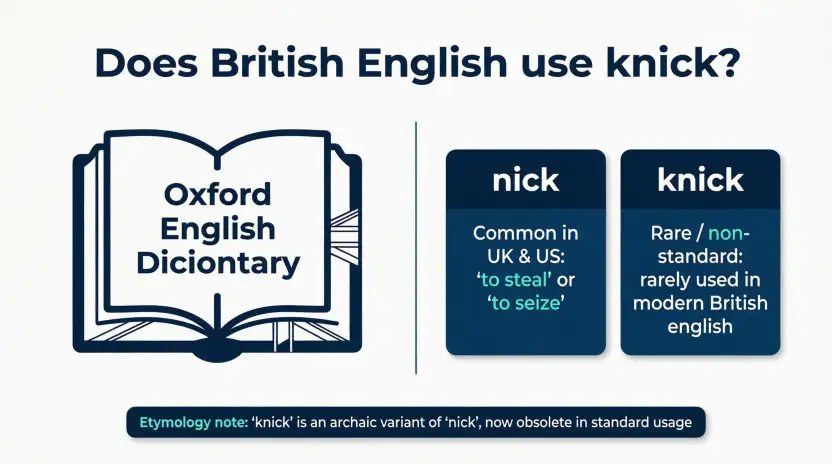
Not as a standard alternative spelling of the everyday word nick.
So if you are writing for British readers, you should still write:
There is a nick in the door.
Not:
There is a knick in the door.
Which Version Should You Use?
United States
Use nick for a small cut, notch, chip, or mark.
Example:
“The table has a small nick on the edge.”
United Kingdom
Use nick for the same meaning. British English also uses nick in several informal expressions that are less common in American English.
Canada
Use nick in standard Canadian English when referring to a small cut or notch.
Australia
Use nick for the ordinary “small cut” meaning. Australian informal English also has other uses of nick. Oxford notes an Australian and New Zealand informal use meaning to go somewhere quickly.
International Writing
For international readers, nick is the safest standard spelling when you mean a small cut or notch.
Avoid using knick as a supposed spelling variation.
Academic Writing
Use nick if the word is needed.
If you are writing about a technical subject, define the term clearly because nick can have specialized meanings in fields such as printing and molecular biology.
Business Writing
Use nick when describing minor physical damage.
For formal business writing, however, a more precise word such as scratch, chip, cut, or damage may be better depending on the situation.
Common Mistakes
Mistake 1: Writing “knick” for a small cut
Incorrect:
There is a knick in my new table.
Correct:
There is a nick in my new table.
Why?
The standard word for a small cut or notch is nick.
Memory tip:
Think nick = notch. Both start with n.
Mistake 2: Confusing nick with knick-knack
Incorrect:
There is a knick on the edge of the vase.
Correct:
There is a nick on the edge of the vase.
But:
The shelf is full of knick-knacks.
The two words look similar, but their meanings are different.
Mistake 3: Assuming “kn-” must be correct
English has many words beginning with kn-, but that does not mean every similar-sounding word needs a silent k.
For example:
- knife
- knee
- know
- knock
But:
- nick
- nail
- night
- name
Spelling must be learned word by word.
Mistake 4: Using “knick” because it sounds right
Nick and knick are normally pronounced the same in English when knick occurs as part of words such as knick-knack. The sound alone cannot tell you which spelling belongs to the word you need.
When you mean a small cut or notch, choose nick.
Everyday Examples of Nick
In Emails
I noticed a small nick on the edge of the product when I opened the box.
This works well when reporting minor physical damage.
In Business Writing
The inspection found several small nicks on the painted surface.
For a formal report, nick can be useful when the damage is small and clearly defined.
In News Headlines
A headline might use nick when reporting damage:
Small Nick Found on Historic Furniture
However, a news writer may choose chip, scratch, or damage if that word is more precise.
In Blogs
Even a careful DIY project can leave a few nicks in the wood.
This is a natural use in practical writing.
On Social Media
Somehow I managed to put a tiny nick in my new phone case.
The word works naturally in casual posts.
In Academic Writing
The sample contained a small nick along its edge.
In technical writing, always consider if a more specialized term is more accurate.
In Daily Conversation
I nicked my finger while cutting the cardboard.
This is a natural everyday use of the verb. Oxford gives similar examples for making a small cut while doing an ordinary task.
Google Trends & Modern Usage
People who search “nick or knick” are usually trying to confirm the spelling of a word they have heard or seen.
The confusion makes sense because English contains several familiar kn- words, and knick-knack is itself a common word. This can lead writers and English learners to wonder if knick might also be an accepted spelling of nick.
Modern standard dictionaries consistently support nick for the common meaning of a small cut, notch, or chip. Cambridge and Oxford both list this use.
Usage also varies by meaning. For example, British English gives nick several informal meanings that are not equally common in American English.
Exact Google Trends figures are not included here because search interest can change over time and by location. The key usage point remains stable: nick is the normal spelling for the everyday word meaning a small cut or notch.
Quick Comparison Table
| Version | Meaning | Correct? | Region | Example |
| nick | Small cut or notch | Yes | US, UK, Canada, Australia, International | There is a nick in the wood. |
| knick | Not the usual everyday form of nick | Generally no | Not a standard regional variant | Avoid it for “small cut.” |
| knick-knack | Small decorative object | Yes | Widely used | She bought a ceramic knick-knack. |
| nick | Steal, informal | Yes | Especially British | Someone nicked my bike. |
| nick | Arrest, informal | Yes | Especially British | The police nicked him. |
| nick | Condition/state in “good nick” | Yes | British, informal | The car is in good nick. |
Key Takeaways
- Nick is the standard spelling for a small cut or notch.
- Knick is not normally used as an alternative spelling of everyday nick.
- Knick-knack is a separate, correctly spelled English word.
- Nick can function as both a noun and a verb.
- “I nicked my finger” means I made a small cut on my finger.
- British English has additional informal meanings of nick.
- In the nick of time is a common English idiom.
- For international and formal writing, use nick when you mean a small cut or notch.
FAQs About Nick or Knick
1. Is it “nick” or “knick”?
Nick is correct when you mean a small cut, notch, chip, or mark. Knick is not the normal spelling of this everyday word. For example, write “There is a nick in the table,” not “There is a knick in the table.” Dictionaries such as Cambridge and Oxford list nick for this meaning.
2. Is “knick” a real English word?
Knick can appear in English in limited or specialized contexts, and it is also familiar as part of knick-knack. However, it is not the normal spelling of the common word nick meaning a small cut or notch. For ordinary English writing, use nick for that meaning.
3. What does “nick” mean?
Nick can mean a small cut, notch, chip, or indentation in something. As a verb, it can mean to make a small cut. British informal English also uses nick for meanings such as steal or arrest, and phrases such as “in good nick” refer to condition.
4. Is “knick” an alternative spelling of “nick”?
For the common meaning of a small cut or notch, no. Standard English uses nick. Although the two spellings may seem related, knick should not normally replace nick in everyday writing.
5. What is a “nick” in a surface?
A nick is a small cut, notch, chip, or damaged spot on an edge or surface. You might find a nick in a wooden table, glass, piece of metal, or painted surface. Cambridge specifically defines nick as a small cut in a surface or edge.
6. What is the difference between “nick” and “knick-knack”?
Nick can mean a small cut or notch. Knick-knack means a small decorative object or ornament. For example, “There is a nick in the table” describes damage, while “The shelf is full of knick-knacks” describes decorative objects.
7. Is “nick” British or American English?
Nick is used in both British and American English for a small cut or notch. However, some additional meanings are especially associated with British informal English. These include nick meaning steal or arrest and in good nick meaning in good condition.
8. What does “in the nick of time” mean?
In the nick of time means just in time, usually at the last possible moment before something bad or unwanted happens. It is an established English idiom. Oxford lists it as meaning at the very last moment.
9. Is “I nicked my finger” correct?
Yes. “I nicked my finger” is correct and means that you made a small cut on your finger. It is especially natural in everyday conversation. Oxford lists nick as a verb meaning to make a small cut in something or yourself.
10. How can I remember “nick” vs “knick”?
Use this simple memory trick: nick = notch. Both words begin with n. If you are talking about a small cut, chip, or notch, choose nick. Save knick for established words such as knick-knack, rather than using it as a spelling of nick.
Conclusion: Nick or Knick?
When you are choosing between nick or knick, the answer is usually straightforward: use nick.
If you mean a small cut, notch, chip, or mark on an object, nick is the standard spelling in both American and British English. You can also use it as a verb when someone makes a small cut, as in “I nicked my finger while shaving.”
Knick should not normally be substituted for nick in everyday writing. The spelling appears most familiarly in knick-knack, which is a different word meaning a small decorative object.
British English also gives nick several informal meanings, including “steal,” “arrest,” and “prison,” so context matters when you read the word.
The easiest rule is this: if you mean a small cut or notch, write “nick.” Keep that rule in mind, and this common spelling confusion becomes easy to avoid.
Read more about!
- Honoring or Honouring: Which Spelling Is Correct?
- Apartment or House: Which One Is Better for You?
- Resignate or Resonate: Which Word Is Correct?

I’m Olivia Parker, a grammar and English writing enthusiast passionate about making English simple and easy to understand. Through Wordsblog, I share clear explanations, useful grammar tips, and practical writing guidance to help readers write with confidence. My goal is to make learning English easier, one word at a time.






13 thoughts on “Nick or Knick: Which Spelling Is Correct?”