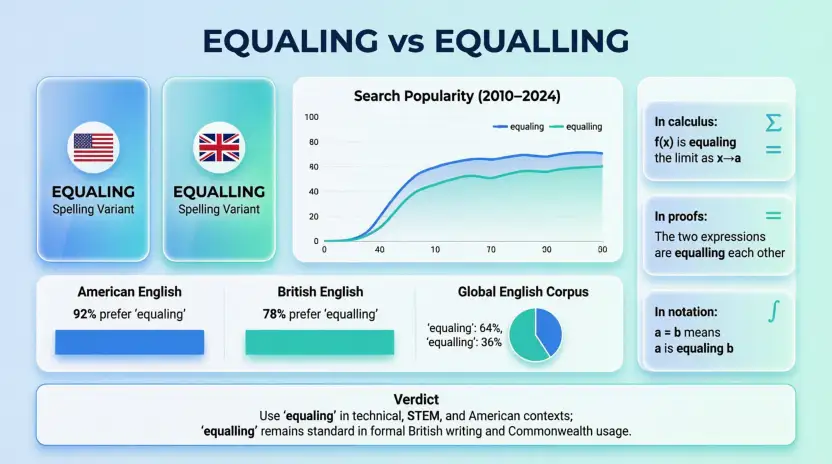
When choosing between equaling or equalling, both spellings are correct, but the preferred form depends on the variety of English you are using. Equaling is the standard spelling in American English, while equalling is standard in British English and is also commonly used in Canadian English.
This difference can confuse writers because the word comes from the verb equal, and English spelling rules change slightly when an ending such as -ing is added. The extra l may look like a spelling mistake to an American reader, while dropping it may look unusual to a British reader.
The good news is that the meaning does not change. Both equaling and equalling mean becoming equal, making something equal, or matching something in value, size, amount, or achievement.
In this guide, you will learn the difference between equaling and equalling, where each spelling is preferred, how the spelling developed, and which version to use in American, British, Canadian, and international writing.
Equaling or Equalling: Featured Snippet & AI Overview
Equaling and equalling are both correct spellings of the present participle of equal.
while equalling is preferred in British English. Canadian English commonly uses equalling, although equaling also appears. The meaning is identical in both forms.
Equaling or Equalling: Quick Answer
The quick answer is simple:
- Equaling = American English
- Equalling = British English
- Equalling is also commonly used in Canadian English.
- Both forms have the same meaning.
- Neither spelling is inherently wrong.
- Your choice should match the English variety and style guide you are following.
For example:
American English:
The athlete is equaling the world record.
British English:
The athlete is equalling the world record.
Both sentences mean that the athlete is matching the existing world record.
The difference is mainly a regional spelling convention, not a difference in grammar or meaning. Oxford lists equalling as the British form and equaling as the US form.
What Does Equaling or Equalling Mean?
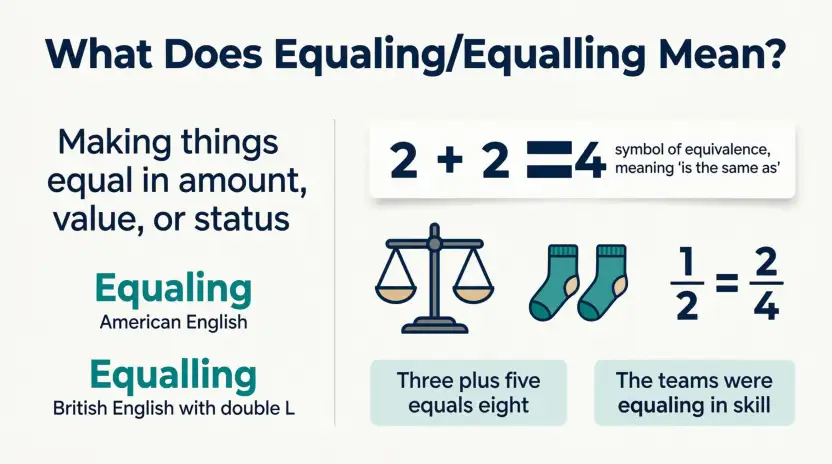
Equaling and equalling are the present participle and -ing forms of the verb equal.
The verb equal can mean to have the same value, amount, size, or level as something else. It can also mean to match someone or something in achievement or quality.
For example:
The new record is equalling the previous mark.
The player is equaling the team’s scoring record.
The two amounts are equal.
The word can be used in several contexts.
1. Mathematics
In mathematics, equal means that two values have the same value.
Two plus two equals four.
2. Achievement
It can describe matching an existing achievement.
She is equalling the national record.
3. Value or quantity
It can describe something reaching the same amount or level.
The new payment is equalling the amount from last year.
The spelling changes when the -ing ending is added:
equal + ing → equaling / equalling
The difference comes from regional spelling rules rather than a difference in meaning.
Cambridge identifies equalling as the UK form and equaling as the US form.
The Origin of Equaling or Equalling
The word equal has a long history in English. Oxford traces equal to Late Middle English and ultimately to the Latin aequalis, from aequus, meaning “even,” “level,” or “equal.”
The verb equal developed into the modern English word used for matching values, quantities, qualities, or achievements.
When English speakers add -ing, spelling conventions differ between major varieties of English.
British English generally keeps the doubled l:
equal → equalling
American English generally uses a single l:
equal → equaling
This follows a broader pattern in English spelling. British English often doubles a final l before certain suffixes, while American English frequently does not.
You can see a similar difference in words such as:
- travelled / traveled
- travelling / traveling
- labelled / labeled
- modelling / modeling
However, spelling patterns are not always identical for every word. That is why it is useful to check the dictionary or style guide used by your audience.
Oxford specifically lists equalling as the -ing form and equaling as the US English form.
British English vs American English
The main difference between equaling and equalling is regional spelling.
| British English | American English | Example |
| equalling | equaling | She is equalling/equaling the record. |
| equalled | equaled | He equalled/equaled the previous score. |
| equal | equal | The two values are equal. |
| equally | equally | Both options are equally useful. |
British English normally uses the doubled l in equalling and equalled.
American English normally uses one l in equaling and equaled.
Oxford’s dictionary entries show this distinction directly: British English uses equalled and equalling, while US English uses equaled and equaling.
Cambridge also labels equalling as the UK form and equaling as the US form.
What about Canadian English?
Canadian English can show variation. Oxford’s American dictionary notes that Canadian English usually uses equalled and equalling, although the US-style forms are also encountered.
This means Canadian writers should normally follow the spelling conventions required by their publication, school, employer, or style guide.
Which Version Should You Use?
The best spelling depends on your audience.
United States
Use equaling.
The runner is equaling the previous record.
This is the standard American spelling.
United Kingdom
Use equalling.
The runner is equalling the previous record.
This follows standard British spelling.
Canada
Equalling is commonly used in Canadian English, but usage can vary. If you are writing for a Canadian publication or institution, follow its preferred style guide.
Australia
Australian English generally follows British-style spelling conventions, so equalling is the natural choice in formal Australian writing.
International Writing
For international audiences, either form can work. The most important rule is consistency.
If your website uses American English throughout, choose equaling.
If your website uses British English throughout, choose equalling.
Academic Writing
Follow the style guide or institution’s preferred English variety.
Do not switch between:
equaling
and
equalling
randomly in the same paper.
Consistency is more important than choosing one form for every English-speaking country.
Business Writing
Use the spelling expected by your company, client, or target market.
For a US company:
The new figure is equaling last year’s total.
For a UK company:
The new figure is equalling last year’s total.
Common Mistakes
One of the most common mistakes is assuming that one spelling is always correct.
Mistake 1: Calling “equalling” incorrect
Incorrect assumption:
“Equalling” is misspelled.
Correct understanding:
“Equalling” is the standard British spelling.
The extra l is intentional.
Mistake 2: Calling “equaling” incorrect
Incorrect assumption:
“Equaling” is always wrong because the British spelling has two l’s.
Correct understanding:
“Equaling” is the standard American spelling.
Mistake 3: Mixing regional styles
For example:
The company is equaling its British sales target while the report uses travelled and labeled.
This can create an inconsistent spelling style.
A better approach is to choose one regional variety and use it consistently.
Memory Tip
Think:
US = equaling
UK = equalling
If you write for a British audience, remember the extra l.
If you write for an American audience, use the single l.
Everyday Examples
Here are practical examples showing how both spellings work.
Emails
American English:
Our sales are equaling last month’s figures.
British English:
Our sales are equalling last month’s figures.
Business Writing
American English:
The company is equaling its previous quarterly performance.
British English:
The company is equalling its previous quarterly performance.
News Headlines
American English:
Local Runner Is Equaling Historic Record
British English:
Local Runner Is Equalling Historic Record
Headlines often shorten grammar and wording, but the spelling follows the publication’s regional style.
Blogs
The new model is equaling the performance of the older version.
or:
The new model is equalling the performance of the older version.
Both are grammatically correct.
Social Media
We’re finally equaling last year’s results!
A British account might write:
We’re finally equalling last year’s results!
Academic Writing
The second group is equaling the performance of the control group.
British academic writing may use:
The second group is equalling the performance of the control group.
Always follow the institution’s required spelling style.
Daily Conversation
Their scores are equaling each other.
British English:
Their scores are equalling each other.
In casual conversation, the spelling is not heard, so the difference mainly matters in writing.
Google Trends & Modern Usage

Searches for “equaling or equalling” usually come from people who have encountered the two spellings and want to know if one is a spelling error.
The confusion is understandable because English has several regional spelling differences. A word that looks unusual in American English may be completely standard in British English, and vice versa.
Modern dictionaries continue to recognize the two forms as regional variants. Cambridge labels equaling as mainly US and equalling as UK usage, while Oxford explicitly gives equalling as the standard -ing form and equaling as the US form.
There is no need to treat one spelling as more grammatically correct than the other.
For SEO and online publishing, the practical lesson is simple: use the spelling that matches the language variety of your target audience.
If you are writing for American readers, equaling is usually the better fit.
If you are writing for British readers, equalling is usually the better fit.
Because exact search-volume data can change over time and by location, this article does not assign unsupported popularity statistics to either spelling.
Quick Comparison Table
| Version | Meaning | Correct? | Region | Example |
| equaling | Matching or becoming equal | Yes | Mainly US English | She is equaling the record. |
| equalling | Matching or becoming equal | Yes | Mainly UK English | She is equalling the record. |
| equal | Having the same value or amount | Yes | All major varieties | The two numbers are equal. |
| equally | To the same degree or amount | Yes | All major varieties | Both are equally useful. |
The important point is that equaling and equalling have the same meaning. The spelling difference reflects regional English conventions.
Key Takeaways
- Equaling and equalling are both correct.
- Equaling is preferred in American English.
- Equalling is preferred in British English.
- Canadian English commonly uses equalling, although variation exists.
- Australian English generally follows British-style spelling.
- The two forms have the same meaning and pronunciation.
- Do not treat the extra l as a spelling error in British English.
- Choose one regional spelling system and use it consistently.
- Always follow a required academic, business, or publication style guide.
FAQs About Equaling or Equalling
1. Is “equaling” or “equalling” correct?
Both equaling and equalling are correct. Equaling is the standard American English spelling, while equalling is the standard British English spelling. The two words have the same meaning. The difference is a regional spelling convention, not a grammatical difference.
2. Is “equalling” British English?
Yes. Equalling is the British English spelling of the -ing form of equal. British English commonly doubles the final l in this form. For example, a British writer might say, “She is equalling the previous record.” Oxford lists equalling as the British form.
3. Is “equaling” American English?
Yes. Equaling is the standard American English spelling. American English normally uses one l in this form. For example, an American writer might write, “She is equaling the previous record.” Oxford and Cambridge both identify the single-l spelling with US English.
4. Does equaling mean the same as equalling?
Yes. Equaling and equalling have the same meaning. Both are forms of the verb equal and can describe matching a value, amount, level, standard, or achievement. The difference is simply spelling. The appropriate choice depends mainly on the English variety used by your audience.
5. Is “equalled” or “equaled” correct?
Both are correct. Equalled is the British spelling, while equaled is the American spelling. The same regional pattern appears with equalling and equaling. If you use British English, choose equalled. If you use American English, choose equaled.
6. Does Canadian English use equalling?
Canadian English commonly uses equalling, although Canadian usage can vary. Oxford’s American dictionary specifically notes equalling as the usual Canadian form while also identifying equaling as the US form. For formal Canadian writing, follow the style guide required by your publication or institution.
7. Why does British English have two Ls in equalling?
British spelling commonly doubles the final l before the -ing ending in words such as equalling. American English usually does not double it in this word, producing equaling. This is a spelling convention rather than a difference in pronunciation or meaning.
8. Which spelling should I use in an American essay?
Use equaling if your essay follows American English. For example, write, “The athlete is equaling the previous record.” If your school, university, or instructor requires another style, follow those instructions instead. Consistency throughout the essay is important.
9. Which spelling should I use in British English?
Use equalling in British English. For example, write, “The athlete is equalling the previous record.” The same British spelling pattern applies to the past form equalled. Oxford and Cambridge both support this regional distinction.
10. Are equaling and equalling pronounced differently?
No. The spelling difference does not normally create a difference in pronunciation. Both forms represent the same word and meaning. The distinction is mainly visible in writing, particularly when comparing American and British English.
Conclusion
The choice between equaling or equalling depends mainly on the English variety you are using. Both spellings are correct, and both describe the act of matching or becoming equal to something.
For American English, use equaling with one l. For British English, use equalling with two l’s. Canadian English commonly uses equalling, while Australian English generally follows British spelling conventions.
The most important lesson is not to treat either spelling as a universal mistake. Regional English varieties have different spelling rules, and reputable dictionaries recognize these differences. Oxford lists equalling as the British form and equaling as the US form, while Cambridge gives the same basic distinction.
For students, editors, bloggers, and business writers, the safest approach is to identify your target audience first. Then choose the appropriate spelling and use it consistently.
Remember: US English uses “equaling,” while British English uses “equalling.”
Read more about!
- Dose or Dosage: What Is the Difference?
- Fabric or Forge: What Is the Difference?
- Fawn or Freeze: What Is the Difference?

I’m Olivia Parker, a grammar and English writing enthusiast passionate about making English simple and easy to understand. Through Wordsblog, I share clear explanations, useful grammar tips, and practical writing guidance to help readers write with confidence. My goal is to make learning English easier, one word at a time.





5 thoughts on “Equaling or Equalling: Which One Should You Use?”