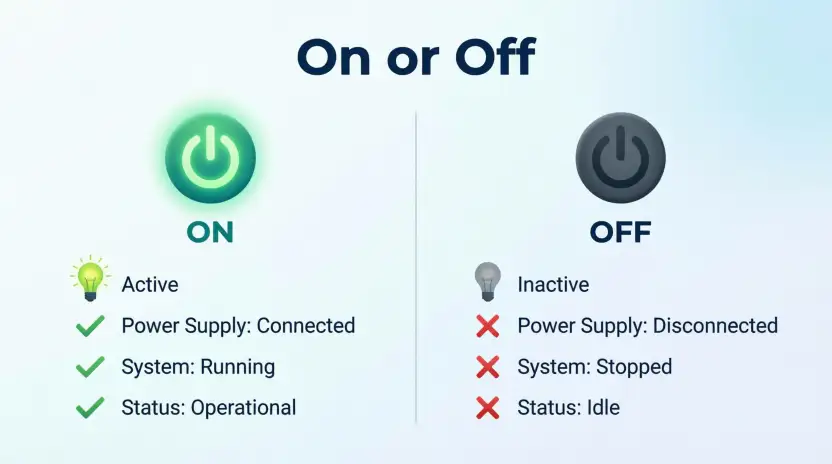
When you are choosing between on or off, the correct word depends on if something is operating, active, connected, available, or not operating. On usually describes an active or working state, while off usually describes a stopped, inactive, or disconnected state.
People often search for “on or off” because these two short words appear everywhere in English. You may see them on switches, devices, instructions, forms, apps, signs, and everyday conversations. The confusion grows because on and off can also work as prepositions, adverbs, adjectives, and parts of common phrases.
For example, you can say, “Turn the light on,” “Turn the light off,” “Is the TV on or off?” and “The meeting is on.” In another context, “The service is off” can mean that it is not operating or that an arrangement has been canceled.
This guide explains on or off in simple terms, shows how the words work in different contexts, and gives practical examples for American, British, Canadian, Australian, academic, and business English.
Featured Snippet + AI Overview
On or off describes two opposite states. On usually means operating, active, connected, or happening, while off usually means not operating, inactive, disconnected, or not happening. For example, “Turn the computer on” means start it, while “Turn the computer off” means stop it. The exact meaning depends on context.
On or Off: Quick Answer
The simplest distinction is:
- On = active, operating, connected, or happening
- Off = inactive, not operating, disconnected, or not happening
Examples
- The light is on.
The light is operating and producing light. - The light is off.
The light is not operating. - Is the computer on or off?
The speaker wants to know its current operating state. - Please turn the fan on.
Start the fan. - Please turn the fan off.
Stop the fan.
Cambridge lists on as an adjective and adverb meaning operating or made to start operating, while off commonly expresses a state in which something is not operating or has moved away from an active or connected position.
The important point is that on and off are not interchangeable. They normally express opposite states.
What Does On or Off Mean?
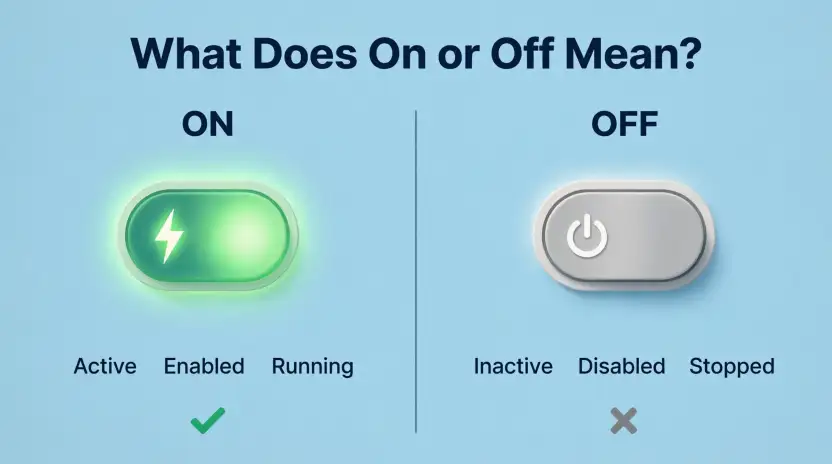
On and off are extremely common English words with many meanings.
What does “on” mean?
In the most basic sense, on can describe something that is:
- Operating
- Active
- Connected
- Happening
- Being worn
- Continuing
- Available or scheduled
Examples:
- The radio is on.
- The heating is on.
- The meeting is on.
- She has her jacket on.
- Keep on working.
- The show is on tonight.
Cambridge also shows that on has many prepositional uses, including position, time, transportation, involvement, and connection.
What does “off” mean?
Off often describes something that is:
- Not operating
- Inactive
- Disconnected
- Away from a surface or position
- Not happening
- Not available
- Removed
Examples:
- The TV is off.
- Turn the oven off.
- The internet is off.
- The event is off.
- Take your shoes off.
The meaning changes with the sentence. That is why learning on and off as simple opposites is useful, but not enough to understand every expression.
On vs. off in everyday English
| Situation | On | Off |
| Light | The light is on. | The light is off. |
| Computer | The computer is on. | The computer is off. |
| TV | The TV is on. | The TV is off. |
| Switch | Turn it on. | Turn it off. |
| Event | The event is on. | The event is off. |
| Clothing | Put it on. | Take it off. |
| Activity | Keep on working. | Stop or switch it off. |
The Origin of On or Off
On and off are both very old English words. Their modern meanings developed from earlier uses connected with position, movement, contact, and separation.
The word on comes from Old English on, related to the idea of being “in,” “on,” or “into.” Its history is connected with Proto-Germanic forms and related words in other Germanic languages. Over time, its meanings expanded into ideas such as position, contact, continuation, and operation.
Off developed from an older form related to Old English of. The meaning gradually developed toward ideas such as separation and movement away. The modern meaning “not working” is much newer than the word itself, with that sense recorded from the 19th century.)
The phrase off and on, meaning intermittently or from time to time, has been recorded since the 16th century.
So, the modern opposition between on and off is closely tied to a basic idea:
on → connected or active
off → separated or inactive
That simple contrast explains many modern uses.
British English vs American English
There is no major spelling difference between on and off in British and American English. Both varieties use the same basic forms.
The main differences may appear in pronunciation, vocabulary around the words, or particular expressions. Cambridge gives pronunciation information for both British and American English and records many shared uses.
| British English | American English | Example |
| on | on | The TV is on. |
| off | off | The TV is off. |
| on and off | on and off | It happened on and off. |
| off and on | off and on | The problem occurred off and on. |
| on-off | on-off | It has an on-off switch. |
Is “on and off” British or American?
It is used in both.
On and off means something happens sometimes but not continuously.
I have been studying on and off all day.
Cambridge defines off and on as something happening or existing only some of the time and also lists on and off as a related expression.
Is “on-off” the same as “on or off”?
Not always.
- on or off = a choice between two states
- on-off = often an adjective describing a switch or something that repeatedly starts and stops
- on and off = intermittently
For example:
Should the switch be on or off?
But:
This device has an on-off switch.
And:
The internet connection has been unstable on and off.
Which Version Should You Use?
Because on and off are standard words in major varieties of English, you normally do not need to choose one based on country.
United States
Use on and off normally.
Turn the lights off before you leave.
United Kingdom
Use the same forms.
Please turn the lights off before you leave.
Canada
Canadian English also uses on and off in the standard way.
Australia
Australian English uses the same basic forms.
International writing
For international readers, on and off are clear and widely understood.
Academic writing
Use the words according to their exact meaning.
The device remained on throughout the experiment.
Avoid vague phrases when a more precise description is possible.
Business writing
On and off are common in workplace communication.
The system is currently off.
The meeting is still on.
Please switch the equipment off after use.
The key is not regional spelling. It is choosing the form that matches the intended meaning.
Common Mistakes With On and Off
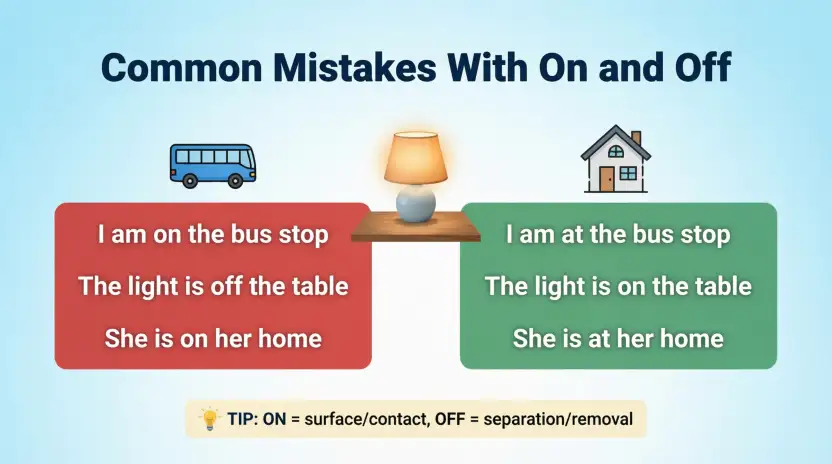
Mistake 1: Treating on and off as interchangeable
Incorrect:
Please turn the computer on after you finish using it.
Correct:
Please turn the computer off after you finish using it.
Why?
If you want someone to stop the computer, use off.
Memory tip:
On starts. Off stops.
Mistake 2: Confusing “on or off” with “on and off”
Incorrect for a choice:
Should the machine be on and off?
Correct:
Should the machine be on or off?
Why?
Use or when choosing between alternatives.
Use and in on and off when describing something that happens intermittently.
The machine has been running on and off all morning.
Mistake 3: Using “on-off” in every situation
Less natural:
Is your phone on-off?
Better:
Is your phone on or off?
Why?
On-off commonly works as a compound adjective, such as an on-off switch. Cambridge defines on-off as describing something that can be in either of two positions and also uses it for something that stops and starts.
Mistake 4: Assuming “off” always means physically away
Example:
The meeting is off.
Here, off does not mean that the meeting moved away from something. It means the planned event is no longer happening.
Similarly:
The alarm is off.
This usually means the alarm is not operating or has been deactivated.
Everyday Examples of On or Off
Emails
Please confirm if the setting should be on or off.
I will turn the notification off during the meeting.
Business Writing
The new system will be on from Monday.
Please make sure all equipment is off before leaving.
News Headlines
Power Off After Severe Storm
New Service Now On in Three Cities
Headlines may shorten sentences, but the basic meanings remain the same.
Blogs
Should you leave Wi-Fi on or off at night?
Here is how to turn location services off.
Social Media
Is your phone always on?
I finally turned my notifications off.
Academic Writing
The device was switched on before each trial.
The equipment was switched off after the test.
Daily Conversation
Is the oven on?
No, it is off.
Can you turn the light on?
Sure.
Google Trends & Modern Usage
The phrase on or off has broad search intent because it can relate to many subjects. People may use the phrase when asking about electronics, switches, settings, appliances, schedules, relationships, subscriptions, internet connections, or everyday choices.
Search intent also changes depending on the words around the phrase.
For example:
- on or off switch → physical controls
- turn on or off → instructions
- should Wi-Fi be on or off → technology
- on or off meaning → vocabulary
- on and off meaning → phrase meaning
- on-off relationship → relationship terminology
- is the event on or off → scheduling
This makes on or off a broad keyword rather than a question with only one meaning.
There is also an important difference between on or off and on and off. The first usually presents two alternatives. The second describes something that happens intermittently. Cambridge explicitly records off and on as meaning something that happens only some of the time and lists on and off as a related expression. (Cambridge Dictionary)
Because search results vary by context, a useful explanation should answer the meaning question while also covering the most common real-world uses.
Quick Comparison Table
| Version | Meaning | Correct? | Region | Example |
| on | Active or operating | Yes | International | The light is on. |
| off | Inactive or not operating | Yes | International | The light is off. |
| on or off | A choice between two states | Yes | International | Is the switch on or off? |
| on and off | Happening intermittently | Yes | International | It rained on and off. |
| off and on | Happening intermittently | Yes | International | He worked off and on. |
| on-off | A compound adjective | Yes | International | An on-off switch |
Key Takeaways
- On usually means active, operating, connected, or happening.
- Off usually means inactive, stopped, disconnected, or not happening.
- On or off presents a choice between two states.
- On and off means intermittently.
- Off and on has a similar meaning to on and off.
- On-off commonly works as a compound adjective.
- British and American English use the same basic spellings.
- On and off can have different meanings depending on context.
- In instructions, turn on usually means start or activate.
- Turn off usually means stop or deactivate.
FAQs About On or Off
1. What is the difference between on and off?
On usually means that something is active, operating, connected, or happening. Off usually means that something is inactive, not operating, disconnected, or not happening. For example, “The computer is on” means it is operating, while “The computer is off” means it is not operating.
2. Is it correct to say “on or off”?
Yes. On or off is correct when you are presenting two possible states or choices. For example, “Should the switch be on or off?” asks which state the switch should be in. The phrase is common in instructions, technology, everyday conversation, and technical writing.
3. Should I use “on and off” or “on or off”?
Use on or off for a choice between two alternatives. Use on and off when something happens intermittently. For example, “Is the light on or off?” asks about its state, while “The light kept flashing on and off” describes repeated changes between the two states.
4. What does “on and off” mean?
On and off means something happens intermittently rather than continuously. For example, “It rained on and off all afternoon” means the rain started and stopped several times. Cambridge also records off and on with this general meaning.
5. Is “on-off” grammatically correct?
Yes. On-off is commonly used as a compound adjective. For example, you can say an on-off switch. It can describe something with two states or, in some contexts, something that repeatedly stops and starts. Cambridge lists both of these uses.
6. Is “turn on” correct English?
Yes. Turn on is a standard phrasal verb meaning to start or activate something. For example, “Turn on the television” means to make the television operate. You can also say, “Turn the television on.” Both word orders are common.
7. Is “turn off” correct English?
Yes. Turn off means to stop or deactivate something. For example, “Turn off the lights before you leave.” You can also say, “Turn the lights off.” The two forms have the same basic meaning.
8. Do British and American English spell on and off differently?
No. On and off have the same standard spelling in British and American English. Their core meanings are also shared. Pronunciation can differ between varieties, but writers do not normally change the spelling based on if they are writing for a British or American audience
9. What does “the event is off” mean?
When someone says the event is off, it usually means the planned event will not happen. For example, “The concert is off because of the weather” means the concert has been canceled or will not take place as planned. This is different from the physical meaning of off.
10. What is an easy way to remember on and off?
A simple memory tip is: On starts, off stops. Think of a light switch. When you switch it on, the light operates. When you switch it off, the light stops operating. This shortcut works well for many everyday examples involving devices and controls.
Conclusion
The choice between on or off is usually simple once you identify the state you want to describe. On generally means active, operating, connected, or happening. Off generally means inactive, stopped, disconnected, or not happening.
The phrase on or off is used when you are choosing between two states. For example, “Is the printer on or off?” asks which state the printer is currently in. By contrast, on and off describes something that happens intermittently, such as “The connection worked on and off all day.” On-off is commonly used as a compound adjective, especially in terms such as on-off switch.
These forms are standard in both British and American English, so regional spelling is not the main issue. Context is what determines the correct expression.
Remember: on starts or activates, off stops or deactivates.
Read more about!
- Honoring or Honouring: Which Spelling Is Correct?
- Apartment or House: Which One Is Better for You?
- Resignate or Resonate: Which Word Is Correct?

I’m Olivia Parker, a grammar and English writing enthusiast passionate about making English simple and easy to understand. Through Wordsblog, I share clear explanations, useful grammar tips, and practical writing guidance to help readers write with confidence. My goal is to make learning English easier, one word at a time.