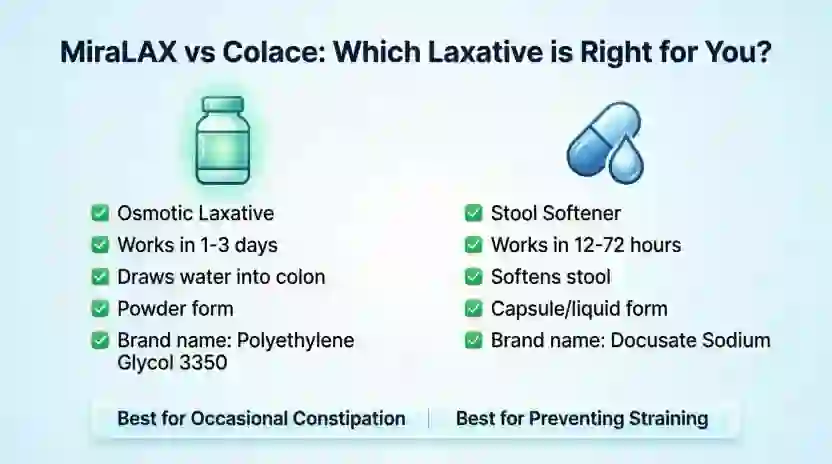
Constipation can be uncomfortable, and choosing between MiraLAX and Colace can be confusing because both are sold for constipation relief. MiraLAX and Colace work in different ways: MiraLAX contains polyethylene glycol 3350, an osmotic laxative, while standard Colace contains docusate sodium, a stool softener.
People often search for “MiraLAX or Colace” because they want to know which product works faster, which one softens stool better, and which option is appropriate for occasional constipation. The answer depends on what you need and why you are constipated.
MiraLAX pulls water into the stool and usually produces a bowel movement within 1 to 3 days. Standard Colace is designed to soften stool and generally produces a bowel movement within 12 to 72 hours.
This guide explains the difference between MiraLAX and Colace, how each works, when each may be used, common mistakes, side effects, and what current constipation guidance says.
MiraLAX or Colace: Featured Snippet & AI Ove
Colace MiraLAX and rview are both used for constipation, but they work differently.
MiraLAX contains polyethylene glycol 3350 and is an osmotic laxative that draws water into the stool. Colace contains docusate sodium and is a stool softener. Has stronger support in current guidelines for chronic idiopathic constipation, while evidence for docusate is limited.
MiraLAX or Colace: Quick Answer
MiraLAX and Colace are not the same type of constipation medicine.
- MiraLAX: Contains polyethylene glycol 3350.
- Colace: Standard Colace contains docusate sodium.
- MiraLAX: Works as an osmotic laxative by retaining water in the stool.
- Colace: Works as a stool softener.
- MiraLAX: Usually produces a bowel movement in 1 to 3 days according to its current OTC labeling.
- Colace: Generally produces a bowel movement in 12 to 72 hours according to its current labeling.
For chronic idiopathic constipation, the AGA-ACG guideline gives polyethylene glycol a strong recommendation based on moderate-certainty evidence. The same guideline did not provide a recommendation for docusate because the evidence was insufficient.
Simple example
If someone says:
“I need something that helps increase stool frequency.”
MiraLAX may be the type of product they are asking about.
If someone says:
“My stool is hard and I need to make it easier to pass.”
A stool softener such as docusate may be the type of product they have in mind.
That does not mean one product is automatically appropriate for everyone. The cause of constipation and the person’s health history matter.
What Does MiraLAX or Colace Mean?
“MiraLAX or Colace” is not a spelling or grammar comparison. It is a comparison between two branded constipation products with different active ingredients.
What is MiraLAX?
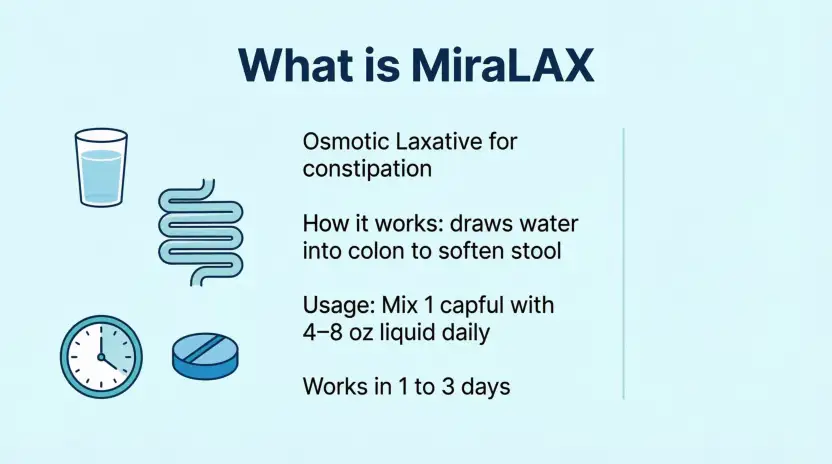
MiraLAX is a brand of product containing polyethylene glycol 3350, commonly abbreviated as PEG 3350. Its current OTC labeling identifies it as an osmotic laxative.
PEG 3350 works by retaining water with the stool. This increases stool water content and helps make bowel movements easier to pass. MedlinePlus describes polyethylene glycol 3350 as a treatment for occasional constipation and notes that it may take 2 to 4 days to produce a bowel movement.
What is Colace?
Standard Colace contains docusate sodium. Its drug label identifies docusate sodium as a stool softener and states that it is used to relieve occasional constipation.
Docusate is intended to soften stool, which can make passing stool easier. Stool softeners are sometimes used when avoiding straining is important.
Important Colace detail
“Colace” is a brand name, not a guarantee that every Colace product contains only docusate.
For example, some Colace products combine docusate sodium with sennosides, a stimulant laxative. Always check the active ingredients on the package before comparing products.
The Origin of MiraLAX and Colace
MiraLAX and Colace are brand names rather than alternative spellings of the same medical term.
The important distinction is their active ingredients.
MiraLAX uses polyethylene glycol 3350. PEG 3350 belongs to a group of substances used as osmotic laxatives because it helps retain water in the stool.
Colace is associated with docusate sodium, a stool-softening ingredient. The current Colace label identifies docusate sodium as the active ingredient in its standard capsule products.
The terms therefore developed around different products and different mechanisms of action. The main question is not which name is “correct.” The useful question is which active ingredient and treatment approach fit the situation.
British English vs American English
Unlike comparisons such as “color vs colour,” MiraLAX vs Colace is not a British-versus-American spelling issue.
| British English | American English | Example |
| MiraLAX | MiraLAX | “MiraLAX contains polyethylene glycol 3350.” |
| Colace | Colace | “Colace contains docusate sodium.” |
| polyethylene glycol | polyethylene glycol | “Polyethylene glycol is an osmotic laxative.” |
| docusate sodium | docusate sodium | “Docusate sodium is a stool softener.” |
The brand names may have different availability and labeling in different countries. Product names and formulations should therefore be checked locally.
For medical writing, it is usually clearer to include the generic ingredient when possible. This reduces confusion when a brand is unavailable or has a different formulation in another market.
Which Version Should You Use?
Because MiraLAX and Colace are medicines, “which one should you use?” cannot be answered safely by brand name alone.
United States
In the United States, current OTC labels identify MiraLAX as polyethylene glycol 3350 and standard Colace as docusate sodium.
For chronic idiopathic constipation, the AGA-ACG guideline gives PEG a strong recommendation. It did not make a recommendation for docusate because evidence was not sufficient for a recommendation.
United Kingdom
Do not assume that US brand names or formulations are identical to products sold in the UK. Check the active ingredient and local product information.
Canada
The same principle applies in Canada. Look at the active ingredient rather than relying only on the brand name.
Australia
Australian products may use different brand names or formulations. Check the package and local medical guidance.
International writing
For international readers, write both the brand and generic ingredient when relevant:
MiraLAX (polyethylene glycol 3350)
and
Colace (docusate sodium)
This makes the information easier to understand across countries.
Academic writing
Academic or medical writing should generally emphasize the generic drug name rather than relying only on a brand name.
Business or general consumer writing
For a consumer article, it is reasonable to use the familiar brand name, but explain the active ingredient the first time it appears.
Common Mistakes
Mistake 1: Treating MiraLAX and Colace as identical
Incorrect:
“MiraLAX and Colace are the same type of laxative.”
Correct:
“MiraLAX contains polyethylene glycol 3350, while standard Colace contains docusate sodium.”
Why: Their active ingredients and mechanisms are different.
Memory tip:
MiraLAX = PEG = osmotic laxative.
Colace = docusate = stool softener.
Mistake 2: Assuming Colace always contains only docusate
Incorrect:
“Every Colace product contains only docusate.”
Correct:
“Standard Colace contains docusate, but some Colace products combine docusate with other ingredients.”
Why: Product formulations can differ. Always read the active-ingredient panel.
Mistake 3: Expecting instant results
Incorrect:
“I took MiraLAX, so it should work immediately.”
Correct:
“MiraLAX generally produces a bowel movement in 1 to 3 days according to its OTC label.”
Why: PEG 3350 is not intended to work like a rapid stimulant laxative.
Mistake 4: Ignoring warning signs
Constipation with severe or persistent abdominal pain, vomiting, significant bloating, or a sudden lasting change in bowel habits needs medical attention rather than simply adding another OTC product. Current product labeling specifically advises medical advice for several of these symptoms.
Everyday Examples
Emails
“My doctor recommended polyethylene glycol for my constipation.”
This is clearer than simply naming a brand if the recipient may live in another country.
Business writing
“Please check the active ingredient before purchasing the product.”
This avoids assuming that a brand has the same formulation everywhere.
News headlines
“MiraLAX and Colace differ in how they treat constipation.”
This is more informative than saying one is simply a “better laxative.”
Blogs
“MiraLAX contains PEG 3350, while standard Colace contains docusate sodium.”
This gives readers the key distinction immediately.
Social media
“MiraLAX and Colace are not the same. Check the active ingredient before comparing them.”
Academic writing
“Polyethylene glycol 3350 is an osmotic laxative, whereas docusate sodium is classified as a stool softener.”
This style is more precise than using brand names alone.
Daily conversation

“Are you comparing MiraLAX with regular Colace? They use different ingredients.”
That simple question can prevent confusion.
Google Trends & Modern Usage
People searching for “MiraLAX or Colace” are usually looking for a practical comparison rather than a definition. Common search intent includes questions such as:
- Is MiraLAX or Colace better for constipation?
- Can you take MiraLAX and Colace together?
- Does MiraLAX work faster than Colace?
- What is the difference between MiraLAX and Colace?
- Is Colace a laxative or a stool softener?
- How does polyethylene glycol compare with docusate?
Search behavior around this topic is driven by treatment choice and symptom relief, not by a language difference.
There is also an important modern distinction between brand searches and generic-drug searches. Readers may search for MiraLAX because it is a familiar brand, while healthcare information often refers to polyethylene glycol 3350.
Exact Google Trends numbers are not included here because search interest changes over time and by location. A reliable article should not invent regional percentages or popularity statistics.
Quick Comparison Table
| Version | Meaning | Correct? | Region | Example |
| MiraLAX | Brand containing PEG 3350 | Yes | Common US brand | “MiraLAX contains polyethylene glycol 3350.” |
| Colace | Brand associated with docusate products | Yes | Common US brand | “Standard Colace contains docusate sodium.” |
| Polyethylene glycol 3350 | Active ingredient in MiraLAX | Yes | International medical term | “PEG 3350 is an osmotic laxative.” |
| Docusate sodium | Active ingredient in standard Colace | Yes | International medical term | “Docusate sodium is a stool softener.” |
| Colace + sennosides | Combination product | Yes | Product-dependent | “This Colace product contains a stool softener and stimulant laxative.” |
The comparison above refers specifically to standard products and should not be used to assume that every product sold under a brand name has the same formulation.
Key Takeaways
- MiraLAX and Colace are different products.
- MiraLAX contains polyethylene glycol 3350.
- MiraLAX is an osmotic laxative.
- Standard Colace contains docusate sodium.
- Docusate is a stool softener.
- MiraLAX generally works within 1 to 3 days according to its current OTC label.
- Standard Colace generally produces a bowel movement within 12 to 72 hours.
- Current AGA-ACG guidance strongly recommends PEG for chronic idiopathic constipation, while it does not provide a recommendation for docusate because of insufficient evidence.
FAQs About MiraLAX or Colace
1. Is MiraLAX or Colace better for constipation?
MiraLAX and Colace work differently, so “better” depends on the situation. MiraLAX contains polyethylene glycol 3350 and is an osmotic laxative. Standard Colace contains docusate sodium and is a stool softener. For chronic idiopathic constipation, current AGA-ACG guidance strongly recommends PEG, while it does not provide a recommendation for docusate because of insufficient evidence.
2. Is MiraLAX a stool softener?
No. MiraLAX is classified as an osmotic laxative. Its active ingredient, polyethylene glycol 3350, works by retaining water with the stool. This increases stool water and helps bowel movements become easier to pass. It is therefore different from docusate, which is classified as a stool softener.
3. Is Colace a laxative or a stool softener?
Standard Colace containing docusate sodium is labeled as a stool softener. Some products sold under the Colace name contain additional ingredients, including stimulant laxatives, so the package should be checked carefully. Do not assume that every Colace product has exactly the same active ingredients.
4. Does MiraLAX work faster than Colace?
Their labeled time frames overlap. MiraLAX generally produces a bowel movement in 1 to 3 days, while standard Colace generally produces one in 12 to 72 hours. Individual results can vary. Neither should be assumed to provide immediate relief simply because it is available over the counter.
5. Can you take MiraLAX and Colace together?
If combining them is appropriate depends on the person’s symptoms, health history, other medicines, and the exact products involved. Because constipation treatments can overlap, it is sensible to ask a doctor or pharmacist before combining them, especially if constipation is persistent or unexplained.
6. What is the main difference between MiraLAX and Colace?
The main difference is the active ingredient and how it works. MiraLAX contains polyethylene glycol 3350 and is an osmotic laxative. Standard Colace contains docusate sodium and is a stool softener. The two products should therefore not be treated as interchangeable names for the same medicine.
7. Which one is recommended for chronic constipation?
The 2023 AGA-ACG clinical practice guideline gave polyethylene glycol a strong recommendation for chronic idiopathic constipation. It did not make a recommendation for docusate because the available evidence was not sufficient. This does not mean every person with constipation should take PEG. Individual circumstances still matter.
8. What are common side effects of MiraLAX?
Polyethylene glycol 3350 can cause gastrointestinal effects such as bloating, gas, cramping, nausea, or diarrhea. MedlinePlus advises following the product or clinician’s directions and discussing relevant medical conditions or medicines with a healthcare professional.
9. When should you ask a doctor about constipation?
Seek medical advice when constipation is persistent, keeps returning, or occurs with concerning symptoms. Product labeling advises medical evaluation for symptoms such as stomach pain, nausea, vomiting, or a sudden change in bowel habits that lasts more than two weeks.
10. Is MiraLAX the same as polyethylene glycol?
MiraLAX is a brand product whose active ingredient is polyethylene glycol 3350. Therefore, polyethylene glycol 3350 is the generic ingredient, while MiraLAX is a brand name. Other products may contain the same active ingredient under different brand names.
Conclusion
MiraLAX and Colace are both used for constipation, but they are not the same medicine. MiraLAX contains polyethylene glycol 3350, an osmotic laxative that retains water with the stool. Standard Colace contains docusate sodium, a stool softener.
The current AGA-ACG guideline provides stronger evidence-based support for PEG in chronic idiopathic constipation. It gives PEG a strong recommendation, while it does not make a recommendation for docusate because the evidence is insufficient.
For occasional constipation, always follow the product label and consider factors such as your symptoms, other medicines, and existing health conditions. Do not assume that every product with the Colace name has the same ingredients.
If constipation is persistent, severe, or accompanied by concerning symptoms, speak with a healthcare professional rather than repeatedly changing OTC treatments.
The simplest way to remember the difference is: MiraLAX is PEG and an osmotic laxative; standard Colace is docusate and a stool softener.
Read more about!
- Honoring or Honouring: Which Spelling Is Correct?
- Apartment or House: Which One Is Better for You?
- Resignate or Resonate: Which Word Is Correct?

I’m Olivia Parker, a grammar and English writing enthusiast passionate about making English simple and easy to understand. Through Wordsblog, I share clear explanations, useful grammar tips, and practical writing guidance to help readers write with confidence. My goal is to make learning English easier, one word at a time.