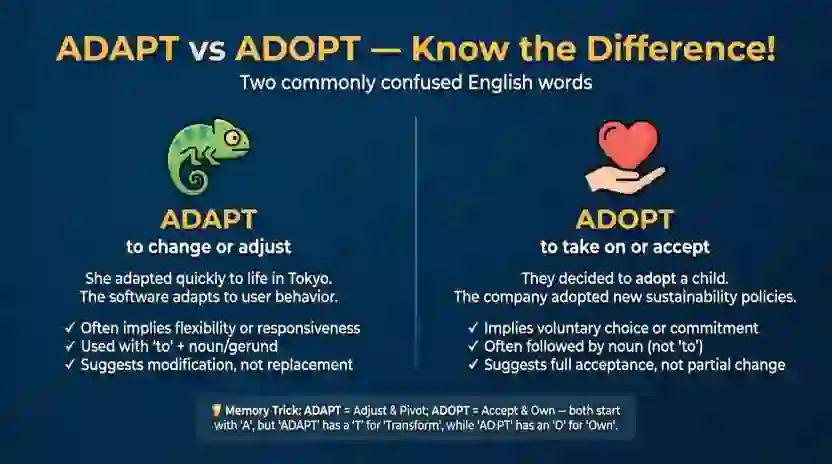
If you are unsure if to use adapt or adopt, the key difference is simple: adapt means to change something so it fits a new situation, while adopt means to accept, choose, or start using something. Both words are verbs, but they are used in different contexts.
People often search for “adapt or adopt” because the two words look and sound similar. Their meanings overlap slightly in some situations, which can make the choice even harder for English learners, students, writers, and professionals.
For example, you might adapt a plan when you change it to suit new conditions. You might adopt a plan when you officially choose or accept it. The difference is small in form but important in meaning.
In this guide, you will learn the meaning, origin, usage, regional differences, common mistakes, and practical examples of adapt and adopt. You will also get simple memory tips to help you choose the right word every time.
Adapt or Adopt: Featured Snippet & AI Overview
Adapt means to change something so it works in a new situation, while adopt means to accept, choose, or begin using something. For example, you adapt a strategy when you modify it, but you adopt a strategy when you decide to use it. The easiest memory tip is: adapt = adjust; adopt = accept or use.
Adapt or Adopt: Quick Answer
The difference between adapt and adopt comes down to what you do with something.
- Adapt = change or modify something to fit a new situation.
- Adopt = accept, choose, approve, or begin using something.
Examples of Adapt
- We need to adapt our plans to the changing weather.
- She quickly adapted to her new school.
- The company adapted its website for mobile users.
In each example, something is changed to fit a new condition.
Examples of Adopt
- The company decided to adopt a new policy.
- Many schools have adopted new teaching methods.
- She adopted a healthier lifestyle.
Here, the subject chooses, accepts, or begins using something.
Simple rule: If you mean change, use adapt. If you mean choose, accept, or start using, use adopt.
What Does Adapt or Adopt Mean?
Although adapt and adopt look almost identical, they have different core meanings.
What Does Adapt Mean?
Adapt means to change something so it works better in a new environment, condition, purpose, or situation.
It can describe changing an object, plan, method, behavior, or even a person’s actions.
Examples:
- We must adapt our strategy.
- Animals adapt to their environment.
- She adapted the lesson for younger students.
- He adapted quickly to his new job.
The word often suggests adjustment.
What Does Adopt Mean?
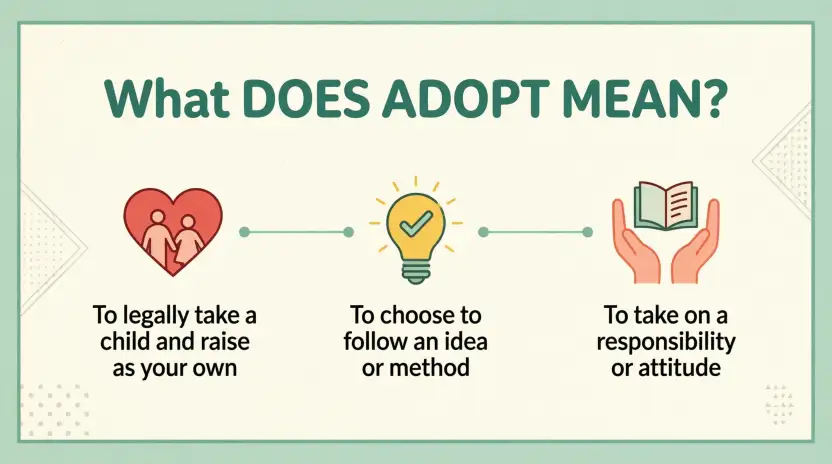
Adopt means to take something as your own choice or to begin using, following, or accepting it.
It is commonly used with:
- policies
- rules
- ideas
- methods
- plans
- habits
- technologies
- beliefs
- lifestyles
Examples:
- The company adopted a new policy.
- The school adopted a new curriculum.
- She adopted a healthier lifestyle.
- The team adopted a different approach.
In these cases, something is selected or accepted rather than modified.
Adapt vs. Adopt in One Sentence
Consider this example:
The company adopted a new marketing strategy and adapted it for different countries.
The company chose the strategy, so it adopted it. It then changed the strategy to fit different markets, so it adapted it.
That distinction is the heart of adapt vs. adopt.
The Origin of Adapt and Adopt
The two words are related in appearance because both entered English through Latin and developed through French influence, but they have different histories and meanings.
Adapt comes from Latin adaptare, meaning roughly “to fit” or “adjust.” Its modern English sense is connected to making something suitable for a particular purpose or condition.
Adopt comes from Latin adoptare, meaning “to choose” or “take as one’s own.” It developed meanings connected with accepting or taking something as one’s own.
Their similar spellings can cause confusion, but their core ideas remain different:
- Adapt → fit or adjust
- Adopt → choose or take as one’s own
This distinction also explains why both words are common in formal English.
British English vs American English
There is no major difference in the basic meaning of adapt and adopt between British and American English. Both varieties use the words in essentially the same way.
| Meaning | British English | American English | Example |
| Change to fit a situation | Adapt | Adapt | We need to adapt the plan. |
| Adjust to a situation | Adapt | Adapt | She adapted to her new job. |
| Accept or choose | Adopt | Adopt | They adopted a new policy. |
| Begin using | Adopt | Adopt | The company adopted new software. |
| Take a child legally as one’s own | Adopt | Adopt | They adopted a child. |
Spelling differences between British and American English do not normally affect adapt or adopt.
The important issue is meaning, not regional spelling.
Which Version Should You Use?
The correct word depends on what you want to say, not simply where you live.
United States
Use adapt when you mean modify or adjust.
We need to adapt the plan.
Use adopt when you mean accept or begin using.
We decided to adopt the plan.
United Kingdom
The same distinction applies in British English.
The team adapted the strategy.
The team adopted the strategy.
Canada
Canadian English also uses both words according to their standard meanings.
Australia
Australian English follows the same basic distinction.
International Writing
For international readers, the clearest approach is to use adapt for adjustment and adopt for acceptance or selection.
Academic Writing
Both words are common in academic English.
- Researchers may adapt a model.
- Universities may adopt a policy.
- Students may adapt their methods.
- Researchers may adopt a theory.
Business Writing
Both words are especially useful in professional communication.
We adopted a new process.
We adapted the process for smaller teams.
The choice tells the reader if something was selected or changed.
Common Mistakes With Adapt and Adopt
Mistake 1: Using Adopt When You Mean Change
Incorrect:
We need to adopt the existing plan to meet the new requirements.
If the meaning is that you will change the plan, adapt is usually the better choice.
Correct:
We need to adapt the existing plan to meet the new requirements.
Memory tip:
Adapt = adjust.
Mistake 2: Using Adapt When You Mean Accept
Incorrect:
The company adapted a new policy.
If the company officially accepted or started using the policy, use adopt.
Correct:
The company adopted a new policy.
Memory tip:
Adopt = accept or choose.
Mistake 3: Confusing “Adapt To” and “Adopt”
These structures are very different.
She adapted to her new environment.
This means she adjusted to the new environment.
She adopted a new routine.
This means she chose or started following the new routine.
The word to after adapt is often a useful clue when talking about adjusting to conditions.
Mistake 4: Thinking Adopt Always Means Adoption
Adopt can refer to legal adoption, but that is only one meaning.
You can also adopt:
- a policy
- an idea
- a method
- a strategy
- a habit
- a technology
So:
The company adopted new software.
does not mean the company legally adopted anything. It means the company chose to start using it.
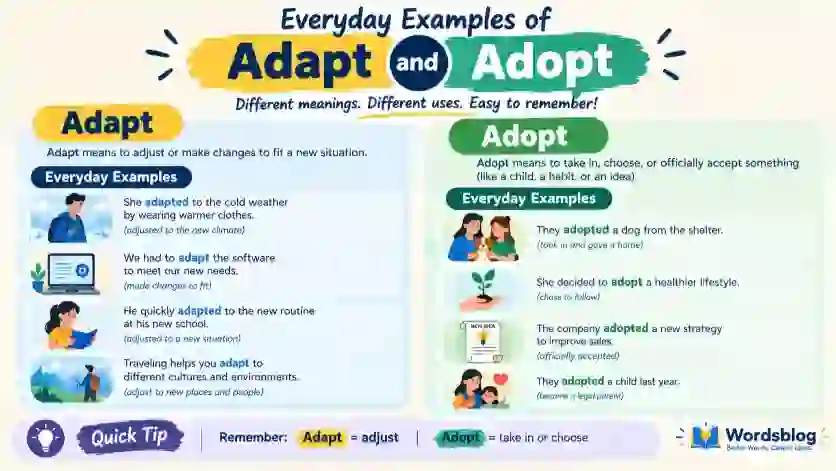
Everyday Examples of Adapt and Adopt
Emails
We may need to adapt the schedule because of the delay.
Please review the new procedure we have adopted.
Business Writing
Our team adapted the strategy to meet customer needs.
The company adopted a new customer-service policy.
News Headlines
Businesses Adapt to Changing Market Conditions
City Council Adopts New Housing Rules
The difference is clear. Businesses change or adjust, while an authority can officially accept rules or policies.
Blogs
You can adapt this recipe based on the ingredients you have.
Many readers have adopted this simple morning routine.
Social Media
I had to adapt my workout after an injury.
I recently adopted a new study routine.
Academic Writing
The researchers adapted the existing model.
The researchers adopted a widely used theoretical framework.
Daily Conversation
It took me a few weeks to adapt to my new schedule.
I adopted a healthier eating routine.
Google Trends & Modern Usage
Searches for “adapt or adopt” are usually driven by spelling and meaning confusion. The words are visually similar, differ by only one letter, and both are frequently used in education, business, technology, and everyday English.
Modern usage does not show a major regional difference in the basic meanings. English speakers in the United States, United Kingdom, Canada, Australia, and other English-speaking regions generally use adapt for adjustment and adopt for acceptance or selection.
The words also appear frequently in formal writing because organizations often adopt policies while people and systems adapt to changes.
Exact search-volume or Google Trends figures should not be assumed without checking current Google Trends data for the specific region and time period.
Quick Comparison Table
| Version | Meaning | Correct? | Typical Use | Example |
| Adapt | Change or adjust | Yes | Plans, methods, behavior, systems | We adapted the plan. |
| Adopt | Accept, choose, or begin using | Yes | Policies, ideas, methods, habits | We adopted a new policy. |
| Adapt to | Adjust to a situation | Yes | Environments, changes, conditions | She adapted to the change. |
| Adopt a child | Legally take a child as one’s own | Yes | Family/legal context | They adopted a child. |
Key Takeaways
- Adapt means to change or adjust something.
- Adopt means to accept, choose, or begin using something.
- You adapt a plan when you modify it.
- You adopt a plan when you choose or accept it.
- Adapt to means to adjust to a new condition.
- Adopt can refer to legal adoption, but it has many other meanings.
- British and American English use the words in essentially the same way.
- A useful memory trick is adapt = adjust and adopt = accept.
FAQs About Adapt or Adopt
1. What is the difference between adapt and adopt?
Adapt means to change or adjust something so it fits a new situation. Adopt means to accept, choose, or begin using something. For example, you can adapt a plan by changing it, but you adopt a plan when you decide to use it. Remember: adapt = adjust; adopt = accept.
2. Is it adapt or adopt a plan?
Both can be correct, but they mean different things. Adopt a plan means to accept or choose the plan. Adapt a plan means to modify it so it works better in a particular situation. For example, a company may adopt a strategy and then adapt it for different markets.
3. Is it adapt or adopt a new policy?
Usually, use adopt when an organization officially accepts or begins using a new policy. For example, “The company adopted a new remote-work policy.” If the organization changes an existing policy to fit new circumstances, adapt may be more appropriate.
4. What does adapt to mean?
Adapt to means to adjust to a new condition, environment, situation, or change. For example, “She adapted to her new job quickly.” The phrase focuses on becoming comfortable or effective under changed circumstances.
5. What does adopt mean in simple English?
Adopt means to choose, accept, or start using something. You can adopt an idea, rule, policy, method, habit, or lifestyle. It can also mean legally taking a child as your own. The exact meaning depends on the context.
6. Is “adopt” only used for children?
No. Adopt has several common meanings. You can adopt a child, but you can also adopt a policy, idea, method, habit, strategy, technology, or approach. In many professional and academic contexts, adopt means to choose or begin using something.
7. Is “adapt” the same as “adjust”?
They are very close in many contexts, but adapt often suggests changing something so it works in a new environment or situation. Adjust can describe a smaller or more specific change. For example, you can adapt a business strategy to a new market or adjust the settings on a device.
8. Can you use adapt and adopt in the same sentence?
Yes. In fact, using both together can make the difference clear. For example: “The company adopted a new strategy and adapted it for international customers.” The company chose the strategy and then changed it to suit a different market.
9. Is “adapt to a new environment” correct?
Yes. Adapt to a new environment is a standard expression. It means adjusting your behavior, skills, or actions so you can function effectively in that environment. For example, “New employees often need time to adapt to a new workplace.”
10. How can I remember adapt vs adopt?
Use this simple memory trick: adapt = adjust and adopt = accept. If something is being changed to fit a new situation, choose adapt. If something is being accepted, chosen, or started, choose adopt.
Conclusion
The difference between adapt and adopt is simple once you focus on the action involved. Adapt means to change, adjust, or modify something so it fits a new situation. Adopt means to accept, choose, approve, or begin using something.
For example, you can adapt a business strategy for a new market, but you adopt a business strategy when you decide to use it. You can also adapt to a new environment, while you can adopt a new habit or policy.
This distinction works across American, British, Canadian, Australian, and international English. It also applies to academic, business, and everyday writing.
When choosing between the two, ask yourself one question: Am I changing something, or am I choosing it? If you are changing it, use adapt. If you are choosing or accepting it, use adopt.
Remember: Adapt means adjust. Adopt means accept. Keep that simple rule in mind, and you will rarely confuse these two words again.
Read more about!
- Honoring or Honouring: Which Spelling Is Correct?
- Apartment or House: Which One Is Better for You?
- Resignate or Resonate: Which Word Is Correct?

I’m Olivia Parker, a grammar and English writing enthusiast passionate about making English simple and easy to understand. Through Wordsblog, I share clear explanations, useful grammar tips, and practical writing guidance to help readers write with confidence. My goal is to make learning English easier, one word at a time.