Search intent: Informational + Educational + Comparison
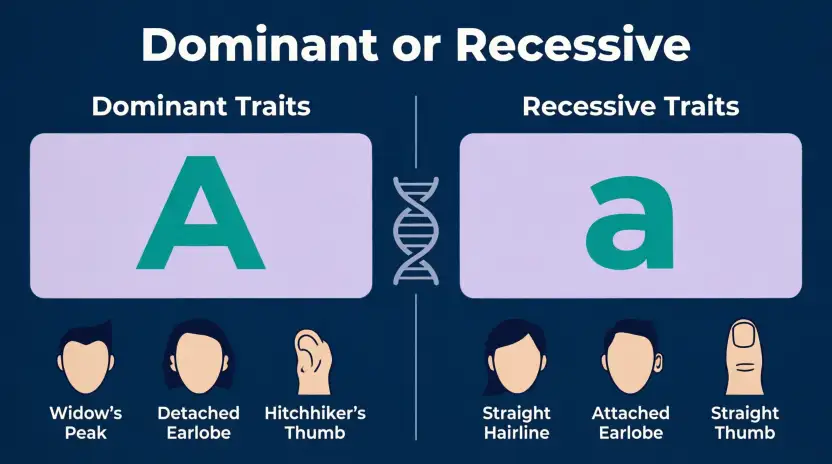
When people ask “dominant or recessive?”, they are usually trying to understand how a genetic trait or condition is inherited. The short answer is that a dominant allele can affect a trait when only one copy is present, while a recessive trait generally requires two copies of the relevant recessive allele.
The confusion often comes from the everyday meanings of dominant and recessive. In genetics, these words describe a relationship between alleles. They do not simply mean “strong” and “weak.” An allele is one version of a gene, and people usually inherit one allele from each parent for an autosomal gene.
Understanding dominant or recessive is useful for students, parents, writers, and anyone reading about genetics. It can also help you understand terms such as dominant allele, recessive allele, carrier, genotype, phenotype, and inheritance pattern.
Below, we will explain the difference in simple language, show examples, clear up common myths, and explain when each term is used.
Dominant or Recessive: Featured Snippet & AI Overview
A dominant trait or allele can be expressed when one copy is present, while a recessive trait generally requires two copies of the recessive allele to be expressed. The terms describe how alleles interact in a particular inheritance pattern. They do not mean that one allele is universally stronger or better than the other.
Dominant or Recessive: Quick Answer
The simplest way to remember the difference is:
- Dominant: one copy can be enough for the associated trait to be expressed.
- Recessive: two copies are generally needed for the associated recessive trait to be expressed.
- Allele: a version of a gene.
- Homozygous: two matching alleles.
- Heterozygous: two different alleles.
For example, using A for a dominant allele and a for a recessive allele:
| Genotype | Typical Mendelian result |
| AA | Dominant phenotype |
| Aa | Dominant phenotype |
| aa | Recessive phenotype |
This is the basic model taught in introductory genetics. However, real human traits can be much more complicated. Many traits are influenced by multiple genes and environmental factors, so not every visible characteristic can be neatly classified as dominant or recessive.
What Does Dominant or Recessive Mean?
In genetics, dominant and recessive describe relationships between different versions of a gene, called alleles.
People typically inherit one allele from each parent for an autosomal gene. If two alleles are different, one may be expressed according to a dominant inheritance pattern while the other is recessive.
What Is a Dominant Allele?
A dominant allele is an allele whose associated trait can be expressed when only one copy is present.
For a simple example:
A + a = dominant phenotype
This does not mean the dominant allele is more powerful in every biological sense. It means that, under that particular inheritance pattern, one copy is sufficient to produce the associated phenotype.
What Is a Recessive Allele?
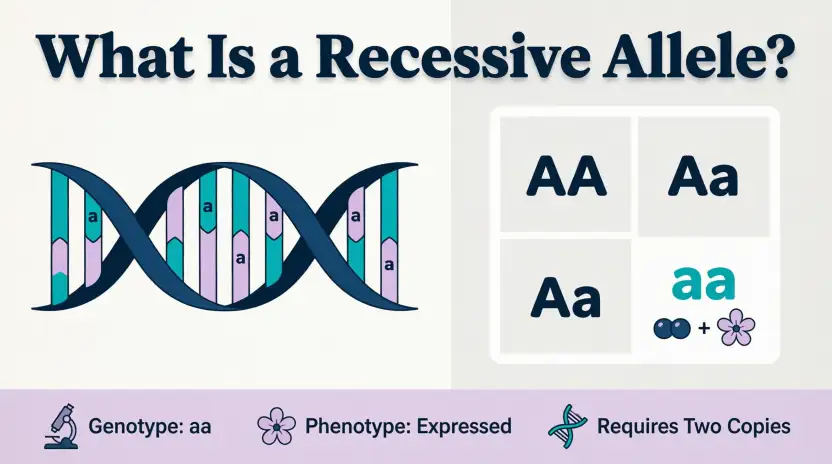
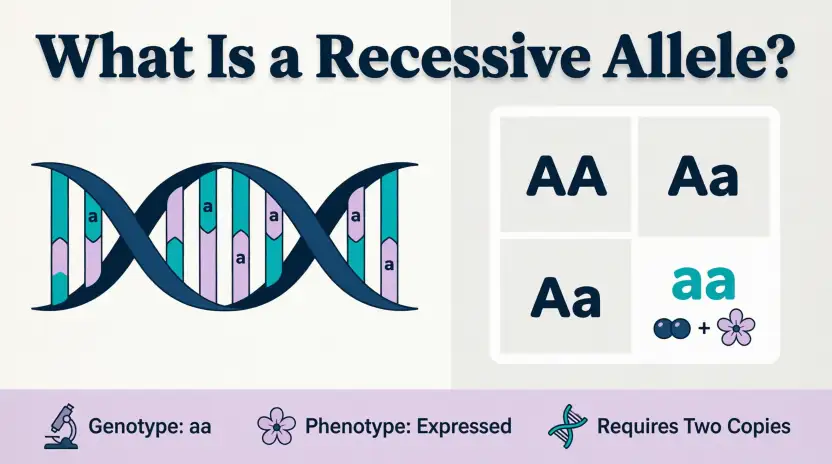
A recessive allele generally produces its associated recessive phenotype when two relevant copies are present.
For example:
a + a = recessive phenotype
A person with one recessive allele and one dominant allele may carry the recessive allele without showing the corresponding recessive phenotype in a simple Mendelian model.
What Is a Carrier?
A carrier is a person who has one copy of a recessive disease-causing variant but does not typically have the condition associated with having two copies.
For autosomal recessive conditions, two carrier parents can have a child who inherits both altered copies.
The Origin of Dominant and Recessive
The genetics meanings of dominant and recessive are closely connected to the work of Gregor Mendel, whose pea-plant experiments helped establish basic principles of inheritance.
Mendel studied characteristics in pea plants and observed patterns in how traits appeared across generations. His work introduced ideas that later became central to Mendelian genetics, including dominant and recessive inheritance.
The terminology developed as scientists worked to describe why one form of a trait could appear in an offspring while another form was not visibly expressed.
Modern genetics has shown that inheritance is often more complex than the simple examples used in early Mendelian genetics. Some traits involve multiple genes, and some alleles interact through patterns such as codominance or incomplete dominance.
So, the classic dominant-versus-recessive model is important, but it should not be treated as a complete explanation of human genetics.
British English vs American English
Unlike spelling pairs such as colour/color or organise/organize, dominant and recessive are spelled the same in British and American English.
The difference is therefore not regional spelling. The terms have the same basic scientific meaning in both varieties of English.
| British English | American English | Example |
| dominant | dominant | A dominant allele can be expressed with one copy. |
| recessive | recessive | A recessive trait generally requires two copies. |
| allele | allele | Each parent contributes an allele. |
| inheritance | inheritance | The condition follows a particular inheritance pattern. |
| genetic trait | genetic trait | The trait may have a genetic basis. |
Scientific writing in both countries uses the same core terminology. The major issue is accuracy, not spelling.
For example, writing “dominant genes are stronger genes” can be misleading. A better sentence is:
“A dominant allele is expressed in the relevant genetic context when one copy is sufficient.”
That wording is more precise.
Which Version Should You Use?
If you are deciding if to write dominant or recessive, the answer depends on what you are describing.
United States
Use dominant when one allele is sufficient for the relevant phenotype in the inheritance pattern being discussed.
Use recessive when the phenotype requires two relevant recessive alleles.
United Kingdom
The same terminology applies. British scientific and educational writing uses dominant, recessive, allele, and inheritance in the same basic way.
Canada
Canadian readers will also recognize the standard genetic terminology. No spelling change is needed.
Australia
Use the same terms in genetics and biology writing. The distinction is scientific rather than regional.
International Writing
For international readers, define the terms the first time you use them.
For example:
“A dominant allele can produce the associated trait when one copy is present, while a recessive trait generally requires two copies.”
This makes the explanation easy for ESL learners and general readers.
Academic Writing
In academic writing, avoid saying that a dominant allele is simply “stronger.”
Instead, describe the specific inheritance pattern and phenotype.
Business Writing
These terms are less common in ordinary business writing. If you use them in health, biotechnology, education, or science-related content, define them clearly for non-specialist readers.
Common Mistakes
Mistake 1: “Dominant means stronger.”
Incorrect:
“A dominant gene is stronger than a recessive gene.”
Better:
“A dominant allele can be expressed when one copy is present in the relevant inheritance pattern.”
Why: Dominance describes an inheritance relationship. It does not simply describe biological strength.
Memory tip:
Dominant = one copy can be enough.
Mistake 2: Calling an allele a gene
Less precise:
“The recessive gene is hidden.”
More precise:
“The recessive allele may not be expressed when paired with a dominant allele in a simple Mendelian model.”
An allele is a version of a gene, so using allele is often more accurate.
Mistake 3: Assuming every trait is dominant or recessive
Not every human characteristic follows a simple dominant-recessive pattern.
Many traits involve several genes. Environmental factors can also influence traits and conditions.
Mistake 4: Thinking recessive means rare
A recessive allele is not automatically rare.
Dominant and recessive describe inheritance behavior. They do not, by themselves, tell you how common an allele is in a population.
Mistake 5: Assuming a recessive allele disappears
A recessive allele can remain in a population even when it is not expressed in a person with one copy.
A carrier can possess one recessive disease-causing variant and pass it to a child.
Everyday Examples
The words dominant and recessive are most useful in science and educational contexts. Here is how they may appear in everyday writing.
Emails
“Could you explain if this condition follows a dominant or recessive inheritance pattern?”
This works well in a school, research, or healthcare-related discussion.
Business Writing
“Our educational materials explain the difference between dominant and recessive inheritance.”
This is suitable for a science or education organization.
News Headlines
“Researchers Study a Rare Recessive Genetic Condition”
A headline may use recessive to identify the inheritance pattern of a condition.
Blogs
“Dominant or recessive? The answer depends on how the particular allele affects the trait.”
This is a clear way to introduce the topic to general readers.
Social Media
“Still confused about dominant vs. recessive traits? Think: one copy can be enough for dominant, while recessive traits generally require two copies.”
This is short and accessible.
Academic Writing
“The condition follows an autosomal recessive inheritance pattern.”
This is more precise than simply saying:
“The condition is recessive.”
Daily Conversation
Someone might ask:
“Is that trait dominant or recessive?”
A simple answer could be:
“It depends on the specific gene and inheritance pattern.”
That answer is safer than assuming every visible trait follows a basic Mendelian pattern.
Google Trends & Modern Usage
People commonly search “dominant or recessive”, “dominant vs recessive”, and related phrases when studying genetics, completing biology assignments, understanding family inheritance, or trying to interpret a genetic condition.
The terms remain common in educational genetics because they provide a simple way to introduce inheritance patterns.
However, modern genetics uses a wider vocabulary than the basic dominant-recessive model. Terms such as allele, genotype, phenotype, carrier, autosomal dominant, autosomal recessive, X-linked, and codominant are important when more detail is needed.
Exact search-volume or Google Trends numbers should not be stated without checking the relevant Google Trends data for a defined region and time period. Therefore, this article does not invent popularity statistics.
One important modern point is that dominant does not mean common, and recessive does not mean rare. These are separate concepts.
Quick Comparison Table
| Version | Meaning | Correct? | Region | Example |
| Dominant | One copy can be sufficient for expression in a relevant inheritance pattern | Yes | Worldwide | A dominant allele can produce the associated phenotype with one copy. |
| Recessive | Two relevant copies are generally required for expression in a simple recessive pattern | Yes | Worldwide | A recessive phenotype can appear when two recessive alleles are present. |
| Dominant gene | Common informal wording for a dominant allele | Sometimes less precise | Worldwide | “The dominant allele is expressed.” is more precise. |
| Recessive gene | Common informal wording for a recessive allele | Sometimes less precise | Worldwide | “The recessive allele is inherited.” is more precise. |
Dominant vs. Recessive: Simple Genetics Example
Imagine a gene with two alleles:
- A = dominant allele
- a = recessive allele
The possible combinations are:
| Parent Alleles | Child Genotype | Simple Mendelian Outcome |
| A + A | AA | Dominant phenotype |
| A + a | Aa | Dominant phenotype |
| a + a | aa | Recessive phenotype |
This simple model explains why a recessive trait may not appear in every generation.
For example, a person with Aa may not show the recessive phenotype but can still carry the recessive allele. If two carriers have a child, there is a possible combination in which the child receives an a allele from each parent.
For an actual genetic condition, however, inheritance can be more complex. The exact gene, variant, chromosome, penetrance, and inheritance pattern matter.
Key Takeaways
- Dominant and recessive describe relationships between alleles.
- A dominant phenotype can be expressed when one relevant dominant allele is present.
- A recessive phenotype generally requires two relevant recessive alleles.
- An allele is a version of a gene.
- A person with one recessive disease-causing allele may be a carrier.
- Dominant does not mean stronger, better, or more common.
- Recessive does not mean weak, unimportant, or necessarily rare.
- Many human traits do not follow a simple dominant-recessive pattern.
- Dominant and recessive are spelled the same in American and British English.
- For precise scientific writing, use allele rather than casually saying “dominant gene” or “recessive gene.”
FAQs About Dominant or Recessive
1. What is the difference between dominant and recessive?
A dominant allele can produce the associated phenotype when one copy is present in the relevant inheritance pattern. A recessive phenotype generally requires two copies of the relevant recessive allele. These terms describe allele relationships, not if one allele is stronger or better.
2. Is dominant stronger than recessive?
No. Dominant does not simply mean stronger. In genetics, dominance describes how an allele affects the phenotype when paired with another allele. Calling a dominant allele “stronger” can create a misleading picture of how genes work.
3. Is recessive the same as rare?
No. Recessive does not mean rare. Recessive describes an inheritance relationship. The frequency of an allele in a population is a different question and must be considered separately.
4. Can a person carry a recessive allele without showing the trait?
Yes. In a simple recessive inheritance pattern, a person with one recessive disease-causing allele may be a carrier without showing the associated condition. That person can still pass the allele to a child.
5. Can two carriers have a child with a recessive condition?
Yes. When both parents carry one altered allele for the same autosomal recessive condition, a child can inherit the altered allele from both parents. For a classic autosomal recessive pattern, each pregnancy has a 25% chance of inheriting both altered copies.
6. What does AA, Aa, and aa mean?
These letters are commonly used in basic genetics examples. AA represents two dominant alleles, Aa represents one dominant and one recessive allele, and aa represents two recessive alleles. In a simple Mendelian model, AA and Aa show the dominant phenotype, while aa shows the recessive phenotype.
7. Are all human traits dominant or recessive?
No. Many human traits are influenced by multiple genes and environmental factors. Some genetic patterns also include codominance, X-linked inheritance, and other forms of inheritance. Therefore, the simple dominant-recessive model is useful for learning genetics but does not explain every human trait.
8. What is a dominant genetic disorder?
A dominant genetic disorder is a condition in which one disease-causing variant can be sufficient to cause the condition under a dominant inheritance pattern. Autosomal dominant disorders involve genes on non-sex chromosomes.
9. What is a recessive genetic disorder?
A recessive genetic disorder generally requires disease-causing variants in both copies of a relevant gene for an autosomal recessive condition. Parents may each carry one altered copy without showing the condition themselves.
10. Is “dominant gene” or “dominant allele” more accurate?
Dominant allele is generally the more precise term. A gene can have different versions, called alleles. Saying “dominant gene” is common in casual or introductory writing, but scientific writing usually refers to the particular allele and its inheritance relationship.
Conclusion
The difference between dominant or recessive becomes much easier once you focus on alleles rather than the everyday meanings of the words. A dominant allele can produce the associated phenotype when one copy is enough under a particular inheritance pattern. A recessive phenotype generally appears when the relevant recessive allele is present in both copies.
The key point is that dominant does not mean stronger, and recessive does not mean weaker or rarer. These words describe how genetic variants relate to observable traits in specific inheritance patterns.
For basic genetics, the AA, Aa, and aa model is a useful starting point. But real human genetics can involve multiple genes, environmental influences, codominance, X-linked inheritance, and other patterns.
If you are writing about genetics, use precise terms such as allele, genotype, phenotype, carrier, autosomal dominant, and autosomal recessive when appropriate.
Remember: dominant and recessive describe inheritance patterns, not which allele is “better” or “stronger.”
Read more about!
- Honoring or Honouring: Which Spelling Is Correct?
- Apartment or House: Which One Is Better for You?
- Resignate or Resonate: Which Word Is Correct?

I’m Olivia Parker, a grammar and English writing enthusiast passionate about making English simple and easy to understand. Through Wordsblog, I share clear explanations, useful grammar tips, and practical writing guidance to help readers write with confidence. My goal is to make learning English easier, one word at a time.







11 thoughts on “Dominant or Recessive: What’s the Difference?”