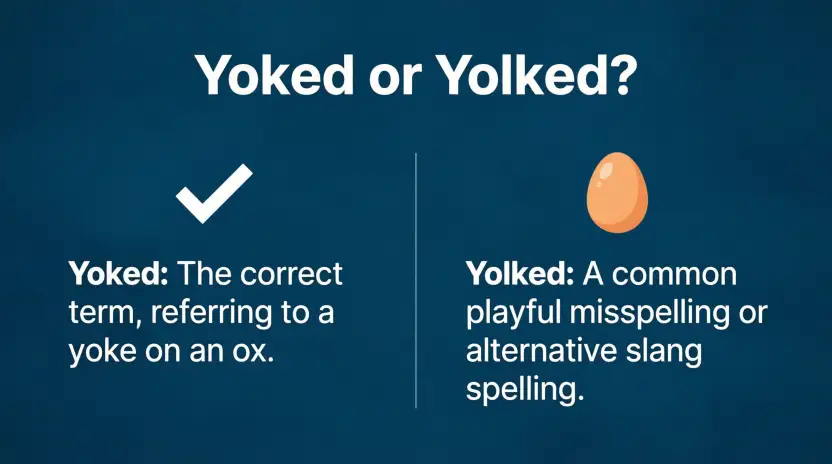
Have you ever wondered if yoked or yolked is the correct word? Both spellings are real English words, but they have different meanings and uses.
Yoked comes from the word yoke and usually means joined, connected, or harnessed together. Yolked comes from yolk and can describe something containing or having a yolk, such as a double-yolked egg. It can also appear as informal slang for someone who is very muscular.
The confusion happens because yoked and yolked sound almost the same in many varieties of English. They differ by only one letter, but that small difference changes the meaning.
This guide explains the difference between yoked and yolked, their meanings, origins, correct usage, regional English patterns, common mistakes, and everyday examples. You will also learn when to use each spelling in academic, business, casual, and online writing.
Yoked or Yolked: Featured Snippet + AI Overview
Yoked is the past tense or past participle of yoke and means joined, connected, or harnessed. Yolked is related to yolk and can describe something containing or having a yolk. In informal slang, yolked can also mean very muscular.
Yoked or Yolked: Quick Answer
The correct word depends on what you mean.
- Yoked = joined, connected, harnessed, or linked.
- Yolked = containing or having a yolk.
- Yolked = informal slang for very muscular or strongly built.
- They are not interchangeable in standard writing.
- They are pronounced very similarly, which causes much of the confusion.
Examples of yoked
The oxen were yoked together.
The two ideas were yoked together in the article.
The horses were yoked to the cart.
Examples of yolked
We bought a double-yolked egg.
The recipe calls for yolked eggs.
In informal fitness language, you may also see:
That athlete is completely yolked.
For formal writing, however, it is usually clearer to use words such as muscular, strong, or well-built when describing someone’s physique.
What Does Yoked or Yolked Mean?
The easiest way to understand these words is to separate their roots.
What does yoked mean?
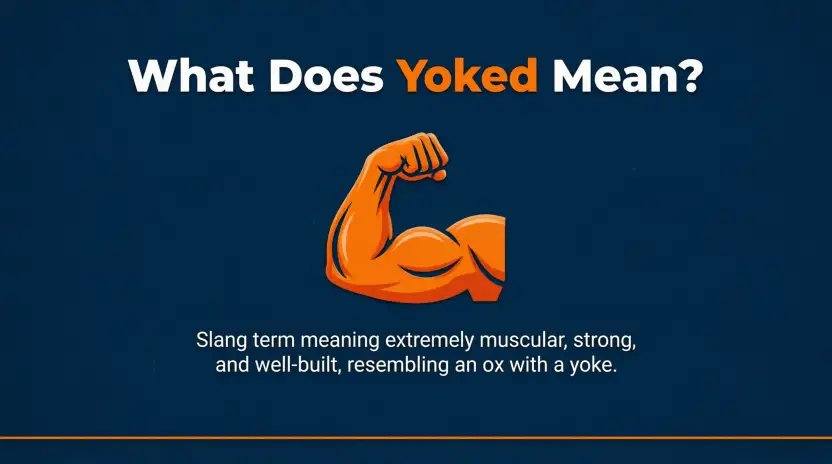
Yoked is the past tense and past participle of the verb yoke.
A yoke is traditionally a wooden device used to connect animals, especially oxen, so they can work together. From this idea, yoke also developed the broader meaning of joining or connecting things.
So yoked can mean:
- joined together
- connected
- linked
- harnessed
- paired
- associated
For example:
The two oxen were yoked together.
Here, yoked has its literal meaning.
It can also be used figuratively:
The two ideas were yoked together.
In this sentence, no animals are involved. The word means that the ideas were connected.
What does yolked mean?
Yolked is related to the noun yolk, the yellow central part of an egg.
For example:
The baker used double-yolked eggs.
Here, yolked describes eggs that contain two yolks.
The word can also appear in specialized or informal contexts. In modern slang, yolked can describe someone with a very muscular or developed physique, especially around the shoulders, upper back, and arms.
For example:
He has become seriously yolked after years of training.
This slang use is much more casual than the traditional meaning connected with eggs.
The simple memory trick
Think of the first part of each word:
yok- → yoke → join
yolk- → yolk → egg
If you are talking about joining things, use yoked.
If you are talking about an egg yolk, use yolked.
The Origin of Yoked or Yolked
The two spellings come from different base words.
Origin of yoked
Yoked comes from yoke, an old word connected with the idea of joining or harnessing. The noun yoke traditionally referred to a wooden frame used to connect draft animals.
Over time, the verb yoke developed both literal and figurative uses.
The literal meaning is easy to picture:
The oxen were yoked to the plow.
The figurative meaning developed from the same idea of joining:
The two systems were yoked together.
The word has a long history in English and is related to older words in other Indo-European languages that carry the idea of joining or connecting.
Origin of yolked
Yolked comes from yolk, the yellow part of an egg.
The spelling is therefore directly connected to the noun yolk.
For example:
a yolked egg
a double-yolked egg
The modern slang use of yolked is separate from the traditional egg-related meaning and is found mainly in informal speech, fitness discussions, and online language.
This difference in origin explains why adding the letter l changes the word.
British English vs American English
There is no major British-versus-American spelling difference between yoked and yolked. Both forms are used in both varieties of English.
The important difference is meaning and context, not regional spelling.
| British English | American English | Example |
| yoked | yoked | The animals were yoked together. |
| yoked | yoked | The two concepts were yoked together. |
| yolked | yolked | The eggs were double-yolked. |
| yolked | yolked | The athlete looked yolked. |
The pronunciation of yoke and yolk is also very similar, which adds to the confusion.
In both British and American English, yoked is the normal form when the meaning is connected to yoke. Yolked is appropriate when the meaning is connected to yolk.
For formal writing, context matters more than regional preference.
Which Version Should You Use?
United States
Use yoked when you mean joined, connected, or harnessed.
Use yolked for an egg-related meaning or, in casual contexts, the slang meaning related to muscularity.
United Kingdom
The same basic distinction applies.
For example:
The horses were yoked together.
But:
The cake recipe uses double-yolked eggs.
Canada
Canadian English generally follows the same distinction.
Choose the spelling based on meaning rather than trying to select a special Canadian form.
Australia
Australian English also uses yoked and yolked according to their meanings.
Always consider the context before choosing the spelling.
International writing
For international readers, clarity is especially important.
If you mean containing an egg yolk, use yolked.
If you are using the slang meaning of yolked, consider replacing it with muscular or well-built when writing for a broad audience.
Academic writing
Academic writing should favor precise and widely understood language.
Use:
The two variables were yoked together.
Avoid slang such as yolked when you mean muscular unless you are specifically discussing informal language.
Business writing
In business writing, yoked may be useful when describing things that are linked or closely connected.
For example:
The two departments were yoked together under one management structure.
However, linked, combined, or integrated may be clearer in some professional contexts.
Common Mistakes
Mistake 1: Using yolked for joining
Incorrect:
The two systems were yolked together.
Correct:
The two systems were yoked together.
Why?
The sentence is about connecting two systems, so the base word is yoke.
Memory tip: If you can replace the word with joined, think yoked.
Mistake 2: Using yoked for eggs
Incorrect:
The recipe requires two double-yoked eggs.
Correct:
The recipe requires two double-yolked eggs.
Why?
The word refers to the egg’s yolk, so the spelling needs the l.
Memory tip: Egg = yolk = yolked.
Mistake 3: Assuming one spelling is always wrong
Both words exist.
The mistake is treating them as alternative spellings of the same word.
They are related to different base words:
yoke → yoked
yolk → yolked
Mistake 4: Using fitness slang in formal writing
You may see:
He’s completely yolked.
This can work in casual fitness or social media language.
In formal writing, however, a clearer choice would be:
He is extremely muscular.
The intended audience should guide your word choice.
Everyday Examples
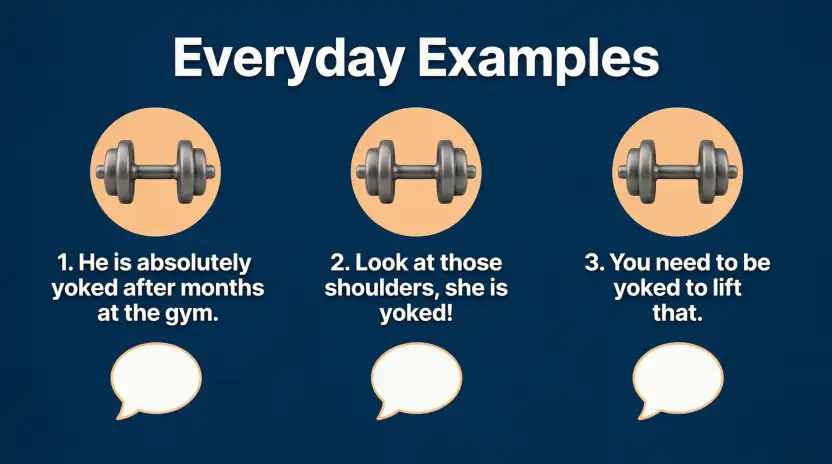
Seeing the words in real sentences makes the distinction much easier.
Emails
Yoked:
The two project teams were yoked together for the final stage.
This is grammatically possible, although combined or joined may sound more natural in everyday business email.
Yolked:
Please confirm if the supplier provides double-yolked eggs.
Business Writing
Yoked:
The two departments were yoked together to manage the new project.
Here, yoked means connected.
Yolked:
The food company sells packaged yolked eggs.
Here, the meaning is connected to egg yolks.
News Headlines
Yoked:
Two Industries Yoked by New Partnership
This headline uses yoked figuratively to mean connected.
Yolked:
Double-Yolked Eggs Become a Popular Breakfast Choice
Here, the word refers directly to egg yolks.
Blogs
Yoked:
These two historical events are often yoked together by researchers.
Yolked:
How to Cook Perfect Double-Yolked Eggs
The surrounding topic makes the intended meaning clear.
Social Media
You might see the informal slang:
I’ve been training hard and finally got yolked.
Here, yolked is casual fitness slang.
For a more neutral statement, write:
I’ve been training hard and have become very muscular.
Academic Writing
Yoked:
The researchers yoked the two experimental conditions for comparison.
In academic contexts, however, the exact technical meaning should be clear from the surrounding explanation.
Yolked:
The study examined the development of yolked eggs in the species.
When discussing biology or eggs, yolked is the relevant form.
Daily Conversation
The horses were yoked together.
The recipe uses two yolked eggs.
Those two ideas are often yoked together.
The key is to focus on the meaning rather than the sound.
Google Trends & Modern Usage
People often search for yoked or yolked because the two words are pronounced very similarly. When someone hears one of them in conversation, it may not be obvious which spelling is intended.
Another reason for the confusion is that yoked has both literal and figurative meanings.
For example, it can describe animals physically connected by a yoke, but it can also describe ideas, groups, or things that are connected.
Yolked has a more direct relationship with eggs. The spelling is easy to recognize when the context involves yolks, egg recipes, or phrases such as double-yolked egg.
Modern informal English adds another layer because yolked can appear as fitness slang for someone who is very muscular.
Exact search-volume or Google Trends figures are not necessary to understand the distinction, and this article does not rely on invented statistics. The main search confusion comes from the similar pronunciation, similar spelling, and different meanings.
For search intent, the simplest rule remains:
Joined or connected = yoked.
Related to an egg yolk = yolked.
Muscular slang = yolked.
Quick Comparison Table
| Version | Meaning | Correct? | Region | Example |
| Yoked | Joined or connected | Yes | US, UK, Canada, Australia, International | The animals were yoked together. |
| Yoked | Linked figuratively | Yes | General English | The two ideas were yoked together. |
| Yolked | Having or containing a yolk | Yes | General English | The eggs were double-yolked. |
| Yolked | Very muscular, informal slang | Yes, informal | Modern informal English | He looks completely yolked. |
| Yolked | Used instead of yoked for connection | No | All regions | Incorrect: The teams were yolked together. |
| Yoked | Used instead of yolked for eggs | No | All regions | Incorrect: It was a double-yoked egg. |
Key Takeaways
- Yoked and yolked are both real English words.
- Yoked comes from yoke.
- Yoked means joined, connected, or harnessed.
- Yolked comes from yolk.
- Yolked can describe something containing or having a yolk.
- Yolked is also used informally to mean very muscular.
- British and American English use the same basic spelling distinction.
- The best way to remember the difference is yoke = join and yolk = egg.
- In formal writing, choose the word that clearly matches your intended meaning.
FAQs About Yoked or Yolked
1. Is “yoked” a correct word?
Yes. Yoked is a correct English word and is the past tense and past participle of yoke. It can mean joined, connected, or harnessed. For example, “The oxen were yoked together” means the oxen were connected by a yoke. It can also be used figuratively for things that are closely connected.
2. Is “yolked” a correct word?
Yes. Yolked is also a valid word. It can describe something that has or contains a yolk, especially in phrases such as “double-yolked egg.” In informal modern English, yolked can also describe someone who is very muscular. The correct meaning depends on context.
3. What is the difference between yoked and yolked?
Yoked comes from yoke and means joined, connected, or harnessed. Yolked comes from yolk and is associated with eggs or egg yolks. In informal slang, yolked can also mean very muscular. The extra l helps connect yolked with the word yolk.
4. Is it “double-yolked” or “double-yoked”?
For an egg containing two yolks, the correct form is double-yolked. The word comes from yolk, the yellow part of an egg. For example: “We cracked a double-yolked egg.” Double-yoked would suggest a connection with yoke instead.
5. Does yoked mean muscular?
It can, especially in informal fitness language. Yoked is sometimes used as slang for someone who is very muscular or heavily built. However, this meaning can vary by speaker and context. In formal writing, muscular, strong, or well-built is usually clearer.
6. Does yolked mean muscular?
In modern informal slang, yolked can mean very muscular, especially when talking about someone’s upper body. This use is common in casual fitness-related language. It is not the best choice for formal or academic writing, where a word such as muscular is more precise.
7. Are yoked and yolked pronounc the same?
They are commonly pronounc the same or very similarly in English. This makes them easy to confuse when heard rather than read. The spelling is what helps show the difference in meaning. Remember that yoke relates to joining, while yolk relates to eggs.
8. Which is correct: “yoked together” or “yolked together”?
The correct phrase is yoke together when you mean joine or connect. For example: “The two teams were yoke together for the project.” Yolked together would be incorrect for this meaning because yolked is based on yolk, not yoke.
9. Can I use yolked in formal writing?
You can use yolked in formal writing when it has its appropriate egg-related meaning. For example, “double-yolked eggs” is perfectly suitable. However, the slang meaning of yolke should generally be avoid in formal writing unless you are discussing slang itself.
10. How can I remember yoked vs yolked?
Use this simple memory trick: yoke = join, so yoked = joined. Yolk = egg, so yolked = related to a yolk. If the sentence is about connecting people, animals, ideas, or things, choose yoked. If it is about eggs, choose yolked.
Conclusion
The difference between yoked and yolked is small in spelling but important in meaning. Yoked comes from yoke and normally means joined, connected, or harnessed.
Yolked comes from yolk and can describe something containing or having a yolk, such as a double-yolked egg. In informal modern language, yolked can also describe someone who is very muscular.
There is no major British-versus-American spelling difference to worry about. Both forms can be use across major varieties of English when the meaning is correct.
When writing for school, work, or a general audience, focus on clarity. If you mean connected, choose yoked. If you mean muscular slang, yolked may work in casual writing, but muscular is clearer in formal contexts.
The easiest rule to remember is simple: yoke means join, while yolk means egg.
Use that small memory trick, and you will rarely confuse yoked or yolked again.
Read more about!
- Honoring or Honouring: Which Spelling Is Correct?
- Apartment or House: Which One Is Better for You?
- Resignate or Resonate: Which Word Is Correct?

I’m Olivia Parker, a grammar and English writing enthusiast passionate about making English simple and easy to understand. Through Wordsblog, I share clear explanations, useful grammar tips, and practical writing guidance to help readers write with confidence. My goal is to make learning English easier, one word at a time.







2 thoughts on “Yoked or Yolked: Which Word Is Correct?”