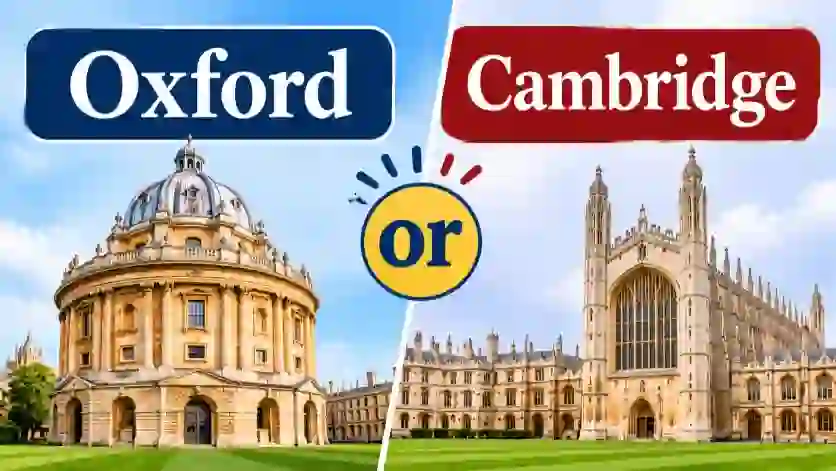
Oxford and Cambridge are two of the world’s most famous universities, but the better choice depends on your subject, learning preferences, and career goals. The University of Oxford and the University of Cambridge are both leading universities in England.
They offer excellent academic opportunities, historic colleges, strong research programs, and respected qualifications. However, they differ in their teaching styles, course structures, college systems, and student experiences.
People often search for Oxford or Cambridge because they want to understand which university is older, which has better courses, and which one offers stronger career opportunities.
Both universities have outstanding reputations, so choosing between them is not simply a matter of rankings. Your preferred subject, course content, teaching approach, and personal interests matter much more.
In this guide, we compare Oxford and Cambridge in simple terms. You will learn about their history, academic strengths, admissions, student life, and key differences so you can make a more informed decision.
Quick Answer: Oxford vs. Cambridge
- Oxford: Often a strong choice for students interested in subjects such as humanities, politics, philosophy, and several other academic fields.
- Cambridge: Particularly well known for mathematics, natural sciences, engineering, and research across many disciplines.
- Teaching: Both universities use small-group teaching, but Oxford is especially known for tutorials, while Cambridge is known for supervisions.
- Location: Oxford is a historic city in Oxfordshire, while Cambridge is a historic city in Cambridgeshire.
Which is better? Neither university is universally better. The right choice depends on your chosen course, preferred teaching environment, and personal goals.
What Is the University of Oxford?
The University of Oxford is a historic public research university in Oxford, England. It is the oldest university in the English-speaking world, with evidence of teaching dating back to at least 1096.
Oxford University+1
Oxford is known for its academic tradition, research, libraries, and college-based student experience. It offers undergraduate and postgraduate courses across a wide range of subjects.
What Makes Oxford Special?
- Tutorial teaching: Students learn through small-group discussions with academic tutors.
- Historic colleges: The university has a distinctive collegiate structure.
- Wide subject choice: Students can study humanities, sciences, medicine, social sciences, and many other fields.
- Independent learning: Students are expected to read, research, and develop their own ideas.
Oxford tutorials are usually conversations between a tutor and one or two students. They allow students to discuss their work and receive individual feedback.
Oxford University+1
What Is the University of Cambridge?
The University of Cambridge is a prestigious public research university in Cambridge, England. It was founded in 1209 and is one of the world’s oldest universities.
University of Cambridge+1
Cambridge has a strong reputation for academic research, scientific discovery, mathematics, engineering, and many other subjects. It combines university departments with a system of individual colleges.
What Makes Cambridge Special?
- Supervision teaching: Students receive small-group academic guidance.
- Research opportunities: The university has a strong research culture.
- Academic variety: It offers courses across arts, humanities, sciences, and professional subjects.
- College community: Students belong to both a university department and a college.
Cambridge supervisions usually involve a small number of students discussing their work with a subject specialist. Students receive feedback and can explore difficult topics in greater depth.
Undergraduate Study+1
Oxford vs. Cambridge: Key Differences
Oxford and Cambridge share many features, but they are not identical. Their history, college structures, course options, and teaching arrangements have some differences.
| Feature | Oxford | Cambridge |
|---|---|---|
| Location | Oxford, England | Cambridge, England |
| Historical record | Teaching existed by 1096 | Founded in 1209 |
| Teaching style | Tutorials | Supervisions |
| College system | 39 colleges | 31 colleges |
| Academic focus | Broad range of subjects | Broad range of subjects |
| University type | Public research university | Public research university |
| Student experience | College-based | College-based |
Both universities have highly respected academic departments and individual colleges. Their teaching methods are also more similar than different: both combine lectures, independent study, and small-group teaching.
uni-of-oxford.custhelp.com+2
Oxford vs. Cambridge: Which University Is Older?
Oxford is older than Cambridge.
There is no exact foundation date for Oxford, but historical records show that teaching existed there in some form by 1096. Cambridge was founded in 1209 by scholars who had left Oxford.
Oxford University+1
Here is a simple timeline:
| University | Historical Date | Detail |
|---|---|---|
| Oxford | 1096 | Earliest known evidence of teaching |
| Cambridge | 1209 | University founded |
Oxford therefore has the longer recorded history. However, both universities have centuries of academic tradition and international recognition.
Oxford vs. Cambridge: Teaching Methods
Teaching is one of the most important things to consider when choosing a university. Oxford and Cambridge both offer personalised academic support, but they use different names for their small-group teaching sessions.
How Does Teaching Work at Oxford?
Oxford uses a teaching method called tutorials. These are usually small discussions between a tutor and one or two students.
During a tutorial, students may:
- Discuss an essay or assignment.
- Explain their ideas and arguments.
- Answer questions about their subject.
- Receive individual feedback.
- Explore topics in greater detail.
Tutorials encourage students to think independently and explain their ideas clearly.
Oxford University+1
How Does Teaching Work at Cambridge?
Cambridge uses a similar system called supervisions. These sessions usually involve a small group of students working with an academic supervisor.
Students may discuss essays, solve problems, review difficult topics, and receive feedback on their work. The number of supervisions varies by course.
Undergraduate Study+1
Are Tutorials and Supervisions Different?
The two methods are very similar. Both provide students with opportunities to discuss academic work in small groups and receive personal feedback.
The main difference is the terminology:
- Oxford calls them tutorials.
- Cambridge calls them supervisions.
Both universities also use lectures, seminars, practical classes, and independent study.
Oxford vs. Cambridge: Which Is Better for Different Subjects?
Your chosen subject is one of the most important factors when comparing Oxford and Cambridge. Both universities offer many respected courses, so you should compare the actual course content rather than relying only on general reputation.
Here are some subject areas students commonly consider:
| Subject | What to Compare |
|---|---|
| English Literature | Course reading lists, literary periods, and assessment methods |
| Mathematics | Course structure, optional papers, and teaching approach |
| Medicine | Clinical training, course length, and practical experience |
| Engineering | Specialisations, laboratory facilities, and project work |
| Law | Modules, teaching methods, and career interests |
| History | Historical periods, research opportunities, and available papers |
| Computer Science | Programming, theory, mathematics, and practical work |
| Natural Sciences | Available scientific subjects and laboratory options |
Neither university is automatically the best choice for every subject. Look at the modules, teaching arrangements, assessment methods, and opportunities offered by the specific course.
Useful tip: Compare the official course pages for both universities before deciding where to apply.
Oxford vs. Cambridge: Admission Requirements
Getting into Oxford or Cambridge is highly competitive. Both universities look for strong academic ability, a genuine interest in the chosen subject, and evidence that applicants are ready for demanding university study.
Oxford Admission Requirements

Oxford considers several parts of an undergraduate application, depending on the course.
These may include:
- Academic qualifications and predicted grades.
- A personal statement.
- An admissions test, where required.
- Written work, where required.
- An interview.
Applicants should check the requirements for their chosen course because the process can differ between subjects.
Cambridge Admission Requirements
Cambridge also assesses applicants through a combination of academic qualifications and course-specific requirements.
These may include:
- Academic grades and predicted results.
- A personal statement.
- An admissions assessment, where required.
- Written work, where required.
- An interview.
Some courses have additional requirements, so applicants should read the official course information carefully.
Can You Apply to Oxford and Cambridge in the Same Year?
No. For undergraduate admission, applicants cannot apply to both Oxford and Cambridge in the same UCAS application cycle. You must choose one of the two universities for that admissions year.
uni-of-oxford.custhelp.com
This makes it important to research both universities before submitting your application.
Oxford vs. Cambridge: Student Life
University life is about more than lectures and exams. Your surroundings, social activities, accommodation, and college community can all affect your experience.
Student Life at Oxford
Oxford is a historic city with university buildings, libraries, museums, shops, cafés, and green spaces.
Students can enjoy:
- College societies and student clubs.
- Sports and fitness activities.
- Music, theatre, and cultural events.
- Historic libraries and museums.
- Social activities within their colleges.
Oxford offers a traditional university atmosphere while also having the facilities and activities of a modern city.
Student Life at Cambridge
Cambridge is also known for its historic architecture, colleges, libraries, and academic environment.
Students can enjoy:
- College societies and sports clubs.
- Student events and performances.
- Museums and cultural activities.
- Walking and cycling around the city.
- College social events and traditions.
The River Cam and the city’s historic surroundings are also well-known parts of the Cambridge experience.
Which City Is Better for Students?
This depends on personal preference.
Oxford may appeal to students who enjoy a lively historic city with a wide range of shops, restaurants, and cultural activities. Cambridge may appeal to those who prefer a compact university city with a strong academic atmosphere and well-known riverside surroundings.
Both offer active student communities and plenty of opportunities outside the classroom.
Oxford vs. Cambridge: College Systems
Both universities have a collegiate structure. This means students belong to a college as well as to the wider university.
Colleges provide communities where students can study, socialise, access support, and take part in activities.
Oxford College System
Oxford has 39 colleges. Each has its own history, buildings, traditions, and student community.
Cambridge College System
Cambridge has 31 colleges. Each college has its own identity and provides academic and social support to its members.
University of Cambridge+1
Does Your College Affect Your Degree?
Your college is an important part of student life, but students studying the same course at different colleges follow the university’s academic requirements.
The university departments and faculties are responsible for course content, core teaching, examinations, and awarding degrees.
uni-of-oxford.custhelp.com
When choosing a college, consider its accommodation, location, facilities, community, and available support.
Oxford or Cambridge: Which Is Better for Career Opportunities?
Both Oxford and Cambridge have internationally recognised qualifications and strong academic reputations. Graduates from both universities work in many different industries.
Possible career areas include:
- Business and finance.
- Law and public service.
- Science and research.
- Technology and engineering.
- Education and academia.
- Medicine and healthcare.
- Media and communications.
However, attending either university does not guarantee a particular job or salary. Your degree subject, skills, experience, work placements, and career choices also matter.
Instead of choosing a university only because of its name, look at the career support, internships, research opportunities, and professional pathways connected to your course.
Oxford vs. Cambridge: Pros and Cons
Both universities have significant advantages, but each may suit different students.
| University | Advantages | Things to Consider |
|---|---|---|
| Oxford | Older institution, personalised tutorials, broad course options | Competitive admission and demanding academic work |
| Cambridge | Personalised supervisions, strong research environment, broad course options | Competitive admission and demanding academic work |
Neither university is an easy option. Students at both should expect independent study, challenging assignments, and a high level of academic commitment.
How to Choose Between Oxford and Cambridge
Choosing between Oxford and Cambridge requires more than comparing their names or reputations. Think about what you want from your university experience.
1. Compare your subject.
Start by checking if each university offers the course you want. Compare modules, optional subjects, practical work, and assessment methods.
2. Explore the teaching style.
Both universities offer small-group teaching. Read about Oxford tutorials and Cambridge supervisions to understand how each works.
3. Research the colleges.
Look at accommodation, facilities, student support, location, and extracurricular activities.
4. Consider the city.
Think about if you prefer Oxford or Cambridge as a place to live and study.
5. Check admission requirements.
Review the grades, tests, interviews, and other requirements for your chosen course.
6. Think about your future goals.
Consider the skills, experiences, and opportunities that will help you move towards your preferred career.
The best university is the one that offers the strongest match for your academic interests and personal needs.
Common Mistakes When Comparing Oxford and Cambridge
People sometimes make incorrect assumptions when choosing between these universities.
| Common Mistake | Correct Information |
|---|---|
| Oxford is better for every subject. | The best choice depends on the course. |
| Cambridge is only for science students. | Cambridge offers arts, humanities, sciences, and many other subjects. |
| Oxford and Cambridge use completely different teaching systems. | Both use personalised small-group teaching. |
| Your college determines your entire degree. | University departments set the core academic requirements. |
| You can apply to both in the same undergraduate admissions cycle. | You must choose one. |
| A degree guarantees a high-paying job. | Career outcomes depend on several factors. |
Understanding these differences can help you make a more informed decision.
Key Takeaways
- Oxford and Cambridge are two leading universities in England.
- Oxford is older, with evidence of teaching dating back to 1096.
- Cambridge was founded in 1209.
- Oxford calls its small-group teaching sessions tutorials.
- Cambridge calls its small-group teaching sessions supervisions.
- Both universities have collegiate systems.
- Both offer courses across humanities, sciences, and professional subjects.
- Undergraduate applicants cannot apply to both in the same UCAS application cycle.
- The best choice depends on your course, academic interests, and personal preferences.
Frequently Asked Questions
1. Is Oxford or Cambridge better?
Neither university is universally better. Both have excellent academic reputations. Your preferred subject, course structure, teaching style, and career goals should guide your decision.
2. Which university is older, Oxford or Cambridge?
Oxford is older. Evidence of teaching at Oxford dates back to at least 1096, while Cambridge was founded in 1209.
3. Are Oxford and Cambridge both in England?
Yes. Oxford is located in Oxfordshire, and Cambridge is located in Cambridgeshire. Both are historic university cities in England.
4. Is Oxford harder to get into than Cambridge?
Both universities are highly competitive. Admission difficulty varies by course, applicant numbers, available places, and selection requirements. It is better to compare the entry requirements for your chosen subject.
5. Can you apply to Oxford and Cambridge at the same time?
No. Undergraduate applicants cannot apply to both universities in the same UCAS application cycle. They must choose one.
6. What is the main difference between Oxford and Cambridge?
Both have collegiate systems and personalised teaching. Oxford calls its small-group sessions tutorials, while Cambridge calls them supervisions. They also differ in their course offerings, college structures, and city environments.
7. Which university is better for science?
Both universities offer strong science courses and research opportunities. Compare the specific subject, laboratory facilities, course structure, and research options before deciding.
8. Which university has more colleges?
Oxford has 39 colleges, while Cambridge has 31 colleges. The number of colleges does not determine which university provides a better education.
9. Do Oxford and Cambridge have the same teaching style?
Their teaching methods are similar. Both use lectures, independent study, and small-group academic sessions. The main difference is that Oxford uses the term tutorials and Cambridge uses supervisions.
10. Are Oxford and Cambridge degrees equally respected?
Both universities have internationally recognised degrees and strong academic reputations. The value of a particular degree also depends on the subject, skills gained, and career path.
Conclusion
Oxford and Cambridge are two outstanding universities with long histories, respected academic programs, and distinctive student experiences.
Oxford has the longer history, while Cambridge is also one of the world’s oldest and most respected universities. Both provide personalised teaching, research opportunities, and strong academic communities.
The choice between Oxford and Cambridge should depend on your subject, preferred course structure, college environment, and future plans. Do not choose one simply because it has a famous name or a particular ranking.
Compare the courses carefully and decide which university suits your goals. Ultimately, the best choice is the place where you can learn, develop your skills, and make the most of your university experience.
Read more about!
- Yay or Yeah: What’s the Difference?
- Glossy or Matte: What’s the Difference?
- Uneligible or Ineligible: Which Spelling Is Correct?

I’m Olivia Parker, a grammar and English writing enthusiast passionate about making English simple and easy to understand. Through Wordsblog, I share clear explanations, useful grammar tips, and practical writing guidance to help readers write with confidence. My goal is to make learning English easier, one word at a time.








2 thoughts on “Oxford or Cambridge: Which University Is Better?”