Choosing between TTF or OTF can feel confusing, especially when a font is available in both formats.
The short answer is that TTF stands for TrueType Font, while OTF stands for OpenType Font, but the difference is more technical than simply saying one is “better.”
OpenType can contain either TrueType or PostScript outlines, so the .otf extension alone does not tell you everything about the font.
People search for TTF or OTF when installing fonts, designing graphics, preparing documents, building websites, or choosing fonts for professional projects. The confusion usually comes from the file extensions and from the common belief that OTF is always more advanced or that TTF is only for older systems.
In this guide, you will learn what TTF and OTF mean, how they developed, how their technical structures differ, when to use each one, and what matters more than the file extension. You will also see practical examples for designers, students, writers, businesses, and everyday users.
TTF or OTF: Featured Snippet & AI Overview
TTF traditionally uses TrueType outlines, while OTF can contain either TrueType or PostScript outlines and can support advanced typographic features. For most everyday users, both work well.
Choose the format that your software or font provider recommends, and check the font’s actual features rather than assuming OTF is always better.
TTF or OTF – Quick Answer
The simplest way to understand TTF or OTF is this:
- TTF means TrueType Font.
- OTF means OpenType Font.
- TrueType was developed by Apple and later adopted by Microsoft.
- OpenType was developed jointly by Microsoft and Adobe.
- OpenType can contain TrueType outlines or PostScript outlines.
- OTF is designed to support advanced typographic and language features.
- Both formats can work across modern operating systems.
- A .ttf extension does not automatically mean a font is outdated.
- A .otf extension does not automatically mean a font is better.
Simple examples
Example 1:
You download a font called
ExampleFont.ttf.
It is a TrueType font file.
Example 2:
You download
ExampleFont.otf.
It may contain OpenType data with PostScript outlines, although OpenType fonts can also use TrueType outlines.
Example 3:
A designer needs alternate characters, ligatures, small capitals, or other OpenType features. An appropriate OpenType font may provide these features within the font file.
So, the better question is often not “Is TTF or OTF better?” but “Which format and features does my software and project need?”
What Does TTF or OTF Mean?
What is TTF?
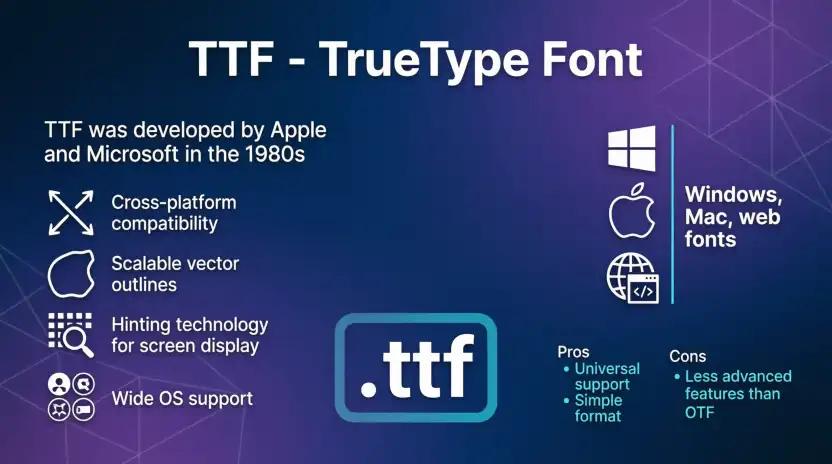
TTF stands for TrueType Font.
TrueType is a digital font technology originally designed by Apple. Microsoft later licensed TrueType technology, and it became widely used on both Windows and Macintosh systems.
A TrueType font describes characters using mathematical outlines. The operating system or application uses this information to render letters on a screen or in print.
TTF became popular because it offered reliable screen and printer output and broad operating-system support.
Today, TTF remains a common font format.
What is OTF?
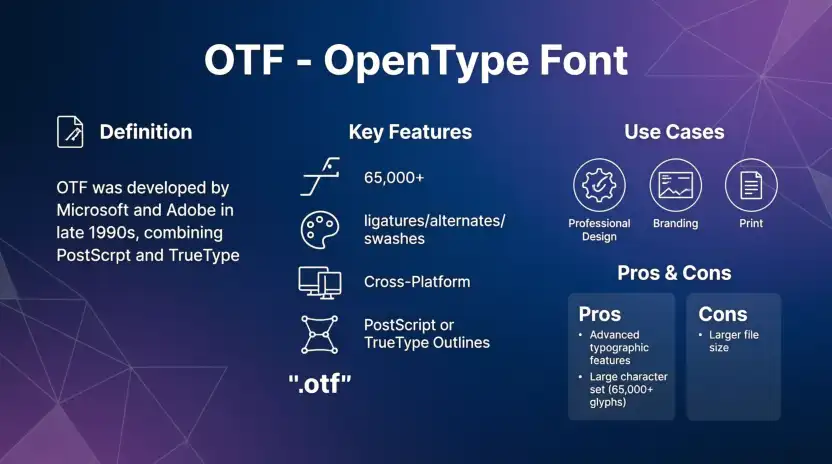
OTF stands for OpenType Font.
OpenType was developed jointly by Adobe and Microsoft as an extension of the TrueType format. It was designed to improve cross-platform compatibility, character-set support, and advanced typographic control.
An important detail is often missed:
OTF does not always mean PostScript outlines.
An OpenType font can contain either:
- TrueType outlines
- PostScript or CFF outlines
Microsoft’s OpenType specification confirms that OpenType files can use either type of outline.
This is why comparing .ttf and .otf purely by file extension can be misleading.
What are font outlines?
A font outline is the mathematical description of a character’s shape.
For example, when a font contains the letter A, the font file stores information that allows software to construct and display that shape.
TTF and OTF can use different outline technologies, but both are designed to describe and render type.
The Origin of TTF or OTF
TrueType emerged from work by Apple and became an important font technology for computer operating systems. Microsoft later licensed the technology, helping TrueType become widely used across Windows and Macintosh environments.
OpenType came later through collaboration between Microsoft and Adobe. Microsoft describes OpenType as an extension of the TrueType format that also supports PostScript font data and advanced typographic features.
OpenType was designed to solve several limitations associated with earlier font technologies.
Its goals included:
- Better cross-platform support
- Broader character-set support
- Better international language support
- Advanced typographic control
- More efficient font distribution
- Greater flexibility for professional typography
OpenType also brought together technologies associated with TrueType and PostScript fonts.
That history explains why OTF is sometimes described as a more flexible format. However, modern OpenType fonts can use TrueType outlines too, so the distinction is not simply TTF = basic and OTF = advanced.
British English vs American English
Unlike words such as colour/color or centre/center, TTF and OTF do not represent British and American spelling differences.
The terms have the same meaning in British English and American English.
| Feature | British English | American English | Example |
| TTF | TrueType Font | TrueType Font | Install a .ttf font |
| OTF | OpenType Font | OpenType Font | Install an .otf font |
| Meaning | Same technical format names | Same technical format names | “Use the OTF version.” |
| Spelling | TTF / OTF | TTF / OTF | No regional spelling change |
| Usage | Design, publishing, documents | Design, publishing, documents | Both formats are used |
The main differences you encounter with TTF and OTF are technical and practical, not British-versus-American language differences.
Modern operating systems support common font technologies, although specific applications can differ in how many OpenType features they expose.
What about Canada and Australia?
The same basic terminology applies.
A Canadian designer may use an OTF font, while an Australian designer may use a TTF font. The choice depends on the font, application, workflow, licensing, and required features rather than English variety.
Which Version Should You Use?
There is no universal rule that says everyone should choose OTF or everyone should choose TTF.
United States
For everyday documents, either format may work well.
For professional design, check if the OTF version provides features you need, such as alternate glyphs or ligatures.
United Kingdom
The same general rule applies.
British English does not require a different font format. Choose based on software compatibility and typographic requirements.
Canada
Either TTF or OTF can be appropriate.
If your project includes multiple languages or specialized typography, examine the font’s character coverage and OpenType features.
Australia
Use the format supported by your application and supplied by the font creator.
There is no Australian-specific requirement to choose TTF or OTF.
International Writing
OTF can be particularly useful when a project needs extensive character sets or advanced typographic features. OpenType was specifically designed with broader language and typographic support in mind.
Academic Writing
For essays, assignments, reports, and research papers, the required font is usually determined by the institution or style guide.
If the instructions specify a particular font, follow them first.
Business Writing
For business documents, compatibility and consistency matter more than simply choosing OTF because it sounds newer.
If everyone on a team needs to edit the document, use a font that their software supports reliably.
Common Mistakes
Mistake 1: Saying OTF is always better
Incorrect:
OTF is always better than TTF.
Correct:
OTF can provide advanced typographic features, but the best choice depends on the font and project.
Why?
OpenType supports advanced features, but not every OTF font will provide every possible feature.
Memory tip:
Format alone does not determine quality.
Mistake 2: Assuming every OTF uses PostScript outlines
Incorrect:
Every OTF font uses PostScript outlines.
Correct:
An OpenType font can contain either TrueType or PostScript outlines.
Microsoft’s OpenType specification explicitly documents both possibilities.
Memory tip:
Think OTF = OpenType container, not automatically “PostScript.”
Mistake 3: Thinking TTF is obsolete
Incorrect:
TTF is an old format that modern computers cannot use.
Correct:
TTF remains a widely used font format.
Microsoft continues to document and support TrueType technology, and TrueType and OpenType remain common font technologies.
Mistake 4: Choosing a format without checking the software
Incorrect:
I always download OTF because it is more professional.
Correct:
I will check which format and features my software supports before installing the font.
Memory tip:
Check the workflow, not just the extension.
Everyday Examples
Please use the supplied OTF font for the marketing email design.
This makes sense when the project specifically requires that font file.
Business Writing
The company template uses a TTF version of the approved typeface.
The important issue is consistency across the team’s documents.
News Headlines
The designer selected an OpenType font for the newspaper layout.
This can be useful when the publication needs advanced typographic controls.
Blogs
I installed the TTF version of the font for my graphics.
This is a normal use of a TrueType font.
Social Media
A designer may choose a font based on its visual style and available glyphs rather than if its file ends in .ttf or .otf.
Academic Writing
My university requires a specific font, so I followed its formatting instructions.
Institutional requirements should take priority over general TTF-versus-OTF advice.
Daily Conversation
Is the font available as TTF or OTF?
Here, the speaker is asking which font file format is available.
Google Trends & Modern Usage
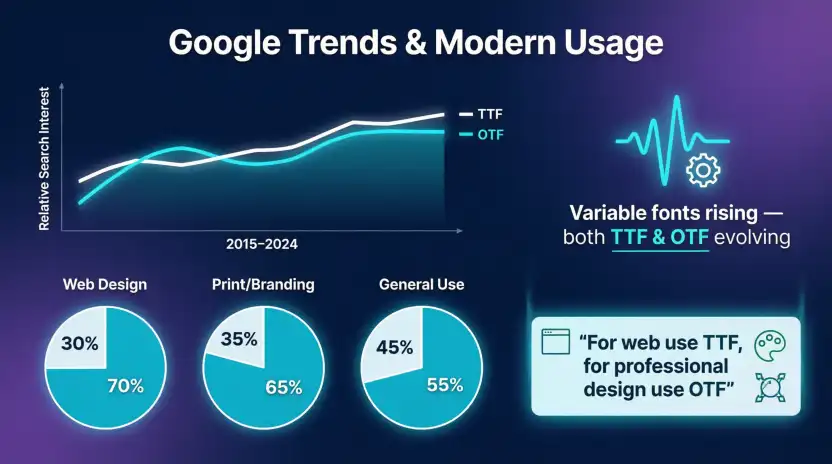
People searching for TTF or OTF are usually trying to solve a practical font problem.
Common search intentions include:
- TTF vs OTF differences
- OTF or TTF for design
- TTF vs OTF for Cricut
- TTF vs OTF for Photoshop
- TTF vs OTF for printing
- Which font format should I install?
- Is OTF better than TTF?
- Can I use TTF instead of OTF?
Search interest also reflects the fact that font technology can be confusing. The extensions look different, but the underlying technologies overlap.
Modern OpenType is especially flexible because it can contain TrueType or PostScript outlines and supports advanced layout information.
There is no reliable basis for claiming that one format is universally more popular today without specifying the platform, software, font family, or market being measured. Usage varies by workflow.
The key modern lesson is simple: do not judge a font only by its filename extension.
Quick Comparison Table
| Version | Meaning | Correct? | Typical Role | Example |
| TTF | TrueType Font | Yes | General font use | FontName.ttf |
| OTF | OpenType Font | Yes | General and advanced typography | FontName.otf |
| OpenType + TrueType outlines | OpenType font using TrueType outlines | Yes | Cross-platform typography | .ttf or .otf |
| OpenType + CFF/PostScript outlines | OpenType font using CFF/PostScript outlines | Yes | Professional typography | Usually .otf |
The last two rows show why the simple statement “TTF is TrueType and OTF is PostScript” is incomplete. OpenType can use either outline technology.
TTF vs OTF: What Really Matters?
When selecting a font, consider these factors instead of focusing only on the extension:
| Factor | TTF | OTF |
| Font file format | TrueType or related implementation | OpenType |
| TrueType outlines | Yes | Can contain them |
| PostScript/CFF outlines | No, traditionally | Can contain them |
| Advanced OpenType features | Depends on font/application | Strong support |
| Cross-platform use | Widely supported | Designed for cross-platform use |
| Language support | Depends on font | Can provide extensive character support |
| Everyday documents | Suitable | Suitable |
| Professional typography | Suitable | Often useful |
| Best choice | Depends on workflow | Depends on workflow |
OpenType’s broader typographic capabilities are one of its major advantages, but actual feature support depends on both the font and the application.
Key Takeaways
- TTF means TrueType Font.
- OTF means OpenType Font.
- TrueType was developed by Apple and later licensed by Microsoft.
- OpenType was developed jointly by Microsoft and Adobe.
- OpenType can contain either TrueType or PostScript outlines.
- OTF is not automatically better than TTF.
- TTF is not an obsolete font format.
- Advanced typography can make OpenType useful for professional design.
- Your software, font features, compatibility, and project requirements should guide your choice.
- Always check the font’s license before using it commercially.
FAQs
1. Is TTF or OTF better?
Neither format is universally better. OTF can offer advanced typographic features and can contain different types of outlines, while TTF remains widely supported and useful. For everyday font installation, either may work perfectly well. The best choice depends on the specific font, software, compatibility requirements, and features needed for your project.
2. What is the main difference between TTF and OTF?
TTF traditionally refers to TrueType fonts, while OTF refers to OpenType fonts. OpenType was designed as a broader font technology and can contain either TrueType or PostScript outlines. It also supports advanced typographic and language features. Therefore, the difference is more technical than simply comparing two file extensions.
3. Is OTF higher quality than TTF?
Not necessarily. Font quality depends heavily on the font’s design, outlines, hinting, character coverage, and how software renders it. OTF provides capabilities that can be valuable for advanced typography, but an excellent TTF can still produce high-quality text. The file extension alone does not determine visual quality.
4. Can an OTF font contain TrueType outlines?
Yes. This is one of the most important points in the TTF versus OTF discussion. Microsoft documents that OpenType fonts can contain either TrueType outlines or PostScript/CFF outlines. Therefore, an OTF file should not automatically be described as a PostScript font.
5. Can I use TTF instead of OTF?
Usually, if the same font family is supplied in both formats and your application supports both, either may work. However, the two files may not necessarily expose identical features or behave identically in every application. If a project specifies a particular format, follow that requirement.
6. Which is better for professional graphic design, TTF or OTF?
For professional typography, OpenType can be useful because it supports advanced typographic features such as alternate glyphs, ligatures, and expanded character sets. However, the actual features depend on the font and application..
7. Is TTF outdated?
No. TrueType remains an established and widely used font technology. Modern operating systems and applications continue to support TrueType fonts. Microsoft describes TrueType as a digital font technology used by both Apple and Microsoft operating systems.
8. Does OTF work on Windows and Mac?
OpenType was specifically designed to provide cross-platform support. The same OpenType font file can be used on Windows and Macintosh systems, although individual applications can differ in how they support particular font features. Always test important production workflows before final delivery.
9. Which font format should I use for a website?
For websites, the choice is usually different from simply choosing between TTF and OTF. Web projects commonly use webfont formats and delivery methods designed for browsers. If you are creating a website, follow the requirements of your webfont system rather than uploading a desktop font file without checking licensing and browser support.
10. Does TTF or OTF affect how a font looks?
It can, but not simply because one extension is “better.” Different outline technologies, font data, hinting, rendering engines, and application support can affect how type appears. If two versions of the same typeface look different, compare the actual font files and rendering environment rather than assuming the extension is responsible.
Conclusion
The choice between TTF or OTF is not really a contest between an old format and a new format. TTF refers to TrueType, while OTF refers to OpenType, a format designed to provide broader typographic and language capabilities.
OpenType can also contain TrueType outlines, which makes the distinction more nuanced than many quick comparisons suggest.
For everyday documents, either format can be a good choice when your software supports it. For professional typography, OpenType may be useful when you need features such as alternate glyphs, ligatures, expanded character sets, or other advanced layout controls.
The most practical approach is to check compatibility, font features, licensing, and project requirements before choosing a file.
You do not need to avoid TTF, and you do not need to choose OTF simply because it sounds more advanced.
The best font format is the one that fits your font, software, and project.
Read more about!
- Buried or Cremated: What Is the Difference?
- Dose or Dosage: What Is the Difference?
- Fabric or Forge: What Is the Difference?

I’m Olivia Parker, a grammar and English writing enthusiast passionate about making English simple and easy to understand. Through Wordsblog, I share clear explanations, useful grammar tips, and practical writing guidance to help readers write with confidence. My goal is to make learning English easier, one word at a time.




2 thoughts on “TTF or OTF: Which Font Format Is Better?”