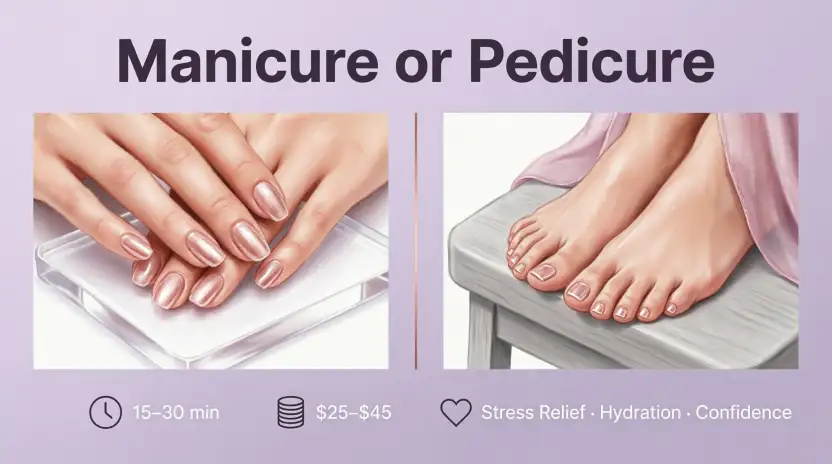
If you are wondering if you need a manicure or pedicure, the simple answer is this: a manicure is mainly for your hands and fingernails, while a pedicure is mainly for your feet and toenails. The two treatments are similar, but they focus on different parts of the body.
People often search for “manicure or pedicure” because the services can look almost the same at a nail salon. Both may include nail trimming, shaping, cleaning, polishing, and skin care. The main difference is where the treatment is performed.
A manicure focuses on the hands and fingernails. A pedicure focuses on the feet and toenails. Some salons also offer a mani-pedi, which combines both services.
In this guide, you will learn what manicure and pedicure mean, where the words came from, how to use them correctly, common mistakes, everyday examples, and which term fits different situations. By the end, the difference should be easy to remember.
Featured Snippet + AI Overview
A manicure is a beauty and nail-care treatment for the hands and fingernails. A pedicure is a similar treatment for the feet and toenails. Both may include trimming, shaping, cleaning, skin care, and nail polish. If the service covers both hands and feet, it may be called a mani-pedi.
Manicure or Pedicure: Quick Answer
The difference between manicure and pedicure is simple:
- Manicure = hands and fingernails
- Pedicure = feet and toenails
- Mani-pedi = manicure + pedicure
A manicure may involve cleaning and shaping the fingernails, caring for the skin around the nails, and applying polish.
A pedicure may involve cleaning and shaping the toenails, caring for the feet, softening the skin, and applying polish. Cambridge defines a pedicure as a beauty treatment for the feet that can include cutting and painting the nails and softening or massaging the skin.
Simple examples
Example 1:
I booked a manicure before the wedding.
This means the person booked a treatment for their hands and fingernails.
Example 2:
I need a pedicure before wearing sandals.
This means the person wants care for their feet and toenails.
Example 3:
We booked a mani-pedi at the salon.
This means they booked both a manicure and a pedicure.
The easiest memory trick is hands = manicure, feet = pedicure.
What Does Manicure or Pedicure Mean?
Although manicure and pedicure are often mentioned together, they do not mean the same thing.
What is a manicure?
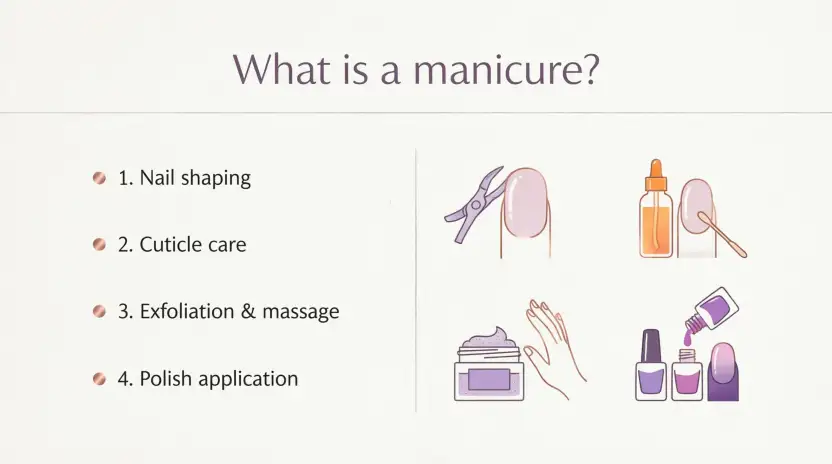
A manicure is a treatment for the hands and fingernails. It can include cleaning, trimming, shaping, smoothing, and painting the nails. It may also include care for the skin around the hands and nails.
For example:
She got a manicure before her job interview.
The word can also be used as a verb:
She manicured her nails before the event.
Cambridge lists both noun and verb uses of manicure.
What is a pedicure?
A pedicure is a treatment for the feet and toenails. It can include trimming and shaping the toenails, cleaning them, and caring for the skin of the feet.
For example:
He gets a pedicure during the summer.
A pedicure can be part of regular personal grooming, especially when people want their feet and toenails to look neat.
Are manicure and pedicure the same?
No. They are related treatments, but they focus on different areas.
A manicure is for the hands. A pedicure is for the feet.
Some steps may be similar, which is why people sometimes confuse the two terms.
The Origin of Manicure and Pedicure
The two words have related structures, which makes their meanings easier to understand.
Where does “manicure” come from?
The word manicure entered English through French and is connected to Latin manus, meaning “hand,” and cura, meaning “care.” Etymonline dates the English noun to 1873 and notes that the meaning referring to treatment and care of the hands and fingernails is attested from 1887.
This origin gives you a useful clue:
manus = hand → manicure = care of the hands
Where does “pedicure” come from?
Pedicure also has Latin roots. It comes through French from Latin pes, meaning “foot,” together with cura, meaning “care.” Etymonline dates the word to 1839 in a sense connected with professional care of the feet. The treatment sense appeared later, with the beauty-treatment meaning developing around the turn of the 20th century.
So you can remember:
ped- = foot → pedicure = care of the feet
The words are therefore not random. Their roots help explain exactly why one refers to hands and the other to feet.
British English vs American English
There is no major British-versus-American spelling difference between manicure and pedicure. Both terms are standard English words in the two varieties.
The main differences you may notice are pronunciation, accent, and local salon terminology.
| Term | British English | American English | Example |
| Manicure | manicure | manicure | I booked a manicure. |
| Pedicure | pedicure | pedicure | She wants a pedicure. |
| Mani-pedi | mani-pedi | mani-pedi | We booked a mani-pedi. |
Cambridge gives different UK and US pronunciations for manicure and pedicure, but the written forms remain the same.
For international writing, manicure and pedicure are both clear and widely understood.
In professional, academic, or business writing, there is usually no reason to replace either word with a regional spelling.
Which Version Should You Use?
Because manicure and pedicure describe different services, the right word depends on what you mean.
United States
Use manicure for hands and fingernails.
Use pedicure for feet and toenails.
For both services, mani-pedi is common informal terminology. Cambridge labels mani-pedi as an informal noun for receiving both treatments.
United Kingdom
The same basic distinction applies:
- Manicure = hands
- Pedicure = feet
The terms are standard in British English as well.
Canada
Use manicure for hand and fingernail care and pedicure for foot and toenail care.
Australia
The same distinction applies in Australian English.
International writing
If your readers come from different countries, use the full terms:
manicure for hands
pedicure for feet
This avoids confusion.
Academic writing
In formal writing, choose the term that accurately describes the treatment.
For example:
The study examined the effects of regular foot care during pedicure treatments.
Avoid using manicure as a general replacement for both services.
Business writing
In a salon menu, website, brochure, or service list, be specific:
Classic Manicure
Classic Pedicure
Manicure and Pedicure Package
This makes the service immediately clear to customers.
Common Mistakes
The most common mistake is treating manicure and pedicure as interchangeable words.
| Incorrect | Correct | Explanation |
| I booked a manicure for my feet. | I booked a pedicure for my feet. | Pedicure refers to feet. |
| She got a pedicure for her fingernails. | She got a manicure for her fingernails. | Manicure refers to hands. |
| I need a manicure on my toes. | I need a pedicure for my toes. | Toenails are part of a pedicure. |
| I got a pedicure on my hands. | I got a manicure on my hands. | Hands receive a manicure. |
Memory tip
Think of the first part of each word:
MANicure → MANUS → hand
PEDicure → PED → foot
You do not need to memorize the Latin details to use the words correctly. Just remember:
Manicure = hands. Pedicure = feet.
Everyday Examples
Knowing the definition is useful, but seeing the words in real sentences makes the difference easier to remember.
Emails
Hi Sarah, I booked a manicure for Friday afternoon.
Could you please schedule my pedicure for next week?
Business writing
A nail salon might write:
Our manicure service includes nail shaping and polish.
Or:
Our pedicure service includes toenail care and foot treatment.
Clear wording helps customers understand exactly what they are booking.
News headlines
New Nail Trends Bring Fresh Ideas to Manicure Designs
Summer Pedicure Trends Focus on Bright Colors
Both uses are natural because the subjects are different.
Blogs
A simple manicure can make your hands look neat and polished.
A regular pedicure can help keep your feet looking well cared for.
Social media
Loving my new manicure!
Ready for summer with a fresh pedicure!
These short forms are common in casual online writing.
Academic writing
The researchers examined consumer preferences for professional manicure and pedicure services.
Here, both words are used because the research covers both types of treatment.
Daily conversation
Are you getting a manicure today?
No, I booked a pedicure.
Or:
I’m getting both. I booked a mani-pedi.
These examples show why context matters.
Google Trends & Modern Usage
People searching “manicure or pedicure” are usually trying to understand the difference between two closely related beauty treatments.
The search may come from someone booking a salon appointment, learning English vocabulary, comparing services, or trying to describe a treatment correctly.
Modern English uses both words as nouns and, in the case of manicure, also as a verb. Cambridge lists manicure as both a noun and verb, while pedicure is commonly used as a noun for foot care.
The phrase mani-pedi is also used informally for both services together.
There is no need to treat manicure and pedicure as competing spellings. They are separate words with separate meanings.
Usage patterns can vary by country, salon, audience, and context. Without a specific current search-volume dataset, exact regional popularity claims should not be assumed.
Quick Comparison Table
| Version | Meaning | Correct? | Main Area | Example |
| Manicure | Treatment for hands and fingernails | Yes | Hands | I booked a manicure. |
| Pedicure | Treatment for feet and toenails | Yes | Feet | I need a pedicure. |
| Mani-pedi | Manicure and pedicure together | Yes | Hands + feet | She booked a mani-pedi. |
| Manicurist | Person who provides manicures | Yes | Hands/nails | The manicurist shaped my nails. |
Cambridge defines a manicurist as a person whose job is to give people manicures.
Key Takeaways
- Manicure means a treatment for the hands and fingernails.
- Pedicure means a treatment for the feet and toenails.
- The two words are not interchangeable.
- A mani-pedi combines a manicure and a pedicure.
- Both manicure and pedicure are standard English terms.
- British and American English use the same spellings.
- Pronunciation can differ between British and American English.
- The easiest memory rule is manicure = hands, pedicure = feet.
FAQs
1. What is the main difference between a manicure and a pedicure?
A manicure focuses on the hands and fingernails, while a pedicure focuses on the feet and toenails. Both may include nail trimming, shaping, cleaning, skin care, and polish. The main difference is the part of the body receiving the treatment.
2. Is a manicure for hands or feet?
A manicure is for the hands and fingernails. It may include cleaning, trimming, shaping, smoothing, and painting the fingernails. If you want a similar treatment for your feet and toenails, the correct term is pedicure.
3. Is a pedicure for hands or feet?
A pedicure is for the feet and toenails. It may include trimming and shaping the toenails and caring for the skin on the feet. Cambridge defines it as a beauty treatment for the feet.
4. What is a mani-pedi?
A mani-pedi is an informal term for having both a manicure and a pedicure. In other words, the hands and fingernails receive a manicure, while the feet and toenails receive a pedicure. The term is commonly used in casual salon and beauty conversations.
5. Are manicure and pedicure the same thing?
No. They are similar types of nail and beauty care, but they focus on different areas. A manicure is for the hands and fingernails. A pedicure is for the feet and toenails. Because many steps can be similar, the two terms are sometimes confused.
6. Which word should I use for toenails?
Use pedicure when you are talking about a treatment for the toenails and feet. For example, “I booked a pedicure” is correct when you mean a salon treatment for your feet. Use manicure when you mean treatment for your hands and fingernails.
7. Which word should I use for fingernails?
Use manicure when you mean a treatment for your fingernails and hands. For example, “She got a manicure before the party” clearly tells the reader that the treatment was for her hands and fingernails.
8. Are manicure and pedicure spelled differently in British and American English?
The standard spellings are the same in British and American English: manicure and pedicure. The pronunciation can differ between the two varieties, but the written forms do not normally change.
9. Can manicure be used as a verb?
Yes. Manicure can be a verb meaning to give someone a manicure or care for the hands and fingernails. For example: “She manicured her nails before the event.” Cambridge lists this verb use.
10. How can I easily remember manicure vs pedicure?
Use this simple rule: manicure = hands, pedicure = feet. You can also connect ped- with words such as pedometer, which relate to feet. Once you remember that difference, choosing between manicure and pedicure becomes much easier.
Conclusion
The difference between manicure or pedicure is simple once you connect each word with the correct body part. A manicure is a treatment for the hands and fingernails. A pedicure is a treatment for the feet and toenails. When someone gets both, the informal term mani-pedi can be used.
These terms are standard in both British and American English, so you do not need a different spelling based on region. The main thing is to choose the word that matches the treatment you mean.
If you are writing for a salon, customer, student, blog reader, or general audience, being specific is the clearest approach. Say manicure for hands and pedicure for feet.
The easiest rule to remember is:
Manicure for your hands. Pedicure for your feet.
Once you remember that one line, you will rarely confuse the two again.
Read more about!
- Nick or Knick: Which Spelling Is Correct?
- Dominant or Recessive: What’s the Difference?
- Yoked or Yolked: Which Word Is Correct?

I’m Olivia Parker, a grammar and English writing enthusiast passionate about making English simple and easy to understand. Through Wordsblog, I share clear explanations, useful grammar tips, and practical writing guidance to help readers write with confidence. My goal is to make learning English easier, one word at a time.