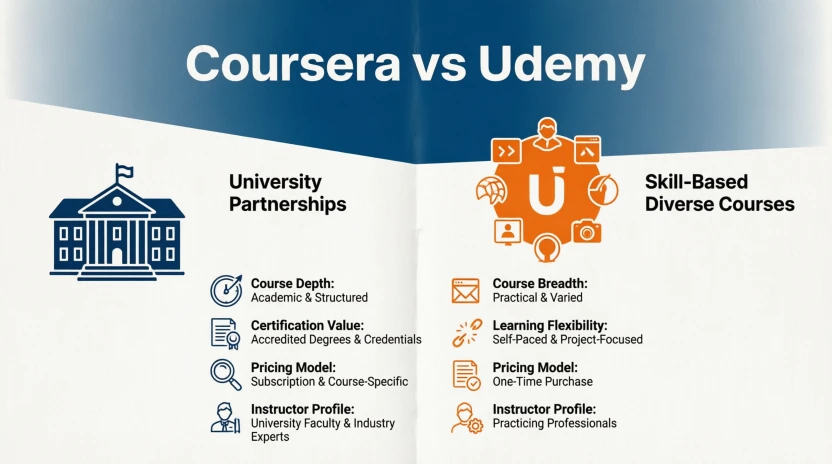
Coursera is often the better choice for structured learning, university-backed programs, and career certificates, while Udemy is a strong option for learning practical skills through individual courses. However, the right choice depends on your goals, budget, and the specific course you want to take.
When comparing Coursera or Udemy, many learners want to know which platform offers better courses, more useful certificates, lower prices, and greater value for their careers. Both platforms offer online learning, but their course formats, teaching styles, and credentials can differ.
For example, a student who wants to study data analytics through a university or employer-designed program may prefer Coursera. Someone who wants to learn WordPress, video editing, Excel, or web development at their own pace may find a suitable course on Udemy.
There is another important point: Coursera and Udemy completed a corporate combination in May 2026, but they continue to operate as separate learning platforms for now. Their courses and subscriptions have not automatically become interchangeable. <Cite refs={[“turn874514search9″,”turn874514search12”]}/>
This guide compares their learning options, pricing models, certificates, course quality, and practical uses. By the end, you will know how to choose the platform that best fits your needs.
Coursera or Udemy: Quick Answer
Coursera is a strong choice for structured learning, professional certificates, and university-linked programs. Udemy is a useful choice for focused, practical lessons and learning specific skills at your own pace.
Choose Coursera if you want a guided program with a recognized course provider. Choose Udemy if you want to learn a particular skill through an individual course. Always check the course content, instructor, certificate type, and total cost before enrolling.
Coursera or Udemy: What Is the Difference?
The main difference is the learning experience each platform offers. Coursera provides courses and programs from universities and companies, including professional certificates and some degree pathways. Udemy offers a broad marketplace of courses taught by individual instructors and other content providers. <Cite refs={[“turn874514search6″,”turn874514search0”]}/>
Here is a quick overview:
- Coursera: Best suited to learners who want structured programs, academic learning, or career-focused credentials.
- Udemy: Best suited to learners who want flexible lessons on a particular subject.
- Both: Can help you develop knowledge and practical skills online.
Neither platform guarantees a job or makes every certificate equally valuable. The value depends on the course, the organization issuing the credential, the skills you develop, and how you use them.
For example, a beginner who wants to understand data analysis might take a structured professional certificate on Coursera. A website owner who wants to learn a particular WordPress feature might prefer a focused Udemy course.
What Is Coursera?
<Entity value=”Coursera” category=”product” disambig=”Online learning platform”/> is an online learning platform that works with universities, companies, and other educational organizations. Its catalog covers subjects such as business, computer science, data science, information technology, healthcare, and the humanities. <Cite refs={[“turn874514search6″,”turn874514search10”]}/>
Learners can choose from different types of study, including:
- Individual online courses.
- Specializations and multi-course programs.
- Professional Certificates.
- University-linked certificate programs.
- Selected online degree programs.
One major attraction is its structured approach. Some programs include graded assignments, projects, assessments, and a planned learning path.
Coursera can be helpful if you want to build knowledge step by step. For example, someone moving into data analytics might study spreadsheets, data cleaning, visualization, and related skills through a connected program.
However, not every Coursera course is university-level study, and not every certificate carries academic credit. Check the specific program page to see who teaches the course, who issues the certificate, and if any formal credit or qualification is offered.
What Is Udemy?
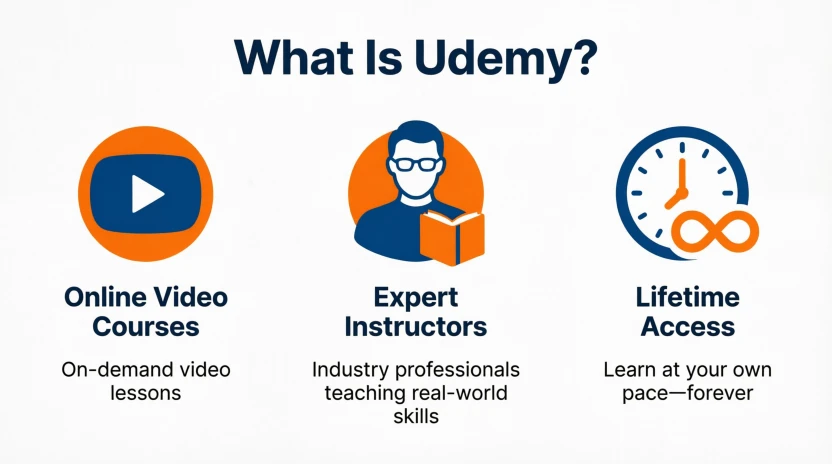
<Entity value=”Udemy” category=”product” disambig=”Online course marketplace”/> is an online learning marketplace where instructors offer courses across professional, technical, creative, and personal development subjects. Topics include programming, graphic design, marketing, business, photography, productivity, and many more. <Cite refs={[“turn874514search0″,”turn874514search4”]}/>
Udemy is useful when you want to focus on a particular skill rather than follow a longer academic program.
Its main features include:
- Individual courses on specific topics.
- Video lessons that learners can follow at their own pace.
- Practical demonstrations and exercises in some courses.
- Course ratings and learner reviews to help with selection.
- Certificates of completion for eligible courses.
For example, a blogger might take a course on search engine optimization. A small business owner might choose a course on bookkeeping or social media marketing.
The main advantage is flexibility. You can often select one course, study the lessons that matter to you, and return to purchased course material later. Udemy states that individual course purchases generally include lifetime access, subject to account and licensing conditions. Subscription access works differently.
Course quality can vary because instructors create their own content. Read recent reviews, inspect the syllabus, and check the last update date before buying.
The Origin of Coursera and Udemy
Coursera and Udemy developed around different approaches to online education.
Coursera launched in 2012 with a focus on making courses from universities available online. Its model expanded to include professional certificates, industry training, and other learning programs.
Today, its catalog includes offerings from universities and companies.Udemy was founded in 2010 as an online learning marketplace. Its model allows instructors to publish courses for learners who want to study a wide range of subjects. This approach supports a broad choice of topics and teaching styles.
In May 2026, the two companies completed a corporate combination. However, they announced that the platforms would remain separate for the time being. This means learners should still check each platform’s own course pages, prices, certificates, and access rules. <Cite refs={[“turn874514search9″,”turn874514search12”]}/>
The key distinction is not simply which platform is older or larger. It is how each course is designed and if it matches your learning goal.
Coursera vs Udemy: British English vs American English
Coursera and Udemy are brand names, not alternative spellings of the same word. Therefore, there is no British-versus-American spelling difference between them.
The table below shows how the names should be used in English writing.
| Context | Correct form | Example |
| British English | Coursera or Udemy | I completed a course on Coursera. |
| American English | Coursera or Udemy | I enrolled in a Udemy course. |
| Canadian English | Coursera or Udemy | She uses Coursera for professional learning. |
| Australian English | Coursera or Udemy | He learned web design through Udemy. |
| Academic writing | Coursera or Udemy | The course was delivered through Coursera. |
| Business writing | Coursera or Udemy | Our team uses Udemy for skills training. |
Always capitalize both names as shown. Do not write coursera or udemy in formal prose when referring to the platforms.
Which Platform Should You Use?
Your location matters less than your learning goal. Both platforms serve international learners, but individual course availability, prices, and subscription offers can vary by country.
United States
Coursera is worth considering if you want a structured professional certificate or a university-linked program. Udemy may be a better fit for a specific technical skill, software tool, or creative task.
Before paying, check if an employer or educational institution values the exact credential you plan to earn.
United Kingdom
UK learners can use either platform for professional development and independent study. Coursera may suit learners seeking structured career programs, while Udemy may suit those who want practical lessons in areas such as coding, design, or marketing.
If you need a formal qualification for employment or further study, confirm its recognition with the relevant employer, professional body, or educational institution.
Canada
Both platforms can help Canadian learners build digital and workplace skills. Choose Coursera when the program’s structure and issuing institution matter to your goals. Choose Udemy when you want a targeted course that addresses a specific skill gap.
Australia
Australian learners can use either platform to study at their own pace. Check course schedules, assessment requirements, available support, and any additional costs before enrolling.
Do not assume that an online certificate automatically counts toward an Australian qualification.
International Learning
For learners outside these countries, the best option depends on language, course access, local payment options, and recognition of credentials.
Review the course details in your region. Some offers and subscriptions may not be available to every learner.
Academic Writing
Coursera may be a stronger starting point for structured academic study, particularly when a program is linked to a university. However, a Coursera certificate does not automatically equal university credit or an accredited degree.
Udemy can still support academic learning by teaching specific skills, such as statistics software, research tools, or programming. Check your institution’s rules before relying on any online course for formal credit.
Business Writing
For workplace training, compare the exact skills taught, assessment methods, and evidence of completion.
Coursera may fit a formal development plan that uses professional programs. Udemy may work well when an employee needs to learn a tool or complete a focused training course.
For either platform, a certificate is only one part of the picture. Demonstrable skills and relevant work often matter too.
Coursera vs Udemy: Price and Value
There is no single price that applies to every course on either platform. Costs depend on the course, program, subscription, region, and current offer.
Udemy allows learners to buy individual courses, while its Personal Plan provides access to a selected catalog for as long as the subscription remains active. Coursera offers different learning products and subscription options, so check the individual program’s pricing page before enrolling. <Cite refs={[“turn874514search4″,”turn874514search3″,”turn874514search6”]}/>
| Factor | Coursera | Udemy |
| Payment options | Vary by course or program | Individual purchases and eligible subscriptions |
| Best value | A program that matches a clear learning or career goal | A focused course that teaches a needed skill |
| Access | Depends on the course or plan | Purchased courses generally offer lifetime access; subscription content requires an active plan |
| Certificate | Depends on the program and issuer | Certificate of completion for eligible courses |
| Budget tip | Compare the full program cost | Compare course content, discounts, and the cost of multiple courses |
Practical advice: Do not judge value by price alone. A low-cost course that teaches exactly what you need can be better than a long program you never finish. A more expensive credential may be worthwhile if its content and issuing organization fit your career plans.
Coursera vs Udemy: Certificates and Career Value
Certificates are one of the biggest reasons people compare these platforms. The important question is not which platform offers more certificates. It is what each certificate represents.
Coursera offers programs that may provide credentials from universities or companies. Some programs are designed for career development, and certain university programs offer additional academic pathways. The exact issuer and status depend on the individual program. <Cite refs={[“turn874514search3″,”turn874514search6”]}/>
Udemy offers certificates of completion for eligible courses. These can show that you finished a course, but a completion certificate is not automatically an accredited qualification or a professional license. <Cite refs={[“turn874514search2″,”turn874514search5”]}/>
Consider these examples:
- For a career change: Compare relevant Coursera professional programs with the skills employers request.
- For a practical tool: A Udemy course may be enough to learn the software and create a useful project.
- For formal education: Confirm if the program awards academic credit or a recognized qualification.
- For a portfolio: Choose a course that helps you produce work you can demonstrate.
Never assume that a certificate alone will secure a job. Employers may also assess your experience, portfolio, interview performance, and practical ability.
Common Mistakes When Choosing Coursera or Udemy
| Incorrect assumption | Better understanding | Why it matters |
| Every Coursera certificate is a degree. | Certificates, courses, and degrees are different credentials. | You need to know what qualification you will receive. |
| Every Udemy course has the same quality. | Course content and teaching quality vary. | Research the instructor and syllabus first. |
| A certificate guarantees employment. | A certificate may support your application but cannot guarantee a job. | Employers assess several factors. |
| All subscriptions provide permanent access. | Access depends on the specific plan. | Subscription content can become unavailable when access ends. |
| The cheapest course is always best. | Course quality and relevance also matter. | A poor match can waste your time. |
| Coursera and Udemy are now one identical platform. | They completed a corporate combination but remain separate platforms for now. | Their catalogs and access arrangements have not automatically merged. |
A simple memory tip is to check the credential, check the content, and check the cost before enrolling.
Everyday Examples of Coursera and Udemy
Here are practical situations that show when each platform may be useful.
Emails
Coursera: “I enrolled in a professional certificate to strengthen my data analysis skills.”
Udemy: “I bought a course to learn how to edit videos.”
Business Writing
Coursera: A manager recommends a structured program to employees who need to develop business or technology skills.
Udemy: A team member takes a focused course to learn a new software tool.
News Headlines
- “Online Learners Compare Coursera and Udemy for Career Training”
- “Professional Certificates and Practical Courses Attract Different Learners”
These are illustrative headlines, not reports of specific news events.
Blogs
A blogger who wants to learn SEO may choose a focused Udemy course. Someone who wants a broader, structured study path in digital marketing may compare programs on Coursera.
Social Media
“I used Coursera to follow a structured learning path.”
“I used Udemy to learn a specific design technique.”
Academic Writing
“Students should verify if an online program offers academic credit before including it in a formal study plan.”
Daily Conversation
“Which platform should I use to learn Python?”
“Compare the course syllabus and teaching style first. Coursera and Udemy both have options, but the best course depends on what you want to learn.”
Google Trends and Modern Usage
People searching for “Coursera or Udemy” are usually comparing online learning platforms, course quality, certificate value, pricing, and career benefits.
The search reflects a practical decision: learners want to spend their time and money on education that helps them reach a goal.
Common reasons for this search include:
- Choosing an online learning platform for the first time.
- Finding affordable courses for professional development.
- Comparing certificates for a résumé or LinkedIn profile.
- Learning programming, data analytics, marketing, or design.
- Deciding between a structured program and a short practical course.
There is no verified live Google Trends comparison presented here, so no numerical search-volume or regional-popularity claims are made.
Search popularity alone would not tell you which platform is better. A more useful approach is to compare the exact courses you are considering, including their content, instructor, reviews, certificate issuer, and total cost.
It is also worth remembering the May 2026 corporate combination. Although Coursera and Udemy are now under the same corporate umbrella, their separate platforms and current learning arrangements still matter to users. <Cite refs={[“turn874514search9″,”turn874514search12”]}/>
Quick Comparison Table: Coursera vs Udemy
| Version | Main purpose | Correct choice? | Best suited to | Example |
| Coursera | Structured online learning and professional programs | Yes | Academic and career-focused learning | Studying data analytics through a guided program |
| Udemy | Individual online courses and practical skill development | Yes | Targeted, flexible learning | Learning a video-editing tool |
| Both | Online education and skill development | Yes | Learners with different goals | Developing skills for work or personal projects |
Neither platform is universally better. The best choice depends on the course and the result you want.
Key Takeaways
- Coursera offers courses and programs from universities, companies, and other educational organizations.
- Udemy provides a broad marketplace of courses across professional and personal topics.
- Coursera may suit structured learning and certain career-focused credentials.
- Udemy may suit practical, targeted learning at your own pace.
- Certificate value depends on the issuer and the credential, not just the platform.
- Course prices and subscription access rules vary, so check the terms before paying.
- Compare instructors, syllabuses, reviews, assessments, and learning outcomes.
- Coursera and Udemy completed a corporate combination in May 2026 but remain separate platforms for now.
FAQs About Coursera or Udemy
1. Is Coursera better than Udemy?
Coursera may be better if you want a structured program, a university-linked course, or a professional certificate that fits your career goals. Udemy may be better if you want to learn a particular skill through an individual course. Compare the actual courses rather than assuming that one platform is always superior.
2. Is Udemy cheaper than Coursera?
Udemy can be cost-effective when you need only one focused course, especially if an individual course is offered at a discount. Coursera’s costs vary by course, program, or subscription. Compare the full price, expected study time, certificate options, and what you will receive before deciding.
3. Are Coursera certificates better than Udemy certificates?
Not always, but they can serve different purposes. Some Coursera programs offer credentials issued by universities or companies, while Udemy provides certificates of completion for eligible courses. Employers may value a credential differently depending on the role, issuer, subject, and practical skills demonstrated.
4. Can I get a job after completing a Coursera course?
A Coursera course can help you develop skills relevant to a job, and some professional programs are designed to support career development. However, completing a course does not guarantee employment. You may also need practical experience, a portfolio, relevant qualifications, and strong interview skills.
5. Can I get a job after completing a Udemy course?
Yes, a Udemy course may help you learn skills that employers need. For example, you could study web development, Excel, or digital marketing and apply what you learn to a project. However, the course certificate alone does not guarantee a job. Focus on demonstrating your skills.
6. Does Udemy offer lifetime access to courses?
Udemy generally provides lifetime access to an individually purchased course, subject to account standing and Udemy’s continued licensing of the course. Subscription content is different: access generally lasts only while your subscription is active. Check the terms for the specific course or plan before enrolling.
7. Is Coursera suitable for beginners?
Yes. Coursera offers beginner-level courses and programs in subjects such as data analytics, business, technology, and other fields. Check the course’s stated level and prerequisites. If you are new to a subject, choose a course that explains the basics and provides clear practice activities.
8. Is Udemy suitable for beginners?
Yes. Many Udemy courses are designed for beginners, although the level varies by instructor and subject. Read the course description, check the syllabus, and look for lessons that start with the basics. Preview available lessons when possible to see if the teaching style suits you.
9. Are Coursera and Udemy the same company now?
Yes. The companies completed a corporate combination in May 2026. However, they announced that Coursera and Udemy would continue operating as separate platforms for the time being. Learners should still check each platform independently for its courses, prices, certificates, and subscription rules.
10. Can I use both Coursera and Udemy?
Yes. You can use both platforms for different purposes. For example, you might take a structured professional program on Coursera and use Udemy to learn a specific software tool. This approach can work well when you choose each course for a clear reason and avoid paying for overlapping content you do not need.
Conclusion: Coursera or Udemy?
When choosing Coursera or Udemy, start with the outcome you want rather than the platform’s name. Coursera is worth exploring if you want structured learning, university-linked programs, or professional certificates that match your career plans. Udemy is a strong option if you want to learn a specific skill through a flexible, individual course.
Neither platform is automatically the best choice for every learner. A well-designed Udemy course can teach a practical skill effectively, while a suitable Coursera program can provide a more structured learning path. In both cases, the instructor, course content, assessments, and your own effort make a difference.
Before enrolling, check the course syllabus, reviews, total cost, certificate issuer, and access rules. If your goal is a formal qualification, confirm that the program provides the recognition you need. If your goal is practical knowledge, look for lessons and projects you can apply to real work.
The best online course is the one that helps you reach your goal, not simply the one with the most familiar name.
Compare your options carefully, choose a clear learning goal, and start with a course you can realistically finish.
Read more about!
- Delt or Dealt: Which Spelling Is Correct?
- Hybrid vs. Indica: What’s the Difference?
- Believes or Beliefs: Which Word Is Correct?

I’m Olivia Parker, a grammar and English writing enthusiast passionate about making English simple and easy to understand. Through Wordsblog, I share clear explanations, useful grammar tips, and practical writing guidance to help readers write with confidence. My goal is to make learning English easier, one word at a time.

1 thought on “Coursera or Udemy: Which Is Better for You?”