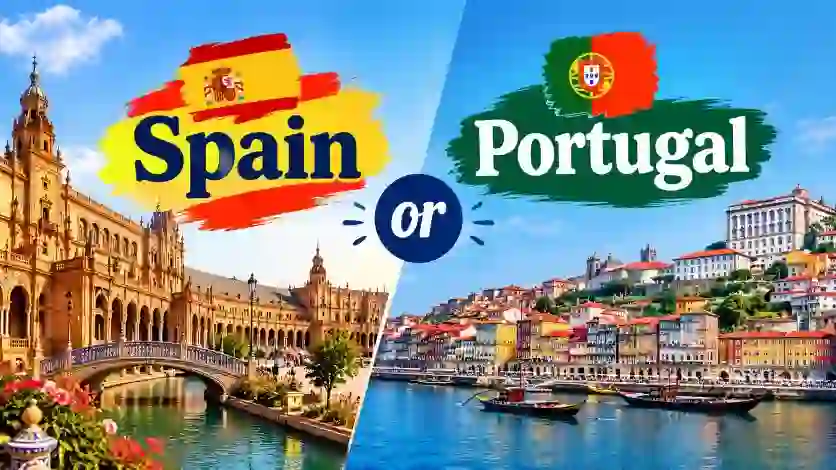
Spain and Portugal are both popular destinations in Southern Europe, but the best choice depends on your budget, travel style, and what you want to experience. Spain is generally known for its larger cities, lively nightlife, regional food, and varied landscapes, while Portugal appeals to many visitors with its coastal towns, historic streets, and relaxed atmosphere.
For travelers comparing Spain or Portugal, the choice is not simply about which country is better. It is about finding the right fit for your trip. Spain may suit you if you want to explore major cities such as Madrid and Barcelona, enjoy late-night dining, or experience a wide range of regional cultures. Portugal may be a better match if you prefer exploring Lisbon and Porto, visiting Atlantic beaches, or taking a slower-paced road trip.
Both countries offer rich history, beautiful coastlines, excellent food, and memorable cultural experiences. Costs, weather, transport, and crowds also vary by location and season. In this guide, you will compare Spain and Portugal across these key areas, learn which country suits different travel needs, and discover practical examples to help you make your decision.
Quick Answer: Spain or Portugal?
Spain is the better choice for travelers who want large cities, diverse regional cultures, lively nightlife, and a wide range of attractions. Portugal is an excellent choice for those who prefer coastal scenery, historic towns, seafood, and a more relaxed travel experience. Both countries offer beaches, culture, and great food. Your ideal destination depends on your budget, interests, travel dates, and preferred pace.
Spain or Portugal: Quick Answer
Choose Spain or Portugal based on the kind of holiday you want. Both countries have plenty to offer, but they provide different experiences.
- Choose Spain for big-city adventures, art museums, flamenco, football, varied regional cuisine, and vibrant nightlife.
- Choose Portugal for Atlantic coastlines, historic neighborhoods, scenic viewpoints, port wine, and charming seaside towns.
- Choose either country for historic architecture, warm-weather trips, local markets, and Mediterranean-style dining influences.
For example, Barcelona is a strong choice for architecture and city beaches. Lisbon suits travelers who enjoy historic streets, viewpoints, and waterfront neighborhoods. If you want a trip that combines city life with smaller towns, either country can work well.
The most useful approach is to compare specific destinations rather than judge two entire countries by one experience.
What Does Spain or Portugal Mean?
Spain and Portugal are neighboring countries on the Iberian Peninsula in southwestern Europe. They share a land border and have long histories shaped by trade, exploration, religion, and cultural exchange.
However, they are separate countries with their own languages, traditions, cuisines, and national identities.
What Is Spain Known For?

Spain is known for its diverse regions, historic cities, beaches, art, and food. Its major destinations include Madrid, Barcelona, Seville, Valencia, and Granada.
Popular experiences include:
- Visiting the Sagrada Família in Barcelona.
- Exploring the Royal Palace and museums in Madrid.
- Watching flamenco performances in Andalusia.
- Trying tapas, paella, and regional specialties.
- Relaxing on the Mediterranean or Atlantic coast.
Spain is geographically diverse. You can visit lively cities, mountain villages, islands, and coastal resorts in the same country.
What Is Portugal Known For?
Portugal is known for its historic towns, Atlantic beaches, traditional music, seafood, and distinctive architecture. Lisbon, Porto, Sintra, and the Algarve are among its best-known destinations.
Popular experiences include:
- Riding a historic tram through Lisbon.
- Exploring Porto’s riverside streets.
- Visiting the palaces of Sintra.
- Enjoying beaches and coastal walks in the Algarve.
- Tasting pastéis de nata and traditional Portuguese dishes.
Portugal is smaller than Spain, which can make it easier to plan a trip around a few major destinations without covering such long distances.
The Origin of Spain and Portugal
Spain and Portugal have different national histories, although both developed from the historical kingdoms of the Iberian Peninsula.
The English name Spain comes through historical forms of the Latin name Hispania, used for the Iberian region during Roman rule. Over many centuries, different kingdoms developed across the peninsula before Spain became a unified monarchy.
The name Portugal developed from the Latin name Portus Cale, associated with the area around present-day Porto. Portugal emerged as an independent kingdom in the Middle Ages and later became a major maritime power.
Both countries played important roles in European exploration and global trade. Their historical influence can still be seen in their languages, architecture, food, and cultural traditions.
Today, Spanish is the main language of Spain, alongside regional languages such as Catalan, Galician, and Basque. Portuguese is the official language of Portugal.
Although Spanish and Portuguese share Latin roots, they are not interchangeable. Visitors should learn a few basic phrases in the language of the country they visit.
Spain vs. Portugal: Main Differences
The biggest differences between Spain and Portugal involve size, travel style, language, destinations, and the experiences each country offers.
| Feature | Spain | Portugal |
| Capital | Madrid | Lisbon |
| Official national language | Spanish, alongside regional official languages | Portuguese |
| Size | Larger country | Smaller country |
| Famous cities | Madrid, Barcelona, Seville | Lisbon, Porto, Coimbra |
| Coastline | Mediterranean and Atlantic | Atlantic |
| Food highlights | Tapas, paella, regional dishes | Seafood, bacalhau, pastéis de nata |
| Cultural experiences | Flamenco, regional festivals, art museums | Fado, historic districts, maritime heritage |
| Nightlife | Extensive options in major cities and resort areas | Lively scenes, especially in Lisbon and Porto |
| Travel distances | Often longer between major destinations | Often shorter between major destinations |
| Best for | Variety, major cities, diverse regional trips | Coastal exploration, compact itineraries, historic towns |
These are broad comparisons, not strict rules. Spain has peaceful coastal villages, and Portugal has lively urban areas. Your experience will depend on where you go.
Which Version Should You Choose?
The best choice depends on your home country, travel goals, and the kind of experience you want.
United States
Spain may suit American travelers who want a varied itinerary with major cities, museums, beaches, and regional food. Portugal can be a good fit for travelers who prefer a compact route featuring Lisbon, Porto, and nearby coastal destinations.
Check flight routes, luggage costs, accommodation prices, and transport options before booking.
United Kingdom
Both countries are popular choices for UK holidays. Portugal is especially convenient for trips centered on Lisbon, Porto, or the Algarve. Spain offers a broad range of options, from city breaks to beach resorts and island holidays.
Compare flight times and airport transfers, not just ticket prices.
Canada
Travelers from Canada may want to consider flight connections and the length of their stay. Spain offers more variety across its regions, while Portugal can be easier to explore on a shorter itinerary focused on a few destinations.
For either country, allow enough time to recover from a long journey and explore without rushing.
Australia
For travelers coming from Australia, the journey is long, so planning a longer stay can make better use of travel time. Spain is attractive for travelers who want a broad cultural itinerary, while Portugal works well for those who want to focus on fewer destinations.
If time allows, visiting both countries is also worth considering.
International Travel
For international visitors, the decision often comes down to personal interests.
Choose Spain for its diverse regions, famous architecture, art, and large-city experiences. Choose Portugal for its Atlantic scenery, historic neighborhoods, and opportunities to combine city visits with coastal exploration.
Academic Travel
Spain may be a strong choice for students studying Spanish, European art, or the history of different Spanish regions. Portugal may be more suitable for students studying Portuguese, maritime history, or Portuguese-speaking cultures.
The best destination depends on the subject, available courses, and institutions involved.
Business Travel
Madrid and Barcelona offer major business environments in Spain. Lisbon and Porto are important business destinations in Portugal.
For a business trip, consider the location of meetings, direct transport links, accommodation near your workplace, and the availability of suitable workspaces. The country itself may matter less than the city where you need to be.
Common Mistakes When Comparing Spain and Portugal
Travelers often make assumptions about these neighboring countries that can lead to poor planning.
| Incorrect assumption | Better understanding | Why it matters |
| Spain and Portugal have the same language. | They have distinct national languages. | Learn basic phrases for your destination. |
| Portugal is always cheaper. | Costs vary by city, season, and activity. | Compare actual travel expenses. |
| Spain is always hotter. | Weather varies by region and season. | Check forecasts and climate conditions for your dates. |
| Portugal is only for beaches. | It also offers cities, museums, historic towns, and countryside. | Plan beyond the coastline. |
| Spain is only for nightlife. | It also has quiet villages, nature, and cultural attractions. | Choose destinations that fit your interests. |
| You can see either country in a few days. | Both have more to offer than a short trip can cover. | Focus on a manageable itinerary. |
Mistake 1: Assuming Spanish and Portuguese Are the Same
The languages share similarities, but their pronunciation, vocabulary, and grammar differ. Do not assume that speaking Spanish means you can automatically communicate in Portuguese.
Mistake 2: Comparing Only Hotel Prices
A lower hotel rate does not always mean a cheaper holiday. Flights, meals, public transport, entrance tickets, and airport transfers all affect the final cost.
Mistake 3: Ignoring Regional Differences
A beach holiday in southern Spain can feel very different from a city break in northern Spain. The same is true of Portugal, where Lisbon, Porto, and the Algarve offer different experiences.
Memory tip: Compare destinations, travel dates, and activities before comparing countries as a whole.
Everyday Examples: Spain or Portugal in Real-Life Decisions
The choice between Spain and Portugal comes up in travel planning, blogs, business discussions, and everyday conversations.
1. Emails
Example:
“I’m comparing Spain and Portugal for our summer holiday. Could you send me the estimated costs for flights and accommodation?”
This makes the purpose of the comparison clear and identifies the information needed.
2. Business Writing
Example:
“Our team is considering Spain or Portugal for the next regional meeting. The final decision will depend on travel costs, accessibility, and venue availability.”
This is useful when comparing locations for work.
3. News Headlines
Example:
“Spain or Portugal: Which Destination Offers the Best Summer Escape?”
A headline like this introduces a comparison without claiming that one country is better for everyone.
4. Blogs
Example:
“Spain or Portugal for First-Time Visitors: A Practical Travel Guide”
This title tells readers what the article will help them decide.
5. Social Media
Example:
“Planning a European trip? Would you choose Spain for its vibrant cities or Portugal for its Atlantic coast?”
This question encourages people to share their preferences.
6. Academic Writing
Example:
“This study compares tourism patterns in Spain and Portugal, focusing on visitor preferences, regional development, and seasonal demand.”
In academic writing, the comparison should be supported by reliable evidence rather than personal impressions.
7. Daily Conversation
Example:
“I’m thinking about visiting Spain or Portugal next year, but I haven’t decided which one suits me better.”
This is a natural way to introduce the choice.
Google Trends and Modern Usage
People search for “Spain or Portugal” for several reasons. Some are planning holidays, while others are comparing living costs, weather, safety, beaches, culture, or the overall quality of life.
The phrase is especially useful because it expresses a direct choice between two destinations. Related searches often become more specific, such as “Spain vs Portugal cost of living,” “Spain or Portugal for a holiday,” or “Portugal vs Spain beaches.”
Why Do People Compare Spain and Portugal?
Travel planning: Visitors want to know which country offers the best fit for their budget, interests, and available time.
Cost comparisons: Travelers and people considering a move abroad want to understand accommodation, transport, food, and everyday expenses.
Weather and beaches: Both countries have coastal destinations, but local conditions differ. The Atlantic coast of Portugal can have cooler water and stronger waves than some Mediterranean destinations in Spain.
Culture and language: Visitors may prefer one country’s food, music, architecture, or language-learning opportunities.
Which Country Is More Popular?
Spain and Portugal both attract international visitors, but popularity depends on the measure used. Tourist arrivals, overnight stays, online searches, and visitor spending do not measure the same thing.
Without a defined date range and a specific data source, it would be misleading to claim that one country is always more popular in Google Trends. Search interest can change with seasons, travel prices, major events, and the countries from which people search.
For a reliable comparison, use Google Trends with the same time period, geographic location, and search category for both terms. Treat its results as relative search interest, not as a count of actual travelers.
The main point is simple: online popularity can help you understand what people are searching for, but it cannot tell you which destination will suit you best.
Quick Comparison Table: Spain vs. Portugal
| Version | Main appeal | Best suited for | Region | Example |
| Spain | Diverse cities, regional culture, nightlife | Travelers who want variety | Southwestern Europe | Exploring Madrid and Barcelona |
| Portugal | Atlantic coast, historic towns, compact routes | Travelers who prefer coastal scenery and relaxed exploration | Southwestern Europe | Exploring Lisbon and Porto |
| Spain and Portugal | Two neighboring countries in one trip | Travelers with more time | Iberian Peninsula | A multi-city European holiday |
Both destinations are good choices. Your interests and itinerary should guide the final decision.
Key Takeaways
- Spain and Portugal are neighboring countries with different languages and cultural identities.
- Spain offers a wide range of large cities, regional traditions, museums, beaches, and nightlife.
- Portugal is known for its historic cities, Atlantic coastline, seafood, and scenic towns.
- Portugal is not always cheaper than Spain. Prices vary by destination and season.
- Spain and Portugal both offer options for families, couples, solo travelers, and students.
- Compare specific destinations rather than making assumptions about entire countries.
- Visiting both countries can be worthwhile if you have enough time and a realistic travel plan.
FAQs About Spain or Portugal
1. Is Spain or Portugal better for a holiday?
Spain may be better if you want major cities, varied regional cultures, museums, and lively nightlife. Portugal may suit you better if you prefer Atlantic beaches, historic neighborhoods, scenic coastal towns, and a more compact itinerary. Neither country is universally better. Your budget, travel dates, interests, and preferred pace should guide your choice.
2. Is Spain or Portugal cheaper to visit?
Neither country is always cheaper. The total cost depends on your destination, season, accommodation, transport, and activities. Popular areas in both countries can be expensive during busy travel periods. Compare the complete cost of your planned trip, including flights and airport transfers, instead of relying on general claims about which country is cheaper.
3. Is Portugal safer than Spain?
Both countries are established tourist destinations, and many visitors travel around them without serious problems. However, no destination is completely free from risk. Petty theft can occur in crowded tourist areas in either country. Check current travel advice, protect your valuables, and use normal precautions when using public transport or visiting busy attractions.
4. Which country has better beaches, Spain or Portugal?
The answer depends on the beach experience you want. Spain offers Mediterranean beaches, island resorts, and Atlantic coastlines. Portugal is known for dramatic Atlantic cliffs, sandy beaches, and surfing areas. Portugal’s Atlantic waters can be cooler and rougher, while some Spanish Mediterranean beaches have calmer water. Always check local swimming conditions.
5. Is Spain or Portugal better for families?
Both countries can work well for families. Spain offers major attractions, beach resorts, public transport in many cities, and a wide range of family activities. Portugal offers historic towns, coastal holidays, and opportunities for relaxed exploration. Consider the ages of your children, accommodation, walking distances, meal options, and travel time between destinations.
6. Which country has better food, Spain or Portugal?
Both countries have excellent food traditions. Spain is known for tapas, paella, regional cheeses, and dishes that vary widely across its regions. Portugal is known for bacalhau, grilled fish, seafood rice, and pastéis de nata. The better choice depends on your tastes. Trying local specialties in either country is one of the best parts of visiting.
7. Can you visit Spain and Portugal on one trip?
Yes. Visiting both countries is practical if you allow enough time and plan your route carefully. For example, you could explore Madrid before traveling to Lisbon, or visit Barcelona and then continue to another destination. Travel times vary by route and transport method, so check current train, bus, and flight schedules before booking.
8. Do Spain and Portugal speak the same language?
No. Spanish is the main language of Spain, although several regional languages also have official status in their respective regions. Portuguese is the official language of Portugal. Both languages developed from Latin and share some vocabulary, but they differ in pronunciation, grammar, and everyday expressions. Learning basic local phrases is helpful in both countries.
9. Is Spain or Portugal better for living abroad?
The better choice depends on your work, budget, lifestyle, language skills, and residency eligibility. Spain offers a broad range of cities and regional lifestyles. Portugal appeals to people who enjoy coastal scenery and its own mix of urban and small-town life. Compare housing costs, taxes, healthcare access, employment options, and current immigration rules before deciding.
10. How many days do you need to visit Spain or Portugal?
For a short trip, focus on one major city and nearby attractions. Around three to five days can provide a useful introduction to Lisbon, Porto, Madrid, or Barcelona, while a longer stay allows more regional exploration. Spain’s larger size often means more travel time between destinations. The ideal length depends on your route and interests.
Conclusion: Spain or Portugal, Which Should You Choose?
Choosing Spain or Portugal comes down to the kind of experience you want. Spain is an excellent option for travelers who enjoy major cities, diverse regional cultures, art, food, and lively evenings.
Portugal is a strong choice for those who want historic streets, beautiful Atlantic scenery, seafood, and a trip that can be built around a smaller number of destinations.
Neither country is automatically better in terms of cost, safety, weather, or overall travel experience. Prices change by season and location, and each country has both busy tourist areas and quieter places to explore. Your travel dates, budget, and interests matter more than broad comparisons.
If you have limited time, choose one country and explore it well. If you have a longer holiday, consider visiting both and comparing their different cities and landscapes for yourself. Before booking, check transport schedules, accommodation prices, local conditions, and current travel guidance.
The best destination is not the one that wins every comparison. It is the one that matches the holiday you want to have. Choose Spain for variety, Portugal for a coastal-focused escape, or both for a richer Iberian adventure. If you found this guide helpful, explore more travel comparisons before planning your next trip.
Read more about!

I’m Olivia Parker, a grammar and English writing enthusiast passionate about making English simple and easy to understand. Through Wordsblog, I share clear explanations, useful grammar tips, and practical writing guidance to help readers write with confidence. My goal is to make learning English easier, one word at a time.








2 thoughts on “Spain or Portugal: Which Is Better for You?”