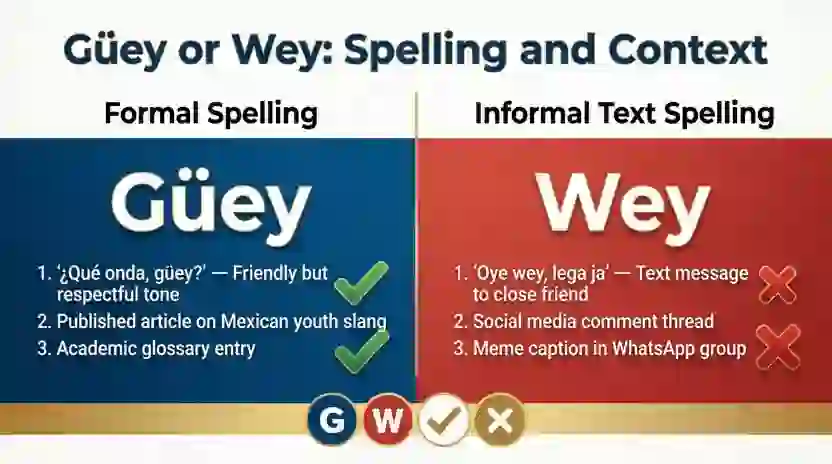
If you are wondering if güey or wey is the correct spelling, güey is the established Spanish spelling, while wey is a very common informal variant used in texting, social media, and casual online writing. Both usually refer to the same Mexican Spanish slang word.
The confusion comes from the way the word sounds. In conversation, güey and wey can sound almost identical, so learners often see both forms and wonder if they have different meanings.
The word can also change meaning depending on tone and context. Among friends, it may be similar to “dude,” “bro,” or “man.” In other situations, it can refer to a foolish person or sound insulting. The Diccionario de americanismos records several of these Mexican uses.
In this guide, you will learn what güey or wey means, which spelling to use, where the word comes from, how it works in everyday Mexican Spanish, and when it is better to avoid it.
Güey or Wey: Featured Snippet + AI Overview
Güey is the established spelling of a common Mexican Spanish slang word. Wey is a widely used informal spelling, especially in texts and online conversations. Both can mean “dude,” “guy,” or “bro,” but güey can also refer to a foolish person or be used as an insult. The meaning depends on context, relationship, and tone.
Güey or Wey: Quick Answer
If you need to choose one spelling for learning or careful writing, choose güey.
Wey is also widely recognized, especially in casual digital communication. It is best understood as an informal spelling variant rather than a completely different word.
Here is the simple difference:
- Güey: Established spelling of the Mexican slang word.
- Wey: Common informal variant, especially online.
- Meaning: Often “dude,” “guy,” “man,” or “bro.”
- Negative meaning: It can also refer to a foolish person or be insulting.
- Formality: Both are informal, but wey has an especially casual, digital feel.
- Best choice for learners: Recognize both, but use güey when you need the established spelling.
For example:
¡Qué onda, güey?
“What’s up, dude?”
And:
¿Qué onda, wey?
“What’s up, dude?”
The spelling changes, but the intended slang word is generally the same.
What Does Güey or Wey Mean?
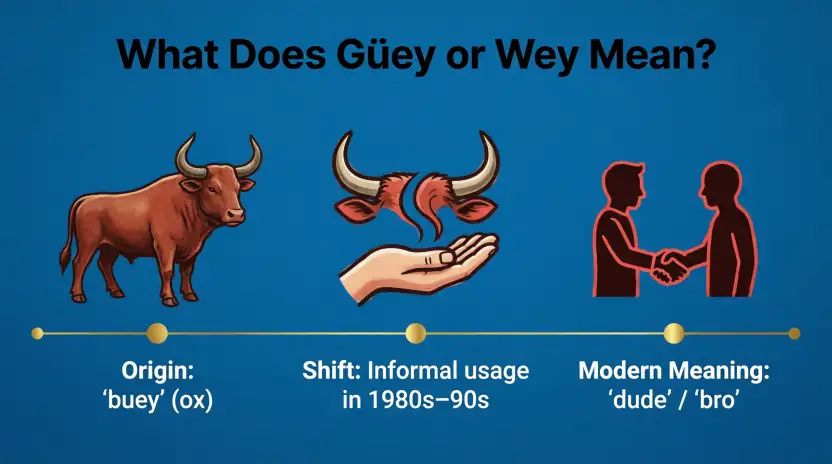
Güey is a Mexican Spanish slang word used to refer to a person. Depending on the situation, it can work like “dude,” “guy,” “man,” or “bro.” The Diccionario de americanismos also records meanings related to a foolish person and a familiar companion in Mexican usage.
One important point is that güey does not have one fixed English translation.
Consider these examples:
Friendly use
Güey, vamos a comer.
“Dude, let’s eat.”
Here, the speaker is using the word as a familiar form of address.
Referring to someone
Ese güey trabaja aquí.
“That guy works here.”
The exact English translation depends on the speaker’s tone.
Negative use
No seas güey.
“Don’t be irrational.”
In this case, the word has a negative sense.
ASALE also records ¡güey! as an expression used in Mexico to call someone’s attention or show surprise.
This is why translating güey mechanically as “idiot” or always translating it as “friend” can both be misleading.
The Origin of Güey or Wey
The commonly cited origin of güey is the Spanish word buey, meaning an ox or castrated bull. The Academia Mexicana de la Lengua explains that güey developed from buey through changes in pronunciation and that the earlier word was associated with ideas of clumsiness or lack of intelligence.
Over time, the expression changed in everyday Mexican speech.
A word that could be used negatively became a familiar form of address in some contexts. This is one reason the modern word can have meanings that seem contradictory.
Today, a person might use güey affectionately with a close friend, while the same word can sound rude or insulting when directed at someone in anger.
The Academia Mexicana de la Lengua specifically describes güey as a highly characteristic expression of Mexican Spanish and connects it to buey.
The history also helps explain why the modern spelling may look unexpected. The pronunciation changed over time, while informal speech continued to reshape the word.
The important lesson for learners is simple: modern güey is not simply the English word “way” written in Spanish.
British English vs American English
There is an important correction to make here. Güey vs. wey is not a British English vs. American English spelling difference.
The word belongs to Mexican Spanish, so the more useful comparison is between established Spanish spelling and informal digital spelling.
| Established / careful form | Informal form | Example |
| güey | wey | ¿Qué onda, güey? |
| güey | wey | ¿Qué onda, wey? |
| güey | guey | Casual writing may omit the ü |
| Mexican Spanish | Online Mexican slang | ¡Ay, güey! |
The diaeresis in güey is part of the established spelling. Wey is commonly encountered in informal messages and social media because it represents the familiar pronunciation in a quick, simplified form.
So if you see wey online, you should not automatically assume that it represents a different word.
What about the United States?
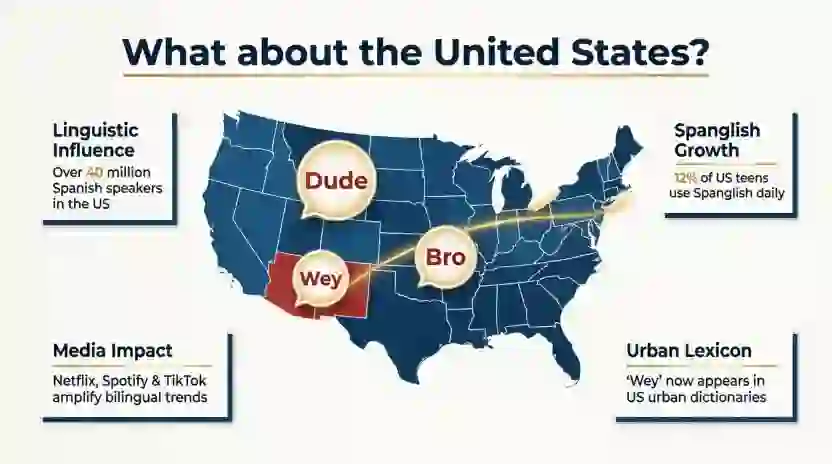
In the United States, you may encounter güey and wey in Mexican American communities, Spanish-language media, social media, music, and conversations influenced by Mexican Spanish.
That does not make the word an American English word. It remains Spanish slang.
Which Version Should You Use?
The best choice depends on your audience and the situation.
United States
If you are writing in English, you normally do not need either form unless you are quoting Spanish or discussing Mexican slang.
If you are writing in Spanish and want the established form, güey is the safer choice.
United Kingdom
The same principle applies. British English does not create a separate spelling of this Mexican Spanish word.
Use güey when referring to the established Spanish form.
Canada
Canadian English and Canadian French do not change the Mexican Spanish spelling.
For Spanish writing, güey remains the useful established form.
Australia
Australian English does not create a separate version of güey.
If the word appears in Mexican Spanish, retain the Spanish spelling.
International Writing
For international readers, güey is easier to identify as the Spanish word.
If you are explaining the term, you can mention that wey is a common informal spelling.
Academic Writing
Avoid güey and wey unless your topic is Spanish slang, Mexican culture, sociolinguistics, or a quoted conversation.
If you need to discuss the word academically, güey is generally the clearer form to use.
Business Writing
Avoid both forms in formal business communication unless they are part of a direct quotation or a specific cultural reference.
Use neutral Spanish instead.
Common Mistakes
Mistake 1: Thinking “wey” is a completely different word
Incorrect idea:
“Wey and güey have completely different meanings.”
Better understanding:
Wey is commonly used as an informal spelling variant of güey.
Memory tip:
Think güey = established form and wey = casual variant.
Mistake 2: Assuming güey always means “idiot”
Incorrect:
“Güey always means idiot.”
Correct:
“Güey can mean ‘dude,’ ‘guy,’ or refer negatively to a foolish person.”
Context matters. ASALE records both familiar and negative meanings.
Memory tip:
Tone changes the meaning.
Mistake 3: Using güey in formal situations
Incorrect:
Using güey in a formal job application or professional letter.
Correct:
Use neutral language in formal communication.
Slang is highly informal language and can sound inappropriate outside familiar social settings.
Memory tip:
Friends = possible. Formal writing = avoid.
Mistake 4: Confusing “wey” with English “way”
Incorrect:
“No way” and “no wey” are the same expression.
Correct:
English way and Mexican Spanish wey are different words.
The pronunciation may cause confusion, especially for English speakers encountering Mexican Spanish online.
Everyday Examples
Emails
Formal email:
Thank you for your message. I will review the information.
Not:
Thanks, güey!
Unless you are deliberately writing an informal message to a close friend, slang does not belong in professional email.
Business Writing
Formal business writing should normally use neutral Spanish.
Gracias por su mensaje.
Instead of:
Gracias, güey.
The second version is highly casual and may sound disrespectful.
News Headlines
A news story about Mexican culture may use güey when the word itself is relevant.
For example:
Why “güey” Became a Familiar Word in Mexican Spanish
The spelling should be preserved when the article is discussing the word.
Blogs
A language-learning blog can introduce the word like this:
In Mexican Spanish, güey can mean “dude” or “guy,” depending on context.
This gives readers the spelling and meaning without encouraging them to use slang blindly.
Social Media
Informal posts may use wey:
No manches, wey 😂
This kind of spelling is especially suited to casual digital communication.
Academic Writing
An academic paper might write:
The Mexican slang term güey has both familiar and negative uses.
Here, the term is being discussed rather than casually used.
Daily Conversation
Among people who are comfortable with Mexican slang, you may hear:
¡Güey, mira eso!
Depending on tone, this could be understood roughly as:
“Dude, look at that!”
ASALE records ¡güey! as an attention-getting or surprise expression in Mexican usage.
Google Trends & Modern Usage
People search “güey or wey” because the word appears in Mexican movies, videos, social media, messages, music, and casual conversation. The pronunciation can make the spelling difficult to identify when learners hear it before seeing it written.
Modern online communication also makes spelling variation more visible. A person may type wey rather than güey in a quick message.
However, frequency on social media should not be confused with formal spelling standards.
The key pattern is:
güey → established spelling
wey → common informal variant
The word is also strongly associated with Mexican Spanish. ASALE identifies güey as a Mexican usage and records several meanings, including “foolish person,” “close friend or companion,” and a term for an unspecified person.
Its meaning also depends heavily on social relationship and tone. A close friend may use it casually, while the same word directed at a stranger can sound rude.
Exact search-volume or Google Trends numbers should not be invented without a current data source. For that reason, the usage discussion here focuses on documented dictionary meanings and observable language patterns rather than unsupported statistics.
Quick Comparison Table
| Version | Meaning | Correct? | Region | Example |
| güey | Dude, guy, man, or foolish person | Yes, established spelling | Mainly Mexico | ¿Qué onda, güey? |
| wey | Same slang word in informal use | Common variant | Mainly Mexican Spanish online/casual use | ¿Qué onda, wey? |
| guey | Informal spelling without the diaeresis | Seen in casual writing | Mexican Spanish | Oye, guey |
| way | English word meaning route, method, etc. | Yes in English, but different word | English | No way! |
The most important distinction is between güey and way. They may sound similar to an English speaker, but they are not the same word.
Key Takeaways
- Güey is the established spelling of the Mexican Spanish slang word.
- Wey is a very common informal spelling variant.
- The word can mean “dude,” “guy,” “man,” or “bro” in familiar contexts.
- It can also refer to a foolish person or work as an insult.
- Tone and context are essential when interpreting the word.
- The word is strongly associated with Mexican Spanish.
- It is not a British English vs. American English spelling difference.
- For formal or professional writing, use neutral language instead.
- For learners, recognizing both güey and wey is useful.
- When discussing the word in careful writing, güey is the clearer choice.
FAQs About Güey or Wey
1. Is güey or wey correct?
Güey is the established spelling of the Mexican Spanish slang word. Wey is a widely used informal variant, especially in texting and online communication. They generally refer to the same expression. If you are learning Spanish or writing about the word carefully, güey is the clearest form to use.
2. What does güey mean in English?
Güey can mean “dude,” “guy,” “man,” or “bro” in friendly Mexican Spanish. It can also have a negative meaning, such as “fool” or “idiot,” depending on context and tone. ASALE records both familiar and negative meanings, so there is no single English translation that works in every situation.
3. Is wey just a slang spelling of güey?
In many casual contexts, yes. Wey is commonly used as an informal spelling of güey. You may see it often in text messages, comments, memes, and social media. The two forms generally refer to the same Mexican Spanish expression, although spelling habits can vary between speakers.
4. Is güey a bad word?
Not always. Güey can be friendly, neutral within a close relationship, or insulting, depending on how it is used. ASALE records both a familiar meaning and negative meanings. Because it is slang, learners should pay attention to the relationship between speakers and the tone of the conversation.
5. Can I use güey with a Mexican friend?
You can hear Mexican speakers use güey casually with friends, but that does not mean it is appropriate in every relationship. If you are learning Spanish, it is safer to understand the word before using it. Tone, familiarity, age, region, and personal preference can all affect how it is received.
6. Is güey used only in Mexico?
Its strongest association is with Mexican Spanish, although dictionaries record the word in some other countries as well. ASALE lists Mexican usage prominently and also records certain uses in El Salvador, Nicaragua, and other contexts. The exact meaning and frequency can vary by country.
7. Is güey the same as English “way”?
No. Güey is a Mexican Spanish slang expression, while English way can mean a route, method, direction, or manner. They may sound similar to English speakers, but their meanings and origins are different.
8. Why is güey spelled with ü?
The ü is part of the established spelling güey. It helps represent the pronunciation intended by the Spanish spelling. Informal writers may instead use wey, which is why learners often encounter both forms online.
9. Should I use güey in formal writing?
Generally, no. Güey is slang and is strongly informal. Formal emails, academic papers, job applications, business documents, and official communication normally call for neutral language. Use the word when it is relevant to the subject, such as when discussing Mexican Spanish or quoting someone.
10. How do you pronounce güey?
For an English-speaking learner, the pronunciation is often approximated as something close to “way.” However, it is a Spanish word, so pronunciation should be learned from Mexican Spanish speakers rather than treated as an English word. The spelling wey reflects the pronunciation that many learners hear.
Conclusion
When choosing between güey or wey, the main point is simple: güey is the established spelling, while wey is a common informal variant. Both can refer to the same Mexican Spanish slang expression.
The meaning is more complicated than the spelling. Depending on the speaker, relationship, and tone, güey can mean “dude,” “guy,” “man,” or “bro.” It can also carry a negative sense and refer to a foolish person. ASALE documents several of these meanings in Mexican usage.
For Spanish learners, the safest approach is to recognize both forms but understand that the word is highly informal. In professional, academic, or formal situations, neutral Spanish is usually a better choice.
If you are writing about the word itself, güey is the clearest form to use. If you see wey in a text, comment, or message, do not assume it is a different word.
Remember: Güey is the established spelling, while wey is the casual spelling you will often see online.
Read more about!
- Nick or Knick: Which Spelling Is Correct?
- Dominant or Recessive: What’s the Difference?
- Yoked or Yolked: Which Word Is Correct?

I’m Olivia Parker, a grammar and English writing enthusiast passionate about making English simple and easy to understand. Through Wordsblog, I share clear explanations, useful grammar tips, and practical writing guidance to help readers write with confidence. My goal is to make learning English easier, one word at a time.







2 thoughts on “Güey or Wey: Which Spelling Is Correct?”