A receipt and an invoice are both business documents, but they serve different purposes. An invoice usually asks for payment and lists what a customer owes, while a receipt confirms that payment or another transaction has been received.
The confusion is common because both documents can show the same basic details, such as products, services, prices, dates, and business information. In some transactions, you may even receive both an invoice and a receipt.
Knowing the difference helps you choose the right word in emails, business documents, accounting records, and everyday conversations. It also makes financial communication clearer.
In this guide, you will learn what receipt or invoice means, how each document works, when to use each term, common mistakes, regional usage, and practical examples. You will also see a simple comparison table that makes the difference easy to remember.
Receipt or Invoice: Featured Snippet + AI Overview
A receipt proves that payment or goods have been received, while an invoice is a document that lists goods or services provided and requests payment. In simple terms, an invoice usually comes before payment, while a receipt usually comes after payment. However, exact business processes can vary.
Receipt or Invoice: Quick Answer
The easiest way to remember the difference is:
- Invoice = request for payment
- Receipt = proof of payment or receipt of goods or money
For example, imagine you hire a designer to create a logo.
The designer may send you an invoice for $500. The invoice tells you what work was completed, how much it costs, and how to pay.
After you pay the $500, the designer may send you a receipt confirming that the payment was received.
Example 1: Online shopping
You order a laptop for $900.
The seller may provide an invoice showing:
- Product: Laptop
- Price: $900
- Taxes or fees
- Payment terms
- Amount due
After payment, you may receive a receipt confirming the transaction.
Example 2: Freelance work
A freelancer completes a website project and sends an invoice for $1,200.
Once the client pays, the freelancer can issue a receipt as proof of payment.
Example 3: Retail purchase
You buy shoes from a store and pay immediately.
The store gives you a receipt showing the purchase and payment. In this situation, you may never see a separate invoice.
Cambridge defines a receipt as something that can prove money, goods, or information have been received. Its Business English definition also describes a receipt as a document showing the price of a purchase and proving payment.
An invoice, by contrast, lists goods or services and their cost, generally as part of the payment process.
What Does Receipt or Invoice Mean?
What is a receipt?
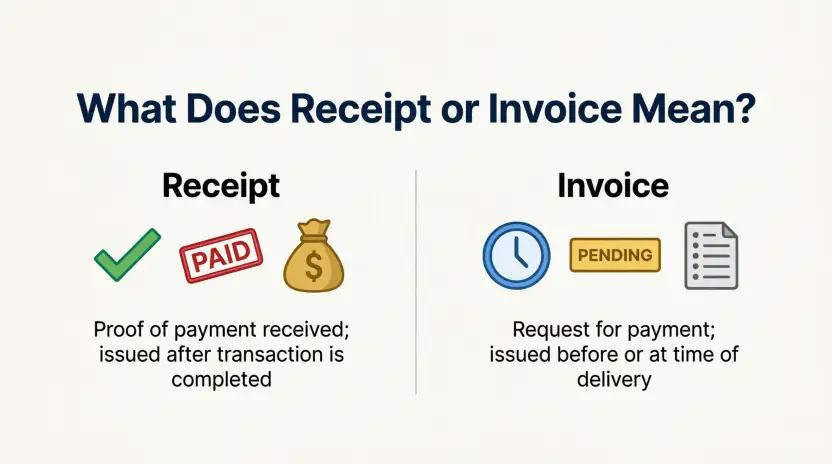
A receipt is a record that confirms something has been received.
In everyday business use, it most often refers to proof that a customer has paid for goods or services.
For example:
Please keep your receipt in case you need to return the item.
A receipt may contain:
- Business name
- Date of purchase
- Items or services
- Quantity
- Price
- Taxes
- Total paid
- Payment method
- Transaction number
A receipt can be printed or digital. Email receipts are now common in retail and online shopping.
What is an invoice?
An invoice is a document that lists goods or services provided and the amount the customer is expected to pay.
For example:
Please send the invoice to our accounts department.
An invoice commonly includes:
- Seller’s name and contact details
- Customer’s information
- Invoice number
- Invoice date
- Description of goods or services
- Quantity
- Price
- Taxes
- Total amount due
- Payment terms
- Due date
Cambridge describes an invoice as a list of things provided or work done, together with their cost, for payment at a later time. In Business English, it describes an invoice as a document that lists what was provided, gives the cost, and asks for payment.
The simplest distinction
Think of the two documents as answering different questions:
Invoice: “How much do you need to pay?”
Receipt: “What payment did you make?”
That distinction will solve most receipt vs invoice questions.
The Origin of Receipt or Invoice
The two words have different histories.
Origin of receipt
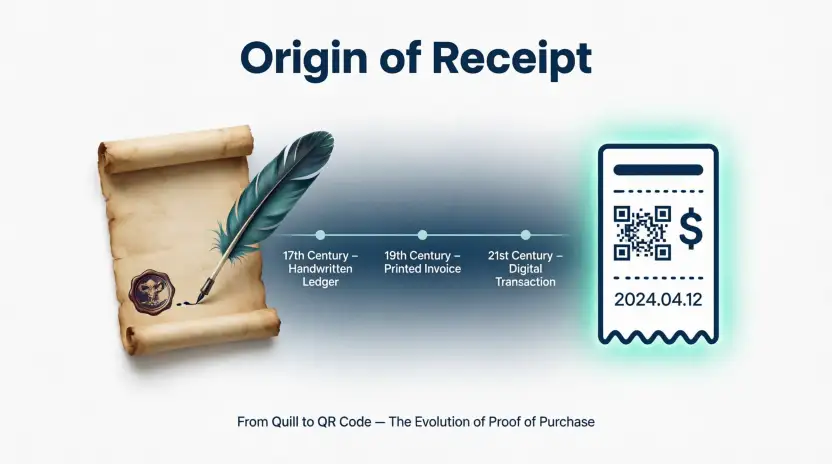
Receipt comes from forms related to receiving. The English noun appeared in the late 14th century as receit, meaning the act of receiving. It came through Anglo-French or Old North French from Medieval Latin recepta, related to Latin recipere, meaning to receive or take.
The spelling changed over time. The p was restored to the written English form after about 1500, but the pronunciation did not change in the same way. That is why receipt is pronounced roughly like “ri-SEET,” not “ri-CEPT.”
The meaning of a written acknowledgment for receiving something is recorded from around the 17th century.
Origin of invoice
Invoice has a different history. It entered English in the 16th century in the sense of a written account containing details and prices of goods sent or shipped.
Its history is connected with French envoi, meaning a sending or dispatch, and ultimately with Latin words related to sending something on its way.
The modern business meaning developed around the idea of documenting goods or services and their prices.
So, the words themselves reflect their basic functions:
- Receipt connects to receiving.
- Invoice connects historically to sending or dispatching a statement of goods and prices.
British English vs American English
Unlike spelling pairs such as color and colour, receipt and invoice are not mainly a British-versus-American spelling issue.
Both words are standard in British and American English.
| Meaning | British English | American English | Example |
| Proof of payment | Receipt | Receipt | Keep the receipt. |
| Request for payment | Invoice | Invoice | Please pay the invoice. |
| Document listing goods/services and cost | Invoice | Invoice | The company sent an invoice. |
| Retail proof of purchase | Receipt | Receipt / sales slip | I need my receipt. |
| Business payment record | Receipt | Receipt | Save the receipt for your records. |
Cambridge lists receipt in both UK and US English and notes that the US also uses terms such as “sales slip” in some contexts.
Likewise, invoice is used in both British and American English for a document showing goods or services and their cost.
Regional differences
The main differences are usually not about the words receipt and invoice themselves. They are more likely to involve:
- Local tax rules
- Accounting practices
- Business terminology
- Retail systems
- Government requirements
- Industry-specific documents
Therefore, you can safely use receipt and invoice in both American and British English when the meaning is correct.
Which Version Should You Use?
The right word depends on what the document does, not simply where you live.
United States
Use receipt when referring to proof that you paid or that something was received.
Use invoice when referring to a document requesting or recording payment for goods or services.
Example:
Please send me the invoice before Friday.
I kept the receipt after purchasing the equipment.
United Kingdom
The same basic distinction applies.
Invoice is common in business transactions, while receipt commonly refers to proof of purchase or payment.
Canada
Canadian English generally uses both receipt and invoice in the same basic ways.
Always follow the terminology required by the business, accounting system, or relevant tax rules.
Australia
Both words are also standard in Australian business English.
The exact document requirements can depend on the type of transaction and applicable regulations.
International writing
For international readers, receipt and invoice are usually clear choices.
If the distinction could cause confusion, explain the document’s purpose rather than relying only on the name.
Academic writing
Use invoice when discussing a charge or payment request.
Use receipt when discussing proof that payment was made.
For example:
The supplier issued an invoice for the laboratory equipment.
Students must submit a receipt for reimbursable expenses.
Business writing
Be precise.
Instead of:
Please send the receipt before payment.
Write:
Please send the invoice before payment.
After payment:
Please send the receipt for our records.
Common Mistakes
Mistake 1: Calling an invoice proof of payment
Incorrect:
I sent the customer an invoice as proof that they paid.
Correct:
I sent the customer a receipt as proof that they paid.
Why?
An invoice normally documents an amount due. A receipt normally confirms that something was received, often payment.
Memory tip:
Invoice = amount due. Receipt = amount received.
Mistake 2: Asking for an invoice after a simple retail purchase
This is not always grammatically wrong, but it may not match the situation.
Less natural in a normal store:
Can I get an invoice for my coffee?
More natural:
Can I get a receipt?
A business transaction may use an invoice when detailed billing information is needed.
Mistake 3: Thinking an invoice always means the customer has not paid
An invoice is commonly used to request payment, but business systems can also use invoices as formal records of transactions that have already been paid or processed.
The key point is the document’s role in the transaction.
Mistake 4: Using receipt and invoice as exact synonyms
Incorrect idea:
A receipt and an invoice are the same thing.
Better understanding:
A receipt and an invoice can contain similar information, but they usually serve different purposes.
Everyday Examples
Emails
Invoice:
Hi James,
Please find attached the invoice for the writing services completed this month.
Receipt:
Hi James,
Thank you for your payment. Please find your receipt attached.
Business writing
Our accounting team will process the invoice within five business days.
Please keep the receipt for your expense report.
News headlines
A business article might use invoice when discussing unpaid bills:
Company Faces Dispute Over Unpaid Invoices
A retail story might use receipt when discussing proof of purchase:
Customers Can Now Receive Digital Receipts
Blogs
Always check your invoice before making a business payment.
Keep your receipt until the return period ends.
Social media
Lost your receipt? Check your email for a digital copy.
We have sent your invoice to the email address on your account.
Academic writing
The researcher submitted the invoice for laboratory supplies.
The student attached the receipt to the reimbursement form.
Daily conversation
Do you need a receipt?
I haven’t paid the invoice yet.
Can you email me the invoice?
I saved the receipt in my phone.
These examples show why context matters more than memorizing a complicated rule.
Google Trends & Modern Usage
People often search receipt or invoice because the two documents can look similar.
Both may contain:
- A business name
- Customer information
- Product or service details
- Prices
- Taxes
- A total amount
- A date
- A transaction number
The important difference is their function.
Modern businesses often use digital invoices and electronic receipts instead of paper documents. Cambridge specifically notes the growing use of email receipts in retail.
Search interest around receipt vs invoice, invoice vs receipt, and difference between receipt and invoice is driven by practical questions about shopping, freelance work, business expenses, accounting, refunds, and payment records.
Exact search-volume figures should not be assumed without current keyword data. The useful pattern is clear: people want to know which document to request, send, save, or use for a particular transaction.
Quick Comparison Table
| Version | Meaning | Correct? | Region | Example |
| Receipt | Proof that payment or something else was received | Yes | International | Keep your receipt. |
| Invoice | Document listing goods/services and amount due | Yes | International | Please pay the invoice. |
| Receipt vs invoice | Comparison of two different business documents | Yes | International | What is the difference between a receipt and an invoice? |
| Invoice vs receipt | Same comparison in reverse order | Yes | International | Do I need an invoice or receipt? |
| Sales receipt | Record of a completed sale or payment | Yes | Common internationally | The store emailed a sales receipt. |
| Sales invoice | Invoice used to document a sale | Yes | Common internationally | The supplier issued a sales invoice. |
Another quick way to remember
| Question | Correct document |
| “What do I owe?” | Invoice |
| “What have I paid?” | Receipt |
| “What services were billed?” | Invoice |
| “What proves I paid?” | Receipt |
| “What should I review before payment?” | Invoice |
| “What should I keep after payment?” | Receipt |
Key Takeaways
- Receipt and invoice are both correct English words.
- A receipt usually confirms that payment or something else was received.
- An invoice usually lists goods or services and asks for payment.
- An invoice commonly appears before payment.
- A receipt commonly appears after payment.
- Both words are standard in American and British English.
- A receipt may be printed or electronic.
- An invoice can be used for detailed business billing and payment records.
- Do not treat receipt and invoice as exact synonyms.
- When in doubt, focus on the document’s purpose.
FAQs
1. What is the main difference between a receipt and an invoice?
An invoice usually tells a customer what they owe for goods or services, while a receipt usually confirms that money or goods have been received. An invoice is commonly connected with requesting payment. A receipt is commonly connected with confirming payment or a completed transaction.
2. Is a receipt proof of payment?
Yes, a receipt can serve as proof of payment when it records that payment was received. Retail receipts commonly show the items purchased, total amount, and payment details. However, the exact legal or accounting value of a receipt can depend on the transaction and applicable rules.
3. Is an invoice proof of payment?
Usually, an invoice is not the same as proof of payment. An invoice normally records what was supplied and how much is due. A separate receipt, payment confirmation, bank record, or other transaction record may show that the amount was actually paid.
4. Can you have both an invoice and a receipt?
Yes. A business can issue an invoice and later provide a receipt after payment. For example, a freelancer may send an invoice for completed work. Once the client pays, the freelancer may issue a receipt confirming the payment.
5. Do I need an invoice or a receipt?
It depends on what you need. If you need a document showing what you owe or what a business is charging you, you may need an invoice. If you need proof that you paid, you usually need a receipt or another payment record.
6. Is a receipt the same as a bill?
Not exactly. A bill or invoice generally tells you how much you need to pay. A receipt usually confirms that payment or another item has been received. In everyday speech, however, people may use these terms loosely depending on the situation.
7. Can an invoice be paid immediately?
Yes. An invoice can be paid immediately. The term invoice describes the billing document, not a guaranteed waiting period. Some businesses give customers a due date, while others expect payment at the time of purchase or shortly afterward.
8. Which comes first, an invoice or a receipt?
In many business transactions, the invoice comes first and the receipt comes after payment. The invoice states the amount owed, while the receipt confirms that payment was received. However, not every transaction follows this exact sequence.
9. Are receipt and invoice used in both American and British English?
Yes. Receipt and invoice are standard terms in both American and British English. The basic distinction is also similar in both varieties. Regional differences are more likely to involve accounting systems, tax rules, or specific business practices than the words themselves.
10. How can I remember the difference between receipt and invoice?
Use this simple memory rule: Invoice = money requested. Receipt = money received. If someone is asking you to pay, think of an invoice. If someone is confirming that you paid, think of a receipt.
Conclusion
The difference between a receipt and an invoice is simple once you focus on purpose. An invoice normally tells a customer what goods or services were provided and how much they need to pay. A receipt normally confirms that payment, goods, or another item has been received.
For example, a freelancer may send an invoice before receiving money. After the client pays, the freelancer may send a receipt. In a retail store, the customer may simply receive a receipt after paying, without a separate invoice.
Both receipt and invoice are correct terms in American and British English. The best word depends on the stage and purpose of the transaction, not on a spelling difference.
When writing emails, invoices, expense reports, or business documents, choose the term that clearly describes the document.
Remember: an invoice tells you what is due, while a receipt shows what was received.
If this guide helped clear up the confusion, save it for the next time you need to choose between receipt or invoice.
Read more about!
- Nick or Knick: Which Spelling Is Correct?
- Dominant or Recessive: What’s the Difference?
- Yoked or Yolked: Which Word Is Correct?

I’m Olivia Parker, a grammar and English writing enthusiast passionate about making English simple and easy to understand. Through Wordsblog, I share clear explanations, useful grammar tips, and practical writing guidance to help readers write with confidence. My goal is to make learning English easier, one word at a time.