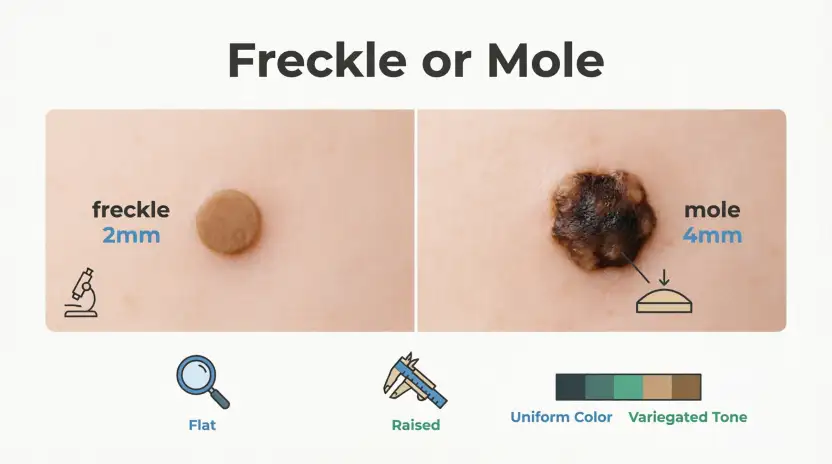
A freckle is usually a small, flat, brownish spot linked to pigment and often becomes more noticeable with sun exposure, while a mole is a distinct skin growth that can be flat or raised and may remain relatively stable over time. Although both can look like small dark spots, they are not the same thing.
People often search “freckle or mole” because the two can look similar, especially on the face, arms, shoulders, and other sun-exposed areas. A freckle may be light brown and appear in clusters, while a mole can have a different shape, texture, or color.
Knowing the basic difference can help you describe what you see more accurately. It is also useful to know when a spot deserves professional attention, because a new or changing mole or skin spot should not simply be assumed to be harmless.
This guide explains the meaning, appearance, origin, everyday usage, regional language differences, and practical distinction between a freckle and a mole.
Freckle or Mole: Quick Answer
The simplest way to remember the difference is:
- Freckle: Usually flat, small, and brown or tan.
- Mole: A distinct skin growth that may be flat or raised.
- Freckles: Often become more noticeable after sun exposure.
- Moles: Can occur almost anywhere on the skin.
- Both: Can vary in color and appearance.
For example:
“She has freckles across her nose.”
This usually refers to several small, flat spots.
“He has a mole on his cheek.”
This usually refers to one distinct spot or growth.
A mole does not have to be raised. The American Academy of Dermatology notes that ordinary moles can be flat or slightly raised and may be brown, tan, black, pink, red, blue, skin-colored, or colorless.
A useful memory tip

Freckle = flat spot.
Mole = distinct skin growth.
This is only a general description. Appearance alone cannot reliably diagnose a skin condition.
What Does Freckle or Mole Mean?
What is a freckle?
A freckle is a small area of skin that has more pigment than the surrounding skin. Freckles are usually flat and can range from light tan to brown.
They are especially noticeable in people whose skin freckles easily. Sun exposure can make freckles more visible.
The word freckle is commonly used in everyday English to describe these small spots on the skin.
Example:
“She has a few freckles on her cheeks.”
The plural freckles is very common because freckles often occur as multiple small spots.
What is a mole?
A mole is a common type of skin growth, medically known as a nevus. Most common moles are harmless. They may be flat or raised and can have different colors.
Example:
“He has a small mole near his eyebrow.”
Unlike freckles, a mole can have more noticeable shape or texture.
Freckle vs. mole at a glance
| Feature | Freckle | Mole |
| Typical appearance | Small, flat spot | Flat or raised growth |
| Common color | Tan or brown | Brown, tan, black, pink, or other colors |
| Usually appears | Often in groups | Often as individual spots |
| Sun exposure | Can make freckles more noticeable | UV exposure is relevant to skin health and melanoma risk |
| Texture | Usually flat | May be smooth or raised |
| Medical term | Common descriptive term | Nevus |
These are general patterns, not rules for diagnosing an individual spot.
The Origin of Freckle and Mole
The two words have different histories and have been used in English for centuries.
Freckle is an old English word connected with the idea of a small spot or mark on the skin. Its history is related to older Germanic forms describing freckles or spots.
Mole has a different history. The word used for the skin mark developed from older English and Germanic terms referring to a spot or blemish on the body.
In modern English, both words have become standard everyday terms.
The important point is that freckle and mole are not different spellings of the same word. They describe different types of skin marks.
British English vs American English
There is no major spelling difference between American and British English for freckle or mole.
| British English | American English | Example |
| freckle | freckle | “She has freckles on her nose.” |
| mole | mole | “He has a mole on his neck.” |
| freckles | freckles | “Her freckles become darker in summer.” |
| moles | moles | “The doctor checked the moles.” |
Regional differences
The words are understood in both British and American English.
You do not normally need to change freckle to another spelling when writing for a British audience. The same is true for mole.
Medical terminology can vary slightly by country or healthcare system, but the everyday words remain familiar.
For international readers, freckle and mole are both clear and widely understood terms.
Which Version Should You Use?

Because freckle and mole have different meanings, you should choose the word based on what you are describing.
United States
Use freckle for a small, usually flat pigmented spot and mole for a distinct skin growth.
United Kingdom
The same distinction generally applies. British readers commonly use both freckle and mole.
Canada
Both terms are standard and understood. Choose the word that matches the spot you are describing.
Australia
Both freckle and mole are normal everyday terms.
International writing
Use simple descriptions when the audience may not know medical terminology:
“a small, flat brown spot”
or
“a small raised skin growth”
Academic writing
Academic and medical writing may use more specific terminology such as nevus when appropriate. Use the terminology required by the field and source.
Business writing
Business writing rarely needs these terms unless the subject involves healthcare, cosmetics, dermatology, or personal care. When they are needed, use the plain terms first.
Common Mistakes
Mistake 1: Treating freckles and moles as synonyms
Incorrect:
“A mole is just another word for a freckle.”
Better:
“A mole and a freckle are different types of skin marks.”
Why?
They can look similar, but they do not mean the same thing.
Memory tip:
Think freckle = small flat spot and mole = skin growth.
Mistake 2: Assuming every mole is raised
Incorrect:
“A flat spot cannot be a mole.”
Correct:
“Some moles are flat, while others are slightly raised.”
The American Academy of Dermatology specifically notes that common moles may be flat or slightly raised.
Mistake 3: Assuming every dark spot is a mole
Incorrect:
“It is dark, so it must be a mole.”
Better:
“It is a dark skin spot, but its exact type should not be assumed from color alone.”
Many skin marks can look alike. A dermatologist can assess a suspicious or changing spot.
Mistake 4: Ignoring changes
A common mole can be harmless, but a new or changing spot deserves attention. Warning signs include changes in size, shape, or color, as well as bleeding, crusting, itching, or pain.
Everyday Examples
Emails
“I noticed a new mole on my arm and plan to have it checked.”
Business writing
“The product is designed to provide coverage for freckles and other visible skin spots.”
News headlines
“Doctors Explain When a Changing Mole Should Be Checked”
Blogs
“Freckles and moles may look similar, but they have important differences.”
Social media
“My freckles always become more noticeable in summer.”
Academic writing
“The study examined changes in pigmented skin lesions.”
Daily conversation
“Is that a freckle or a mole?”
“I have a small mole on my cheek.”
“She has lots of freckles across her nose.”
These examples show that freckle and mole work naturally in everyday English. The choice depends on what the speaker is describing.
Google Trends & Modern Usage
People search for “freckle or mole” because visual skin marks can be difficult to identify from casual observation. The question also appears in searches such as:
- freckle vs mole
- difference between a freckle and a mole
- is it a freckle or mole
- what is the difference between freckles and moles
- freckle or mole on face
- small brown spot freckle or mole
- how to tell a freckle from a mole
Search interest around these phrases reflects both language confusion and health-related curiosity.
There is no need to invent a specific Google Trends percentage to explain this topic. Search behavior can vary by country, season, health concerns, and public awareness.
For health questions, the key point is that search results cannot replace a professional examination. The American Academy of Dermatology recommends having a new or changing mole or skin spot evaluated, particularly when it is growing, itching, bleeding, or changing.
Quick Comparison Table
| Version | Meaning | Correct? | Region | Example |
| Freckle | Usually a small, flat pigmented spot | Yes | US, UK, Canada, Australia, International | “She has freckles on her nose.” |
| Mole | A skin growth that may be flat or raised | Yes | US, UK, Canada, Australia, International | “He has a mole on his cheek.” |
| Freckles | Plural of freckle | Yes | English-speaking regions | “His freckles are easy to see.” |
| Moles | Plural of mole | Yes | English-speaking regions | “The doctor checked the moles.” |
Important: Neither word is a “correct spelling” alternative to the other. They have different meanings.
Key Takeaways
- Freckle and mole are different words with different meanings.
- A freckle is usually a small, flat, pigmented spot.
- A mole is a distinct skin growth that may be flat or raised.
- Freckles often appear in groups.
- Moles can appear almost anywhere on the skin.
- There is no major British-versus-American spelling difference for these words.
- Do not assume that every dark spot is a mole or every flat spot is a freckle.
- A new or changing mole or skin spot should be assessed by a healthcare professional.
FAQs About Freckle or Mole
1. What is the difference between a freckle and a mole?
A freckle is usually a small, flat, pigmented spot, while a mole is a distinct skin growth that can be flat or raised. Freckles often appear in groups and may become more noticeable with sun exposure. Moles can vary in color, size, shape, and texture.
2. Is a freckle the same as a mole?
No. A freckle and a mole are not synonyms. A freckle generally describes a small, flat pigmented spot. A mole is a type of skin growth, also called a nevus. Although they can look similar, they have different meanings and characteristics.
3. Can a mole be flat like a freckle?
Yes. Not every mole is raised. The American Academy of Dermatology says common moles can be flat or slightly raised. This is one reason why appearance alone may not always make it easy to distinguish a mole from another pigmented skin spot.
4. Are freckles usually raised?
No. Freckles are generally flat rather than raised. They are usually small areas of increased pigmentation. If a spot is noticeably raised, it may be something other than a typical freckle, although only a qualified professional can determine what a particular skin lesion is.
5. Are moles always brown?
No. Moles can have several colors. The American Academy of Dermatology notes that moles may be brown, tan, black, red, pink, blue, skin-toned, or colorless. Color alone is therefore not enough to identify a mole or determine if it is concerning.
6. Do freckles become darker in the sun?
Freckles can become more noticeable with sun exposure. This is one reason people may notice more contrast between freckles and surrounding skin during sunnier months. Sun protection remains important because ultraviolet radiation can damage skin and increase skin cancer risk.
7. When should I have a mole checked?
A mole should be professionally assessed if it is changing in size, shape, or color, or if it becomes itchy, painful, inflamed, crusty, or starts bleeding. A new or unusual skin mark that does not go away should also be checked.
8. Is “freckle or mole” correct English?
Yes. “Freckle or mole” is a natural English phrase when someone is trying to distinguish between the two. For example, “Is that a freckle or a mole?” is grammatically correct and natural in everyday conversation.
9. Do British and American English use different words?
No major vocabulary difference exists for these two terms. British and American speakers commonly use freckle and mole. The words may appear in medical contexts with additional terminology, but the everyday terms are widely understood in both varieties of English.
10. Can you tell a mole is dangerous just by looking at it?
Not reliably. Some concerning skin lesions can resemble ordinary moles or other spots. Dermatologists use clinical examination and, when needed, further testing to evaluate suspicious lesions. A changing, bleeding, itchy, painful, or unusual spot should be professionally assessed.
Conclusion
The difference between a freckle and a mole is easier to understand once you focus on what each word describes. A freckle is usually a small, flat area of increased pigmentation. A mole is a distinct skin growth that may be flat or raised and can vary in color and appearance.
In everyday English, both freckle and mole are correct words. They are not British and American alternatives, and one should not be used as a replacement for the other.
If you are writing, choose freckle when you mean the typical small, flat pigmented spot and mole when referring to a distinct skin growth. If you are asking about an actual spot on your skin, remember that a web article cannot identify it with certainty.
Pay particular attention to spots that are new or changing in size, shape, or color, or that itch, hurt, bleed, or become crusty. These changes should be discussed with a healthcare professional.
Simple takeaway: A freckle is usually a flat pigment spot; a mole is a skin growth. When a spot changes, have it checked rather than guessing.
Read more about!
- Nick or Knick: Which Spelling Is Correct?
- Dominant or Recessive: What’s the Difference?
- Yoked or Yolked: Which Word Is Correct?

I’m Olivia Parker, a grammar and English writing enthusiast passionate about making English simple and easy to understand. Through Wordsblog, I share clear explanations, useful grammar tips, and practical writing guidance to help readers write with confidence. My goal is to make learning English easier, one word at a time.