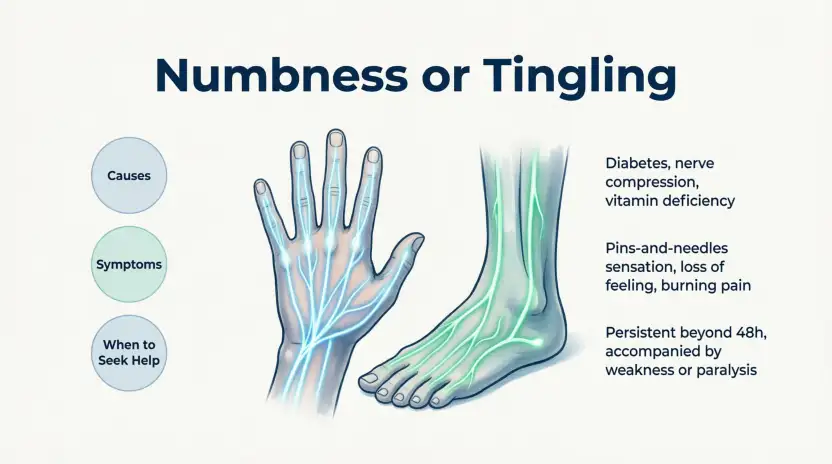
Numbness and tingling are often used together, but they describe different sensations. Numbness means you have less or no feeling in an area, while tingling feels like pins and needles, prickling, or tiny electric sensations. You can have one or both at the same time.
People often search for “numbness or tingling” because these sensations can happen after sitting in one position, putting pressure on a limb, or sleeping on an arm. They can also occur with nerve irritation or other health conditions. The meaning depends on where the sensation occurs, how long it lasts, and if other symptoms appear.
This guide explains the difference between numbness and tingling in plain English. It also covers common causes, everyday examples, how the terms are used in American and British English, common wording mistakes, and when the symptoms may need medical attention.
Numbness or Tingling: Quick Answer
The simplest difference is this:
- Numbness: You cannot feel an area normally.
- Tingling: You can feel an unusual prickling, buzzing, burning, or pins-and-needles sensation.
- Both: An area may feel numb and then start tingling as normal sensation returns.
Examples
Numbness:
“My foot feels numb after sitting on it.”
This means normal feeling has been reduced.
Tingling:
“I feel tingling in my fingers.”
This describes an unusual prickling or pins-and-needles sensation.
Both:
“My hand became numb and then started tingling.”
This can happen when pressure on a nerve is relieved and sensation begins to return.
The two words are closely related, but they are not exact synonyms.
What Does Numbness or Tingling Mean?
What does numbness mean?
Numbness describes reduced, altered, or absent sensation.
A numb area may feel:
- Less sensitive than usual
- Completely without feeling
- Difficult to feel when touched
- Heavy or “dead”
- Different from the surrounding skin
For example:
“My leg is numb.”
The speaker means the leg does not feel normal.
What does tingling mean?
Tingling describes an unusual sensation. People often describe it as:
- Pins and needles
- Prickling
- Buzzing
- Crawling
- A mild electric feeling
- Tiny needle-like sensations
For example:
“I have tingling in my toes.”
The person can feel something unusual, rather than having no sensation at all.
Can numbness and tingling happen together?
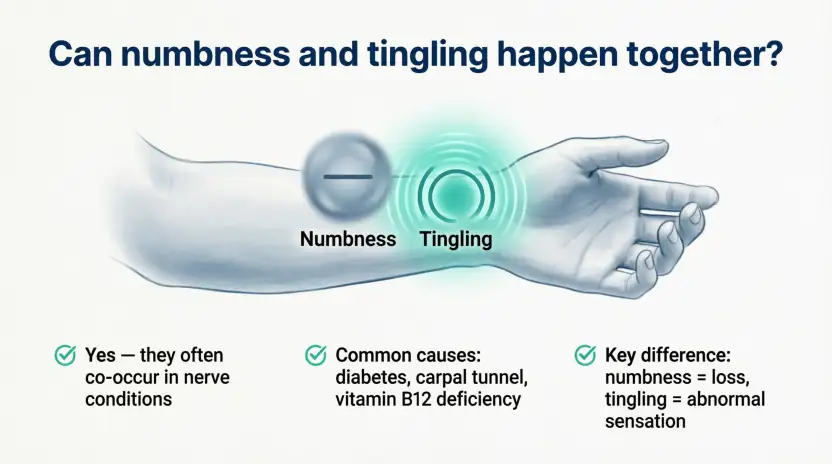
Yes. They commonly appear together.
Someone might say:
“My arm went numb and started tingling.”
In everyday speech, people may use the two terms interchangeably. In careful writing, however, they describe different sensations.
The Origin of Numbness and Tingling
The words numb and tingle have different histories.
Numb comes from an older English form related to the idea of being unable to feel. Over time, the word developed its modern meaning of lacking normal sensation.
Tingle has been used in English for a prickling or sharp sensation. Its modern use refers to a physical feeling that may be described as pins and needles.
These words have remained common because they describe sensations that are difficult to explain with a single technical term. In everyday English, people often use simple phrases such as “my hand is numb” or “my fingers are tingling.”
British English vs American English
There is no major spelling difference between American and British English for numbness or tingling. Both varieties use the same words.
| British English | American English | Example |
| numbness | numbness | “I have numbness in my hand.” |
| tingling | tingling | “There is tingling in my foot.” |
| pins and needles | pins and needles | “I have pins and needles in my leg.” |
| numb | numb | “My fingers feel numb.” |
| tingling sensation | tingling sensation | “She noticed a tingling sensation.” |
The main difference is often style and context, not vocabulary.
British and American medical writing can also use more formal terms such as altered sensation, loss of sensation, or paresthesia. These terms are more technical than ordinary conversation.
Which Version Should You Use?
Use the word that matches the sensation you want to describe.
United States
In everyday American English, numbness and tingling are both standard.
“I have numbness in my fingers.”
“I have tingling in my feet.”
United Kingdom
British English uses the same basic terms.
“My hand feels numb.”
“I have pins and needles in my leg.”
Canada
Canadian English also commonly uses numbness, tingling, and pins and needles.
Australia
Australian English uses these terms in much the same way.
International writing
For a worldwide audience, use simple terms first:
“numbness or a tingling sensation”
If needed, explain a technical term such as paresthesia afterward.
Academic writing
Academic or medical writing may require more precise terminology. Define technical terms before using them.
Business writing
These words are less common in business writing unless you are discussing health, workplace safety, or an employee’s symptoms.
Common Mistakes
Mistake 1: Treating numbness and tingling as exact synonyms
Incorrect:
“Numbness means a pins-and-needles feeling.”
Better:
“Tingling often describes a pins-and-needles feeling, while numbness describes reduced or absent sensation.”
Why?
The sensations can occur together, but they are not identical.
Memory tip:
Numb = less feeling. Tingling = unusual feeling.
Mistake 2: Using “tingling” when you mean complete loss of sensation
Less precise:
“My entire hand has a tingling feeling and I cannot feel touch.”
More precise:
“My hand feels numb, with some tingling.”
This makes the description clearer.
Mistake 3: Assuming every case has the same cause
Numbness or tingling can happen for many different reasons. The words describe a sensation, not a diagnosis.
If symptoms are persistent, severe, recurring, or sudden, the cause should be assessed by a qualified healthcare professional.
Mistake 4: Using technical terms without explanation
Paresthesia is a medical term associated with abnormal skin sensations, including sensations such as tingling or pins and needles.
For general readers, “tingling” is usually easier to understand.
Everyday Examples
Emails
“I have been experiencing numbness in my hand and may need to take a short break.”
Business writing
“The employee reported temporary numbness and tingling in the hand.”
News headlines
“New study examines causes of numbness and tingling.”
A headline may use both terms because readers commonly search for them together.
Blogs
“Numbness or tingling can feel strange, especially when it appears without an obvious reason.”
Social media
“Has anyone else experienced tingling in their fingers after working at a desk?”
Academic writing
“Participants reported changes in sensation, including numbness and tingling.”
Daily conversation
“My foot is numb.”
“Why are my fingers tingling?”
“I have pins and needles in my leg.”
These examples show why context matters. The best word depends on the sensation being described.
When Numbness or Tingling May Need Medical Attention
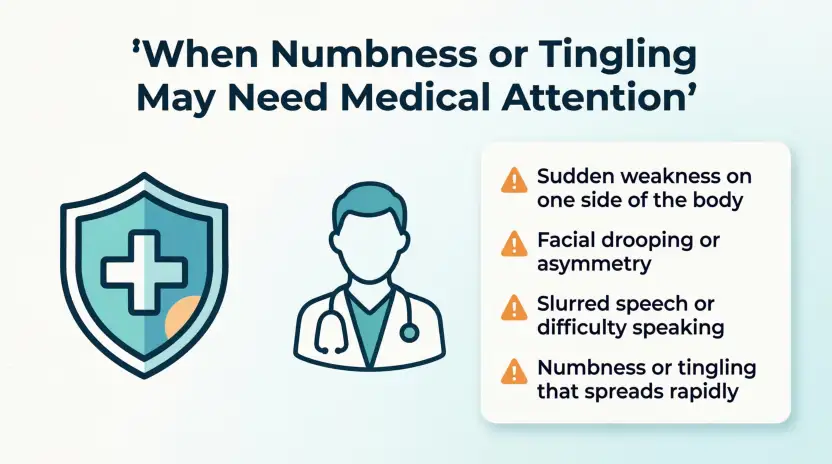
Numbness or tingling can sometimes be temporary. For example, pressure on a nerve can cause a limb to “fall asleep.”
However, symptoms that are sudden, severe, persistent, or accompanied by other concerning symptoms should not be ignored.
Seek urgent medical attention if numbness or tingling occurs suddenly with symptoms such as:
- Weakness or paralysis
- Trouble speaking
- Confusion
- Severe dizziness
- Difficulty walking
- Sudden vision problems
- Severe headache
- Loss of bladder or bowel control
- Symptoms after a serious injury
This article explains the language difference between the terms. It does not diagnose the cause of a person’s symptoms.
Google Trends & Modern Usage
People search for “numbness or tingling” because the two sensations are closely connected and are often experienced together.
The phrase is especially common in health-related searches, patient information, symptom descriptions, and medical communication.
There is no need to invent a specific search-volume statistic to understand the language pattern. In general usage, numbness focuses on reduced sensation, while tingling focuses on an unusual sensation such as pins and needles.
Searchers may also use related phrases such as:
- Numbness and tingling
- Tingling sensation
- Pins and needles
- Numb hands
- Tingling fingers
- Numb feet
- Tingling in legs
- Loss of sensation
- Causes of numbness
- Causes of tingling
Quick Comparison Table
| Version | Meaning | Correct? | Region | Example |
| Numbness | Reduced or absent sensation | Yes | English-speaking regions | “I have numbness in my foot.” |
| Tingling | Prickling or pins-and-needles sensation | Yes | English-speaking regions | “I feel tingling in my fingers.” |
| Numb | Adjective describing reduced sensation | Yes | US, UK, Canada, Australia | “My hand feels numb.” |
| Tingling sensation | Unusual prickling or similar feeling | Yes | International | “She noticed a tingling sensation.” |
| Pins and needles | Common phrase for a prickling sensation | Yes | Especially common in UK usage, also widely understood elsewhere | “I have pins and needles.” |
| Paresthesia | Medical term for abnormal sensations | Yes | Medical/technical writing | “The patient reported paresthesia.” |
Key Takeaways
- Numbness means reduced or absent normal sensation.
- Tingling means an unusual prickling or pins-and-needles sensation.
- You can experience numbness and tingling at the same time.
- Neither word is automatically a diagnosis.
- “Pins and needles” is a common everyday expression for tingling.
- American and British English use the same basic spellings.
- Use simple words for general readers and technical terms when the context requires them.
- Sudden or serious symptoms may require urgent medical evaluation.
FAQs
1. What is the difference between numbness and tingling?
Numbness means you have reduced or absent normal sensation. Tingling means you feel an unusual sensation such as prickling, buzzing, or pins and needles. They can occur separately or together. For example, a hand may first feel numb and then start tingling as normal sensation returns.
2. Is tingling the same as numbness?
No. Tingling and numbness are related but describe different sensations. Tingling usually means an unusual prickling or pins-and-needles feeling. Numbness means normal sensation is reduced or missing. People often experience both, which is why the phrase “numbness and tingling” is common.
3. What does numbness mean?
Numbness means an area has less normal feeling or no feeling. A numb hand, foot, arm, or leg may feel different from the surrounding area. Touch, pressure, temperature, or pain may feel reduced. The word describes a sensation and does not by itself identify its cause.
4. What does tingling feel like?
Tingling can feel like pins and needles, tiny prickles, buzzing, crawling, or a mild electric sensation. It may happen in the fingers, hands, feet, legs, arms, or another area. The exact feeling varies from person to person and can occur with or without numbness.
5. Is “numbness or tingling” grammatically correct?
Yes. “Numbness or tingling” is grammatically correct. The phrase joins two nouns with the conjunction “or.” It is useful when discussing either symptom without saying that both are present. In health writing, “numbness and tingling” is also common when both sensations are being discussed together.
6. Is “numbness and tingling” better than “numbness or tingling”?
Neither is always better. Use “numbness or tingling” when either symptom may occur. Use “numbness and tingling” when both symptoms are present or when discussing the two together. The correct choice depends on the meaning of the sentence.
7. What is another word for tingling?
Common alternatives include pins and needles, prickling, and a tingling sensation. In medical writing, paresthesia may be used as a technical term for abnormal sensations. For general readers, “tingling” or “pins and needles” is usually clearer.
8. What is the opposite of numbness?
The opposite of numbness is generally normal or full sensation, although there is not one exact opposite word for every context. If an area feels unusually sensitive rather than numb, terms such as increased sensitivity or hypersensitivity may be more appropriate.
9. Should I say “numb” or “numbness”?
Use numb when describing something with an adjective: “My fingers feel numb.” Use numbness as a noun: “I have numbness in my fingers.” Both are correct, but their grammar is different.
10. When should numbness or tingling be checked by a doctor?
Persistent, recurring, unexplained, or worsening numbness or tingling may need medical evaluation. Sudden symptoms, especially when combined with weakness, speech problems, confusion, severe dizziness, or other serious symptoms, require urgent attention. The appropriate response depends on the person’s overall symptoms and circumstances.
Conclusion
Numbness and tingling are related, but they do not mean exactly the same thing. Numbness describes reduced or absent sensation, while tingling describes an unusual sensation such as prickling or pins and needles.
Both terms are standard in American, British, Canadian, and Australian English. There is no major spelling difference between the regional varieties. The main difference is the meaning of the sensation being described.
For everyday writing, keep the distinction simple. Use numbness when normal feeling is reduced or missing. Use tingling when the person feels an unusual prickling or pins-and-needles sensation. If both occur, saying “numbness and tingling” is clear and natural.
Remember this simple rule: Numb means less feeling, while tingling means an unusual feeling.
If you are writing about symptoms, choosing the more precise word can make your message much easier to understand.
Read more about!
- Nick or Knick: Which Spelling Is Correct?
- Dominant or Recessive: What’s the Difference?
- Yoked or Yolked: Which Word Is Correct?

I’m Olivia Parker, a grammar and English writing enthusiast passionate about making English simple and easy to understand. Through Wordsblog, I share clear explanations, useful grammar tips, and practical writing guidance to help readers write with confidence. My goal is to make learning English easier, one word at a time.