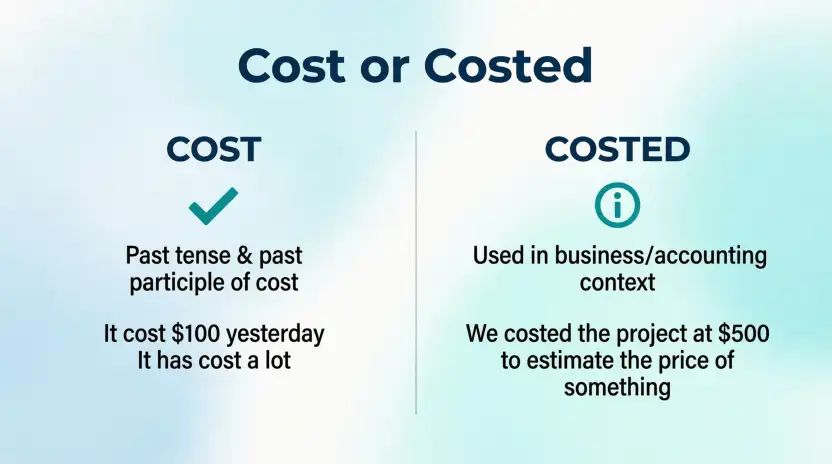
When choosing between cost or costed, the correct word depends on what you mean. For the usual meaning of “required a certain amount of money,” the past tense and past participle are cost, not costed. For example, “The car cost $20,000.”
However, costed is also a real and correct verb when it means “to calculate or estimate the cost of something,” especially a project, plan, or proposal.
This difference causes confusion because cost is an irregular verb, while costed looks like the regular past tense form that English learners might expect. You may also see phrases such as “a fully costed proposal” or “the project was costed at $2 million,” where costed is the right choice.
In this guide, you will learn the difference between cost and costed, how each form works, where costed is commonly used, and which form to choose in American, British, Canadian, and international English. You will also see practical examples for everyday, academic, and business writing.
What Does Cost or Costed Mean?
What does cost mean?
As a verb, cost can mean that something requires a particular amount of money.
For example:
The new computer cost $1,200.
It can also mean that something caused a person to lose something valuable:
The mistake cost him his job.
Cambridge lists both the money meaning and the meaning of causing someone to lose something valuable.
The important point is that cost does not normally become “costed” simply because the action happened in the past.
Compare:
- Present: The laptop costs $800.
- Past: The laptop cost $800.
- Present perfect: The laptop has cost $800.
What does costed mean?
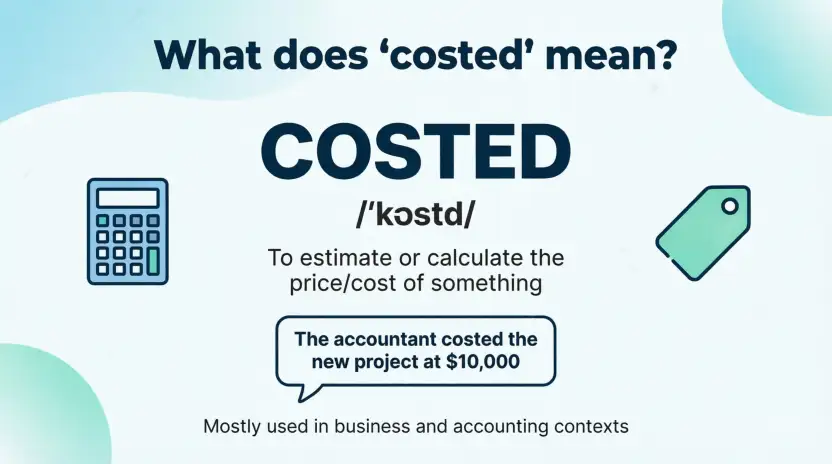
Costed is used when someone calculates, estimates, or determines how much something will cost.
For example:
The company costed the new building at $10 million.
This does not mean the building already required $10 million in payment. It means someone worked out an estimated cost.
You may also see:
The proposal was fully costed.
This means the financial cost of the proposal has been calculated.
Oxford and Cambridge both recognize this specialized meaning of costed.
The Origin of Cost or Costed
The word cost has a long history in English. Oxford traces the verb and noun to Middle English forms influenced by Old French, ultimately connected with Latin constare, meaning “to stand firm” or “to stand at a price.”
Over time, cost became an irregular English verb. Unlike many regular verbs, it does not normally add -ed to form its past tense.
For example:
- walk → walked
- work → worked
- price → priced
- cost → cost
This is why:
The jacket cost $100.
is standard when referring to the amount paid.
However, English also developed another use of cost meaning “to estimate the cost.” In this sense, costed developed as a regular past form. Modern dictionaries recognize this distinction.
This explains why both cost and costed can be correct. They are not simply two interchangeable past-tense forms.
British English vs American English
The distinction between the two meanings is important in both British and American English. Oxford’s British-English entry gives cost as the normal past form for the money meaning and specifically lists costed for the meaning “to estimate how much money will be needed.”
Oxford’s American English entry also recognizes costed for the estimating sense.
| Meaning | British English | American English | Example |
| Required a certain amount of money | cost | cost | The car cost $30,000. |
| Calculated an estimated cost | costed | costed | The team costed the project. |
| Calculated a proposal | costed | costed | The proposal was fully costed. |
| Past participle for ordinary price meaning | cost | cost | It has cost more than expected. |
There can be differences in how often specialized business wording appears in different regions, but the basic distinction is not simply “British = costed” and “American = cost.”
For ordinary statements about what something cost, cost is the safe standard form in both varieties.
Which Version Should You Use?
United States
Use cost when you mean that something required a particular amount of money.
The renovation cost $50,000.
Use costed when you mean that someone calculated the expected cost.
The contractor costed the renovation at $50,000.
Oxford’s American English dictionary recognizes this distinction.
United Kingdom
The same basic rule applies.
The house cost £300,000.
But:
The council costed the proposed project at £2 million.
The second sentence means that the expected financial requirement was calculated.
Canada
For general Canadian English, cost is the natural choice when discussing what something required in payment.
Use costed when you specifically mean “calculated the cost,” especially in formal or professional contexts.
Australia
The same distinction is useful in Australian English:
The repairs cost $5,000.
but:
The engineers costed the repairs before work began.
International Writing
If your readers come from different English-speaking regions, make the meaning clear through the sentence.
Use cost for actual or stated prices.
Use costed for estimates, budgets, calculations, and proposals.
Academic Writing
Academic writing may use costed when discussing financial estimates, economic models, projects, or research planning.
For example:
The researchers developed a fully costed plan for the study.
For a simple past price, use cost:
The equipment cost $2,000.
Business Writing
Costed is particularly useful in business and project management language.
Common phrases include:
- fully costed proposal
- costed plan
- costed project
- costed options
- costed estimate
The word often appears in formal financial planning because it describes the process of working out expected expenses.
Common Mistakes
Mistake 1: Using “costed” for an ordinary past price
Incorrect in standard general usage:
The shoes costed $100.
Correct:
The shoes cost $100.
Why?
Here, cost means that the shoes required a payment of $100. It is the irregular past form of the verb.
Memory tip:
If you can replace the sentence with “required payment of,” use cost.
Mistake 2: Thinking “cost” is always the past tense
Not always:
We costed the project before approving it.
Here, costed is correct because the verb means “calculated the cost.”
Memory tip:
Ask: “Did someone calculate the cost?”
If yes, costed may be the correct form.
Mistake 3: Confusing “costed” with “priced”
These verbs can overlap, but they are not always identical.
The store priced the product at $50.
This means the seller set or displayed the price.
The company costed the product at $35.
This means the company calculated its cost.
Oxford defines price as fixing something at a particular price level, while cost can refer to estimating the amount needed to produce something.
Mistake 4: Using “costed” in “has cost”
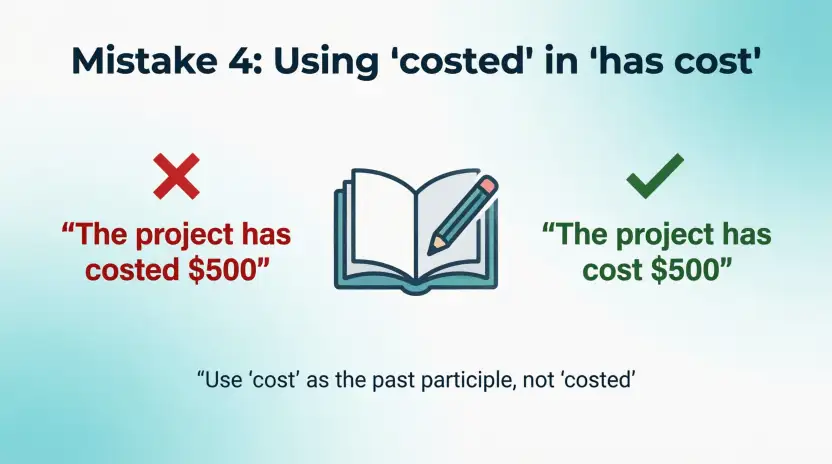
Incorrect for the normal money meaning:
The repairs have costed more than expected.
Correct:
The repairs have cost more than expected.
But:
We have costed several repair options.
is correct if you mean that you calculated their costs.
Everyday Examples
The best way to understand cost vs costed is to see how each word works in real writing.
Emails
Cost:
The replacement parts cost $450.
Costed:
We have costed the replacement options and attached the figures.
Business Writing
Cost:
The expansion cost the company $2 million.
Costed:
The finance team costed the expansion before approval.
News Headlines
Cost:
New stadium project cost taxpayers millions.
Costed:
Government releases fully costed housing plan.
The second pattern focuses on a financial calculation or proposal rather than simply stating what something already cost.
Blogs
The entire trip cost less than we expected.
But:
We costed three travel plans before booking.
Social Media
My new laptop cost $900.
But:
I costed the whole project before deciding to start it.
The first sounds natural for everyday conversation. The second is more specialized.
Academic Writing
The equipment cost $3,000.
But:
The research team costed the proposed study before submitting the grant application.
Daily Conversation
Most everyday speakers will use cost when talking about prices:
How much did it cost?
It cost me $20.
That meal cost too much.
If you are talking about calculating a budget, costed can be appropriate:
Have you costed the project yet?
Google Trends & Modern Usage
People searching for “cost or costed” are usually trying to solve a grammar or word-choice problem. The confusion comes from the fact that cost behaves like an irregular verb, while costed is also a legitimate form in a specific meaning.
Modern dictionary entries support both forms, but they assign them different jobs. Cambridge gives cost as the past tense and past participle for the ordinary “require a certain price” meaning, while it uses costed for calculating the price of a future project.
Oxford makes the same core distinction. Its English entry lists cost as the normal past form and costed specifically for the estimating sense.
General usage patterns also explain why the word appears often in business and government-style writing. Expressions such as fully costed proposals, costed plans, and costed projects describe financial calculations rather than ordinary purchases.
Dictionary.com also records costed as a past and past-participle form and provides examples from contemporary sources, showing that the form is actively used rather than being an obsolete word.
Exact Google Trends figures should be checked directly in Google Trends for a specific country and date range. Without that data, it would be misleading to claim a precise regional popularity ranking.
Quick Comparison Table
| Version | Meaning | Correct? | Region | Example |
| cost | Required a certain amount of money | Yes | US, UK, Canada, Australia, international | The car cost $25,000. |
| cost | Caused someone to lose something | Yes | All major varieties | The mistake cost him his job. |
| costed | Calculated or estimated a cost | Yes | US, UK, international | We costed the project. |
| costed | Used as a normal past form for a purchase price | Usually no | General English | The car cost $25,000. |
| costed out | Calculated the expected cost | Yes | Especially professional/business contexts | We costed out the options. |
The key is not the country alone. Meaning and context determine the correct form.
Key Takeaways
- Cost is the normal past tense of cost when something required a certain amount of money.
- Costed is correct when it means “calculated or estimated the cost.”
- “The phone cost $500” is correct.
- “The team costed the project at $500,000” is also correct.
- Do not use costed simply because you are talking about the past.
- Costed is common in formal, financial, project, and business contexts.
- Both British and American English recognize the specialized estimating use of costed.
- When unsure, ask what the verb means: paid/required money = cost; calculated a price = costed.
FAQs: Cost or Costed
1. Is “costed” a correct word?
Yes. Costed is a correct English word when it means “calculated or estimated the cost of something.” For example, “The company costed the project at $2 million.” However, when you mean that something required a certain amount of money, the normal past form is cost, as in “The project cost $2 million.”
2. What is the past tense of “cost”?
The past tense is usually cost when the verb means “required a certain amount of money.” For example, “The laptop cost $800.” English does not normally change this meaning to costed. Costed has a separate use meaning that someone calculated or estimated a cost.
3. Should I say “it cost” or “it costed”?
Say “it cost” when you mean the price or amount of money required. For example, “The dress cost $100.” Saying “it costed $100” is not the standard form for this meaning. Use costed when someone calculates an estimated cost, such as “The designer costed the project at $100,000.”
4. When should I use “costed”?
Use costed when the verb means “calculated or estimated the cost.” It is especially useful for projects, proposals, budgets, plans, products, and financial estimates. For example, “The engineers costed the new bridge at $50 million.” The word focuses on the calculation of expected cost, not simply on what someone paid.
5. Is “costed” British or American English?
Costed is recognized in both British and American English for the meaning “to estimate or calculate the cost.” Oxford lists this use in both its English and American English entries. The main difference is not that one country uses costed and the other does not. Context determines if it is appropriate.
6. Is “the project costed $1 million” correct?
Usually, that sentence does not express the intended meaning clearly. If you mean the project required $1 million, say “The project cost $1 million.” If you mean someone calculated its expected cost, say “The team costed the project at $1 million.” The preposition at often helps make the estimating meaning clear.
7. What is the difference between “cost” and “costed”?
Cost can mean that something required a certain amount of money, while costed can mean that someone calculated or estimated the amount needed. Compare “The building cost $5 million” with “The architects costed the building at $5 million.” The first states the cost. The second describes the costing process.
8. Is “has costed” correct?
It can be correct when costed means “calculated or estimated.” For example, “The team has costed the proposal.” But for the normal price meaning, use has cost: “The project has cost more than expected.” The intended meaning determines the correct form.
9. What does “fully costed” mean?
Fully costed means that the financial cost of a plan, proposal, project, or policy has been calculated in detail. For example, “The company presented a fully costed expansion plan.” It does not mean that the company has already paid the full amount. It means the expected costs have been worked out.
10. Is “costed out” correct English?
Yes. Costed out can mean that someone calculated the expected cost of something. For example, “We costed out several options before choosing a supplier.” Oxford includes cost something out as a use of the verb cost.
Conclusion
The difference between cost and costed becomes simple once you focus on meaning. Use cost when you are saying how much something required, or how much someone paid. For example, “The laptop cost $900” and “The repairs cost more than expected.”
Use costed when you mean that someone calculated or estimated the cost of a project, plan, proposal, or product. For example, “The engineers costed the project at $4 million.” This specialized use is recognized in both British and American English.
For everyday English, cost is the form you will use most often when talking about prices. In business, finance, planning, and project work, costed can be useful when describing a costing process.
The easiest memory rule is: If something had a price, it cost; if someone calculated the price, they costed it.
If this guide cleared up the difference, use the same rule whenever you come across cost vs costed in your writing.
Read more about!
- Nick or Knick: Which Spelling Is Correct?
- Dominant or Recessive: What’s the Difference?
- Yoked or Yolked: Which Word Is Correct?

I’m Olivia Parker, a grammar and English writing enthusiast passionate about making English simple and easy to understand. Through Wordsblog, I share clear explanations, useful grammar tips, and practical writing guidance to help readers write with confidence. My goal is to make learning English easier, one word at a time.