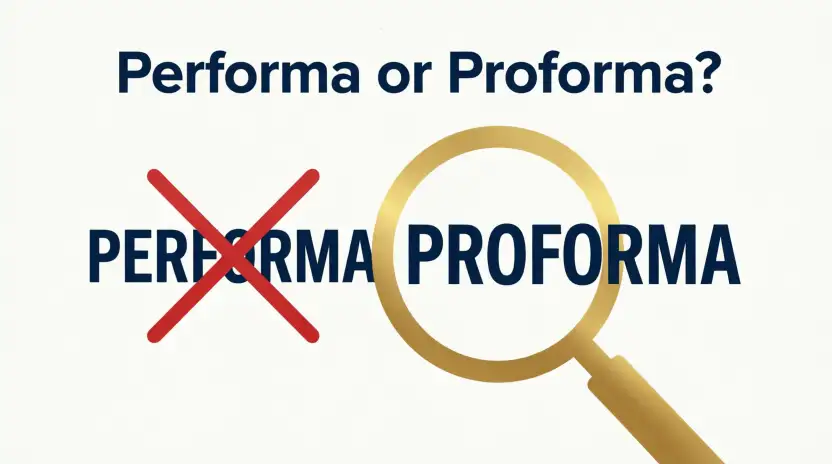
If you are unsure if to write performa or proforma, the form you want is proforma, or more traditionally pro forma. In business English, the term is used for documents such as a pro forma invoice, and it can also describe projected financial figures or a standard form or procedure. “Performa” is a common misspelling.
This confusion is easy to understand. The words sound similar, and “performa” may appear in emails, invoices, templates, and online documents. That repeated use can make the spelling look correct even when it is not the standard English form.
The good news is that the rule is simple. If you mean a preliminary invoice, a standard document, or projected financial figures, use pro forma or proforma, depending on the style of the document.
In this guide, you will learn the meaning of both forms, where the term comes from, how British and American English handle it, and which version to use in business, academic, and everyday writing.
Performa or Proforma: Quick Answer
The short answer is:
- ❌ performa: usually a misspelling of the term
- ✅ proforma: recognized alternative spelling
- ✅ pro forma: traditional and widely used form
- ✅ pro-forma: also found in some styles, especially before a noun
For example:
❌ Please send me the performa invoice.
✅ Please send me the pro forma invoice.
✅ Please send me the proforma invoice.
A pro forma invoice is generally a preliminary commercial document that gives information such as goods, prices, and terms before a final invoice is issued.
The term can also have other meanings. For example:
- pro forma statement
- pro forma financial results
- pro forma document
- pro forma letter
- pro forma procedure
So, if you are searching for performa or proforma which is correct, remember the key point: the “pro” spelling belongs to the English term.
What Does Performa or Proforma Mean?
The two spellings are not equal in standard English usage.
What does “pro forma” mean?
Pro forma comes from Latin and means roughly “for the sake of form” or “as a matter of form.”
In modern English, it has several uses.
1. A preliminary business document
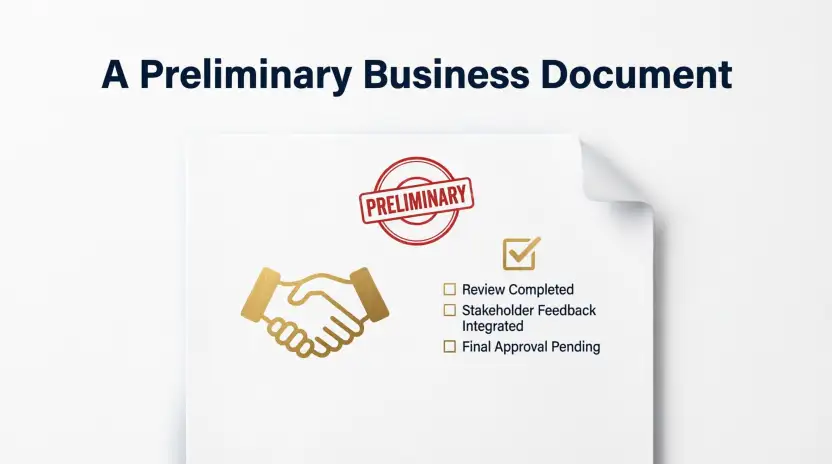
A pro forma invoice is used in commerce to show information about a proposed transaction before the final invoice stage.
For example:
Please review the attached pro forma invoice before we arrange shipment.
Cambridge defines a pro forma invoice as an invoice used before goods or services are supplied, or as a document showing prices for a potential customer.
2. A standard document or template
The term can refer to a document prepared as an example or standard model.
Example:
The manager sent a pro forma letter to all new clients.
3. Projected or adjusted financial information
In accounting and finance, pro forma can describe financial results that are not the final reported figures.
Example:
The company released its pro forma earnings for the new period.
Cambridge lists this financial use for results that are not final and are intended to show an expected or adjusted picture.
What does “performa” mean?
Performa is often seen as a spelling error for proforma or pro forma in English business writing.
For example:
❌ Please prepare the performa invoice.
Use:
✅ Please prepare the pro forma invoice.
The spelling performa is especially easy to create because the word sounds similar when spoken quickly.
The Origin of Performa or Proforma
The expression pro forma comes from Latin prō fōrmā. Its basic sense is connected with doing something “for the sake of form.”
English adopted the expression as a term used for something done according to a form, procedure, or expected format. It later developed important uses in business, commerce, law, and finance.
The spelling also explains why pro forma is so closely connected to forms and formal documents.
The form proforma developed as a closed-up spelling. Modern dictionaries recognize proforma as an alternative form of pro forma, although pro forma remains a very common dictionary form. Dictionary.com lists “also proforma,” while Collins also records “proforma” in relevant American usage.
This is different from performa. The latter does not represent the Latin expression behind the English term.
So the easiest way to remember the origin is:
pro + forma → pro forma → proforma
Not:
performa
British English vs American English
British and American English generally use the same underlying term here. The main variation is not performa vs proforma. It is if writers use pro forma, proforma, or sometimes pro-forma.
| Form | British English | American English | Example |
| pro forma | Common | Common | pro forma invoice |
| proforma | Used | Used | proforma invoice |
| pro-forma | Also seen | Also seen | pro-forma document |
| performa | Not the standard form for this meaning | Not the standard form for this meaning | performa invoice ❌ |
Cambridge uses pro forma as its main dictionary form and also records proforma invoice as a variant in its business dictionary.
There can also be differences in house style. For example, GOV.UK guidance specifically advises writers not to use proforma in its content and instead to use plain English such as “template” or “form” when that is what the writer means.
That is a style choice, not proof that proforma is an English misspelling.
Which Version Should You Use?
The best form depends partly on context.
United States
For formal American English, pro forma is a clear and familiar choice.
Use it in expressions such as:
- pro forma invoice
- pro forma statement
- pro forma earnings
- pro forma financial results
Proforma is also recognized in American dictionary sources, especially in compounds.
United Kingdom
Pro forma is widely understood and used in British English.
In business and government documents, follow the style guide used by your organization. Some British government guidance prefers plain English alternatives such as “form” or “template” where they communicate the meaning more clearly.
Canada
For Canadian business writing, pro forma is a clear international form. If your company has a house style, follow it consistently.
Australia
Pro forma is also suitable for professional and business writing. As with other English-speaking regions, the exact formatting may depend on the organization’s style guide.
International writing
For international readers, pro forma is usually the clearest form because it closely matches major dictionary entries and established business terminology.
Academic writing
Use pro forma when it is part of an established term in your field.
For example:
The researchers used a pro forma data collection sheet.
If “form” or “template” communicates the meaning just as well, a plain-English alternative may be easier for general readers.
Business writing
In business documents, consistency matters.
If you write:
pro forma invoice
do not randomly switch between:
performa invoice
proforma invoice
pro-forma invoice
unless your organization’s style guide specifically requires different forms.
Common Mistakes
Mistake 1: Writing “performa invoice”
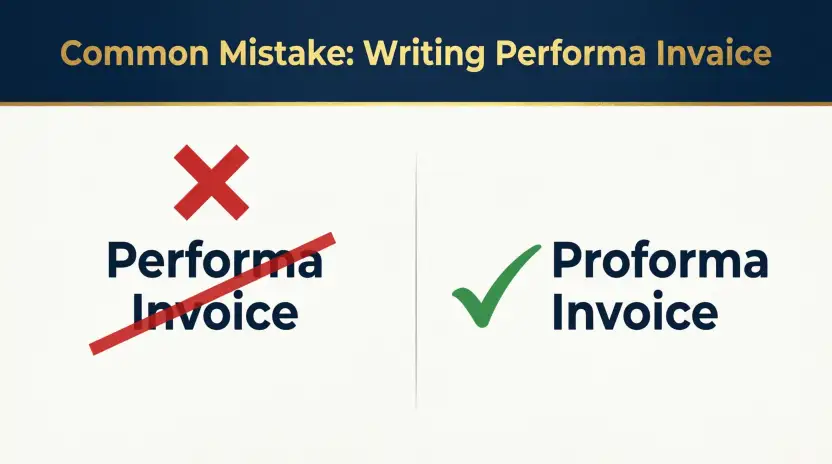
Incorrect:
Please find the performa invoice attached.
Correct:
Please find the pro forma invoice attached.
Explanation:
The established business term is pro forma invoice. Cambridge also records proforma invoice as an alternative form.
Memory tip:
Think pro + forma = according to form.
Mistake 2: Assuming “performa” is a shorter form
Some writers think “performa” is simply a shortened version of “pro forma.”
It is not.
The original expression is pro forma, so the spelling begins with pro, not per.
Mistake 3: Treating every pro forma invoice as a final invoice
A pro forma invoice is not automatically the same thing as a final tax invoice.
For example, HMRC explains that a pro-forma invoice can be used to provide information about goods or services before supply and that it does not serve the same accounting function as a valid VAT invoice.
Memory tip:
Think:
Pro forma = preliminary information.
Then check the applicable tax and accounting rules before treating it as an official invoice.
Mistake 4: Using a specialized term when plain English is clearer
Not every situation needs the phrase pro forma.
Instead of:
Complete the pro forma before your appointment.
you might write:
Complete the form before your appointment.
If the document is simply a form, “form” may be clearer.
Everyday Examples
Here are practical examples showing how the term appears in real writing.
Emails
Please review the attached pro forma invoice.
Could you send us a pro forma before we place the order?
Business Writing
The supplier provided a pro forma invoice before shipment.
We prepared a pro forma statement based on the proposed transaction.
News Headlines
Company releases pro forma financial figures after acquisition.
Blogs
A pro forma invoice can help a buyer understand expected costs before delivery.
Social Media
Our team has prepared a pro forma estimate for the upcoming project.
Academic Writing
The research team used a pro forma data collection sheet.
Daily Conversation
They sent me a pro forma before I confirmed the order.
These examples show that pro forma is not limited to invoices. Its meaning changes slightly depending on the context.
Google Trends & Modern Usage
People search “performa or proforma” because both spellings appear online, especially in business documents and invoice-related searches.
Search results can also create confusion. A misspelled term may appear repeatedly in templates, emails, websites, or user-generated content. Seeing the same spelling many times does not necessarily make it the standard spelling.
There is also a second source of confusion: pro forma and proforma are both encountered in English.
Major dictionary sources support the established term pro forma, while some dictionaries also recognize proforma as an alternative spelling.
Modern business usage includes:
- pro forma invoice
- pro forma financial statement
- pro forma earnings
- pro forma results
- pro forma document
- pro forma letter
For official documents, always check the terminology used by your organization, industry, or relevant government authority.
Quick Comparison Table
| Version | Meaning | Correct? | Region | Example |
| performa | Usually intended as “pro forma” | ❌ Usually incorrect | English usage | performa invoice |
| pro forma | According to form; preliminary, standard, or projected depending on context | ✅ Yes | International | pro forma invoice |
| proforma | Closed-up alternative form of pro forma | ✅ Yes in recognized usage | English usage | proforma invoice |
| pro-forma | Hyphenated form found in some styles | ✅ Used in some styles | Varies | pro-forma document |
For the clearest professional wording, pro forma is a strong default.
Key Takeaways
- Performa is generally a misspelling when you mean the business term.
- Pro forma is the traditional and widely recognized form.
- Proforma is also an accepted alternative spelling in some dictionary and business usage.
- Pro forma invoice refers to a preliminary commercial document.
- Pro forma can also describe projected or adjusted financial information.
- British and American English do not create a simple “performa vs proforma” regional difference.
- Always follow your employer’s or publication’s style guide when one exists.
- When in doubt, pro forma is a clear professional choice.
FAQs
1. Is “performa” or “proforma” correct?
Proforma is a recognized spelling of pro forma, while performa is generally a misspelling when used for the English business term. In formal writing, pro forma is a clear choice. For example, write “pro forma invoice,” not “performa invoice.”
2. Is “proforma” one word or two words?
Both pro forma and proforma are found in English usage. Cambridge uses pro forma as its main form and also records “proforma invoice” as an alternative. For formal writing, check your organization’s preferred style.
3. Is “performa invoice” correct?
No. If you mean the commercial document, write pro forma invoice or, where your style allows it, proforma invoice. “Performa invoice” is generally a spelling error. A pro forma invoice is normally used before the final supply or invoicing stage.
4. What is the meaning of a pro forma invoice?
A pro forma invoice is a preliminary commercial document that can show goods or services, prices, and other transaction details before the final invoice stage. It may be used to request payment before delivery or to show a potential customer the expected price.
5. Is pro forma the same as an invoice?
Not always. A pro forma invoice is generally a preliminary document rather than the final tax or accounting invoice. For example, HMRC states that a pro-forma invoice cannot be used as evidence for reclaiming input VAT in the way a valid VAT invoice can.
6. Is pro forma British or American English?
Pro forma is used in both British and American English. The main difference is often style rather than nationality. You may also encounter proforma or pro-forma. The exact choice can depend on a dictionary, publisher, company, or government style guide.
7. What does pro forma mean in accounting?
In accounting and finance, pro forma can describe financial information prepared to show an expected or adjusted picture rather than simply the final reported figures. Examples include pro forma earnings and pro forma financial statements.
8. Is “proforma” grammatically correct?
Yes, proforma is recognized as an alternative spelling in English sources. However, pro forma is a widely used dictionary form and is often the clearest choice in formal writing. Follow the style guide for your workplace, publication, or institution.
9. How do you remember pro forma?
Think of the Latin-based expression pro forma, connected with “form.” This makes pro forma easier to remember than “performa.” For business writing, picture the common phrase pro forma invoice.
10. Should I write “pro forma” or “proforma” on an invoice?
Use the form required by your organization’s style guide. If there is no specific rule, pro forma invoice is a clear and widely recognized choice. The most important point is to avoid performa invoice, which is generally a spelling error for this term.
Conclusion
The confusion between performa or proforma comes mainly from similar pronunciation and the way business terms spread through emails, templates, and online documents.
The established expression is pro forma, and proforma is also recognized as an alternative spelling. Performa, however, is generally not the form you want when writing about a pro forma invoice, pro forma statement, or similar business document.
For professional writing, pro forma is a safe and clear default. Use it in phrases such as “pro forma invoice,” “pro forma statement,” and “pro forma financial results.” If your company or publication uses proforma, consistency with that style is more important than switching forms randomly.
Also remember that a pro forma invoice is not automatically the same as a final tax invoice. The exact accounting or tax treatment depends on the relevant rules and jurisdiction.
The simple rule to remember is: when you mean the established business term, choose “pro forma,” not “performa.”
If this guide helped clear up the spelling, consider sharing it with someone who deals with business documents or invoices.
Read more about!
- Nick or Knick: Which Spelling Is Correct?
- Dominant or Recessive: What’s the Difference?
- Yoked or Yolked: Which Word Is Correct?

I’m Olivia Parker, a grammar and English writing enthusiast passionate about making English simple and easy to understand. Through Wordsblog, I share clear explanations, useful grammar tips, and practical writing guidance to help readers write with confidence. My goal is to make learning English easier, one word at a time.






4 thoughts on “Performa or Proforma: Which Spelling Is Correct?”