An SUV is usually better for passenger space and everyday driving, while a truck is better for towing, hauling, and heavy-duty work. Choosing between an SUV or truck depends on how you plan to use the vehicle.
This comparison can be confusing because modern SUVs and pickup trucks can share many features. Both can offer four-wheel drive, strong engines, large cabins, and useful cargo space. Some SUVs can even tow heavy loads, while some trucks are comfortable enough for daily family use.
People often search for SUV or truck when buying a new vehicle, comparing family transportation options, or deciding what works best for work and recreation. The right choice depends less on which vehicle looks better and more on what you need it to do.
An SUV usually gives you an enclosed cargo area, comfortable seating, and easy daily use. A pickup truck gives you an open bed that is useful for tools, equipment, building materials, and large loads.
In this guide, we will compare SUVs and trucks by space, towing, cargo, fuel use, comfort, off-road ability, cost, and everyday practicality.
SUV or Truck – Quick Answer
An SUV is generally the better choice for families, passengers, and everyday driving, while a truck is usually better for towing, hauling, and work-related tasks.
Choose an SUV if you need:
- More enclosed passenger and cargo space
- Comfortable family transportation
- Easier everyday driving
- Flexible seating
- Weather-protected cargo
Choose a truck if you need:
- An open cargo bed
- Strong towing ability
- Heavy hauling capability
- Space for tools and equipment
- A vehicle for work or outdoor activities
For example, a family that mainly drives to school, work, and stores may prefer an SUV. A contractor who carries lumber, tools, or equipment may get more value from a truck.
Definition and Meaning of SUV or Truck
What is an SUV?
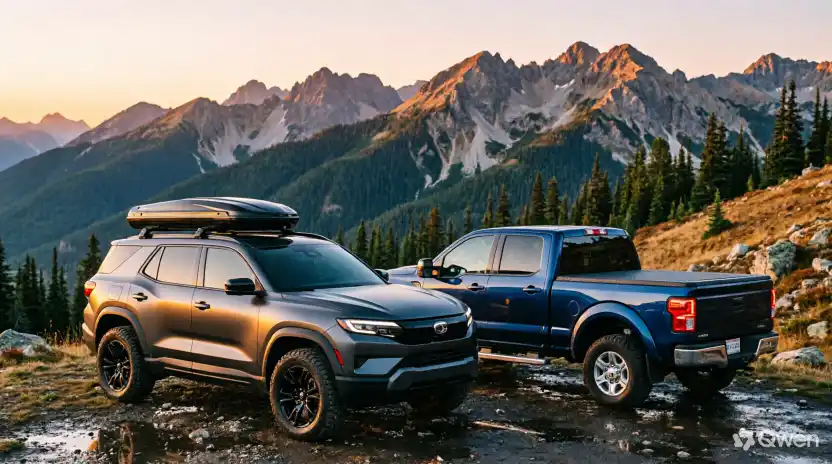
SUV stands for sport utility vehicle. It is a type of passenger vehicle designed to combine features of a car with features commonly associated with utility vehicles.
Cambridge Dictionary defines SUV as an abbreviation for sport utility vehicle and describes it as a large, powerful passenger vehicle.
SUVs are available in many sizes.
Examples include:
- Subcompact SUVs
- Compact SUVs
- Midsize SUVs
- Full-size SUVs
Some have two rows of seats, while larger models may have three.
SUVs are popular because they can offer a useful balance of passenger comfort, cargo space, ground clearance, and available all-wheel or four-wheel drive.
What is a truck?
A truck is a vehicle designed mainly to transport goods, equipment, or other loads. In American English, “truck” can refer to many types of vehicles, including pickup trucks and larger commercial vehicles.
For an SUV-or-truck comparison, people usually mean a pickup truck.
A pickup has:
- A passenger cabin
- A separate or integrated cargo bed
- Towing capability
- Hauling capability
- Different cab and bed sizes
The open bed is one of the biggest differences between a pickup truck and an SUV.
SUV vs pickup truck
| Feature | SUV | Pickup Truck |
| Passenger space | Usually excellent | Varies by cab |
| Cargo area | Enclosed | Open bed |
| Towing | Good to excellent on some models | Often excellent |
| Hauling | Good | Excellent |
| Family use | Excellent | Good to excellent |
| Work use | Good | Excellent |
| Weather protection for cargo | Excellent | Limited in open bed |
| Off-road use | Available on many models | Available on many models |
The best choice depends on your main purpose.
The Origin of SUV or Truck
Where does SUV come from?
SUV is an abbreviation for sport utility vehicle. The term developed as the automotive market created vehicles that combined passenger-car features with utility and off-road characteristics.
SUVs became increasingly common as manufacturers offered vehicles with higher seating positions, larger interiors, and available four-wheel-drive systems.
Today, the SUV category includes a wide range of vehicles. Some are small and designed mainly for city driving. Others are large and built for towing, off-road travel, or carrying several passengers.
Where does truck come from?
The word truck has a much older history than the modern pickup truck.
The modern vehicle meaning developed around the idea of a vehicle used to carry goods. Cambridge Dictionary defines a truck as a large road vehicle used for transporting goods and also lists pickup truck as a related type.
The pickup truck later became an important vehicle for farming, construction, transportation, recreation, and everyday driving.
Why do SUV and truck categories overlap?
Modern vehicle design has blurred some traditional boundaries Some trucks offer luxury interiors and family-friendly seating. Some SUVs are also built on truck-based platforms.
There is even a regulatory distinction between car SUVs and truck SUVs in the United States. The EPA explains that some SUVs are classified as trucks under regulatory rules based on factors such as weight, drive system, and design.
So, “SUV” and “truck” are not always completely separate technical categories.
British English vs American English Spelling
Is “truck” used differently in British English?
Yes. In British English, lorry is commonly used for a large road vehicle that carries goods, while truck is also used in some contexts. Cambridge specifically lists “lorry” as a UK term for truck.
In American English, truck is the standard everyday term.
The word SUV is also widely used internationally, although local names for similar vehicles can vary.
| British English | American English | Example |
| SUV | SUV | I bought an SUV. |
| Lorry | Truck | The truck is carrying goods. |
| Pickup truck | Pickup truck | He drives a pickup truck. |
| 4×4 | SUV / 4×4 | The vehicle has four-wheel drive. |
Does the spelling change?
The spelling SUV does not normally change between British and American English.
The larger difference is often the vocabulary used for different types of vehicles.
For example:
British English:
“I saw a lorry on the road.”
American English:
“I saw a truck on the road.”
For a website targeting an international audience, SUV and truck are widely understood, but “pickup truck” is clearer when you specifically mean a pickup.
Which Vehicle Should You Use?
United States
A pickup truck is a strong choice if you regularly tow trailers, carry equipment, or use a cargo bed.
An SUV may be better if your main needs are passengers, commuting, family trips, and enclosed cargo.
United Kingdom
Vehicle terminology can differ. “Lorry” usually refers to larger goods vehicles, while an SUV remains an SUV.
For personal transportation, compare SUVs with pickup trucks rather than large commercial lorries.
Canada
Both SUVs and pickup trucks are common choices. An SUV can be useful for families and winter driving, while a truck can be useful for towing, hauling, and outdoor work.
Australia
An SUV may suit families and general road use. A pickup, often called a ute in Australia, can be useful for work, towing, and carrying equipment.
International Writing
For a global audience, use clear terms such as:
- SUV
- pickup truck
- four-wheel drive
- cargo bed
- towing
- passenger space
Avoid assuming that every country uses “truck” in exactly the same way.
Academic or Formal Writing
Use the full term the first time if your readers may not know the abbreviation:
A sport utility vehicle (SUV) provides enclosed passenger and cargo space.
After that, SUV is fine.
Business Writing
Be specific about the vehicle’s purpose.
Instead of saying:
We need a truck.
Say:
We need a pickup truck that can tow a trailer and carry equipment.
Clear wording prevents confusion.
Common Mistakes with SUV or Truck
Mistake 1: Treating every SUV as a truck
Incorrect:
“Every SUV is a pickup truck.”
Correct:
“An SUV and a pickup truck are different vehicle types.”
An SUV normally has an enclosed rear cargo area. A pickup has an open cargo bed.
Mistake 2: Assuming every truck is designed for heavy work
Not every pickup has the same towing or payload capacity.
Always check the specific vehicle’s ratings before towing or hauling.
Mistake 3: Choosing based only on size
A bigger vehicle is not automatically better.
A large SUV may be unnecessary for someone who mainly drives alone. A large truck may also be excessive if the owner rarely carries or tows anything.
Mistake 4: Ignoring cargo protection
A truck bed is useful, but an open bed does not protect cargo from weather as well as an enclosed SUV cargo area.
Mistake 5: Assuming all SUVs have four-wheel drive
Some SUVs have front-wheel drive, some have all-wheel drive, and others offer four-wheel drive.
Check the exact model and trim.
SUV or Truck in Everyday Examples

Emails
SUV example:
We need an SUV with enough space for five passengers and luggage.
Truck example:
We need a pickup truck to carry construction equipment.
Business Writing
The company is considering an SUV for sales staff who travel between offices.
The company needs a truck for transporting tools and materials.
News Headlines
Common headline wording may include:
- SUV Sales Continue to Grow
- Truck Demand Remains Strong
- New SUV Adds More Cargo Space
- Pickup Truck Gets a New Towing System
Blogs
A car blog may write:
An SUV is usually more practical for families, while a pickup truck makes more sense for frequent hauling.
Social Media
SUV or truck? I need something for family trips and weekend adventures.
Formal Writing
SUVs generally prioritize passenger comfort and enclosed cargo space, while pickup trucks offer an open cargo bed and strong utility.
Daily Conversation
“Should we get an SUV or a truck?”
“If you’re mostly carrying the family, I’d choose an SUV.”
SUV or Truck – Google Trends & Usage Data
Searches for SUV or truck are closely connected to vehicle buying, comparisons, towing, family transportation, fuel costs, cargo space, and outdoor activities.
Exact search interest changes by country and over time. It would not be accurate to give one fixed popularity figure without a specific Google Trends location and date range.
Why do people search “SUV or truck”?
Common search reasons include:
- Buying a new vehicle
- Comparing family vehicles
- Choosing a work vehicle
- Comparing towing ability
- Comparing cargo space
- Planning outdoor activities
- Comparing fuel economy
- Understanding maintenance costs
- Choosing between an SUV and pickup
SUV popularity
SUVs have become a major part of the vehicle market. The U.S. EPA reports a long-term shift from sedans and wagons toward car SUVs and truck SUVs. Its latest automotive trends reporting also shows that SUV production represents a large share of U.S. vehicle production.
Truck popularity
Pickup trucks remain important for work, towing, construction, agriculture, recreation, and personal transportation.
The strongest choice depends on the buyer’s actual needs rather than popularity alone.
Search intent behind “SUV or truck”
The keyword has clear commercial investigation intent.
People searching it are often close to making a decision. They want to know:
Which vehicle gives me the best combination of practicality, comfort, capability, and value?
That is why a useful comparison should discuss real-life needs instead of simply naming a winner.
SUV vs Truck Comparison Table
| Feature | SUV | Truck |
| Best for | Families and daily use | Work and hauling |
| Seating | Usually strong | Depends on cab |
| Cargo | Enclosed | Open bed |
| Towing | Good to excellent | Often excellent |
| Heavy hauling | Limited to strong | Strong |
| Passenger comfort | Usually excellent | Varies |
| Weather protection | Excellent | Lower for open-bed cargo |
| Off-road options | Many available | Many available |
| Family trips | Excellent | Good to excellent |
| Work use | Good | Excellent |
| City driving | Often easier | Can be less convenient |
| Large equipment | Limited | Better suited |
Which one wins?
There is no universal winner.
SUV wins for: family use, passenger comfort, enclosed cargo, and everyday driving.
Truck wins for: towing, hauling, equipment, and open-bed utility.
Key Takeaways
- An SUV is usually better for families and everyday passenger use.
- A pickup truck is usually better for towing and hauling.
- SUVs have enclosed cargo areas.
- Pickup trucks have open cargo beds.
- Not every SUV has four-wheel drive.
- Not every truck has the same towing or payload capacity.
- The best choice depends on how you use the vehicle.
- Always check the exact model’s specifications before buying or towing.
FAQs
1. Is an SUV better than a truck?
An SUV is better for many families and daily drivers, while a truck is better for towing, hauling, and work.
2. Is an SUV or truck better for families?
An SUV is usually the better family choice because it offers comfortable seating and an enclosed cargo area.
3. Is a truck better for towing?
Often, yes. Many pickup trucks are designed with strong towing capability, but ratings vary by model.
4. Is an SUV cheaper than a truck?
It depends on the model, size, features, and market. Compare purchase price, fuel, insurance, and maintenance costs.
5. Which has more cargo space, an SUV or truck?
It depends on the vehicle. SUVs offer enclosed cargo space, while trucks offer an open bed that is useful for large items.
6. Is an SUV safer than a truck?
Neither category is automatically safer. Safety depends on the specific vehicle, equipment, design, and driving conditions.
7. Should I buy an SUV or truck?
Choose an SUV for passenger-focused use and a truck if you regularly tow, haul, or carry equipment.
Conclusion
Choosing between an SUV or truck depends on what you need from your vehicle. An SUV is usually the stronger choice for families, commuting, road trips, passengers, and enclosed cargo. It gives you a practical mix of comfort and utility.
A pickup truck makes more sense when your daily life includes towing trailers, carrying tools, moving equipment, or using an open cargo bed. Trucks can also work well as family vehicles, especially models with spacious crew cabs.
Do not choose based only on appearance or size. Think about how often you carry passengers, how much cargo you need, if you tow, where you drive, and how much vehicle you actually need.
Also check the specifications of the exact model before buying. Towing capacity, payload, fuel economy, dimensions, and drivetrain can vary widely between vehicles.
The simplest rule is easy to remember: choose an SUV for people and everyday flexibility, and choose a truck for hauling and heavy-duty utility.
If you are still comparing the two, make a list of your top five vehicle needs. The right choice will usually become much clearer.
Read more about!

I’m Olivia Parker, a grammar and English writing enthusiast passionate about making English simple and easy to understand. Through Wordsblog, I share clear explanations, useful grammar tips, and practical writing guidance to help readers write with confidence. My goal is to make learning English easier, one word at a time.







5 thoughts on “SUV or Truck: Which One Is Better for You?”