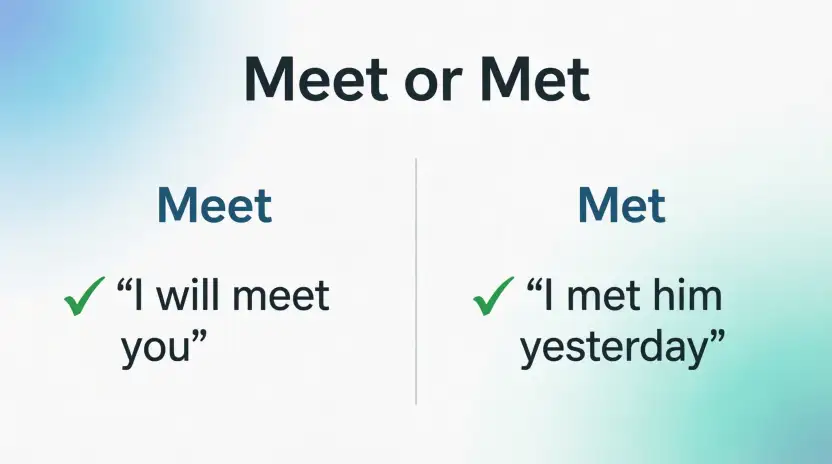
“Meet or met” is a common English grammar question because both words come from the same verb but refer to different times. Meet is the present or base form, while met is the simple past and past participle of meet.
The difference is mainly about tense and context, not British versus American English. You use meet for present, future, or base-form constructions, while met usually describes an action that happened in the past.
This can become confusing in sentences such as “I meet him yesterday” and “I met him yesterday.” The first is incorrect because yesterday places the action in the past. The second is correct.
In this guide, you will learn exactly when to use meet and met, see clear examples, avoid common mistakes, and understand how these forms work in everyday, academic, and business English.
Meet or Met: Featured Snippet + AI Overview
Meet is the base and present form of the verb, while met is its simple past and past participle form. Use meet for present or future situations, such as “I meet my manager every Monday.” Use met for completed past actions, such as “I met my manager yesterday.”
Meet or Met: Quick Answer
The simplest rule is:
- Meet = present, base form, or future context
- Met = past tense and past participle
- Meet is used for actions that happen now, regularly, or later.
- Met is used for completed actions in the past.
Examples
Present:
I meet my friends every Friday.
Past:
I met my friends last Friday.
Future:
I will meet my friends tomorrow.
Notice that meet can appear with will, while met cannot.
❌ I will met him tomorrow.
✅ I will meet him tomorrow.
Cambridge Dictionary lists met as both the past simple and past participle of meet.
What Does Meet or Met Mean?
What Does “Meet” Mean?
Meet is the base form of the verb. It can mean coming together with another person, seeing someone for the first time, or coming together for a planned purpose.
For example:
I meet my colleagues every morning.
We need to meet tomorrow.
I would like you to meet my sister.
Meet also has other meanings. It can mean satisfying a need, achieving a target, or fulfilling a requirement.
The product meets our needs.
We must meet the deadline.
The building meets all safety requirements.
Cambridge includes meanings related to coming together, being introduced to someone, waiting for someone, satisfying requirements, and achieving goals.
What Does “Met” Mean?
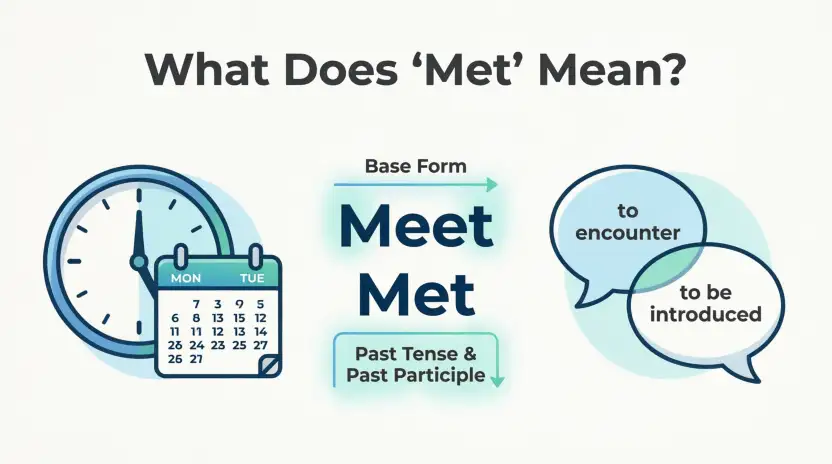
Met is the simple past and past participle of meet. It normally describes something that has already happened.
I met Sarah yesterday.
We met at school in 2020.
They met for lunch last week.
It can also appear with helping verbs:
I have met him before.
She had met the client previously.
So, met does not simply mean “meet in the past.” It can also be used as the past participle after have, has, or had.
The Origin of Meet or Met
The history of meet is much older than modern English.
The verb comes from Middle English mēten and Old English metan, with meanings connected to finding, encountering, coming together, and obtaining. It is linked to the Proto-Germanic form motjanan and ultimately to a Proto-Indo-European root associated with meeting or assembling.
Over time, meet developed several related meanings. By around the 14th century, it could describe physical contact or coming together. Later, it gained more abstract meanings, including encountering something and satisfying a requirement or expectation.
The form met developed as the past form of meet. Today, English learners simply need to remember the irregular verb pattern:
meet → met → met
This is similar to other irregular verbs such as:
see → saw → seen
go → went → gone
take → took → taken
The key point is that met is not a different verb. It is a grammatical form of meet.
British English vs American English
There is no meaningful British-versus-American difference between meet and met. Both varieties use the same irregular verb forms.
| British English | American English | Example |
| meet | meet | We meet every Monday. |
| met | met | We met last Monday. |
| have met | have met | I have met her before. |
| will meet | will meet | I will meet him tomorrow. |
Cambridge gives the same basic forms for British and American English: meet → met → met.
The difference you notice in a sentence is therefore usually caused by tense or sentence structure, not regional spelling.
For example:
British English: I met him yesterday.
American English: I met him yesterday.
Both are correct.
What about pronunciation?
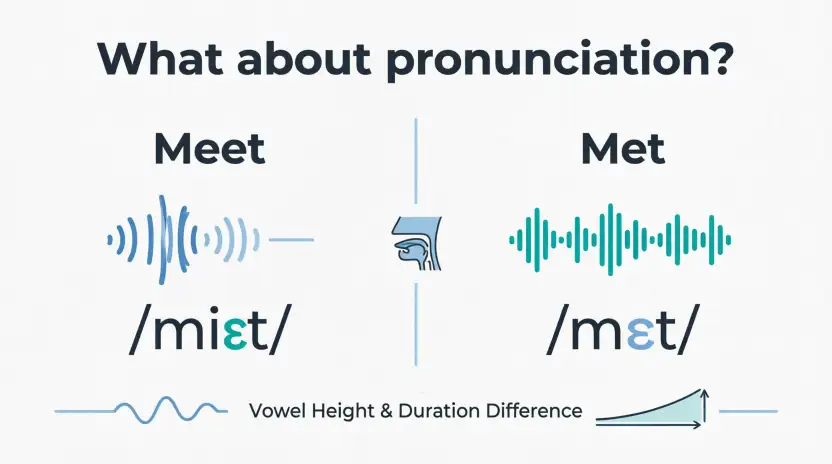
The two forms also have different pronunciations:
- meet: /miːt/
- met: /met/
The vowel sound changes, so they should not be treated as interchangeable forms when speaking.
Which Version Should You Use?
United States
Use meet for present and future situations:
I meet my team every Tuesday.
I will meet you at 5 p.m.
Use met for completed past actions:
I met her yesterday.
United Kingdom
The same rule applies.
We meet every week.
We met last week.
There is no special British rule that changes meet into another past form.
Canada
Canadian English also follows the standard irregular verb pattern:
meet → met → met
Australia
Australian English uses the same forms as standard English elsewhere:
I meet him every morning.
I met him yesterday.
International Writing
For international readers, focus on clear time markers.
Words such as yesterday, last week, ago, in 2020, earlier, previously often signal a past event.
Words such as today, usually, every week, tomorrow, next month often point toward present or future situations.
Academic Writing
Use the form that matches the time of the research or event.
The researchers met in 2024.
The researchers meet every month.
Business Writing
The same distinction is important in professional emails and reports.
We met with the client yesterday.
We will meet with the client tomorrow.
Common Mistakes
Mistake 1: Using “meet” with a finished past time
Incorrect:
I meet him yesterday.
Correct:
I met him yesterday.
Why?
Yesterday clearly refers to the past, so the verb must be in the past form.
Memory tip:
If the event is finished and happened before now, think meet → met.
Mistake 2: Using “met” after “will”
Incorrect:
I will met you tomorrow.
Correct:
I will meet you tomorrow.
Why?
After will, English uses the base form of the verb.
will meet
will go
will see
will take
Not:
will met
will went
will saw
will took
Mistake 3: Using “meet” after “have”
Incorrect:
I have meet her before.
Correct:
I have met her before.
Why?
The present perfect uses:
have/has + past participle
The past participle of meet is met.
Mistake 4: Using “met” for a regular habit
Incorrect:
I met my manager every Monday.
Correct:
I meet my manager every Monday.
If you are describing a current routine, use the present form.
Mistake 5: Confusing “met” with a separate word
Met is not simply an alternative spelling of meet. It is the past and past participle form of the verb.
meet → present/base form
met → past/past participle
Everyday Examples
Emails
It was great to meet you yesterday.
Here, meet appears after to, so the base form is required.
Another example:
I met with the marketing team yesterday.
Here, met is correct because the meeting already happened.
Business Writing
We will meet to discuss the proposal.
We met to discuss the proposal last Tuesday.
Our teams meet every month.
These three sentences show future, past, and regular present use.
News Headlines
News writing often uses the simple past for completed events:
Leaders met to discuss the agreement.
For an upcoming event, a headline may use:
Leaders to meet tomorrow.
Blogs
I met a writer who changed the way I think about grammar.
For general advice:
You may meet unfamiliar words when reading older texts.
Social Media
I met my best friend ten years ago.
Can’t wait to meet everyone tomorrow!
Both forms work because the time references are different.
Academic Writing
The researchers met to review the results.
The researchers have met several times to discuss the findings.
The first uses simple past. The second uses present perfect.
Daily Conversation
Did you meet John?
Yes, I met him yesterday.
When will you meet him again?
This short conversation shows the difference clearly.
Google Trends & Modern Usage
People often search “meet or met” because English learners see both forms and are unsure which one belongs in a sentence. The confusion is especially common when a sentence contains time expressions such as yesterday, tomorrow, already, or before.
The modern usage rule is stable: meet is the base or present form, while met is the past and past participle form. Cambridge dictionaries confirm this distinction.
There is also no major regional issue to solve. British and American English use the same forms.
Instead of memorizing isolated sentences, look at the verb pattern:
meet → met → met
Then check the time and grammar around the verb.
Quick Comparison Table
| Version | Meaning | Correct? | Region | Example |
| meet | Base/present form | Yes | All major English varieties | I meet her every week. |
| met | Past form | Yes | All major English varieties | I met her last week. |
| met | Past participle | Yes | All major English varieties | I have met her before. |
| meet | After “will” | Yes | All major English varieties | I will meet her tomorrow. |
| met | After “will” | No | Standard English | ❌ I will met her. |
| meet | After “have” | No | Standard English | ❌ I have meet her. |
Meet vs. Met: Grammar Pattern
| Sentence Pattern | Correct Form | Example |
| Present simple | meet/meets | We meet every Friday. |
| Past simple | met | We met last Friday. |
| Future with will | meet | We will meet next Friday. |
| Infinitive | meet | I want to meet her. |
| Present perfect | met | I have met her before. |
| Past perfect | met | I had met him before. |
| Modal verb | meet | We should meet soon. |
| Continuous | meeting | We are meeting tomorrow. |
This table is useful because the correct choice depends not only on time but also on the grammar pattern around the verb.
Key Takeaways
- Meet is the base and present form of the verb.
- Met is the simple past and past participle.
- Use meet for present habits and many future constructions.
- Use met for completed past actions.
- After will, use meet, not met.
- After have, has, or had, use met.
- British and American English use the same forms.
- The easiest pattern to remember is meet → met → met.
FAQs About Meet or Met
1. Is “met” the past tense of “meet”?
Yes. Met is the simple past of meet. For example, “I meet him every week” describes a present routine, while “I met him last week” describes a completed past event. Cambridge also lists met as both the past simple and past participle of meet.
2. Should I say “I meet him yesterday” or “I met him yesterday”?
Say “I met him yesterday.” The word yesterday identifies a completed past event, so the simple past form met is required. “I meet him yesterday” incorrectly combines a present-form verb with a past-time expression.
3. Is it “I have meet” or “I have met”?
The correct form is “I have met.” After have or has in the present perfect, use the past participle. Since the past participle of meet is met, the correct pattern is have met.
4. Is “I will meet you” correct?
Yes. “I will meet you” is correct. After the modal verb will, English uses the base form of the verb. Therefore, use meet, not met: “I will meet you tomorrow.”
5. What is the difference between “meet” and “met”?
The main difference is tense and grammatical form. Meet is the base or present form, while met is the past and past participle. For example, “We meet every Monday” is present, while “We met last Monday” is past.
6. Is “meet” American English and “met” British English?
No. This is a common misunderstanding. Both British and American English use meet and met. The choice depends on grammar and time, not on the variety of English. Cambridge lists the same basic verb forms for both varieties.
7. Can I use “met” after “to”?
Usually, no. After the infinitive marker to, use the base form: “I want to meet her.” Do not write “I want to met her.” The same pattern appears with many verbs, such as “to go,” “to see,” and “to take.”
8. What are the three forms of “meet”?
The three main forms are meet, met, met. The first is the base form, the second is the simple past, and the third is the past participle. For example: “I meet,” “I met,” and “I have met.”
9. Which is correct: “We meet yesterday” or “We met yesterday”?
“We met yesterday” is correct. The word yesterday tells the reader that the event happened in the past. Use the simple past form met for that situation.
10. Is “met” ever used with “have”?
Yes. Met is the past participle of meet, so it is used with have, has, and had. Examples include “I have met her,” “She has met him,” and “They had met before.”
Conclusion
The difference between meet or met is simple once you focus on verb tense. Meet is the base and present form, while met is the simple past and past participle form.
Use meet when talking about something that happens now, happens regularly, or will happen in the future. For example, “We meet every Friday” and “We will meet tomorrow” are both correct.
Use met when describing a completed past event or when forming perfect tenses. For example, “We met yesterday” and “I have met her before” are correct.
The rule does not change between British and American English. Both use the same irregular pattern, meet → met → met.
When you are unsure, look for the time or grammar pattern around the verb. Words such as yesterday and last week often point to met, while will, to, and modal verbs normally require meet.
Remember: Meet is for the base or present form, met is for the past and past participle.
Read more about!
- Nick or Knick: Which Spelling Is Correct?
- Dominant or Recessive: What’s the Difference?
- Yoked or Yolked: Which Word Is Correct?

I’m Olivia Parker, a grammar and English writing enthusiast passionate about making English simple and easy to understand. Through Wordsblog, I share clear explanations, useful grammar tips, and practical writing guidance to help readers write with confidence. My goal is to make learning English easier, one word at a time.