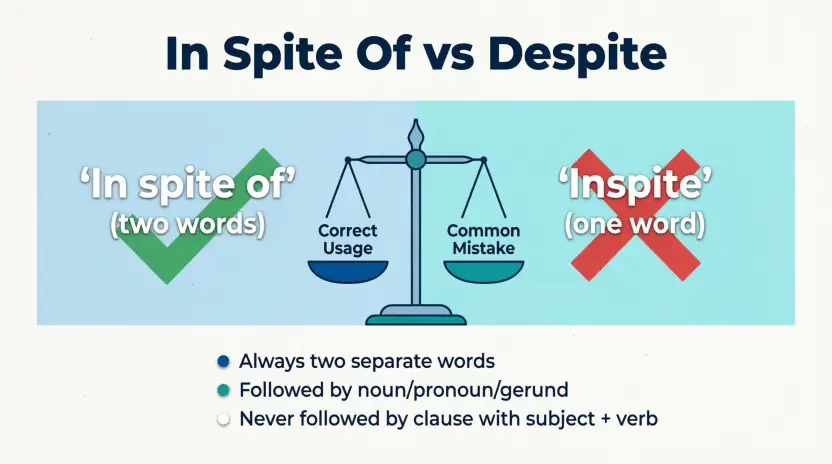
“Despite” is the correct word, while “inspite” is not standard English. Many people search for “inspite or despite” because the two forms sound similar, and the phrase “in spite of” makes the spelling even more confusing. The key is simple: despite is written as one word, while the correct three-word phrase is in spite of.
This small spelling difference can cause problems in emails, essays, school assignments, business writing, and everyday communication. A sentence such as “Inspite of the rain” may look natural because it sounds like “in spite of,” but inspite is not the standard form.
In this guide, you will learn the meaning and grammar of despite and in spite of, how they differ, where they come from, and how to use them correctly. You will also see real examples and common mistakes. Let’s start with the simple answer.
Inspite or Despite: Quick Answer
The correct choices are:
- Despite ✅
- In spite of ✅
- Inspite ❌
Both despite and in spite of mean that something happened even though there was a difficulty, problem, or opposing condition.
Examples
- Despite the rain, we went outside.
- In spite of the rain, we went outside.
- Despite being tired, she finished her work.
- In spite of being tired, she finished her work.
The meaning is almost the same in these examples.
The main difference is grammatical form:
despite + noun / pronoun / -ing form
in spite of + noun / pronoun / -ing form
Never write “inspite” as one word in standard English.
What Does Inspite or Despite Mean?
What Does “Despite” Mean?
Despite is a preposition. It means even though, regardless of, or in spite of.
It introduces something that contrasts with the main action or result.
Example:
Despite the cold weather, the children played outside.
The cold weather could have stopped them, but they played outside anyway.
Another example:
Despite his fear, he gave the speech.
His fear was an obstacle, but he still gave the speech.
What Does “In Spite Of” Mean?
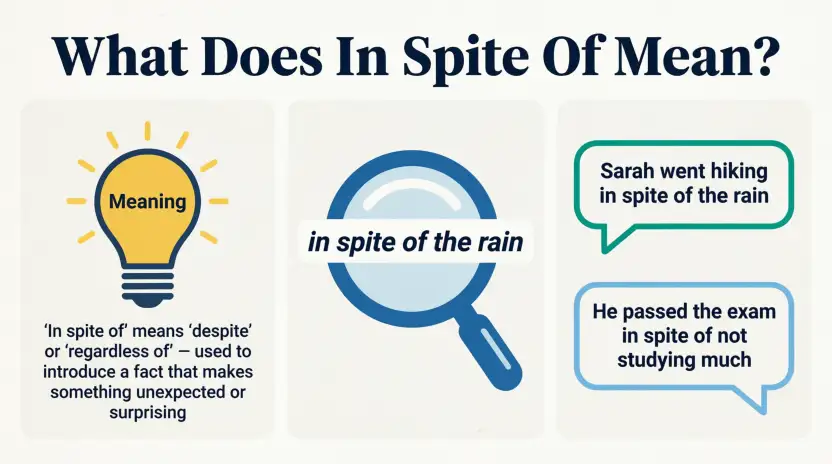
In spite of has the same basic meaning as despite.
In spite of the traffic, we arrived on time.
This means:
We arrived on time even though there was heavy traffic.
Why Is “Inspite” Wrong?
Inspite is usually a spelling mistake caused by combining the words in in spite of.
The correct expression has spaces:
in spite of ✅
Not:
inspite of ❌
A useful memory trick is to remember that spite remains a separate word after in.
The Origin of Inspite or Despite
The two expressions have different histories.
Despite developed from an older expression related to despite, meaning contempt, defiance, or opposition. Over time, its use developed into the modern preposition meaning “in spite of” or “regardless of.”
The expression in spite of is built from the ordinary words in, spite, and of. Here, spite carries the older sense of opposition or defiance.
Modern English has kept despite as a single word and in spite of as a multi-word expression.
The important point for modern writers is not the historical form. It is the standard spelling used today:
- despite = one word
- in spite of = three words
- inspite = nonstandard spelling
British English vs American English
Both British and American English use despite and in spite of. There is no major regional rule that makes despite correct in one country and in spite of correct in another.
| Feature | British English | American English | Example |
| Despite | Correct | Correct | Despite the rain, we left. |
| In spite of | Correct | Correct | In spite of the rain, we left. |
| Inspite | Nonstandard | Nonstandard | Avoid “inspite.” |
| Despite + -ing | Correct | Correct | Despite feeling tired, she worked. |
| In spite of + -ing | Correct | Correct | In spite of feeling tired, she worked. |
Which One Sounds More Natural?
Both forms are normal.
Despite is shorter and often works well in concise writing:
Despite the delay, the meeting started.
In spite of can sound slightly more conversational or emphatic:
In spite of the delay, the meeting started.
Your choice can depend on sentence rhythm and personal style.
Which Version Should You Use?
United States
Use despite or in spite of. Both are standard.
For concise professional writing, despite is often a convenient choice.
United Kingdom
Both despite and in spite of are standard British English.
Use whichever fits the sentence naturally.
Canada
Canadian English accepts both forms.
The important rule is to avoid the nonstandard spelling inspite.
Australia
Australian English also uses both despite and in spite of.
Choose based on tone and sentence structure.
International Writing
For international readers, despite is short and easy to recognize.
However, in spite of is also clear and widely understood.
Academic Writing
Both forms can be used in academic writing.
Despite the limitations, the study produced useful results.
This is concise and formal.
Business Writing
Despite is often useful when you want a short, direct sentence.
Despite the delay, the project remains on schedule.
In all regions and writing styles, avoid inspite.
Common Mistakes
Mistake 1: Writing “Inspite”
Incorrect:
Inspite of the rain, we went outside.
Correct:
In spite of the rain, we went outside.
Explanation:
The phrase contains three separate words.
Memory tip:
Think IN + SPITE + OF, not INSPITE + OF.
Mistake 2: Using “Despite Of”
Incorrect:
Despite of the rain, we went outside.
Correct:
Despite the rain, we went outside.
Explanation:
Despite does not normally take of directly after it.
Use:
despite + noun
or:
in spite of + noun
Mistake 3: Confusing “Despite” With “Although”
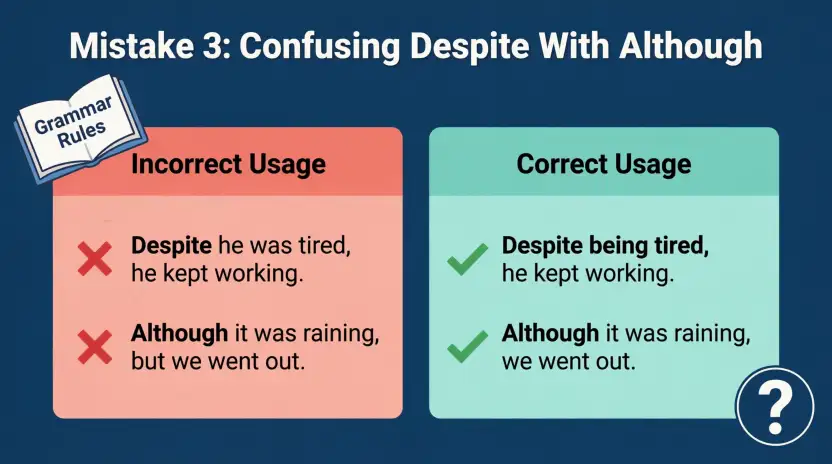
Incorrect:
Despite it was raining, we went out.
Correct:
Despite the rain, we went out.
Or:
Although it was raining, we went out.
Explanation:
Despite normally needs a noun, pronoun, or -ing form. Although can introduce a full clause.
Mistake 4: Using “Despite” and “In Spite Of” Together
Incorrect:
Despite in spite of the rain, we went out.
Correct:
Despite the rain, we went out.
Or:
In spite of the rain, we went out.
Choose one structure.
Everyday Examples
Emails
Despite the short notice, I was able to attend the meeting.
In spite of the delay, we completed the report.
Business Writing
Despite the higher costs, the company continued the project.
In spite of several challenges, the team met its deadline.
News Headlines
Despite Heavy Rain, Flights Continue
In Spite of Delays, Service Has Resumed
Both structures can work in news writing.
Blogs
Despite the busy schedule, I found time to exercise.
In spite of the extra work, the experience was worthwhile.
Social Media
Despite the rain, it was a great day!
In spite of everything, we had fun.
Academic Writing
Despite the small sample size, the results were useful.
In spite of these limitations, the research offers valuable insights.
Daily Conversation
Despite being tired, I went to the gym.
In spite of the traffic, we got there early.
Google Trends & Modern Usage
People often search “inspite or despite” because in spite of sounds like a single expression when spoken. This can lead writers to combine in and spite into the incorrect form inspite.
Modern standard English uses despite as one word and in spite of as three words.
Search interest around this topic also reflects a common grammar and spelling question: if despite and in spite of have different meanings. In most ordinary sentences, they express the same basic contrast.
There is no need to invent a difference where none exists. The main issue is choosing the correct grammatical structure.
Quick Comparison Table
| Version | Meaning | Correct? | Region | Example |
| Despite | Even though / regardless of | ✅ Yes | International | Despite the rain, we left. |
| In spite of | Even though / regardless of | ✅ Yes | International | In spite of the rain, we left. |
| Inspite | Intended to mean “in spite” | ❌ No | Standard English | Avoid this spelling. |
| Despite of | Intended to mean “despite” | ❌ No | Standard English | Avoid this structure. |
Key Takeaways
- Despite is the correct one-word form.
- In spite of is also correct.
- Inspite is not the standard spelling.
- Despite does not normally need of after it.
- Use despite + noun.
- Use in spite of + noun.
- Both expressions show contrast or an unexpected result.
- Both are used in British, American, Canadian, and Australian English.
FAQs
1. Is “inspite” a correct word?
No. Inspite is not the standard spelling in modern English. The correct expression is in spite of, written as three separate words. You can also use despite, which is written as one word. For example: “Despite the rain, we went out” or “In spite of the rain, we went out.”
2. Which is correct, “inspite” or “despite”?
Despite is correct. Inspite is not standard English. If you want to use the longer expression, write in spite of. For example, “Despite the problem, we continued” and “In spite of the problem, we continued” are both correct.
3. Is “in spite of” the same as “despite”?
Yes. In most common situations, in spite of and despite have the same meaning. Both show that something happened even though there was a difficulty or opposing condition. The main difference is grammatical form: despite is one word, while in spite of contains three words.
4. Can I say “despite of”?
No. In standard English, do not normally use of immediately after despite. Say “despite the rain,” not “despite of the rain.” If you want to use of, use the complete phrase in spite of: “in spite of the rain.”
5. Can “despite” be used before a verb?
Yes, but normally use the -ing form rather than a base verb. For example, “Despite feeling tired, she continued working” is correct. You can also use a noun phrase, such as “Despite her tiredness, she continued working.” Avoid structures such as “despite she was tired.”
6. Is “in spite of” formal English?
Yes. In spite of is standard English and can be used in formal and informal writing. It is suitable for essays, reports, emails, articles, and conversation. Despite is also standard and can sometimes make a sentence shorter.
7. Which is better for academic writing, “despite” or “in spite of”?
Both are grammatically correct and suitable for academic writing. Despite is often useful when you want a concise sentence, such as “Despite the limitations, the findings are useful.” The choice usually depends on sentence flow and style rather than correctness.
8. Can “despite” start a sentence?
Yes. Starting a sentence with despite is completely normal. For example: “Despite the heavy traffic, we arrived on time.” It can also appear later in a sentence: “We arrived on time despite the heavy traffic.” Both structures are correct.
9. Why do people write “inspite”?
The mistake usually comes from the way in spite of sounds when spoken. Because the phrase is commonly used as a unit, writers may mistakenly combine in and spite into one word. Remembering the three-word structure can prevent this error.
10. What is an easy way to remember “despite” and “in spite of”?
Use this simple rule: despite = one word, while in spite of = three words. Also remember that despite does not normally take of after it. If you see “inspite,” separate it into in spite.
Conclusion
The choice between inspite or despite is easier once you know the basic rule. Despite is the correct one-word form, while in spite of is the correct three-word expression. Inspite is not the standard spelling, and despite of is also not the normal grammatical structure.
Both despite and in spite of express contrast. They show that something happened even though there was a problem, condition, or reason that might have prevented it. Both forms are used in British and American English, as well as other varieties of standard English.
For simple and concise writing, despite is a useful choice. If you prefer in spite of, keep the words separate.
The easiest rule to remember is: Despite is one word. In spite of is three. Inspite is not correct.
Use the right form consistently, and this common spelling and grammar mistake will disappear from your writing.
Read more about!
- Nick or Knick: Which Spelling Is Correct?
- Dominant or Recessive: What’s the Difference?
- Yoked or Yolked: Which Word Is Correct?

I’m Olivia Parker, a grammar and English writing enthusiast passionate about making English simple and easy to understand. Through Wordsblog, I share clear explanations, useful grammar tips, and practical writing guidance to help readers write with confidence. My goal is to make learning English easier, one word at a time.