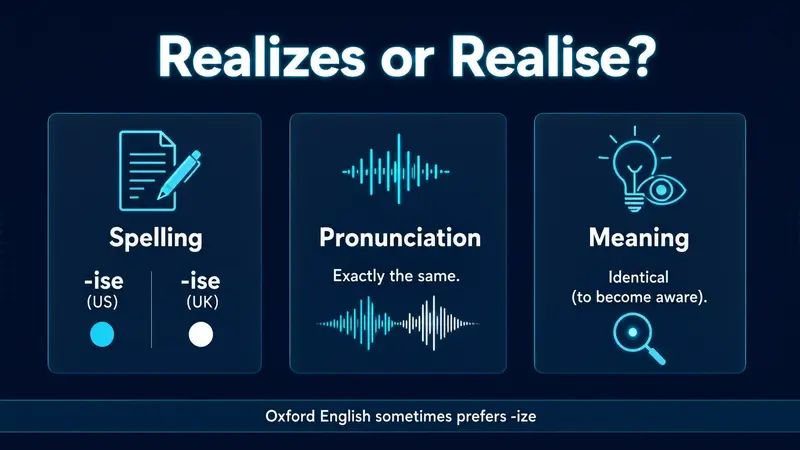
Both realizes and realises are correct spellings of the same verb. The main difference is regional: realizes is standard in American English, while realises is common in British English and other varieties that follow British spelling conventions.
If you are writing for an American audience, use realizes. If your readers are mainly in the UK, realises is usually the better choice. Both forms mean to understand something, become aware of a fact, or make something happen.
For example, an American writer might say, “She realizes her mistake,” while a British writer might write, “She realises her mistake.” Neither sentence is grammatically wrong.
This spelling difference can confuse students, ESL learners, bloggers, and professional writers because both forms appear in dictionaries and online articles. The key is to understand which spelling suits your audience and use it consistently. This guide explains the meanings, origins, regional differences, common mistakes, and everyday uses of realizes and realises.
Realizes or Realises: Quick Answer
Realizes is the standard American English spelling, while realises is common in British English. Both words have the same meaning and pronunciation. Choose the spelling that matches your target audience or the style guide you follow.
- American English: She realizes the truth.
- British English: She realises the truth.
- Both spellings are correct in their respective spelling systems.
What Does Realizes or Realises Mean?
Realizes and realises are third-person singular present-tense forms of the verb realize or realise. They have the same definition, and the only difference is the spelling.
The verb has several related meanings.
1. To understand something
Use the word when someone understands a fact, problem, or situation.
- She realizes why the plan failed.
- He realises that he made a mistake.
2. To become aware of something
The verb can describe the moment someone notices or understands something they did not know before.
- Maria realizes that she has lost her keys.
- James realises that he is running late.
3. To achieve a goal or ambition
Realize and realise can also mean to make a dream, plan, or ambition come true.
- She realizes her dream of becoming a teacher.
- He realises his ambition to start a business.
4. To recognize the importance of something
The verb can describe understanding the value or importance of a person, event, or situation.
- The team realizes the importance of good communication.
- She realises how much her support matters.
In each example, the meaning remains unchanged when you switch between the two spelling conventions.
The Origin of Realizes and Realises
The spelling difference between realizes and realises comes from different English spelling conventions. It does not indicate a difference in meaning or pronunciation.
The verb realize developed from real, a word associated with what is actual or genuine. Over time, the verb gained meanings connected with making something real, understanding a fact, and becoming aware of a situation.
The main spelling difference is the ending -ize or -ise.
- -ize: Standard in American English and also used in Oxford-style British English.
- -ise: Common in general British English and widely used in Australian English.
An important point is that -ize is not simply an American invention. Oxford University Press uses -ize in its house style for many words, including realize and organize. This explains why you may see these spellings in British publications.
Over time, schools, newspapers, publishers, and organizations developed their own spelling preferences. Both forms remain accepted today, but the preferred choice depends on the English variety and editorial style.
British English vs American English
The main difference between realizes and realises is the spelling convention followed by the writer or publisher.
| British English | American English | Example |
| Realises | Realizes | She realises/realizes the truth. |
| Realised | Realized | He realised/realized his mistake. |
| Realising | Realizing | They are realising/realizing their potential. |
| Realisation | Realization | Her realisation/realization came late. |
American English generally uses realize, realizes, realized, realizing, and realization.
General British English commonly uses realise, realises, realised, realising, and realisation. However, British publications that follow Oxford spelling may use the -ize forms.
Why Does American English Use a Z?
American English generally prefers -ize in words such as realize, organize, and recognize. These forms are standard in American dictionaries and everyday writing.
Examples:
- The team realizes its mistake.
- She organizes her notes.
- He recognizes the problem.
Why Does British English Often Use an S?
Many British publications prefer -ise in these verbs. This convention is common in UK newspapers, general writing, and many official documents.
Examples:
- The team realises its mistake.
- She organises her notes.
- He recognises the problem.
Both spelling systems are valid. The best choice is the one that matches your readers and your chosen style guide.
Which Version Should You Use?
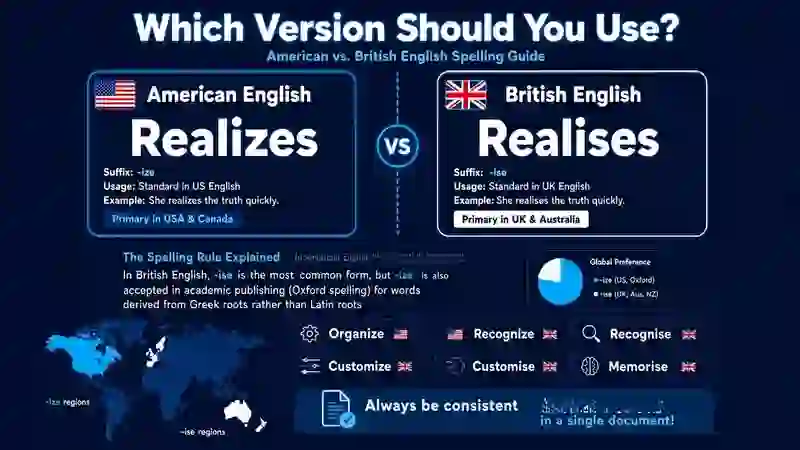
Your audience and writing purpose should guide your spelling choice. Use these recommendations as a starting point.
United States
Use realizes.
American readers generally expect realizes, along with realized, realizing, and realization.
Example: “The manager realizes that the deadline has changed.”
United Kingdom
Use realises for general British English.
Example: “The manager realises that the deadline has changed.”
If your publisher or university follows Oxford spelling, realizes may also be appropriate.
Canada
Realizes is commonly used in Canadian English, especially in words ending in -ize. However, some organizations may follow different house styles.
Example: “She realizes the importance of the decision.”
For formal writing, check your institution’s spelling guide.
Australia
Use realises as the usual choice in Australian English.
Example: “He realises that he needs more time.”
Australian writing commonly follows the -ise convention, although individual publishers may have their own rules.
International Writing
If your website targets readers around the world, choose one spelling system and apply it consistently.
For example, use realizes if your website mainly targets US readers. Choose realises if your primary audience is in the UK, Australia, or another region that generally follows British spelling.
Neither form prevents international readers from understanding your writing.
Academic Writing
Follow your university, journal, or examination board’s style guide.
Some academic publishers use Oxford spelling, which accepts the -ize convention in British English. Others prefer -ise. Do not assume that every British institution follows the same rule.
Business Writing
Use the spelling expected by your company, client, or target market.
- US business email: “She realizes the report needs an update.”
- UK business email: “She realises the report needs an update.”
When writing for a client, follow the client’s style guide rather than changing spellings based on personal preference.
Common Mistakes With Realizes and Realises
Both spellings are correct, but writers can still make mistakes by mixing spelling systems or using an incorrect form.
| Incorrect or inconsistent usage | Better version | Explanation |
| She realises the problem. (in US-style text) | She realizes the problem. | Use the standard US spelling. |
| He realizes the problem. (in general UK-style text) | He realises the problem. | Match common British usage. |
| She realizes her mistake. He recognised it too. | She realizes her mistake. He recognized it too. | Keep the spelling system consistent in US English. |
| He is realiseing the truth. | He is realising the truth. | The correct form is realising, not realiseing. |
| She realiseds her mistake. | She realised her mistake. | The correct past-tense form is realised. |
The first two examples are not universally incorrect sentences. They are simply unsuitable for the specified regional style. The -ize spelling is also acceptable in some British styles.
A Simple Memory Tip
Remember this basic pattern:
- Z = US preference: realizes, realized, realizing.
- S = common UK preference: realises, realised, realising.
The same pattern applies to the related noun:
- US: realization
- Common UK: realisation
One final tip: do not change the spelling inside a direct quotation if the original wording needs to remain exact. Preserve the source’s spelling.
Everyday Examples of Realizes and Realises
These examples show how both spellings work in different situations. Each pair has the same meaning, but the spelling follows a different convention.
1. Emails
American English: “I realize that I sent the wrong attachment. Please find the correct file attached.”
British English: “I realise that I sent the wrong attachment. Please find the correct file attached.”
Both sentences work in a professional email when the spelling matches the intended style.
2. Business Writing
American English: “The company realizes the value of customer feedback.”
British English: “The company realises the value of customer feedback.”
The verb expresses an understanding of the importance of customer feedback.
3. News Headlines
American English: “Local Business Realizes Its Expansion Goals”
British English: “Local Business Realises Its Expansion Goals”
A publication may capitalize headline words according to its own style, but the spelling difference remains the same.
4. Blogs
American English: “She realizes that small changes can improve her writing.”
British English: “She realises that small changes can improve her writing.”
If you publish blog posts regularly, choose one English variety in your editorial guidelines. This helps keep your articles consistent.
5. Social Media
American English: “I finally realize why everyone loves this book!”
British English: “I finally realise why everyone loves this book!”
Both versions sound natural. Your preferred spelling can depend on your audience or the style you normally use.
6. Academic Writing
American English: “The researcher realizes that the results require further analysis.”
British English: “The researcher realises that the results require further analysis.”
In academic work, follow the spelling requirements set by your institution or publisher.
7. Daily Conversation
American English: “He realizes he left his keys at home.”
British English: “He realises he left his keys at home.”
The meaning is identical. The spelling difference does not change how the verb is used in ordinary conversation.
Google Trends and Modern Usage
People search for realizes or realises because they want to know which spelling is correct, particularly when writing for a specific country or audience.
Both forms are established English spellings. General usage patterns favor realizes in American English and realises in much British and Australian writing. Canadian English commonly uses realizes, although individual publications can set their own preferences.
There is no reason to assume that one spelling is becoming universally correct or that the other is disappearing. Without a verified, date-specific Google Trends comparison, it would be misleading to give exact search volumes or claim a measured rise or fall in popularity.
The confusion often comes from three sources:
- Different dictionaries: A dictionary may list realize as the main entry and identify realise as a regional variant.
- International websites: Search results can show articles written in different varieties of English.
- Word-processing tools: Spell-checkers may flag a valid spelling if their language setting uses a different English variety.
For accurate writing, set your spell-checker to the appropriate language variety and use the same spelling throughout your document.
Google Trends can help compare interest in search terms over a selected period, but search interest alone does not determine if a spelling is correct.
Quick Comparison Table
| Version | Meaning | Correct? | Region | Example |
| Realizes | Understands or becomes aware | Yes | American English; Oxford-style English | She realizes the truth. |
| Realises | Understands or becomes aware | Yes | Common British and Australian English | She realises the truth. |
| Realized | Past tense of realize | Yes | American English; Oxford-style English | He realized his error. |
| Realised | Past tense of realise | Yes | Common British English | He realised his error. |
| Realizing | Present participle of realize | Yes | American English; Oxford-style English | She is realizing her potential. |
| Realising | Present participle of realise | Yes | Common British English | She is realising her potential. |
The key point is that these forms express the same meanings. Their spelling depends on regional convention and editorial style.
Key Takeaways
- Realizes is the standard spelling in American English.
- Realises is common in British and Australian English.
- Both spellings have the same meaning and pronunciation.
- British English can also use realizes under Oxford spelling conventions.
- Canadian English commonly uses realizes, but follow the relevant style guide.
- The past-tense forms are realized and realised.
- The noun forms are realization and realisation.
- Choose one spelling system and use it consistently throughout your writing.
FAQs About Realizes or Realises
1. Is realizes or realises correct?
Both realizes and realises are correct spellings of the same verb. The difference is regional rather than grammatical. American English normally uses realizes, while general British English often uses realises. Oxford-style British writing may also use realizes. Choose the spelling that matches your audience or the style guide you follow.
2. Is realizes American or British English?
Realizes is the standard spelling in American English. It is also used in British English by publishers that follow Oxford spelling. If you are writing for a general British audience, realises is usually the more familiar choice. The meaning stays the same regardless of the spelling.
3. Is realises British English?
Yes. Realises is a common spelling in British English. It follows the -ise convention used in many UK publications, newspapers, and official documents. However, British English also permits realizes in Oxford-style writing. For schoolwork or professional documents, follow the relevant style guide.
4. Is realise spelled with an s or a z?
Both spellings exist: realise uses an s, while realize uses a z. American English generally prefers realize, and common British English usage favors realise. The spelling you choose should match the English variety used in your writing. Neither form has a different meaning.
5. How do you spell realizes in the UK?
In general British English, the preferred spelling is often realises. However, some British publishers and academic institutions follow Oxford spelling and use realizes. If you are writing for a UK school, employer, or publication, check its style requirements before choosing a form.
6. Is realises wrong in American English?
Realises is not the standard American spelling. US readers will generally expect realizes. Although readers can understand both forms, using the standard American spelling is better for US schoolwork, professional writing, and websites targeting an American audience.
7. What is the difference between realized and realised?
Realized and realised are past-tense forms of the same verb. American English generally uses realized, while general British English often uses realised. For example, “She realized her mistake” and “She realised her mistake” communicate exactly the same idea.
8. Is it realizing or realising?
Both realizing and realising are correct. American English usually uses realizing, while general British English commonly uses realising. The same spelling pattern applies to realizes/realises and realized/realised. Keep the forms consistent within your chosen English style.
9. Which spelling should I use on my website?
Choose the spelling that suits your main audience. Use realizes if your website targets American readers and realises if it mainly serves readers who expect general British English. If you publish for an international audience, select one consistent style and apply it across your articles, headings, examples, and metadata.
10. Does realises mean something different from realizes?
No. Both spellings have the same meaning. They can describe becoming aware of something, understanding a fact, or achieving a goal. For example, “She realizes her dream” and “She realises her dream” mean the same thing. The only difference is the spelling convention used.
Conclusion: Realizes or Realises?
The choice between realizes and realises depends on the type of English you use. Both spellings are correct, and both express the same meaning. The difference lies in regional spelling preferences, not grammar or pronunciation.
For American English, choose realizes. For general British English, realises is usually the better option. Australian English also commonly favors realises, while Canadian English generally uses realizes. Remember that some British publishers follow Oxford spelling and prefer the -ize ending.
If you write articles for a website, the most useful approach is to choose your target audience first. Set your preferred English variety, check your spelling, and apply the same convention throughout your content. This makes your writing more consistent and professional.
You do not need to memorize two different meanings because there are none. You only need to remember which spelling suits your readers.
The easiest rule to remember is this: US English usually uses realizes, while general UK English usually uses realises.
If you found this guide helpful, explore more word-choice and spelling guides on Wordsblog to improve your everyday English.
Read more about!
- Recognized or Recognised: Which Spelling Is Correct?
- 1080i or 1080p: Which Is Better for Your TV?
- CT or MRI: What’s the Difference?

I’m Olivia Parker, a grammar and English writing enthusiast passionate about making English simple and easy to understand. Through Wordsblog, I share clear explanations, useful grammar tips, and practical writing guidance to help readers write with confidence. My goal is to make learning English easier, one word at a time.






1 thought on “Realizes or Realises: Which Spelling Is Correct?”