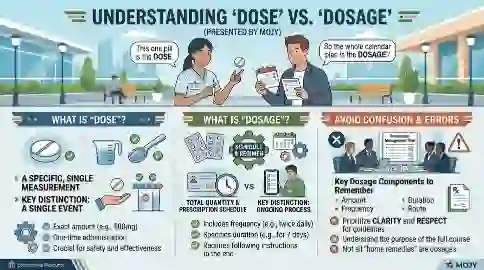
A dose is the amount of medicine taken at one time, while dosage refers to how much medicine to take and how often. These two words are closely related, so it is easy to use them in the wrong way.
People often search for dose or dosage when reading medicine labels, following a doctor’s instructions, writing health information, or talking about treatment. The confusion usually comes from the fact that both words describe medicine amounts.
The key difference is simple. A dose is a specific amount taken on one occasion. Dosage is the broader plan or instructions for taking a medicine. For example, “Take a 500 mg dose” refers to one amount, while “The dosage is 500 mg twice a day” describes the treatment schedule.
In this guide, you will learn the meaning of dose and dosage, how they differ, their history, British and American usage, common mistakes, and real examples. You will also learn which word to use in formal and everyday writing.
Dose or Dosage – Quick Answer
A dose is the amount of medicine taken at one time. Dosage describes the amount, frequency, and schedule for taking medicine.
For example:
- Dose: Take one 500 mg dose.
- Dosage: Take 500 mg twice a day.
- Dose: The patient received a single dose.
- Dosage: The doctor changed the dosage.
A simple way to remember it is:
Dose = one amount. Dosage = the treatment instructions or schedule.
Definition and Meaning of Dose or Dosage
What does dose mean?
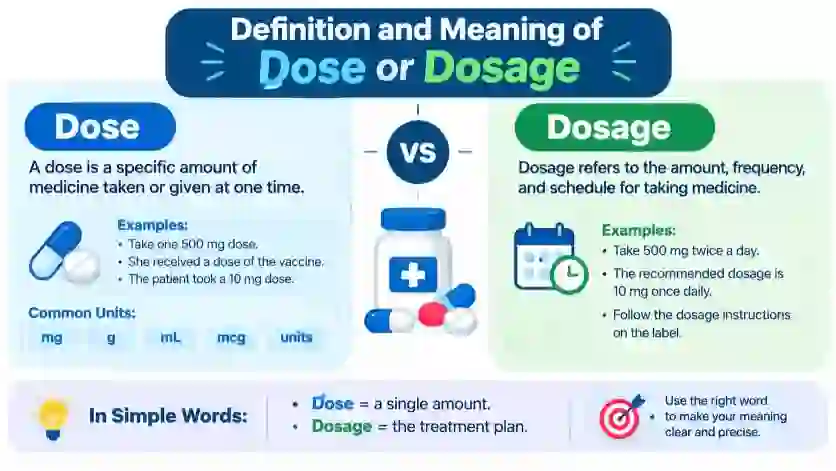
A dose is a specific amount of a medicine or other substance taken at one time.
For example:
She took a 10 mg dose of the medicine.
Here, 10 mg is the dose.
The word can also describe an amount given to someone, rather than taken by mouth.
For example:
The patient received a dose of the vaccine.
In medicine, a dose may be measured in units such as:
- Milligrams (mg)
- Grams (g)
- Milliliters (mL)
- Micrograms (mcg)
- Units
The correct amount depends on the specific medicine and the instructions from a qualified healthcare professional.
What does dosage mean?
Dosage refers to the amount of medicine and the way it should be taken over a period of time.
It can include:
- How much to take
- How often to take it
- When to take it
- How long to take it
For example:
The recommended dosage is 10 mg once daily.
Here, dosage describes the treatment plan rather than just one amount.
Dose vs dosage in simple terms
| Term | Simple Meaning | Example |
| Dose | Amount taken at one time | Take one 10 mg dose |
| Dosage | Instructions for taking medicine | Take 10 mg twice daily |
| Dose | A single amount given | The patient received a dose |
| Dosage | Overall medication schedule | The doctor changed the dosage |
Can dose and dosage mean the same thing?
In casual speech, people sometimes use dose and dosage as if they mean the same thing.
However, careful medical and professional writing often keeps a distinction between them.
Dose usually points to a specific amount.
Dosage usually refers to the broader instructions for using that medicine.
This distinction helps make medical writing clearer.
The Origin of Dose or Dosage
Origin of dose
The word dose comes through French from Latin dosis, meaning a giving or portion. The Latin term itself came from Greek dosis, related to the idea of giving.
The word entered English centuries ago and became closely linked with medicine and the amount of a substance given to a patient.
Today, dose is widely used in medical, pharmaceutical, and everyday English.
Origin of dosage
Dosage developed from dose with the suffix -age.
The suffix helped form a noun referring to the amount or system of dosing.
Over time, dosage became an established medical term for the way a medicine is given, including its amount and schedule.
Why do the two words look similar?
The words are related because dosage is built from dose.
This is why their meanings overlap.
The difference is mainly about usage:
- Dose focuses on an amount given or taken.
- Dosage focuses on the instructions or regimen for using a medicine.
The spelling does not change between British and American English in the same way that words such as colour and color do.
British English vs American English Spelling
Are dose and dosage spelled differently?
No. Dose and dosage have the same spelling in British and American English.
The main difference is not spelling. It is how the words are used in context.
| British English | American English | Meaning |
| dose | dose | Amount taken at one time |
| dosage | dosage | Amount and schedule for treatment |
| a dose of medicine | a dose of medicine | Same usage |
| recommended dosage | recommended dosage | Same usage |
| daily dosage | daily dosage | Same usage |
Regional differences
There is no major British-American spelling difference for dose or dosage.
A British doctor and an American doctor can both write:
Take one dose daily.
They can also both use:
Follow the recommended dosage.
The main variation comes from local medical style, not spelling.
Style guides and medical writing
Medical organizations may have their own preferred wording.
Professional writers should follow the style guide used by their employer, publisher, hospital, university, or health organization.
In patient-facing writing, clarity is especially important. If dose is more precise, use dose. If you are describing a full medication schedule, dosage may be clearer.
Which Spelling Should You Use?

United States
Use dose for a specific amount.
Use dosage when discussing the overall instructions for taking a medicine.
Example:
Take a single dose with water.
Ask your doctor about the correct dosage.
United Kingdom and Commonwealth
The same basic distinction works in British English and other major Commonwealth varieties.
There is no need to change the spelling.
Global English
For international readers, use the word that gives the clearest meaning.
If you mean one amount, use dose.
If you mean the complete schedule, use dosage.
Academic writing
Academic and medical writing should aim for precision.
For example:
Each participant received a 20 mg dose.
For a treatment schedule:
The dosage was adjusted during the study.
Business and health writing
Health websites, product information, and professional documents should avoid vague wording.
Instead of:
Take the right dosage.
A clearer sentence may be:
Follow the dosage instructions provided by your healthcare professional or the medicine label.
Common Mistakes with Dose or Dosage
Mistake 1: Using dosage for one amount
Incorrect:
Take one dosage of the medicine.
Better:
Take one dose of the medicine.
When you mean one specific amount taken at one time, dose is usually the better choice.
Mistake 2: Using dose for the whole schedule
Less precise:
The doctor changed my dose to three times a day.
Clearer:
The doctor changed my dosage to three times a day.
The second sentence describes the treatment schedule.
Mistake 3: Assuming dosage only means amount
Dosage can refer to the amount, but in careful medical usage it often covers the wider plan for taking the medicine.
That may include the amount, frequency, timing, and duration.
Mistake 4: Treating the words as completely interchangeable
The words overlap, but they are not always interchangeable.
Use dose when you mean a particular amount.
Use dosage when you mean the instructions or regimen.
Easy memory tip
Remember:
Dose = a single amount.
Dosage = the dosing plan.
This simple distinction works well for most everyday writing.
Dose or Dosage in Everyday Examples
Emails
Dose:
Please confirm ifa the patient received the second dose.
Dosage:
Could you confirm the recommended dosage?
The first refers to a particular administration. The second asks about the treatment instructions.
Business and professional writing
Dose:
The product is available in several dose strengths.
Dosage:
The package provides dosage information for adults.
Professional health writing should use the term that matches the intended meaning.
News headlines
News articles may use dose when discussing a specific vaccination or treatment amount.
Example:
Patients Receive a Second Dose
Dosage may appear when an article discusses changes to treatment instructions.
Example:
New Dosage Guidance Released
Blogs
A health blog might say:
The doctor recommended a lower dose.
Or:
Always follow the dosage instructions on the label.
The first focuses on an amount. The second focuses on instructions.
Social media
Informal posts often use dose:
I just got my second dose.
In more careful health communication, writers may use dosage when discussing the full instructions.
Formal writing
Academic and medical texts often distinguish the terms.
Example:
Participants received a single dose of the study medicine.
Another example:
The dosage was adjusted according to the treatment protocol.
Daily conversation
People commonly say:
Did you take your dose?
They may also ask:
What is the dosage?
Both are natural, but they ask slightly different questions.
Dose or Dosage – Google Trends & Usage Data
Why do people search “dose or dosage”?
The phrase dose or dosage is usually searched because people want to know which word fits a particular medical sentence.
Common search questions include:
- Dose or dosage?
- What is the difference between dose and dosage?
- Is dose the same as dosage?
- What does dosage mean?
- What is a medication dose?
- How do you use dose in a sentence?
- How do you use dosage in a sentence?
These searches come from students, patients, writers, ESL learners, healthcare content creators, and people reading medicine instructions.
Regional usage
There is no major spelling split between the United States and the United Kingdom for these words.
Both dose and dosage are used in major varieties of English.
Exact Google Trends popularity can change by country, date, and search wording. Without a specific Trends period and region, fixed popularity numbers should not be claimed.
Modern usage
Today, dose is especially common when people discuss a specific administration of medicine or a vaccine.
Examples include:
- first dose
- second dose
- single dose
- booster dose
Dosage is common when discussing treatment instructions or medication plans.
Examples include:
- recommended dosage
- daily dosage
- dosage instructions
- dosage adjustment
This difference helps explain why both words remain common in modern health writing.
Quick Comparison Table
| Word | Meaning | Correct? | Common Context | Example |
| Dose | A specific amount taken at one time | Yes | Medicine, vaccines | Take one dose |
| Dosage | Amount and schedule for treatment | Yes | Medical instructions | Follow the dosage |
| Dose | One administration | Yes | Clinical writing | Second dose |
| Dosage | Overall dosing plan | Yes | Health information | Recommended dosage |
| Dose | Specific quantity | Yes | Patient instructions | A 20 mg dose |
| Dosage | Treatment instructions | Yes | Medical guidance | Adjust the dosage |
Key Takeaways
- Dose means a specific amount of medicine taken or given at one time.
- Dosage usually refers to the amount and schedule for taking medicine.
- The two words are closely related.
- Dose is common for terms such as “first dose” and “second dose.”
- Dosage is common in phrases such as “recommended dosage.”
- British and American English use the same spellings.
- Use dose for a specific amount and dosage for a broader treatment plan.
- In medical writing, choose the word that gives the clearest meaning.
FAQs
1. What is the difference between dose and dosage?
A dose is a specific amount taken or given at one time. Dosage usually describes the amount and schedule used for treatment.
2. Is dosage the same as dose?
Not exactly. The words overlap, but dose usually means one specific amount, while dosage often means the wider dosing plan or instructions.
3. Should I say “dose of medicine” or “dosage of medicine”?
Use dose of medicine when referring to a specific amount taken at one time. Use dosage when discussing the recommended amount or treatment schedule.
4. Is “dosage” American or British English?
Dosage is used in both American and British English. Its spelling is the same in both varieties.
5. Is “first dose” correct?
Yes. First dose is a standard phrase when referring to the first specific amount of a medicine or vaccine that someone receives.
6. Is “recommended dosage” correct?
Yes. Recommended dosage is commonly used for instructions about how much medicine to take and how often to take it.
7. Can dose and dosage be used interchangeably?
Sometimes, especially in casual speech. However, careful medical writing benefits from using dose for a specific amount and dosage for the broader treatment plan.
Conclusion
The difference between dose or dosage is small but useful. A dose usually means a specific amount of medicine taken or given at one time. Dosage usually refers to the wider instructions for using that medicine, including the amount and schedule.
For example, you can receive a second dose of a medicine or vaccine. You can also follow a recommended dosage that tells you how much to take and how often to take it.
The spelling is the same in British and American English, so this is not a regional spelling issue. The main challenge is choosing the word that best matches the meaning.
For everyday and professional writing, remember the simple rule: dose is one amount, while dosage is the dosing plan. When writing about medicines, always follow the exact instructions from the product label or a qualified healthcare professional rather than relying on general examples.
Remember: one amount is a dose, while the full plan is the dosage.
Use this distinction in your writing, and these two easily confused words will become much easier to handle.
Read more about!
- Bose or Beats: Which Headphones Are Better?
- Verry or Very: Which Spelling Is Correct?
- Prefix or Suffix: Meaning, Differences, Examples, and Usage

I’m Olivia Parker, a grammar and English writing enthusiast passionate about making English simple and easy to understand. Through Wordsblog, I share clear explanations, useful grammar tips, and practical writing guidance to help readers write with confidence. My goal is to make learning English easier, one word at a time.





6 thoughts on “Dose or Dosage: What Is the Difference?”