If you are asking if a word part is a prefix or suffix, the simple answer is this: a prefix comes before a word, while a suffix comes after it.
This basic difference helps learners understand how English words are built. For example, in “unhappy,” “un-” is a prefix because it comes before “happy.” In “happiness,” “-ness” is a suffix because it comes after “happy.”
Many people search for “prefix or suffix” because they are unsure which word part belongs at the beginning or end of a word. Others want to understand how prefixes and suffixes change meaning, spelling, or grammar.
Knowing the difference can make reading, spelling, vocabulary, and writing easier. Prefixes often change the meaning of a base word, while suffixes can change meaning or even change the word’s grammatical form. Understanding both also helps you work out the meaning of unfamiliar words.
Prefix or Suffix and Quick Answer
A prefix is added to the beginning of a word or base. A suffix is added to the end.
| Word Part | Position | Example | Result |
| Prefix | Before the base | un + happy | unhappy |
| Prefix | Before the base | re + write | rewrite |
| Suffix | After the base | happy + ness | happiness |
| Suffix | After the base | teach + er | teacher |
| Suffix | After the base | quick + ly | quickly |
A simple way to remember it is:
Prefix = before
Suffix = after
For example:
- “un-” in “unfair” is a prefix.
- “re-” in “rewrite” is a prefix.
- “-ful” in “helpful” is a suffix.
- “-ness” in “kindness” is a suffix.
- “-ly” in “slowly” is a suffix.
Cambridge defines a prefix as a letter or group of letters added to the beginning of a word, while a suffix is added to the end.
Definition and Meaning of Prefix or Suffix
What Is a Prefix?
A prefix is a letter or group of letters placed at the beginning of a base word, root, or stem.
Prefixes often change the meaning of a word.
Examples:
- happy → unhappy
- agree → disagree
- write → rewrite
- possible → impossible
- understand → misunderstand
In “unhappy,” the prefix “un-” gives the word the opposite meaning.
In “rewrite,” “re-” shows the idea of doing something again.
Prefixes are useful because one small word part can help you understand a larger word.
What Is a Suffix?
A suffix is a letter or group of letters added to the end of a word.
Suffixes can change the meaning or grammatical form of a word.
Examples:
- happy → happiness
- teach → teacher
- quick → quickly
- care → careful
- hope → hopeful
The suffix “-ness” changes the adjective “happy” into the noun “happiness.”
The suffix “-ly” can turn an adjective into an adverb, as in “quick” → “quickly.”
What Is the Difference?
The main difference is position.
A prefix comes before the base:
un + kind = unkind
A suffix comes after the base:
kind + ness = kindness
Both are types of affixes. English word formation commonly uses prefixes and suffixes to create related words or different forms of words.
The Origin of Prefix or Suffix
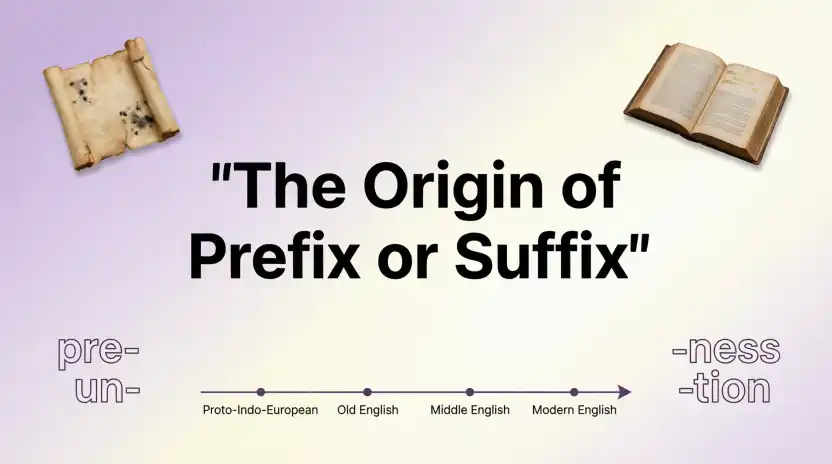
The words “prefix” and “suffix” have old Latin roots.
“Prefix” comes from Latin roots connected with the idea of “fixing before.” The word entered English through French and Latin forms. Oxford dates the noun “prefix” to the mid-17th century and traces its history to Latin praefixus, meaning “fixed in front.”
“Suffix” is also based on Latin. It carries the idea of something being attached or fixed after another element.
English has borrowed many prefixes and suffixes from Latin, Greek, French, and other languages. This is why English has word parts such as:
- pre-
- post-
- anti-
- inter-
- sub-
- -tion
- -ment
- -ness
- -able
Many common prefixes and suffixes help readers understand unfamiliar vocabulary. The University of Wisconsin notes that many English prefixes and suffixes have Latin and Greek origins.
Why Do Spelling Differences Exist?
The words “prefix” and “suffix” themselves do not have a special British-versus-American spelling.
However, some words created with suffixes can have different spellings.
For example:
- organise — British English
- organize — American English
- realise — British English
- realize — American English
- analyse — British English
- analyze — American English
These differences are related to English spelling conventions, not a different definition of “prefix” or “suffix.”
British English vs American English Spelling
The basic rules for prefixes and suffixes are almost the same in British and American English.
The main differences appear in certain words that use particular suffixes or spelling patterns.
| Word | British English | American English |
| organize | organise | organize |
| realize | realise | realize |
| analyse | analyse | analyze |
| recognise | recognise | recognize |
| centre | centre | center |
| colour | colour | color |
The “-ise/-ize” difference is especially important.
British English often uses -ise, while American English commonly uses -ize:
- organise / organize
- recognise / recognize
- apologise / apologize
However, British English can also use -ize, so it is not correct to say that every British word must use “-ise.”
The British Council gives examples of suffixes such as “-ise/-ize” when teaching word formation and common suffix patterns.
Which Spelling Should You Use?
The best spelling depends on your audience.
For a US Audience
Use American spelling when writing mainly for readers in the United States.
Examples:
- organize
- realize
- recognize
- analyze
For a UK Audience
Use British spelling when your main readers are in the United Kingdom.
Examples:
- organise
- realise
- recognise
- analyse
For Commonwealth Readers
Countries such as Australia, New Zealand, and other English-speaking regions may generally follow British-based spelling conventions, but individual style guides can differ.
For a Global Website
Choose one spelling system and use it consistently.
For example, if your website mainly targets American readers, use American spelling throughout your articles.
Consistency is usually more important than switching between spelling systems.
Common Mistakes with Prefix or Suffix
Understanding the difference is easy, but learners often make a few common mistakes.
Mistake 1: Calling the Ending a Prefix
Incorrect:
In “unhappy,” “un-” is a suffix.
Correct:
In “unhappy,” “un-” is a prefix.
It comes before the base word.
Mistake 2: Calling the Beginning a Suffix
Incorrect:
In “kindness,” “-ness” is a prefix.
Correct:
In “kindness,” “-ness” is a suffix.
It comes after “kind.”
Mistake 3: Confusing Root Words and Affixes
A root or base carries the main meaning of a word. A prefix or suffix is attached to it.
Example:
un + help + ful = unhelpful
- un- = prefix
- help = base
- -ful = suffix
Mistake 4: Assuming Every Ending Is a Suffix
Not every group of letters at the end of a word is automatically a suffix.
The letters need to function as a meaningful word-forming element. Word structure can sometimes be more complex than simply looking at the first or last few letters.
Mistake 5: Thinking Prefixes Always Change Grammar
Prefixes often change meaning without changing the word class.
For example:
happy → unhappy
Both are adjectives.
Suffixes, however, often change grammatical form:
happy → happiness
The first is an adjective, while the second is a noun.
Prefix or Suffix in Everyday Examples
Prefixes and suffixes appear in everyday communication, schoolwork, emails, news, social media, and formal writing.
In Emails
Example:
Please rewrite the email before sending it.
Here, “re-” is a prefix meaning “again.”
Another example:
The information is unavailable.
“un-” is a prefix that creates a negative meaning.
In News
News writing contains many words with prefixes and suffixes.
Examples:
- international
- disagreement
- government
- development
- unemployment
- education
These word parts can help readers understand long words.
On Social Media
Social media uses many words formed with prefixes and suffixes.
Examples:
- unfollow
- repost
- misinformation
- friendship
- follower
- quickly
For example, “unfollow” contains the prefix “un-,” while “follower” contains the suffix “-er.”
In Formal Writing
Prefixes and suffixes are common in academic and professional writing.
Examples:
- development
- communication
- international
- environmental
- professional
- educational
Understanding these word parts can make difficult vocabulary easier to understand.
Prefix or Suffix & Google Trends & Usage Data
The search phrase “prefix or suffix” has clear educational intent. People commonly use this type of query when studying English grammar, vocabulary, spelling, or word formation.
Public search-interest tools such as Google Trends show relative search interest rather than a fixed number of searches. Search interest can also change by country, school season, exams, and educational demand.
For this topic, search behavior is likely to be strongest in contexts where English grammar and vocabulary learning are common, including:
- United States
- United Kingdom
- India
- Pakistan
- Australia
- Canada
However, Google Trends does not provide a permanent worldwide search-volume number for “prefix or suffix.” Its data is relative, so it is better to describe the topic as an ongoing educational search rather than claim an exact monthly volume.
Search results also show strong educational use of the topic. Cambridge, the British Council, and educational resources all teach prefixes and suffixes as important parts of English word formation.
Prefix and Suffix Variations Side by Side
| Feature | Prefix | Suffix |
| Position | Beginning | End |
| Main role | Often changes meaning | Often changes meaning or grammar |
| Example | un + happy | happy + ness |
| Result | unhappy | happiness |
| Another example | re + write | teach + er |
| Result | rewrite | teacher |
| Common use | Meaning changes | Word-form changes |
FAQs About Prefix or Suffix
1. What is a prefix?
A prefix is a letter or group of letters added to the beginning of a word to create a new word or change its meaning. For example, “un-” in “unhappy” is a prefix.
2. What is a suffix?
A suffix is a letter or group of letters added to the end of a word or base. For example, “-ness” in “happiness” is a suffix.
3. Is un a prefix or suffix?
“Un-” is a prefix because it comes at the beginning of a word. Examples include “unhappy,” “unknown,” and “unfair.”
4. Is ly a prefix or suffix?
“-ly” is a suffix because it comes at the end of words. For example, “quickly” and “slowly” contain the suffix “-ly.”
5. Is ing a prefix or suffix?
“-ing” is a suffix. It commonly appears at the end of verbs, such as “running,” “reading,” and “writing.”
6. Can a word have both a prefix and a suffix?
Yes. A word can have both.
For example:
un + help + ful = unhelpful
“un-” is the prefix, and “-ful” is the suffix.
7. How can I remember the difference between a prefix and suffix?
Remember this simple rule:
Prefix = before
Suffix = after
If the word part comes before the base, it is a prefix. If it comes after the base, it is a suffix.
Conclusion: Prefix or Suffix
Knowing if a word part is a prefix or suffix becomes simple when you remember its position. A prefix comes before a base word, while a suffix comes after it. For example, “re-” in “rewrite” is a prefix, while “-er” in “teacher” is a suffix. Prefixes often change the meaning of a word, while suffixes can change meaning or grammatical form.
British and American English generally follow the same basic prefix and suffix rules. Some words may have different spelling conventions, such as “organise” and “organize,” but these differences do not change what a prefix or suffix is.
When writing for a specific audience, follow that audience’s preferred spelling system and stay consistent.
The easiest memory trick is prefix = before and suffix = after. Once you understand this rule, you can break longer words into smaller parts and often understand their meaning more easily. This makes prefixes and suffixes useful tools for reading, spelling, vocabulary building, schoolwork, and professional writing.
Read more about!

I’m Olivia Parker, a grammar and English writing enthusiast passionate about making English simple and easy to understand. Through Wordsblog, I share clear explanations, useful grammar tips, and practical writing guidance to help readers write with confidence. My goal is to make learning English easier, one word at a time.




5 thoughts on “Prefix or Suffix: Meaning, Differences, Examples, and Usage”