A fawn response focuses on pleasing or appeasing others, while a freeze response involves becoming still, quiet, or unable to act. Both terms describe ways people may respond when they feel threatened, overwhelmed, or under strong stress.
People often search for fawn or freeze because the two responses can look similar from the outside. Someone may become quiet, avoid conflict, or struggle to respond. This can make it hard to know which term fits.
The key difference is the type of response. A fawn response centers on appeasing another person to reduce conflict or danger. A freeze response centers on becoming still, silent, or unable to respond.
These terms are often discussed alongside the better-known fight-or-flight responses. They can appear in psychology, mental health education, personal development, and everyday discussions about stress.
In this guide, you will learn the meaning of fawn and freeze, how the terms differ, where they came from, common mistakes, and simple examples. This will help you understand the terms without confusing them.
Fawn or Freeze – Quick Answer
A fawn response involves trying to please, appease, or avoid upsetting someone during a stressful situation. A freeze response involves becoming still, quiet, or unable to respond.
Simple examples
- Fawn: Someone agrees with another person to avoid conflict.
- Freeze: Someone becomes silent and cannot decide what to say.
- Fawn: Someone quickly apologizes even when they are unsure they did anything wrong.
- Freeze: Someone feels unable to move or act during a frightening event.
The two responses can sometimes happen together or occur at different times.
Definition and Meaning of Fawn or Freeze
What does fawn mean?
In discussions of stress responses, fawn describes a pattern of trying to appease or please another person when feeling threatened or unsafe.
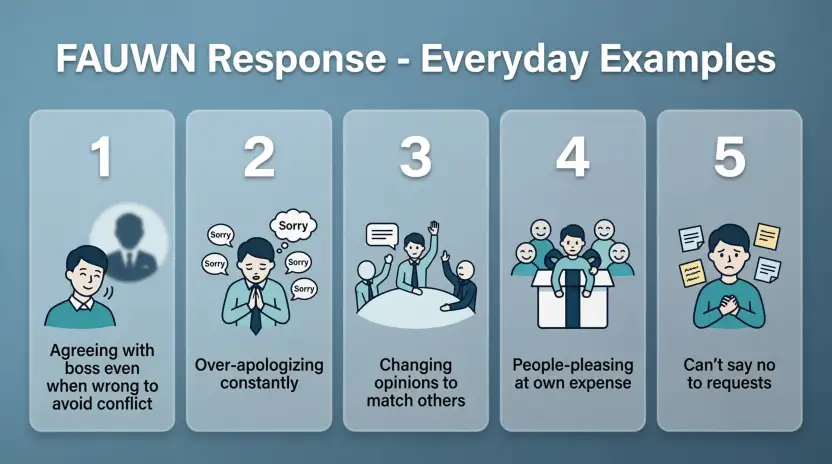
A person may:
- Agree quickly to avoid conflict
- Apologize repeatedly
- Put another person’s needs first
- Avoid saying no
- Try to keep everyone happy
The central idea is appeasement.
What does freeze mean?
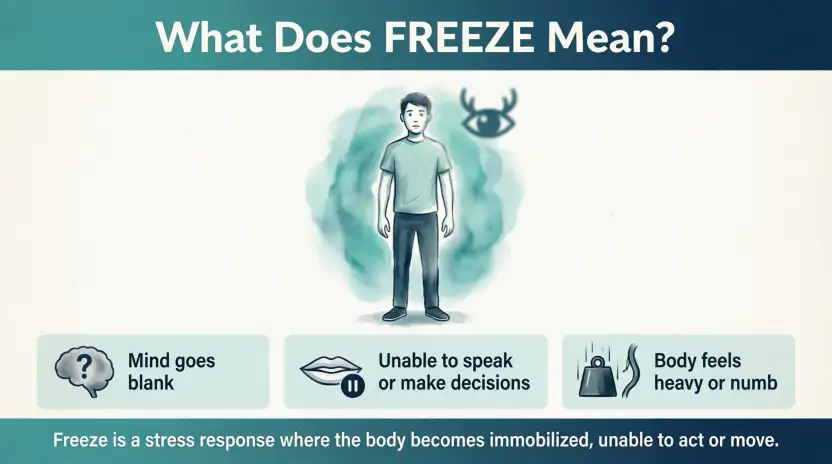
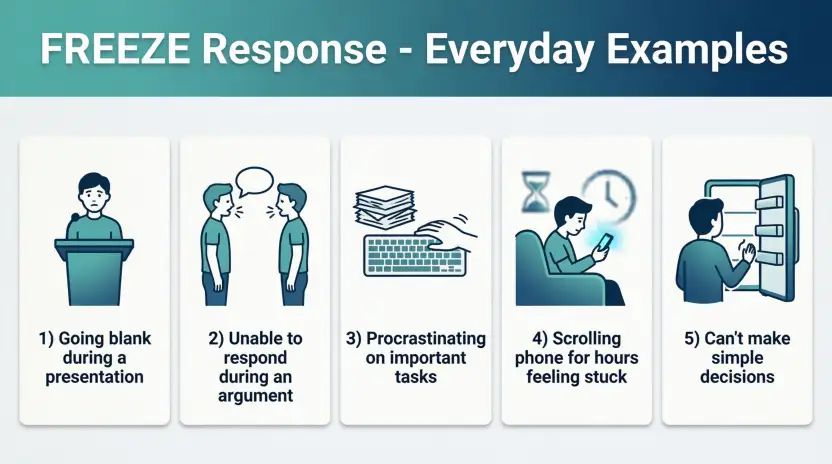
Freeze describes a response in which a person becomes still, quiet, or unable to respond normally during a stressful or threatening situation.
A person may:
- Become very quiet
- Feel unable to speak
- Struggle to make a decision
- Feel mentally stuck
- Remain physically still
The central idea is inhibition or lack of immediate action.
Fawn vs freeze
| Response | Main idea | Simple example |
| Fawn | Appease or please | “Okay, I will do it.” |
| Freeze | Become still or unable to respond | “I cannot think of what to say.” |
Both terms describe responses to stress or perceived threat, but they describe different patterns.
Are these medical diagnoses?
No. Fawn and freeze are descriptive terms used in discussions of stress and threat responses. They are not, by themselves, formal mental health diagnoses.
A person’s reaction can depend on the situation, personal history, environment, and many other factors.
The Origin of Fawn or Freeze
Origin of “fawn”
The word fawn has a long history in English. Its everyday meaning can refer to showing excessive friendliness or submission toward someone.
In modern discussions of stress responses, the term fawn response is used to describe appeasing behavior in response to perceived threat or conflict.
This meaning became more common through trauma and stress-response discussions.
Origin of “freeze”
The word freeze has been used in English for centuries. Its basic meaning relates to becoming very cold or becoming fixed or motionless.
In the context of threat responses, freeze describes becoming still or inhibited when faced with danger or intense stress.
The word is easy to understand because the physical image is clear: something that freezes becomes still.
Why do people use these terms?
The terms give people simple language for describing different reactions to stress.
Traditional discussions often focus on fight or flight. Modern educational discussions may also mention responses such as freeze and fawn.
These labels can help explain behavior, but they should not be treated as a complete explanation of someone’s experience.
British English vs American English Spelling
Is the spelling different?
There is no major British-American spelling difference between fawn and freeze.
Both British and American English use the same spellings:
- fawn
- fawning
- freeze
- freezing
- froze
- frozen
The main difference is not spelling. It is meaning and context.
| British English | American English | Example |
| fawn | fawn | fawn response |
| fawning | fawning | fawning behavior |
| freeze | freeze | freeze response |
| freezing | freezing | freezing in fear |
| froze | froze | He froze. |
| frozen | frozen | She felt frozen. |
What about pronunciation?
The words are generally pronounced in the same way in British and American English.
Fawn sounds like “fawn.”
Freeze rhymes with words such as please and trees.
Which spelling is correct?
Both fawn and freeze are correct English words.
They are not alternative spellings of the same word. They have different meanings and describe different concepts.
Which Spelling Should You Use?
For US English
Use fawn and freeze exactly as written.
Example:
The article explains the difference between fawn and freeze responses.
For UK English
Use the same spellings.
Example:
The discussion compares fawn and freeze responses to stress.
For Canada and Australia
The same standard spellings apply.
For international readers
Use short explanations because the terms may be unfamiliar.
For example:
Fawn means trying to appease someone, while freeze means becoming unable to respond.
For academic writing
Define the terms before using them.
For example:
In stress-response discussions, the term “fawn” can describe appeasing behavior, while “freeze” can describe a state of inhibited action.
For professional writing
Avoid assuming that every reader knows these terms. Give a brief definition when they first appear.
Common Mistakes with Fawn or Freeze
Mistake 1: Treating them as synonyms
Incorrect:
“Fawn and freeze mean the same thing.”
Correct:
“Fawn and freeze describe different stress responses.”
Why?
Fawn focuses on appeasement. Freeze focuses on becoming still or unable to respond.
Mistake 2: Thinking fawn means physically becoming still
Incorrect:
“Fawn means you cannot move.”
Correct:
“Freeze can describe becoming still or unable to act.”
Memory tip:
Think fawn = please, while freeze = stop.
Mistake 3: Assuming freeze always means fear
Freeze can occur during fear or threat, but the word freeze has many other meanings in ordinary English.
For example:
The lake may freeze in winter.
Context tells you which meaning is intended.
Mistake 4: Using “fawn” only as an animal word
Fawn can refer to a young deer, but it also has other meanings.
In the phrase fawn response, it refers to appeasing behavior.
Mistake 5: Confusing “fawning” with normal kindness
Being kind or helpful does not automatically mean someone is showing a fawn response.
The term is used in a more specific context involving perceived threat, conflict, or strong stress.
Fawn or Freeze in Everyday Examples
Emails
A fawn-style response might appear in an email like:
“I am sorry. I can take care of it right away.”
A freeze response might look like someone struggling to reply because they feel overwhelmed.
Business writing
A person may use overly agreeable language to avoid disagreement.
Example:
“Whatever works for you is completely fine.”
However, a single polite sentence does not prove a fawn response. Context matters.
News writing
News articles may use these terms when discussing stress, trauma, or human behavior.
Example:
Experts discussed different ways people can respond to stressful events.
Social media
The terms are often used in posts about stress and personal experiences.
Example:
“I used to become quiet during conflict. Learning about the freeze response helped me describe that experience.”
Formal writing
Formal writing should define the terms clearly.
Example:
The fawn response refers to attempts to appease another person during perceived threat, while the freeze response involves inhibited action or speech.
Daily conversation
Someone might say:
“I do not argue when I feel stressed. I just freeze.”
Another person might say:
“I tend to agree with people because I want to avoid conflict.”
These examples show why the terms are different.
Fawn or Freeze – Google Trends & Usage Data
Search interest
People search for fawn or freeze because these terms are common in online discussions about stress responses, trauma education, psychology, and personal experiences.
Related searches may include:
- fawn response meaning
- freeze response meaning
- fawn vs freeze
- fight flight freeze fawn
- what is the fawn response?
- what does freeze response mean?
- fawn response examples
- freeze response examples
Regional usage
The terms are used in English-speaking countries, including the United States, United Kingdom, Canada, and Australia.
Exact Google Trends popularity can change by country and time period. Without a specific Trends date range and location, it would not be accurate to provide a fixed search-volume or popularity figure.
Why is there confusion?
The confusion often comes from the fact that both responses can involve avoiding confrontation.
For example, one person may try to make another person happy, while another may become completely silent.
From the outside, both may look like avoidance. The underlying behavior is different.
Modern usage
Today, these terms appear in:
- Psychology education
- Stress-response discussions
- Mental health content
- Self-help articles
- Social media
- Educational resources
The safest approach is to use the terms as descriptive concepts rather than assuming that one word explains a person’s entire behavior.
Quick Comparison Table
| Term | Meaning | Correct? | Common Context | Example |
| Fawn | Appease or please to reduce conflict | Yes | Stress discussions | “I agreed to avoid an argument.” |
| Freeze | Become still or unable to respond | Yes | Stress discussions | “I could not speak.” |
| Fawning | Showing appeasing behavior | Yes | Stress and behavior | “He kept trying to please everyone.” |
| Freezing | Becoming still or inhibited | Yes | Stress or fear | “She froze during the event.” |
| Fawn | Young deer | Yes | Animal meaning | “A fawn followed its mother.” |
| Freeze | Become solid because of cold | Yes | Weather/science | “The water will freeze.” |
FAQs
1. What is the difference between fawn and freeze?
Fawn involves trying to appease or please someone during perceived threat or conflict. Freeze involves becoming still, quiet, or unable to respond.
2. Is fawn a real stress response?
“Fawn” is commonly used in discussions of stress and trauma responses to describe appeasing behavior. It is a descriptive term, not a standalone mental health diagnosis.
3. What does freeze mean in psychology?
In psychology and stress-response discussions, freeze can describe becoming still, quiet, or temporarily unable to act when facing intense stress or perceived danger.
4. Can someone fawn and freeze at the same time?
A person’s reactions can overlap or change during the same stressful situation. Someone might initially freeze and later try to appease another person.
5. Is fawn the same as being nice?
No. Being kind or helpful does not automatically mean fawning. The term usually refers to appeasing behavior connected with perceived threat, conflict, or strong stress.
6. Is freeze the same as being lazy?
No. A freeze response is not simply laziness. In stress discussions, freeze describes an inhibited response in which someone may struggle to act, speak, or make decisions.
7. Is fawn or freeze a diagnosis?
No. These terms describe patterns of responding to stress or perceived threat. They should not be used alone to diagnose a mental health condition.
Conclusion
The difference between fawn or freeze is mainly about how a person responds to stress or perceived threat. A fawn response centers on appeasing, pleasing, or avoiding conflict with another person. A freeze response involves becoming still, quiet, or unable to respond.
The two can sometimes look similar. For example, both may involve avoiding confrontation. The important difference is the behavior itself. Fawning involves an active attempt to reduce conflict through appeasement, while freezing involves inhibited action or speech.
The words also have ordinary meanings outside stress-response discussions. A fawn can mean a young deer, while freeze can mean becoming solid because of cold.
For clear writing, always use the surrounding context to explain which meaning you intend. If you are writing for a general audience, define the terms the first time you use them.
Remember: fawn tries to please, while freeze becomes still.
Use this simple distinction whenever you need to explain the two terms, and your writing will be much clearer.
Read more about!
- Buried or Cremated: What Is the Difference?
- Dose or Dosage: What Is the Difference?
- Fabric or Forge: What Is the Difference?

I’m Olivia Parker, a grammar and English writing enthusiast passionate about making English simple and easy to understand. Through Wordsblog, I share clear explanations, useful grammar tips, and practical writing guidance to help readers write with confidence. My goal is to make learning English easier, one word at a time.