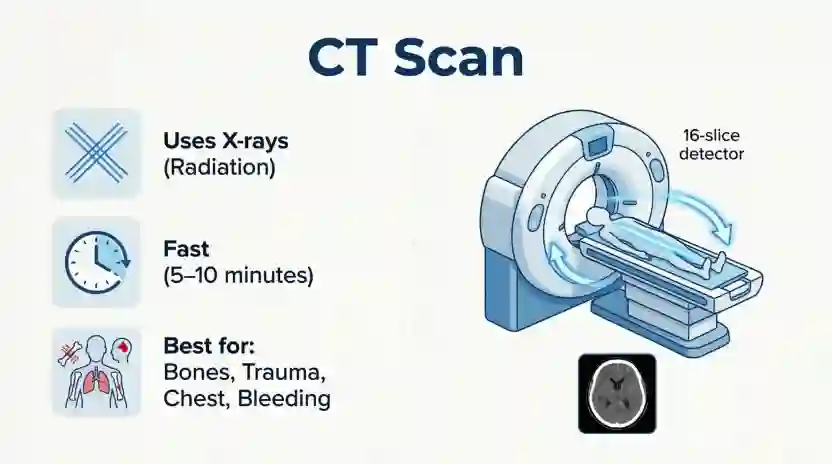
CT and MRI are both medical imaging tests, but they work in different ways and help doctors answer different questions. A CT scan uses X-rays to create detailed images of the body, while an MRI uses a strong magnetic field and radio waves to produce detailed images of organs and soft tissues.
People often search for “CT or MRI” because they want to know which test is better, safer, faster, or more accurate. The answer depends on the part of the body being examined and the condition a doctor wants to investigate. Neither test is best for every situation.
A CT scan is often useful when doctors need quick images, such as after a serious injury. An MRI can provide greater detail for many problems involving the brain, spinal cord, muscles, ligaments, and other soft tissues.
Both tests have benefits and limitations. CT scans use ionizing radiation, while MRI scans do not. However, MRI requires special safety checks for metal objects and certain implanted medical devices.
In this guide, you will learn how CT and MRI differ, what each test can detect, how they compare in safety and cost, and what to expect during an examination. You will also find practical examples to help you understand why a doctor might recommend one test instead of the other.
CT or MRI: The Quick Answer
A CT scan uses X-rays to create cross-sectional images of the body and is often faster. An MRI uses a magnetic field and radio waves to produce detailed images of soft tissues without ionizing radiation. CT is often preferred for urgent injuries and certain lung or bone problems, while MRI is useful for many brain, spine, joint, and soft-tissue conditions. The best choice depends on the medical question.
CT or MRI: Quick Answer
The main difference between CT and MRI is the technology each test uses.
- CT scan: Uses X-rays and a computer to create detailed body images.
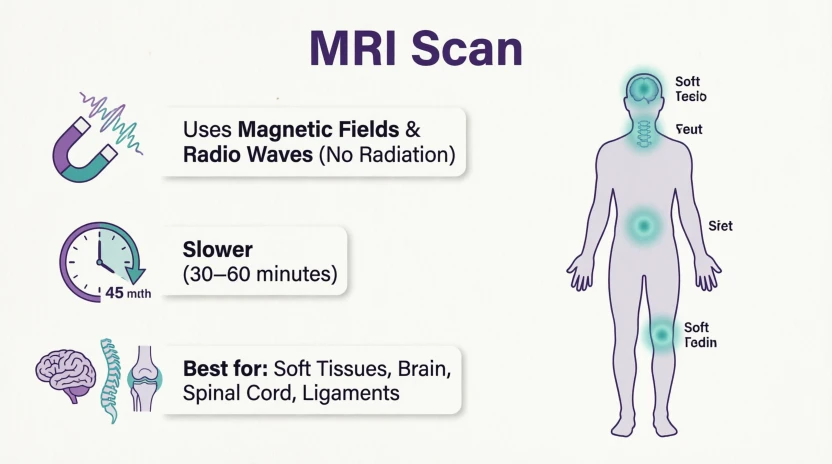
- MRI scan: Uses a strong magnetic field, radio waves, and a computer to create detailed body images.
- CT advantage: Usually faster and often useful in emergencies.
- MRI advantage: Often provides better detail of many soft tissues.
- Safety difference: CT uses ionizing radiation. MRI does not, but its strong magnetic field requires careful safety screening.
For example, a doctor may request a CT scan after a serious accident to check for internal injuries. An MRI may be recommended to examine a torn knee ligament or investigate certain spinal problems.
These are common patterns, not fixed rules. Doctors select the test that is most likely to provide the information needed for diagnosis and treatment.
What Does CT or MRI Mean?
What Is a CT Scan?
CT stands for computed tomography. It is also called a CAT scan, although CT is the more common term in modern medical settings.
A CT scanner uses X-rays taken from different angles. A computer combines these measurements to create cross-sectional images, sometimes called slices.
These images help doctors examine bones, lungs, blood vessels, organs, and other structures inside the body.
Doctors may use CT scans to:
- Check for internal bleeding after an injury.
- Examine certain lung conditions.
- Detect some tumors and other abnormal growths.
- Assess fractures and complex bone injuries.
- Investigate abdominal pain.
- Guide some medical procedures.
Some CT examinations use a contrast material to make certain tissues or blood vessels easier to see. The need for contrast depends on the examination and the patient’s medical history.
What Is an MRI Scan?
MRI stands for magnetic resonance imaging.
An MRI scanner uses a strong magnetic field, radio waves, and a computer to create detailed images of internal body structures. Unlike CT, MRI does not use X-rays or ionizing radiation.
MRI is especially useful for examining many soft tissues. These include the brain, spinal cord, muscles, ligaments, tendons, and certain internal organs.
Doctors may use MRI to:
- Examine some brain and spinal conditions.
- Investigate ligament and tendon injuries.
- Assess certain joint problems.
- Study some tumors and soft-tissue abnormalities.
- Investigate selected nerve-related conditions.
- Monitor particular diseases or treatments.
Some MRI examinations use a contrast agent called gadolinium to improve image detail. Not every MRI requires contrast.
What Is the Main Difference?
CT and MRI both help doctors see inside the body, but they produce images differently.
CT is often useful when speed matters or when doctors need to examine particular bones, lungs, or internal injuries. MRI is often useful when detailed images of soft tissues are important.
The two tests can complement each other. In some cases, a doctor may recommend both because each can reveal different information.
The Origin of CT and MRI
CT and MRI developed from different scientific technologies. Their names describe how each imaging method works.
The Origin of CT
The term computed tomography combines the idea of computer processing with tomography, a method of creating images of sections through an object.
CT technology developed during the 20th century. The first clinical CT systems became available in the early 1970s and helped transform medical imaging by allowing doctors to view cross-sectional images of the brain and, later, other body areas.
Modern CT scanners can produce detailed images quickly. This makes them useful for many emergency examinations and other situations where speed is important.
The Origin of MRI
The term magnetic resonance imaging describes the use of magnetic resonance signals to produce images of the body.
MRI grew out of scientific research into nuclear magnetic resonance and its use for studying tissues. Medical MRI developed during the 1970s and became increasingly available in hospitals during the following years.
The word nuclear appeared in the name of the underlying scientific technique, but MRI does not require ionizing radiation. The common medical term is simply MRI.
Why Are They Different?
CT and MRI use different physical processes to create images. This means they highlight different features of the body and have different practical strengths.
CT is generally quicker. MRI often provides more detailed views of many soft tissues. Neither method has replaced the other because they serve different diagnostic needs.
British English vs American English
CT and MRI are standard medical abbreviations in both British and American English. The main differences are often found in the surrounding terminology, not the abbreviations themselves.
| British English | American English | Example |
| CT scan | CT scan | The doctor ordered a CT scan. |
| MRI scan | MRI scan | She needs an MRI scan of her knee. |
| Computed tomography | Computed tomography | CT stands for computed tomography. |
| Magnetic resonance imaging | Magnetic resonance imaging | MRI stands for magnetic resonance imaging. |
| Radiographer | Radiologic technologist or radiographer | A trained professional performs the scan. |
| Hospital appointment | Imaging appointment or hospital appointment | The patient attended an imaging appointment. |
Regional Differences
In the United Kingdom, radiographer is a common term for the professional who performs the examination. In the United States, radiologic technologist is widely used.
The abbreviations CT and MRI are understood internationally. When writing for a general audience, spell out each abbreviation at its first mention.
For example:
- CT means computed tomography.
- MRI means magnetic resonance imaging.
This approach helps readers who are unfamiliar with medical terminology.
Which Version Should You Use?
There is no single test that is best for every patient. The right examination depends on symptoms, the suspected condition, medical history, and the information the doctor needs.
United States
Both CT and MRI are widely used in American healthcare. Doctors often choose CT for rapid assessment of certain injuries and MRI when detailed soft-tissue images are needed.
United Kingdom
The NHS and private healthcare providers use both tests. A clinician decides which examination is appropriate and if it is needed urgently.
Canada
CT and MRI are both used in Canadian healthcare. The choice depends on the suspected condition, the clinical urgency, and local imaging services.
Australia
Doctors in Australia use CT and MRI for different diagnostic purposes. The recommended examination depends on the body area and the medical question.
International Writing
Use CT scan and MRI scan for clear, widely understood wording. Define both abbreviations the first time they appear, especially in educational content.
Academic Writing
In academic or medical writing, use the full term at first mention, followed by the abbreviation in parentheses.
For example:
“Computed tomography (CT) and magnetic resonance imaging (MRI) are common diagnostic imaging methods.”
Follow the journal’s style guide and relevant medical terminology standards.
Business and Patient Education Writing
Use plain language. Explain why a doctor might recommend a test without suggesting that one is always superior.
For patient information, avoid statements such as “MRI is always safer” or “CT is always more accurate.” These claims ignore the purpose of the examination and the patient’s circumstances.
Common Mistakes
People often compare CT and MRI as if they were interchangeable tests. Although both create images of the body, their strengths, limitations, and safety considerations differ.
| Incorrect statement | Correct information | Explanation |
| MRI uses X-rays. | MRI uses a magnetic field and radio waves. | MRI does not use ionizing radiation. |
| CT and MRI show exactly the same details. | Each test has different strengths. | The best test depends on the body part and condition. |
| MRI is always better than CT. | Neither test is always better. | CT may be more suitable when speed matters. |
| CT radiation stays in the body. | CT uses ionizing radiation, but it does not leave radiation stored in the body. | The radiation exposure occurs during the examination. |
| Everyone with a metal implant cannot have an MRI. | Some implants are MRI-safe or MRI-conditional. | Staff must identify the exact device and follow safety rules. |
| Every CT or MRI requires contrast. | Many examinations do not require contrast. | Contrast depends on the clinical purpose. |
Memory Tip
Remember this simple guide:
- CT: X-rays and speed.
- MRI: Magnetic field and soft-tissue detail.
This is a useful starting point, not a substitute for medical advice. The correct examination can vary even when two patients have similar symptoms.
Everyday Examples of CT and MRI
CT and MRI are medical tests, so examples are best understood through real-life healthcare situations rather than ordinary language rules.
Emergency Care
After a serious accident, a doctor may request a CT scan to look for internal bleeding or certain injuries. CT can produce images quickly, which may be important when urgent decisions are needed.
Brain Examination
CT and MRI can both examine the brain. CT may be used first in some emergencies, while MRI can provide additional detail for certain neurological conditions.
The decision depends on the symptoms and what the medical team needs to investigate.
Knee and Joint Injuries
A patient with a suspected ligament tear may need an MRI because it can show many soft-tissue injuries in detail. CT may be more appropriate for certain complex bone injuries.
Back Pain
A doctor may recommend MRI when investigating certain spinal conditions involving nerves, discs, or other soft tissues. CT may be useful for some fractures and bone-related problems.
Not every case of back pain needs either scan. The clinician considers the symptoms and if imaging is likely to change treatment.
Lung and Chest Problems
CT is commonly used to examine the lungs and chest in detail. MRI has more limited routine use for many lung problems, although it is useful for selected chest and heart examinations.
Tumor Assessment
Both CT and MRI can help doctors investigate and assess some tumors. The preferred method depends on the tumor’s location, the type of information needed, and the wider treatment plan.
Follow-Up Examinations
A patient may have repeat imaging to monitor a condition or assess treatment. The medical team selects the appropriate test based on the area being examined and the need to compare results over time.
Google Trends and Modern Usage
People search for “CT or MRI” because they want a simple answer to a complex medical comparison. Common questions include which test is safer, which gives clearer images, which costs less, and which is better for a specific symptom.
The phrase is also common in patient education because CT and MRI are frequently mentioned together in discussions about diagnostic imaging.
However, a search phrase alone does not establish which test is more popular in a particular country. Without verified, date-specific search data, exact regional rankings or numerical trends should not be claimed.
The general usage pattern is clear: patients want to understand the purpose, experience, risks, and benefits of each examination before attending an appointment.
One important point is that “better images” does not always mean “better test.” A scan is useful when it answers the right medical question. A fast CT scan may be the better choice in an emergency, while an MRI may be more useful for a particular soft-tissue problem.
If you want to compare search interest over time, Google Trends can be used to explore terms such as “CT scan,” “MRI scan,” and “CT vs MRI.” Results should be checked for the chosen country and time period, and interpreted as relative search interest rather than a direct count of all searches.
Quick Comparison Table
| Feature | CT Scan | MRI Scan |
| Full name | Computed tomography | Magnetic resonance imaging |
| Technology | X-rays and computer processing | Magnetic field, radio waves, and computer processing |
| Ionizing radiation | Yes | No |
| Typical speed | Usually faster | Usually slower |
| Soft-tissue detail | Good for many structures, depending on the scan | Often excellent for many soft tissues |
| Common uses | Certain emergencies, injuries, lungs, and bones | Brain, spine, joints, and many soft-tissue conditions |
| Metal safety | Many implants do not prevent CT | Requires careful screening for implants and metal |
| Contrast | May use iodine-based contrast | May use gadolinium-based contrast |
| Noise | Usually less noisy | Often loud; hearing protection is provided |
| Best choice | Depends on the medical question | Depends on the medical question |
No comparison table can replace a clinician’s assessment. The most appropriate scan depends on the patient’s needs and the information required.
Key Takeaways
- CT stands for computed tomography and uses X-rays.
- MRI stands for magnetic resonance imaging and uses a strong magnetic field and radio waves.
- CT is often faster and useful in many emergency situations.
- MRI often provides more detail for many soft-tissue problems.
- CT uses ionizing radiation, while MRI does not.
- MRI requires careful screening for metal and implanted devices.
- Either test may use contrast, but contrast is not required for every examination.
- A doctor chooses the test based on symptoms, medical history, and the suspected condition.
FAQs About CT or MRI
1. Which is better, CT or MRI?
Neither test is always better. CT is often preferred when rapid imaging is important or when certain lung, bone, or internal injuries need assessment. MRI often provides more detail for many soft-tissue conditions. The best option depends on the body part being examined and the suspected problem.
2. Is an MRI safer than a CT scan?
MRI does not use ionizing radiation, which is an important difference from CT. However, MRI has its own safety requirements because its strong magnetic field can interact with certain implants and metal objects. CT may be the more appropriate choice in some situations. A clinician weighs the benefits and risks of the recommended examination.
3. Does a CT scan use radiation?
Yes. CT uses X-rays, which are a form of ionizing radiation. The amount of exposure depends on the examination and other factors. Doctors request CT scans when the expected medical benefit justifies the exposure and aim to use an appropriate imaging protocol.
4. Does an MRI use radiation?
MRI does not use X-rays or ionizing radiation. It creates images using a strong magnetic field, radio waves, and computer processing. Even so, MRI is not suitable for every person or situation. Patients must disclose implants, medical devices, and possible metal fragments before the examination.
5. Which scan is faster, CT or MRI?
CT scans are generally faster than MRI scans. Some CT examinations take only a few minutes to acquire images, while MRI examinations often take longer because they require several imaging sequences. The full appointment may take additional time for preparation, contrast, and safety checks.
6. Is CT or MRI better for the brain?
Both can be useful for brain examinations. CT is often used in urgent situations, such as after certain head injuries or when a rapid assessment is needed. MRI can provide detailed information for many neurological conditions. The best test depends on symptoms, urgency, and the suspected diagnosis.
7. Is CT or MRI better for back pain?
MRI is often useful when a doctor needs to examine spinal discs, nerves, and other soft tissues. CT can provide detailed views of bones and may be useful for certain fractures. Many cases of back pain do not require immediate imaging, so the decision depends on symptoms and clinical assessment.
8. Which scan costs more, CT or MRI?
MRI often costs more than CT, but the actual price varies by country, provider, body area, and if contrast is needed. Insurance coverage and public healthcare arrangements also affect what a patient pays. Check with the imaging provider or insurer for an accurate estimate.
9. Can I have an MRI if I have metal in my body?
Possibly, but you must tell the MRI team about any implant, medical device, or possible metal fragment. Some devices are safe under specific conditions, while others may make MRI unsafe or require special procedures. Staff need to identify the exact device before deciding if the scan can proceed.
10. Do CT and MRI scans require contrast dye?
No. Many CT and MRI scans are performed without contrast. When needed, CT contrast is often iodine-based, while MRI contrast commonly uses a gadolinium-based agent. The choice depends on the examination. Tell your healthcare team about kidney problems, allergies, pregnancy, or previous contrast reactions before the test.
Conclusion: CT or MRI?
CT and MRI are both valuable medical imaging tests, but they are designed to provide different types of information. CT uses X-rays to create detailed images quickly and is often useful for certain emergencies, lung problems, and bone injuries. MRI uses a magnetic field and radio waves, making it especially useful for examining many soft tissues, including the brain, spine, ligaments, and muscles.
When deciding between CT or MRI, do not focus on which test sounds more advanced or has fewer risks in general. Focus on the medical question the scan needs to answer. CT involves ionizing radiation, while MRI requires special precautions for certain implants and metal objects. Both may use contrast agents when needed.
Your doctor will consider your symptoms, medical history, possible risks, and the information required before recommending a scan. If you have concerns about radiation, implants, contrast, pregnancy, or cost, ask your healthcare team before the appointment.
The most important takeaway is simple: the best scan is the one that safely provides the information your medical team needs. Understanding the difference can help you feel more prepared and ask better questions at your next appointment.
Read more about!
- Bitchin Slang: Meaning, Origin, Examples & How to Use It
- BTK Meaning Slang: Is It Common in Text Messages?
- Grape Slang Meaning: What Does Grape Mean in Slang?
- Birdie Slang Meaning: Everything You Need to Know

I’m Olivia Parker, a grammar and English writing enthusiast passionate about making English simple and easy to understand. Through Wordsblog, I share clear explanations, useful grammar tips, and practical writing guidance to help readers write with confidence. My goal is to make learning English easier, one word at a time.







7 thoughts on “CT or MRI: What’s the Difference?”