Sike is the more common informal spelling, while syke is a less common variant, but psych! is the established spelling for the slang expression. If you have seen someone write “sike!” or “syke!” after a joke, you may wonder which spelling is right. The confusion is easy to understand because all three forms can sound like “sike.”
People often search for sike or syke because the expression appears in texts, memes, social media posts, comments, and casual conversations. It is usually used when someone says something surprising and then quickly reveals that it was not true.
For example, someone might say, “I ate your last cookie. Sike!” The speaker means that the statement was a joke or trick.
In this guide, you will learn what sike and syke mean, where they came from, how they differ from psych, which spelling is best for different situations, and how people use them today. You will also see simple examples, common mistakes, and answers to the most common questions.
Sike or Syke – Quick Answer
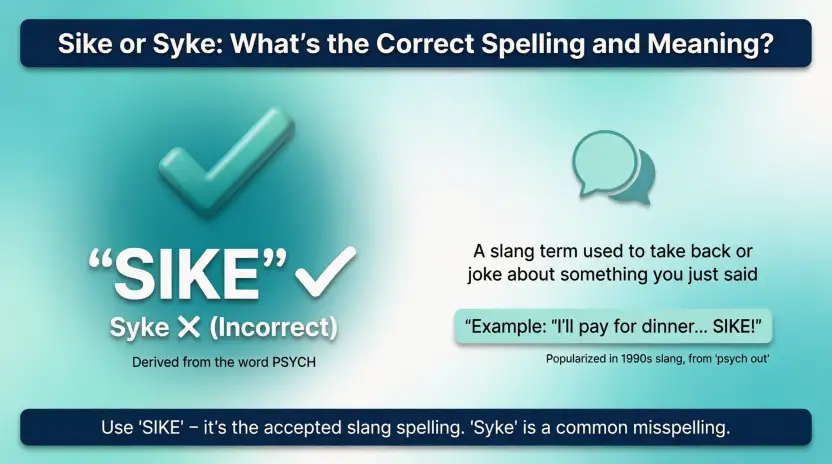
Sike and syke are informal spellings of the slang expression psych!, which means “just kidding,” “fooled you,” or “I was joking.”
For example:
- “I forgot your birthday. Sike!”
- “You really believed me? Sike!”
- “We have a test tomorrow. Psych!”
Which spelling is best?
| Spelling | Status | Best use |
| psych | Established spelling | General writing and standard usage |
| sike | Informal variant | Texts, memes, chats, casual posts |
| syke | Less common variant | Very informal use |
If you are writing something formal, avoid all three as slang. Use “just kidding,” “I was joking,” or another clear expression.
Definition and Meaning of Sike or Syke
What does “sike” mean?
In modern slang, sike is used to tell someone that a previous statement was a joke, trick, or false statement.
It often creates a quick surprise.
For example:
“I just bought you a new car. Sike!”
The speaker did not really buy the car. The word sike tells the listener that the statement was not serious.
What does “syke” mean?
Syke has the same slang meaning when it is used as a variant of sike or psych.
For example:
“You thought I was serious. Syke!”
The meaning is:
“I was only joking.”
However, syke is less common than sike in this slang use.
What does “psych!” mean?
Psych! is the established spelling of the slang interjection.
It is used after a statement to reveal that the speaker was trying to fool or surprise someone.
It can mean:
- Just kidding
- Fooled you
- Got you
- I was joking
- That was not true
The expression is usually informal.
Is “sike” a real word?
Yes, but there is an important detail.
Sike also exists as a separate English noun in regional usage. In Scotland and northern England, sike can refer to a small stream, ditch, or gully.
That meaning is unrelated to the modern slang spelling sike! meaning “fooled you.”
This is one reason context matters.
The Origin of Sike or Syke
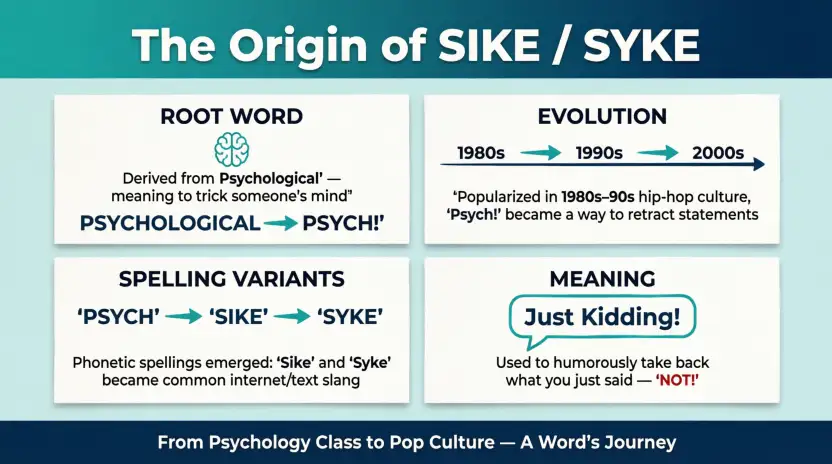
Where did “psych!” come from?
The slang psych! is connected with the verb psych, especially the expression psych out.
The word family is related to ideas about the mind or mental state. The shortened interjection developed as a way to say that someone had been fooled, surprised, or mentally thrown off.
The slang expression became widely associated with casual American English and youth speech in the late twentieth century.
Over time, people began using the short form:
Psych!
It worked as a quick way to reveal a joke or trick.
How did “sike” develop?
The spelling sike appears to be a pronunciation-based spelling of psych.
The pronunciation makes the change easy to understand.
Psych is pronounced roughly like:
“sike”
People who heard the word in conversation could spell it according to its sound. That helped sike become a common informal spelling.
Dictionary.com lists sike as a less common spelling variant of psych in this slang sense.
How did “syke” develop?
Syke is another spelling based mainly on sound.
Because slang often spreads through speech, texting, online communities, and social media, speakers may create different spellings for the same sound.
Wiktionary lists syke as an alternative slang form of psych.
So the three forms can be understood like this:
psych → sike → syke
The last two are informal spellings rather than separate standard words for the same slang expression.
British English vs American English Spelling
Is this a British vs American spelling difference?
No. Sike vs syke is not a normal British English versus American English spelling difference.
The established slang spelling psych can be understood in both varieties of English. The informal forms sike and syke are more about slang, pronunciation, and personal or online spelling choices.
| Feature | British English | American English |
| Established slang form | psych! | psych! |
| Informal variant | sike | sike |
| Less common variant | syke | syke |
| Meaning | Fooled you / joking | Fooled you / joking |
| Formal writing | Avoid slang | Avoid slang |
What should publishers use?
Formal publishers, schools, newspapers, and professional websites should normally avoid slang when a clear standard expression is better.
Instead of:
“Psych!”
A formal writer could use:
“Just kidding.”
Or:
“I was only joking.”
The choice depends on the audience.
A social media post can use sike for a casual tone. A school essay usually should not.
Which Spelling Should You Use?
For US English
If you are writing standard English, psych is the safer spelling for the slang expression.
For casual online writing, sike is widely recognizable.
For UK English
Use psych when you want the established spelling of the slang expression.
Avoid sike and syke in formal writing.
For Canada and Australia
The same advice applies.
Use psych for the established slang form and avoid slang in formal work unless you are discussing the word itself.
For international readers
Sike may be easier for some readers to understand because it looks like the way the word sounds.
However, if your goal is correct standard spelling, psych is the better choice.
For academic writing
Avoid the slang entirely unless your topic is language, slang, social media, or popular culture.
Use:
- just kidding
- joking
- jokingly
- fooled you
For social media
Casual forms are common.
You may see:
- Sike!
- Syke!
- Psych!
- SIKE!
- Sike, nah!
The tone is informal and playful.
Common Mistakes with Sike or Syke
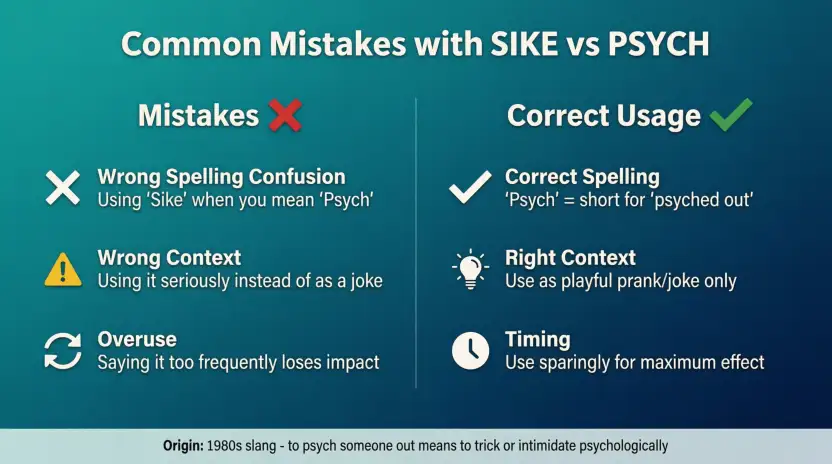
Mistake 1: Treating “syke” as the standard spelling
Incorrect for standard usage:
“Syke! I was joking.”
Better:
“Psych! I was joking.”
Why?
Syke is an informal variant.
Memory tip:
Think psych when you want the established spelling.
Mistake 2: Assuming “sike” is always wrong
Sike is widely used as an informal slang spelling.
It is not the best choice for formal writing, but it is common in texts, memes, chats, and casual social media.
Mistake 3: Writing “psyche”
Psyche is not normally the same as slang psych!
It is a different word with its own meanings.
For example:
“The story explores the human psyche.”
Here, psyche refers to the mind or inner self.
Mistake 4: Using “sike” in formal writing
Instead of:
“Sike, the meeting was not canceled.”
Write:
“Just kidding. The meeting was not canceled.”
The second version is clearer and more professional.
Mistake 5: Confusing slang with standard spelling
Slang can develop spellings that do not follow the spelling of the original word.
That is exactly why psych, sike, and syke can cause confusion.
Sike or Syke in Everyday Examples
In text messages
“I got you a new phone. Sike!”
Meaning: The speaker is joking.
On social media
“I am deleting my account. SIKE!”
The capital letters add emphasis. The tone is playful and informal.
In a conversation
“You have to clean the whole house today. Psych!”
The speaker then reveals that the statement was a joke.
In a meme
“Me: I will go to bed early tonight.
Also me at 2 a.m.: Sike.”
This type of use is common in humorous online writing.
In a blog
A casual blog may use:
“You might think the answer is obvious. Sike!”
This gives the article a playful voice.
In news writing
Professional news writing normally avoids sike and syke unless the word itself is part of the story.
For example:
The post ended with the slang expression “sike,” signaling that the earlier claim was a joke.
In academic writing
Academic writing should normally explain the expression rather than use it casually.
For example:
The slang expression “psych!” is used to signal that a previous statement was not serious.
Sike or Syke – Google Trends & Usage Data
Why do people search “sike or syke”?
People usually search this phrase because they hear the expression before they see it written.
The pronunciation does not make the spelling obvious.
When someone hears:
“Sike!”
They may naturally write sike or syke.
This creates the spelling question.
Is “sike” more common than “syke”?
In modern informal use, sike appears to be the more common spelling of the two.
Dictionary sources recognize sike as a variant of psych, while syke is also recorded as an alternative slang form.
Exact popularity can change by country, platform, age group, and time. Without a specific Google Trends region and date range, it would not be reliable to give an exact search-volume number.
Where is the word used?
You are most likely to encounter these forms in:
- Text messages
- Social media
- Memes
- Online comments
- Gaming chats
- Casual conversations
- Youth slang
The word is much less suitable for formal documents.
Why does slang have different spellings?
Slang often spreads through speech before people agree on a written form.
When a word is heard rather than read, people may spell it according to its pronunciation.
That can create several informal forms.
This is what makes sike or syke different from a normal spelling question such as colour vs color.
Quick Comparison Table
| Spelling | Meaning | Correct? | Best Context | Example |
| Psych | Fooled you / joking | Established slang spelling | General informal writing | “Psych! I was joking.” |
| Sike | Fooled you / joking | Informal variant | Texts and social media | “Sike! You believed me.” |
| Syke | Fooled you / joking | Less common informal variant | Very casual use | “Syke! Just kidding.” |
| Psyche | Mind or inner self | Different word | Formal/general English | “The human psyche.” |
| Just kidding | I was joking | Standard phrase | All casual and many formal contexts | “Just kidding.” |
The easiest rule
If you mean the slang expression:
If you are writing formally:
Just kidding.
FAQs About Sike or Syke
1. Is “sike” or “syke” correct?
Sike is the more common informal spelling, while syke is a less common variant. The established spelling of the slang expression is psych!
2. Is “sike” a real word?
Yes. Sike exists as a regional English noun, and it is also used informally as a spelling variant of psych! The two meanings are different.
3. What does “sike” mean in texting?
In texting, sike usually means “just kidding,” “fooled you,” or “I was joking.” It is often added after a surprising or false statement.
4. What does “syke” mean?
Syke is an informal spelling variant of psych! It can mean “fooled you” or “just kidding,” but it is less common than sike.
5. Is “psych” the correct spelling?
Yes. Psych! is the established spelling for the slang interjection. It is connected to the word psych and the expression psych out.
6. Can I use “sike” in formal writing?
It is better to avoid it. In formal writing, use “just kidding,” “I was joking,” or another clear phrase instead.
7. Is “psyche” the same as “sike”?
No. Psyche is a different word. It can refer to the human mind or inner self, while sike is an informal spelling used for the slang expression “psych!”
Conclusion
When comparing sike or syke, the main point is that both are informal spellings used for the slang expression psych! Sike is the more common informal form, while syke is less common.
The established spelling is psych!, which is used to signal that a previous statement was a joke, trick, or false claim. For example, “I bought you a new car. Psych!” means the speaker was not being serious.
The spelling confusion comes mainly from pronunciation. People hear the word as “sike,” so sike and syke developed as phonetic spellings. This is why the forms are common in texts, memes, social media, and casual conversations.
For formal writing, it is better to avoid all of these slang forms. Use “just kidding” or “I was joking” instead.
If you want the safest spelling for the slang expression, choose psych. If you are writing a casual post, sike is widely understood.
Remember: psych is the established spelling, sike is the common informal spelling, and syke is a less common variant.
Use the form that matches your audience and writing style.
Read more about!
- Buried or Cremated: What Is the Difference?
- Dose or Dosage: What Is the Difference?
- Fabric or Forge: What Is the Difference?

I’m Olivia Parker, a grammar and English writing enthusiast passionate about making English simple and easy to understand. Through Wordsblog, I share clear explanations, useful grammar tips, and practical writing guidance to help readers write with confidence. My goal is to make learning English easier, one word at a time.