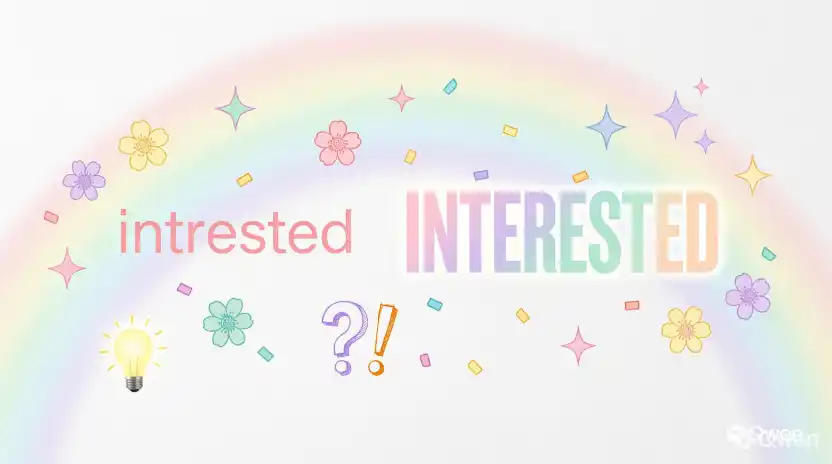
Interested is the correct spelling, while intrested is a common misspelling. If you want to say that someone wants to know more about something or feels curious about it, use interested.
The word interested is common in everyday English. You may use it when talking about hobbies, jobs, people, news, subjects, or activities. For example, you can say, “I am interested in learning English.”
Many people type intrested because the word is often pronounced quickly. The second e can be easy to miss when spelling the word. This makes the mistake common, especially for English learners and people writing quickly.
The good news is that the rule is simple. Interested has two e letters after the “t” sound: interested. The spelling intrested is not standard English.
In this guide, you will learn the correct spelling, meaning, word origin, British and American usage, common mistakes, and real-life examples. You will also learn an easy way to remember the spelling.
Interested or Intrested – Quick Answer
The correct spelling
Interested is correct.
Intrested is incorrect in standard English.
Examples:
- I am interested in history.
- She is interested in the job.
- Are you interested in joining us?
The correct form is:
interested ✅
The incorrect form is:
intrested ❌
Easy spelling rule
Think of the word as:
interest + ed = interested
The base word is interest. When -ed is add, it becomes intere.
Definition and Meaning of Interested or Intrested
What does interested mean?
Interested means wanting to know more about something, enjoying something, or giving attention to something.
For example:
I am interest in science.
This means the person likes science or wants to learn more about it.
Another example:
She is interest in the new position.
This means she wants to know more about the job or may want to apply for it.
Interested as an adjectiv
Interest is commonly us as an adjective.
Examples:He is interest in music.
- They are interest in buying a house.
- We are interestein your offer.
A very common structure is:
interested in + noun
Examples:
I am interest in photography.
She is interest in the course.
Interested with a verb
You can also use interested in + -ing.
Examples:
- I am interest in learning Spanish.
- He is interest in starting a business.
- They are interest in visiting Japan.
What does intrested mean?
Intrested is not the standard spelling of the word.
It is usually a spelling mistake caused by leaving out the second e in interested.
Correct:
I am interest in the course.
Incorrect:
I am intrest in the course.
The Origin of Interested or Intrested
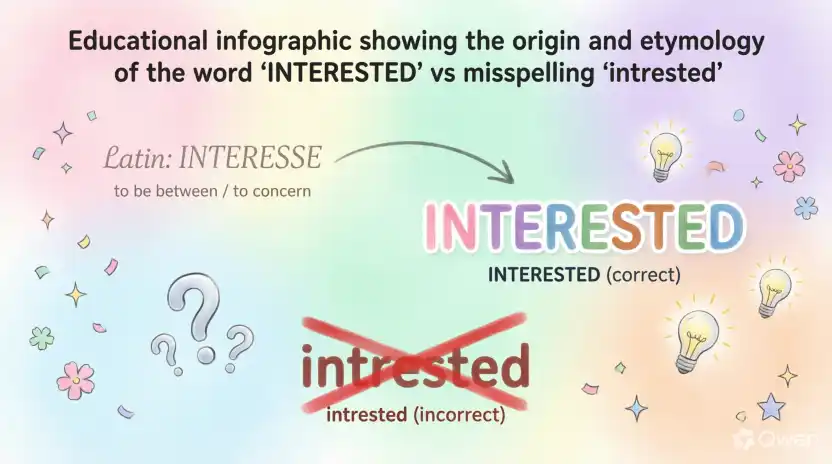
Where does interested come from?
Interested comes from the word interest.
The English word interest came through French from Latin interesse, which relates to the idea of being important or being involv in something.
Over time, interest developed several related meanings in English. It can refer to curiosity, attention, involvement, concern, or a desire to know more.
The adjective interested developed from the verb interest.
The basic word family includes:
- interest
- interested
- interesting
- interests
Why do people spell it intrested?
The misspelling intrest usually happens because the word is pronounced quickly .
When people say interest, the middle vowel sound may not be strongly heard. As a result, some writers leave out the second e.
However, pronunciation does not change the standard spelling.
Remember:
interest + ed = interested
British English vs American English Spelling
Is the spelling different in British and American English?
No. Interest is spelled the same in British and American English.
| British English | American English | Correct? |
| interested | interested | ✅ Yes |
| intrested | intrested | ❌ No |
| interesting | interesting | ✅ Yes |
| intresting | intresting | ❌ No |
There is no standard British spelling intrested.
There is also no standard American spelling intrested.
Regional spelling rule
Some English words have different British and American spellings.
For example:
- colour / color
- favourite / favorite
- organise / organize
But interested is not one of those words.
Use interested in both varieties of English.
Style guides and publishing
Schools, publishers, businesses, and newspapers may use different style guides. However, standard dictionaries agree on the spelling interested.
For professional writing, always use interested.
Which Spelling Should You Use?
For US English
Use:
interested ✅
Example:
I am interest in this position.
For UK and Commonwealth English
Use:
interested ✅
The spelling does not change.
For international English
Use interested. It is the standard spelling understood across major English varieties.
For academic writing
Use interested in essays, reports, research papers, and assignments.
Example:
Students are increasingly interest in environmental studies.
For business writing
Use interested in emails, proposals, applications, and professional messages.
Example:
We are interest in discussing your proposal.
The safest rule is simple:
Always use interested, not intrested.
Common Mistakes with Interested or Intrested
Mistake 1: Leaving out the second e
Incorrect:
I am intrest in the course.
Correct:
I am interest in the course.
The correct spelling contains interest + ed.
Mistake 2: Writing intresting
Incorrect:
This is an intresting book.
Correct:
This is an interesting book.
The base word is interest, so the spelling keeps the e.
Mistake 3: Confusing interested and interesting
These words have different uses.
Interested describes how a person feels.
I am interested in science.
Interesting describes something that creates interest.
Science is interesting.
This is an important difference for English learners.
Quick memory tip
Break the word into two parts:
interest + ed
If you can spell interest, you can spell interested.
Interested or Intrested in Everyday Examples
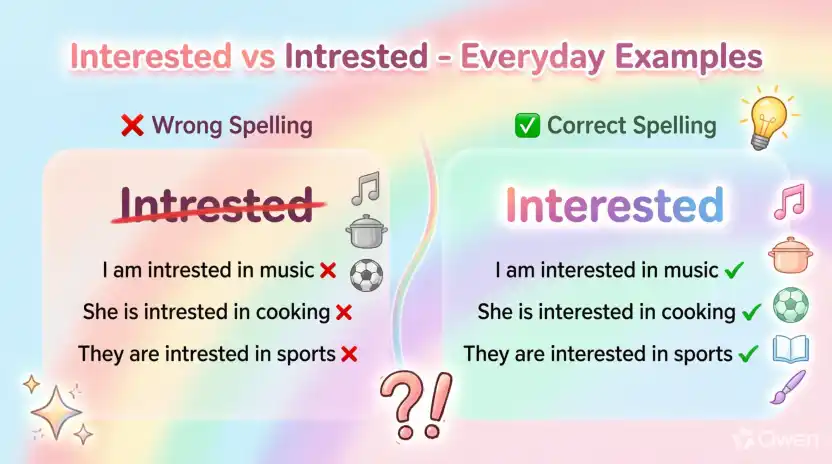
Emails
Correct:
I am interest in learning more about your services.
Incorrect:
I am intrest in learning more about your services.
Business writing
Correct:
We are interest in working with your company.
The word sounds professional and is common in formal business communication.
News and media
Examples:
Young readers are interest in new technology.
Investors are interest in the latest market news.
Blogs
Example:
If you are interest in improving your English, start with common spelling mistakes.
Social media
Example:
Anyone interested in joining the study group can send me a message.
Academic writing
Example:
Many students are interest in learning a second language.
Daily conversation
Example:
Are you interest in watching a movie tonight?
Another example:
I am not intereste in football.
Interested or Intrested – Google Trends & Usage Data
Why do people search for interested or intrested?
People often search this spelling comparison because intrested looks close to the correct word.
Common search questions include:
- Is it interest or intrested?
- How do you spell interested?
- Is intrest a word?
- Interested meaning
- Interested spelling
- Interested vs intrested
The search intent is mainly educational. Students, ESL learners, writers, and people checking a spelling mistake may search for the answer.
Modern usage
Interested is a normal and widely used English word.
It appears in:
- Emails
- Job applications
- School assignments
- Business communication
- Social media
- News articles
- Everyday conversation
The misspelling intrested may appear in informal online writing, but that does not make it a correct spelling.
Regional popularity
There is no meaningful British-versus-American spelling difference for this word.
Both use:
interested
Exact Google Trends interest can change by country and time. Without a specific date range and region, it would be misleading to give a fixed search-volume or popularity figure.
Quick Comparison Table
| Word | Meaning | Correct? | Usage | Example |
| interested | Wanting to know or learn more | ✅ Yes | Standard English | I am interested in art. |
| intrested | Common misspelling | ❌ No | Avoid | I am intrested in art. |
| interesting | Causing interest | ✅ Yes | Standard English | The book is interesting. |
| intresting | Common misspelling | ❌ No | Avoid | The book is intresting. |
Interested vs interesting
| Word | Describes | Example |
| interested | A person’s feeling | She is interested in science. |
| interesting | Something that creates interest | Science is interesting. |
This difference is especially useful for ESL learners.
FAQs
1. Is interest or intrest correct?
Interested is the correct spelling. Intrestis a common misspelling and should not be us in standard English.
2. Is intrest a real word?
No. Intrested is not the standard spelling. Use interested in formal and informal English.
3. How do you spell interested?
The correct spelling is interest. You can remember it as interest + ed.
4. Why do people spell interested as intrested?
People often leave out the second e because the word can be pronounc quickly, making that vowel less noticeable.
5. Is interest the same in British and American English?
Yes. Interested has the same spelling in British and American English.
6. What is the difference between interested and interesting?
Interested describes a person’s feeling, while interesting describes something that creates interest.
7. Is “I am interest in” correct?
Yes. Interested in is a standard English expression. For example, “I am interest in learning French.”
Conclusion
Interested is the correct spelling, while intrested is a common spelling mistake. The correct word contains the full base word interest, followed by -ed.
The easiest way to remember it is to break it into two parts:
interest + ed = interested
This spelling works in both British and American English. You should use interested in schoolwork, emails, business writing, job applications, social media, and everyday conversation.
It is also useful to know the difference between interested and interesting. A person is interest in something, while something can be interest to a person.
If you are an English learner, remembering the base word can help you avoid this mistake. Do not remove the secon e just because you may not hear it clearly when the word is spoke quickly.
The final rule is easy:
Use “interested” every time. “Intrested” is not the correct spelling.
Read more about!
- Bose or Beats: Which Headphones Are Better?
- Verry or Very: Which Spelling Is Correct?
- Prefix or Suffix: Meaning, Differences, Examples, and Usage

I’m Olivia Parker, a grammar and English writing enthusiast passionate about making English simple and easy to understand. Through Wordsblog, I share clear explanations, useful grammar tips, and practical writing guidance to help readers write with confidence. My goal is to make learning English easier, one word at a time.