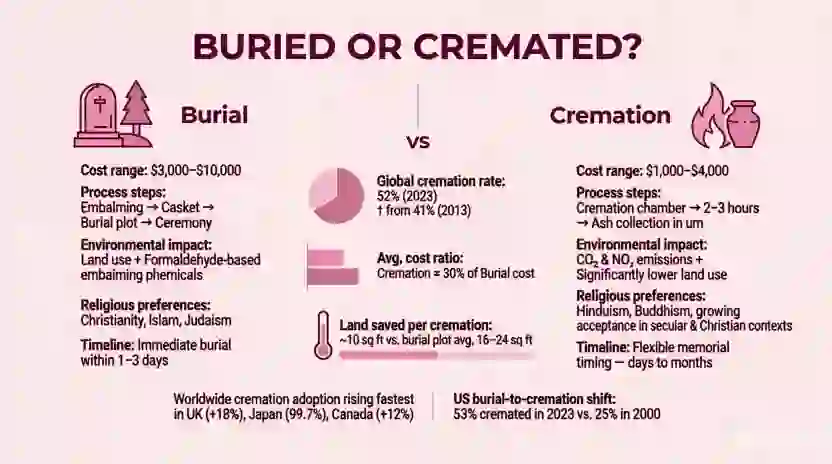
When talking about what happens to a person after death, buried or cremated describes two different ways of handling human remains. A person is buried when their body is placed in the ground, while a person is cremated when their body is subjected to cremation and reduced to remains commonly called ashes.
The confusion usually comes from treating these words as if they were interchangeable. They are not. They describe different processes, although both can be part of a funeral or memorial service.
This distinction matters in everyday conversation, news writing, obituaries, family discussions, and formal documents. It also helps English learners choose the right verb and understand phrases such as “he was buried,” “she was cremated,” and “the ashes were buried.”
In this guide, you will learn the exact difference between buried or cremated, how each word is used, common mistakes, regional usage, practical examples, and answers to common questions.
Buried or Cremated: Featured Snippet & AI Overview
Buried and cremated have different meanings. A person is buried when their body is placed in the ground, usually in a grave. A person is cremated when their body is subjected to cremation using intense heat. After cremation, the remains may be kept in an urn, buried, or handled according to personal, religious, or legal requirements.
Buried or Cremated: Quick Answer
The simplest distinction is:
- Buried = the body is placed in the ground.
- Cremated = the body undergoes cremation.
- Burial = the act or process of placing a body in the ground.
- Cremation = the process of cremating a body.
- Cremated remains = the remains produced after cremation.
Examples
- His father was buried in the family cemetery.
- Her grandmother was cremated after the funeral service.
- His ashes were later buried beside his wife.
The third example is important. Buried and cremated are not always mutually exclusive. A person can be cremated first and have their cremated remains buried afterward. Cambridge Dictionary specifically recognizes the term cremation burial for this practice.
What Does Buried or Cremated Mean?
What does “buried” mean?
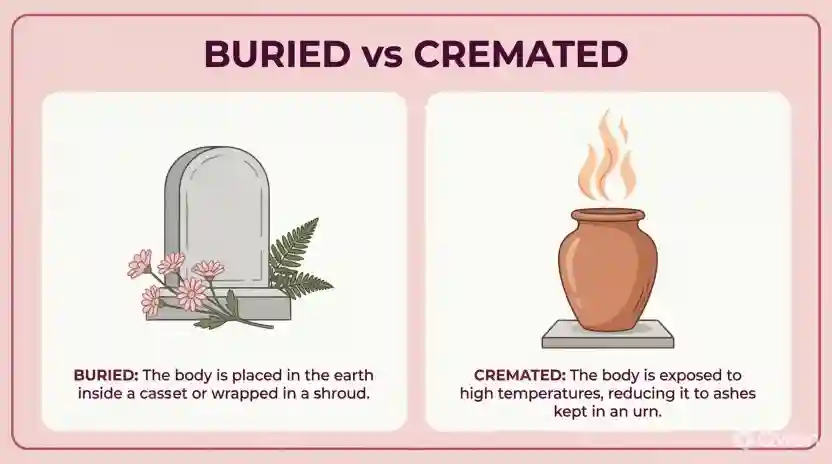
Buried is the past tense and past participle of bury. When talking about a deceased person, bury means to place the body in the ground.
For example:
The author was buried in a small cemetery.
Here, the person’s body was placed in a grave.
The word buried can also have other meanings:
- buried treasure
- buried under snow
- buried in paperwork
- buried in thought
So, context determines the meaning.
What does “cremated” mean?
Cremated is the past tense and past participle of cremate. It means that a dead person’s body was subjected to cremation. Merriam-Webster defines cremate as subjecting a body to cremation, involving intense heat and the processing of bone fragments.
For example:
She was cremated according to her wishes.
After cremation, the resulting remains may be placed in an urn, buried, or handled in another permitted way.
Oxford also defines cremation as the act of cremating someone and notes that it can refer to a funeral at which the person is cremated.
The key difference
The main difference is what happens to the body:
Burial: The body is placed in the ground.
Cremation: The body is processed through cremation, after which the remains can be kept, buried, or otherwise handled according to the applicable wishes and rules.
The Origin of Buried or Cremated
The two words have different histories.
Bury
Bury is an old English word. Oxford lists its modern verb forms as bury, buried, and burying. Its basic meaning in the context of death is to place a dead body in the ground.
The word has also developed several figurative meanings. For example, someone can be “buried in work,” meaning they have a large amount of work to deal with.
Cremate
Cremate entered English much later. Merriam-Webster gives its first known use as 1874 and traces it to Latin crematus, the past participle of cremare, meaning “to burn up.”
This explains why cremate, cremation, and related words are closely connected with burning and heat.
The important point for modern English is simple: bury describes placement in the ground, while cremate describes the cremation process.
British English vs American English
There is no major British-American spelling difference between buried and cremated. Both forms are standard in British and American English.
| British English | American English | Example |
| buried | buried | He was buried in London. |
| cremated | cremated | She was cremated after the funeral. |
| burial | burial | The burial took place on Friday. |
| cremation | cremation | The family chose cremation. |
| cremated remains | cremated remains | The cremated remains were placed in an urn. |
The words are therefore suitable for both major varieties of English.
What can differ is funeral terminology, legal procedure, cultural practice, and local preference, rather than the spelling of these words. Official guidance can also vary by jurisdiction. For example, UK government guidance discusses separate procedures for burial, cremation, and the handling or transport of ashes.
Which Version Should You Use?
The answer depends less on English variety and more on the meaning you want.
United States
Use buried when the body was placed in a grave.
Use cremated when the person underwent cremation.
United Kingdom
The same distinction applies. Both buried and cremated are standard terms.
Canada
Both words are standard and understood. Choose the word that accurately describes the person’s final arrangements.
Australia
Use buried for burial and cremated for cremation. The distinction is the same.
International writing
For a worldwide audience, use the simple terms buried and cremated. If the context is sensitive, explain the process clearly rather than assuming readers share the same funeral traditions.
Academic writing
Use precise terms such as:
- burial
- cremation
- human remains
- cremated remains
- interment
Avoid vague wording when the exact process matters.
Business writing
In formal documents, accuracy and sensitivity are important. For example:
The deceased was cremated, and the cremated remains were returned to the family.
This is clearer than using an indirect phrase that could be misunderstood.
Common Mistakes
Mistake 1: Using “buried” to mean cremated
Incorrect:
She was buri and her body was turned into ashes.
Better:
She was cremat, and her ashes were later buried.
Why?
The body is cremat first. The resulting remains can then be buri.
Memory tip:
Buried = body in the ground. Cremated = body processed by cremation.
Mistake 2: Saying “cremated in a grave”
Incorrect:
He was cremat in a grave.
Better:
He was cremat, and his ashes were later buri in a grave.
The two actions can happen at different stages.
Mistake 3: Treating “cremation” and “burial” as identical
Incorrect:
The family chose burial, so the body was cremat.
Better:
The family chose cremation.
Or:
The family chose burial.
The choice of word should match the actual process.
Mistake 4: Forgetting that ashes can be buri
A common misconception is that cremation means the remains can never be buri. That is not true. Cremat remains can be buri, which is one reason the phrases can sometimes appear together.
Everyday Examples
Emails
Please let us know if the deceas will be buri or cremated.
Business writing
The family has request that the cremat remains be return to them.
News headlines
Family Announces Plans to Have Beloved Author Cremated
Blogs
Choosing between being buri or cremat is a personal decision.
Social media
She will be cremate and her family plans to hold a private memorial.
Academic writing
Burial and cremation represent different methods of handling human remains.
Daily conversation
Was he buri or cremat?
This question is grammatically natural, although funeral arrangements can be a sensitive subject. Use respectful language when discussing someone’s death.
Google Trends & Modern Usage
People search “buried or cremated” because the phrase combines two closely related but different funeral terms. Searchers may be looking for the difference in meaning, the correct word for an obituary, or information about funeral arrangements.
Modern English uses both terms widely. There is no reason to treat either buried or cremated as an incorrect or outdated word.
The more important issue is context. A person can be buried without being cremat, cremat without being buried, or cremat and then have their remains buried.
Search interest can also vary by country because funeral customs, laws, religions, and available services differ. Official guidance confirms that practical arrangements can vary by location. For example, UK guidance for deaths in Pakistan notes that burial and cremation arrangements depend on local facilities and authorities.
Because Google Trends data can change over time and exact comparisons depend on the selected countries and date ranges, it is better not to claim a specific worldwide popularity ranking without checking the relevant live dataset.
Quick Comparison Table
| Version | Meaning | Correct? | Region | Example |
| Buried | Body placed in the ground | Yes | Worldwide English | He was buried in the cemetery. |
| Cremated | Body subjected to cremation | Yes | Worldwide English | She was cremated after the service. |
| Burial | Act or process of burying | Yes | Worldwide English | The burial was held privately. |
| Cremation | Act or process of cremating | Yes | Worldwide English | The family chose cremation. |
| Cremated remains | Remains after cremation | Yes | Worldwide English | The remains were placed in an urn. |
| Cremation burial | Cremated remains subsequently buried | Yes | Worldwide English | The family arranged a cremation burial. |
Key Takeaways
- Buri means a dead person’s body is plac in the ground.
- Cremated means the body undergoes cremation.
- Burial and cremation are different processes.
- Both buried and cremated are correct standard English words.
- British and American English use the same spellings.
- A person can be cremat and their remains can later be buri.
- Use the word that accurately describes what happened.
- In sensitive writing, choose clear and respectful language.
FAQs About Buried or Cremated
Is it better to say buried or cremated?
Neither word is universally “better.” They describe different practices. Say buri when a body is plac in the ground and cremat when the body undergoes cremation. Your choice should reflect what actually happened rather than regional English preference. Both terms are standard in British, American, Canadian, Australian, and international English.
What is the difference between being buri and cremat?
Being buri normally means placing a person’s body in the ground, usually in a grave. Being cremat means subjecting the body to cremation. After cremation, the remains may be plac in an urn, buried, or handl in another way according to applicable wishes and requirements.
Can someone be cremat and buri?
Yes. A person can be cremat first, after which the cremat remains can be buri. This is sometimes call a cremation burial. Cambridge Dictionary recognizes the term for a process in which a person’s body is cremat and the resulting ashes are then buri often in a container.
Is “he was cremat” grammatically correct?
Yes. “He was cremat” is grammatically correct. It uses the passive form of the verb cremate. For example, “He was cremat after the funeral service” clearly states that cremation took place. Merriam-Webster lists cremated as the past and past participle form of cremate.
Is “she was buri” correct English?
Yes. “She was buri” is standard English. It means that her body was plac in the ground. Cambridge and Oxford both define bury in the context of death as placing a dead body in the ground.
Which is correct: cremated or cremation?
Both can be correct, but they have different grammatical roles. Cremat is normally a verb form or participle: “She was cremat.” Cremation is a noun: “The family chose cremation.” Use the form that fits the sentence.
What do you call someone who is cremat?
You can say “a person who was cremat” or “the deceased was cremat.” In formal writing, terms such as cremat remains may be more appropriate when discussing what remains after the cremation process. Avoid inventing unusual labels when a simple phrase is clearer.
Are buri and cremat opposites?
They can describe contrasting choices for the treatment of a body, but they are not exact opposites. A body can be cremat and the resulting remains can later be buri. Therefore, the words describe different stages or methods rather than two completely exclusive states.
Which word should I use in an obituary?
Use the word that accurately reflects the person’s arrangements. For example, “He was buri at the family cemetery” or “She was cremat, and a memorial service was held later.” If the information is unknown, do not guess. Accuracy and respectful wording are more important than using a particular style.
Does British English use “cremated” differently from American English?
No major difference exists in the basic meaning or spelling. Cremated is standard in both British and American English. The same is true of buried. Differences are more likely to concern local funeral practices, regulations, and terminology than the basic English vocabulary.
Conclusion
The choice between buri or cremat is easy to understand once you focus on the action being describ. Buried means that a person’s body is plac in the ground. Cremated means that the body undergoes cremation. Both are correct and widely used in modern English.
The words are not simply different spellings or regional alternatives. They describe different processes. However, they can occur together when a person is cremat and the resulting remains are later buri.
For everyday writing, keep the distinction simple. Use buried for burial and cremated for cremation. In formal or sensitive writing, choose precise terms such as burial, cremation, and cremated remains.
If you are writing an obituary, article, email, or academic paper, accuracy matters more than complexity.
Remember: the body is buried, the body is cremated, and cremated remains can also be buried.
Read more about!
- Bose or Beats: Which Headphones Are Better?
- Verry or Very: Which Spelling Is Correct?
- Prefix or Suffix: Meaning, Differences, Examples, and Usage

I’m Olivia Parker, a grammar and English writing enthusiast passionate about making English simple and easy to understand. Through Wordsblog, I share clear explanations, useful grammar tips, and practical writing guidance to help readers write with confidence. My goal is to make learning English easier, one word at a time.





7 thoughts on “Buried or Cremated: What Is the Difference?”