Search intent: Informational, educational, and comparison
Primary keyword: preceed or precede
Related keywords: precede meaning, preceed meaning, is preceed a word, precede vs preceed, correct spelling of precede, precede definition, how to spell precede, proceed vs precede
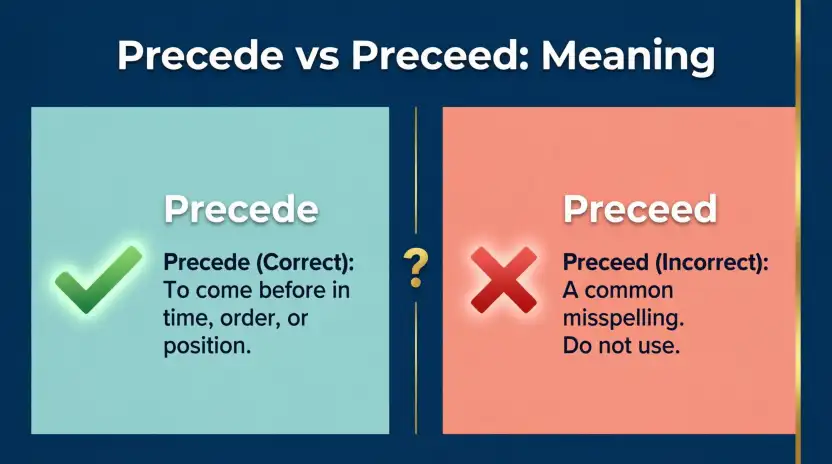
If you are unsure if to write “preceed” or “precede,” the correct spelling is “precede.” “Preceed” is a common misspelling, not the standard spelling of the verb. Precede means to come before someone or something in time, place, or order. For example, “A short introduction will precede the presentation.”
This spelling causes confusion because English has the word proceed, which is spelled with -ceed and means to move forward or continue. The similar sounds and spellings can make it easy to accidentally write “preceed” instead of “precede.”
In this guide, you will learn the difference between preceed or precede, what precede means, where the word comes from, how to use it correctly, and how it differs from related words such as proceed, preceding, and predecessor. You will also see practical examples for school, work, emails, blogs, and everyday English.
Preceed or Precede: Featured Snippet & AI Overview
Precede is the correct spelling. It means “to come before” or “to happen before.” Preceed is a misspelling of precede. For example, “The introduction will precede the main discussion.” Remember: precede = come before, while proceed = move forward or continue.
Preceed or Precede: Quick Answer
The correct word is precede.
| Word | Correct? | Meaning | Example |
| precede | Yes | To come or happen before | A warning preceded the announcement. |
| preceed | No | Common misspelling of precede | ❌ A warning preceeded the announcement. |
| proceed | Yes | To continue or move forward | Please proceed with the meeting. |
The easiest way to remember the difference is:
- Precede = come before
- Proceed = move forward
- Preceed = incorrect spelling
Cambridge Dictionary defines precede as being or going before something or someone in time or space. Oxford gives the same core meaning and also lists uses involving order and physical movement.
Examples
- The meeting will precede the dinner.
- A brief introduction preceded the lecture.
- The current manager preceded her in the role.
If you are writing an essay, email, report, or professional document, use precede, not preceed.
What Does Preceed or Precede Mean?
Precede
Precede is a verb meaning to come before something or someone in time, order, or position.
For example:
The introduction will precede the main presentation.
Here, the introduction happens first and the presentation happens afterward.
The word can describe events:
Heavy rain preceded the storm.
It can also describe people or positions:
Maria preceded James as department manager.
And it can describe something that appears earlier in a sequence:
See the preceding chapter for more information.
Cambridge and Oxford both recognize these uses. Oxford also lists the construction “precede something with something,” meaning to put or do one thing before another.
Preceed
Preceed is not the standard spelling of this verb. It is a common spelling error caused partly by confusion with proceed.
Dictionary.com specifically identifies preceed as a misspelling of precede.
So:
- ❌ The announcement was preceeded by a warning.
- ✅ The announcement was preceded by a warning.
Precede vs. Proceed
This is another important distinction.
Precede means to come before.
The introduction preceded the speech.
Proceed means to continue or move forward.
The speaker proceeded with the presentation.
The two words look and sound similar, which is one reason writers sometimes create the incorrect spelling preceed. Dictionary.com notes that precede and proceed are especially easy to confuse because of their similar spelling and pronunciation.
The Origin of Precede
The word precede has a long history. Oxford traces it to Late Middle English, through Old French preceder, from the Latin praecedere. The Latin word combines prae, meaning “before,” with cedere, meaning “go.”
This history helps explain the spelling and meaning.
The basic idea is:
prae + cedere → precede → go before
The same historical root is connected with related English words such as preceding, precedence, and predecessor.
The spelling preceed likely feels natural because English has several common words ending in -ceed, especially proceed. However, precede follows its own historical spelling pattern.
That is why the correct spelling is:
P-R-E-C-E-D-E
Not:
P-R-E-C-E-E-D
British English vs American English
There is no British-versus-American spelling difference between precede and preceed. Standard English uses precede in both varieties.
| Feature | British English | American English | Example |
| Correct verb | precede | precede | The introduction will precede the lecture. |
| Incorrect spelling | preceed | preceed | ❌ The introduction will preceed the lecture. |
| Past tense | preceded | preceded | The lecture was preceded by a welcome. |
| -ing form | preceding | preceding | See the preceding section. |
| Meaning | Come before | Come before | The event precedes the ceremony. |
Cambridge lists precede in both its UK and US dictionary content, with the same basic meaning. Oxford also lists precede in both its standard and American English dictionaries.
So you do not need to change precede based on if you are writing for readers in the United States or United Kingdom.
Which Version Should You Use?
Use precede regardless of your English variety.
United States
Use precede in American English.
The ceremony will precede the dinner.
United Kingdom
Use precede in British English.
The introduction preceded the discussion.
Canada
Use precede in Canadian writing as well. The spelling does not change to preceed.
Australia
Australian English also uses precede.
International Writing
For international readers, precede is the standard choice.
Academic Writing
Use precede in essays, research papers, reports, and other formal academic work.
The literature review precedes the methodology section.
Business Writing
Use precede when describing order, events, meetings, or previous roles.
The CEO’s announcement was preceded by several meetings.
The key point is simple: there is no standard regional version called “preceed.”
Common Mistakes
The most common mistake is adding an extra e before the final d.
Mistake 1
❌ The introduction preceeded the report.
✅ The introduction preceded the report.
Why? The past tense of precede is preceded, not preceeded.
Mistake 2
❌ The speech will preceed the ceremony.
✅ The speech will precede the ceremony.
Why? The base form is precede.
Mistake 3
❌ Please preceed with the next step.
✅ Please proceed with the next step.
Why? Here, the intended meaning is “continue,” so the correct word is proceed, not precede.
A Simple Memory Tip
Think:
Precede = before
The beginning pre- can help you remember the idea of something coming before.
Think:
Proceed = forward
So:
Precede = before
Proceed = forward
And:
Preceed = misspelling
Everyday Examples
Knowing the definition is useful, but seeing precede in real situations makes the difference easier to remember.
Emails
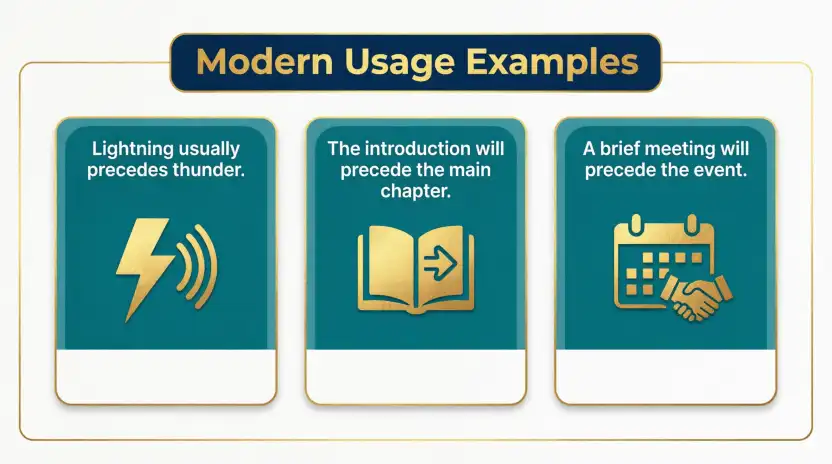
A brief introduction will precede the attached report.
Please review the instructions that precede the application form.
Business Writing
Several planning meetings preceded the product launch.
She preceded him as director of the department.
News Headlines
Heavy Rain Precedes Weekend Storm
Announcement Preceded by Weeks of Discussion
News writing often uses precede when explaining what happened before an important event.
Blogs
Before discussing the solution, it helps to understand the events that preceded it.
Social Media
A short video preceded the main announcement.
For casual posts, you may often use simpler words such as before, but precede is perfectly correct.
Academic Writing
The experiment was preceded by a review of previous studies.
The preceding section explains the research method.
Daily Conversation
A short meeting preceded the dinner.
In everyday speech, before is usually more natural:
A short meeting happened before dinner.
But precede is useful when you want a more formal tone.
Google Trends & Modern Usage
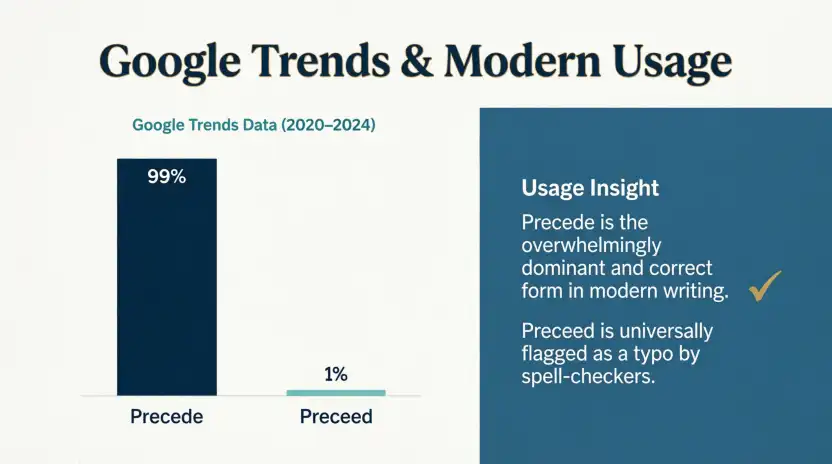
People commonly search for “preceed or precede” because the incorrect spelling is easy to create. The confusion is strongly connected to the similar word proceed, which uses the spelling -ceed.
There is no need to treat preceed as a British or American variant. Standard dictionary references identify precede as the correct word and describe preceed as a misspelling.
Modern English continues to use precede in formal writing, academic English, business communication, journalism, and general written English.
The related forms are also common:
- precede = come before
- preceded = came before
- preceding = coming before
- predecessor = a person or thing that came before
- precedence = priority or the condition of coming first
Cambridge defines preceding as something existing or happening before another thing, while Oxford lists preceding as the adjective form related to precede.
If you see preceed in a spell-check result, edit it to precede.
Quick Comparison Table
| Version | Meaning | Correct? | Region | Example |
| precede | Come before | ✅ Yes | US, UK, Canada, Australia, International | The introduction will precede the lesson. |
| preceed | Intended to mean “come before” | ❌ No | Not a standard regional spelling | ❌ The introduction will preceed the lesson. |
| proceed | Continue or move forward | ✅ Yes | US, UK, Canada, Australia, International | Please proceed with the lesson. |
| preceded | Came before | ✅ Yes | All standard varieties | The lesson was preceded by an introduction. |
| preceding | Coming or existing before | ✅ Yes | All standard varieties | Read the preceding paragraph. |
Key Takeaways
- Precede is the correct spelling.
- Preceed is a common misspelling.
- Precede means to come before in time, order, or position.
- Proceed means to continue or move forward.
- The past tense of precede is preceded.
- The adjective form is preceding.
- There is no standard British or American spelling difference here.
- Use precede in academic, professional, business, and everyday writing.
- A useful memory tip is precede = before and proceed = forward.
FAQs
1. Is “preceed” a correct word?
No. Preceed is a misspelling of precede. The standard English verb is precede, meaning to come before someone or something in time, order, or position. If you are writing an essay, email, report, article, or professional document, use precede, not preceed.
2. What is the correct spelling, preceed or precede?
The correct spelling is precede. It contains one e between the “c” and final “d” sound pattern: p-r-e-c-e-d-e. The spelling preceed is incorrect. For example, write “The introduction will precede the presentation,” not “The introduction will preceed the presentation.”
3. What does precede mean?
Precede means to come before someone or something in time, order, or position. For example, “A short introduction preceded the lecture” means that the introduction happened before the lecture. The word can also describe something that comes earlier in a sequence, such as “the preceding chapter.”
4. What is the past tense of precede?
The past tense and past participle of precede are preceded. For example, “The meeting was preceded by a short presentation.” Do not write preceeded. Oxford lists preceded as the standard past form of precede.
5. What is the difference between precede and proceed?
Precede means to come before, while proceed means to continue or move forward. For example, “The introduction preceded the presentation” means the introduction came first. “Please proceed with the presentation” means continue with it. Their similar spelling is one reason people sometimes write the incorrect form preceed.
6. Is precede used in British English?
Yes. Precede is standard in British English. It is also standard in American English and other major varieties of English. There is no British spelling preceed and American spelling precede. Both varieties use precede for the verb meaning “to come before.”
7. How do you remember how to spell precede?
A useful memory trick is precede = before. The prefix pre- often relates to something that comes before. Also remember that proceed means to move forward. This gives you a simple pair: precede = before, proceed = forward.
8. What is the difference between preceding and precede?
Precede is a verb. It describes an action or relationship, as in “The introduction will precede the lesson.” Preceding is usually an adjective meaning “coming before,” as in “Read the preceding paragraph.” Both words are correct, but they perform different grammatical roles.
9. Can I use precede in academic writing?
Yes. Precede is suitable for academic writing, especially when describing order, sequence, or events that happened earlier. For example, “The survey was preceded by a review of previous research.” In some cases, the simpler word before may sound more natural, so choose the word that best fits your sentence.
10. Why do people spell precede as preceed?
People often spell precede incorrectly as preceed because English contains the familiar spelling -ceed in words such as proceed. Since precede and proceed also have similar pronunciation, writers can transfer the spelling pattern from one word to the other. The standard spelling remains precede.
Conclusion: Preceed or Precede?
When choosing between preceed or precede, use precede. It is the correct standard spelling and means to come before someone or something in time, order, or position. The spelling preceed is a common error, not a British or American alternative.
The confusion often comes from proceed, which is a different word. Proceed means to continue or move forward, while precede means to come before. Once you connect pre- with the idea of “before,” the spelling becomes easier to remember.
Use precede in emails, academic papers, business writing, articles, reports, and other formal or informal contexts when you need this meaning. Use preceded for the past tense and preceding when describing something that comes before.
Remember: Precede comes before, proceed moves forward.
If you often confuse similar English words, learning them in pairs can make your writing clearer and more accurate.
Read more about!
- Buried or Cremated: What Is the Difference?
- Dose or Dosage: What Is the Difference?
- Fabric or Forge: What Is the Difference?`

I’m Olivia Parker, a grammar and English writing enthusiast passionate about making English simple and easy to understand. Through Wordsblog, I share clear explanations, useful grammar tips, and practical writing guidance to help readers write with confidence. My goal is to make learning English easier, one word at a time.