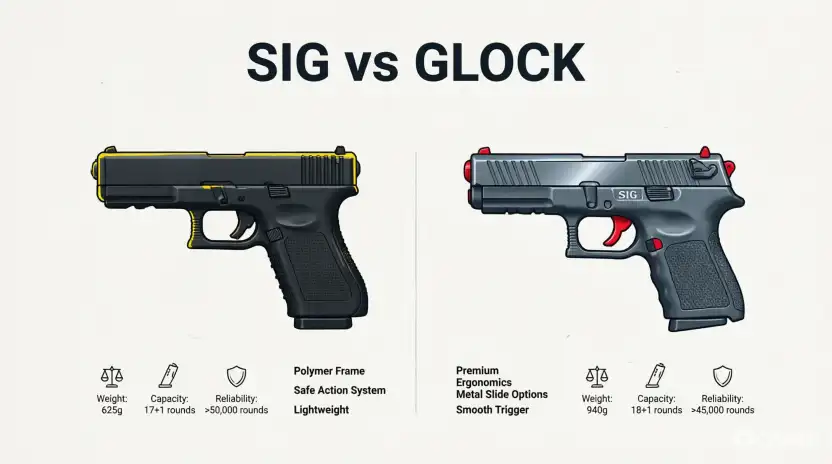
Choosing between SIG or Glock is not a question of which word is spelled correctly. SIG and Glock are different firearm brands, and each makes several different pistol models. SIG is commonly used as a shortened form of SIG SAUER, while Glock refers to the Austrian manufacturer and its pistol family.
People often search for “SIG or Glock” because the names appear together in discussions about handguns, law enforcement, military equipment, and popular culture. The confusion grows because both companies make well-known striker-fired pistols, but their product lines are not identical.
For example, the SIG SAUER P320 and Glock 17 are both widely recognized service-pistol platforms, yet they come from different manufacturers and use different design approaches. SIG describes the P320 as a modular striker-fired platform, while Glock describes its pistols around its Safe Action system and a relatively simple parts design.
This guide explains what SIG or Glock means, where the names came from, how the brands differ, and how to use the terms correctly in writing. It also covers common mistakes, regional usage, modern search behavior, and practical examples.
SIG or Glock: Featured Snippet & AI Overview
SIG and Glock are different firearm brands, not alternative spellings.
Usually SIG refers to SIG SAUER, a manufacturer with roots in Switzerland and Germany and a major U.S. presence. Glock is an Austrian firearm manufacturer founded by Gaston Glock. Both produce pistols, but their models, designs, histories, and naming systems differ.
SIG or Glock: Quick Answer
The short answer is simple:
- SIG usually means SIG SAUER.
- Glock refers to GLOCK, the Austrian firearms manufacturer.
- They are separate companies.
- Both produce pistols and other firearm products.
- A specific comparison should name the models being compared.
- “SIG” and “Glock” should not be treated as synonyms.
For example:
“The discussion compared a SIG pistol with a Glock pistol.”
This is different from:
“Is SIG or Glock the correct spelling?”
The second question is based on a misunderstanding. Neither is a spelling variant of the other.
Examples
Example 1:
“I was reading about SIG and Glock pistols.”
Here, the writer is referring to two different brands.
Example 2:
“The SIG SAUER P320 is a modular striker-fired pistol.”
SIG SAUER identifies the manufacturer and P320 identifies the model.
Example 3:
“The Glock 17 is one of Glock’s best-known pistol models.”
Glock’s official history traces the development of its service pistol to the early 1980s.
What Does SIG or Glock Mean?
What Does SIG Mean?
SIG is commonly used as a shortened reference to SIG SAUER. The company has a long history connected to Swiss industrial manufacturing and later to the SIG SAUER brand.
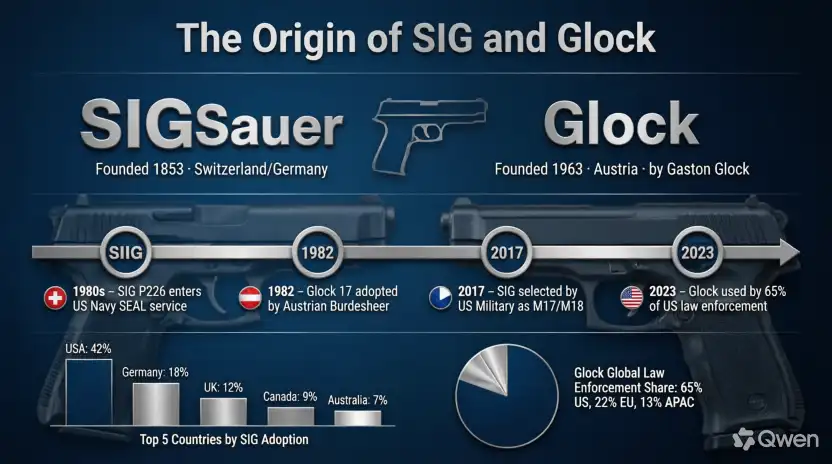
According to SIG SAUER’s official history, the company’s roots go back to 1853 in Switzerland. Its firearms history includes the Swiss P49, the predecessor of the P210, and later pistol development for military and police use. The American company SIGARMS was established in 1985, and the company changed its name to SIG SAUER in 2007.
Today, SIG SAUER produces a broad range of firearms and related products. One well-known pistol family is the P320, which SIG describes as a modular striker-fired platform.
What Does Glock Mean?
Glock refers to the Austrian manufacturer GLOCK and, depending on context, to one of its pistols.
Gaston Glock founded the company in 1963. Glock’s modern pistol history began in the early 1980s when the company developed a semi-automatic service pistol for the Austrian military. The Glock 17 was later accepted by the Austrian Army in 1983.
The name therefore works differently from a normal dictionary word. It can identify the company, the brand, or, in informal speech, a Glock pistol.
Why the Confusion Happens
Searches such as “SIG or Glock” often leave out the model name.
That creates an important problem: a brand-to-brand comparison can be too broad.
A SIG P320 and a Glock 17 are specific products. “SIG” and “Glock” are brand-level terms.
This distinction matters in accurate writing.
The Origin of SIG and Glock
The History of SIG
SIG’s history is much older than the modern SIG SAUER brand name.
The company began in Switzerland in 1853 as a wagon factory. It later entered firearms manufacturing and became known as Schweizerische Industrie-Gesellschaft, or SIG.
Its firearms history expanded during the 20th century. SIG also developed relationships with J.P. Sauer & Sohn, helping shape the modern SIG SAUER identity.
In the United States, SIGARMS was established in 1985. The company officially changed its name to SIG SAUER in 2007.
The History of Glock
Glock has a different origin.
Gaston Glock founded the company in Austria in 1963. The company initially produced products such as polymer and metal components and later expanded into military-related products.
In the early 1980s, Glock developed its semi-automatic service pistol for the Austrian military. The Glock 17 was accepted by the Austrian Army in 1983.
Glock later expanded internationally, including the U.S. market.
Why Their Histories Matter
The two brands developed along different paths.
SIG has roots stretching back to 19th-century Swiss industry and later developed a wide firearms portfolio.
Glock entered the modern pistol market much later and became known for a polymer-framed service-pistol design and its Safe Action system.
British English vs American English
Unlike many common “-ise vs -ize” or spelling questions, SIG vs Glock is not a British-versus-American spelling issue.
| British English | American English | Example |
| SIG / SIG SAUER | SIG / SIG SAUER | “The article mentions SIG SAUER.” |
| Glock | Glock | “The report mentions Glock.” |
| SIG pistol | SIG pistol | “The source discusses a SIG pistol.” |
| Glock pistol | Glock pistol | “The source discusses a Glock pistol.” |
The brand names generally remain the same across English-speaking regions.
What About “Sig” vs “SIG”?
You may see SIG, Sig, or SIG SAUER in informal writing.
For formal or professional writing, SIG SAUER is usually the clearest form when referring to the company. “SIG” can be used when the context is already clear.
“Glock” is normally written with a capital G when referring to the brand.
Style Guide Tip
When writing an article, report, or academic paper, identify the company clearly on first mention:
“SIG SAUER, commonly shortened to SIG, produces several firearm platforms.”
After that, “SIG” may be used when the meaning remains clear.
Which Version Should You Use?
There is no correct choice between SIG and Glock in the way there would be between a misspelling and a correct spelling.
Your choice depends on what you mean.
United States
Use SIG SAUER or SIG when referring to that company or its products.
Use Glock when referring to the Glock brand or a Glock model.
United Kingdom
The same distinction applies. The names do not become different because of British English.
Canada
Use the official brand names when accuracy matters.
Australia
The same basic naming rule applies. Avoid treating the two names as spelling variants.
International Writing
Use the full company name when the audience may not know the abbreviation:
“SIG SAUER (often called SIG)”
This removes ambiguity.
Academic Writing
Academic writing should be precise.
Instead of writing:
“SIG is better than Glock.”
A more precise sentence is:
“The study compares a SIG SAUER model with a Glock model.”
If the exact models are known, name them.
Business Writing
Use official brand names where possible.
For example:
“The report compares products from SIG SAUER and GLOCK.”
This is clearer than using unexplained abbreviations.
Common Mistakes
Mistake 1: Treating SIG and Glock as Spellings
Incorrect:
“Is SIG another way to spell Glock?”
Correct:
“Are SIG and Glock different firearm brands?”
Explanation:
They are separate brands.
Memory tip:
SIG = one brand. Glock = another brand.
Mistake 2: Comparing Brands Without Naming Models
Weak:
“SIG is better than Glock.”
Better:
“The article compares specific SIG SAUER and Glock models.”
Explanation:
Each company makes multiple models, so a broad brand comparison can hide important differences.
Mistake 3: Writing “SIG Sauer” as a Generic Name
Less precise:
“a Sauer”
Better:
“a SIG SAUER pistol”
Explanation:
Use the established brand name when clarity matters.
Mistake 4: Assuming “Glock” Is Only a Model
Incorrect:
“Glock is the name of one pistol.”
Correct:
“GLOCK is a firearm manufacturer and brand with multiple pistol models.”
Glock’s official history describes several generations and models developed after the original service pistol.
Everyday Examples
Emails
“The report compares SIG SAUER and Glock products.”
Business Writing
“The company requested a comparison of two manufacturers, SIG SAUER and GLOCK.”
News Headlines
“SIG and Glock Brands Appear in New Firearms Report”
A headline may shorten SIG SAUER to SIG when space is limited.
Blogs
“SIG or Glock: What Is the Difference?”
This is a natural search-focused headline because it matches the way people commonly phrase the query.
Social Media
“SIG or Glock? These are different brands, not different spellings.”
Academic Writing
“This paper examines differences between selected SIG SAUER and Glock pistol platforms.”
Daily Conversation
“Is that a SIG or a Glock?”
In casual speech, the brands can function as shorthand for products made by those companies.
Google Trends & Modern Usage

The search phrase “SIG or Glock” reflects a common comparison-style query. People often use short brand names rather than full corporate names when searching online.
The important semantic relationship is:
SIG → SIG SAUER → firearm manufacturer → pistol models
and:
Glock → GLOCK → firearm manufacturer → pistol models
Modern search behavior can also mix the brand and model levels. Someone may search for “SIG P320 vs Glock,” for example, while another person may simply search “SIG or Glock.”
That creates different levels of search intent.
A reader searching “SIG or Glock” usually wants a comparison.
A reader searching “SIG P320 vs Glock” has moved to a specific model comparison.
Exact search-volume claims should not be made without current keyword data. The usage discussion here is based on the wording and meaning of the terms rather than invented search statistics.
Quick Comparison Table
| Version | Meaning | Correct? | Region | Example |
| SIG | Common short form of SIG SAUER | Yes | International | “SIG makes several firearm products.” |
| SIG SAUER | Official brand/company name | Yes | International | “SIG SAUER developed the P320.” |
| Glock | Brand/manufacturer name | Yes | International | “Glock produces several pistol models.” |
| GLOCK | Official stylized brand form | Yes | International | “GLOCK is an Austrian manufacturer.” |
| Sig Sauer | Common written form | Generally understood | International | “Sig Sauer P320” |
| SIG vs Glock | Brand comparison | Yes | International | “SIG vs Glock” |
SIG vs Glock: Important Differences in Naming
| Feature | SIG SAUER | GLOCK |
| Brand type | Firearms manufacturer | Firearms manufacturer |
| Common short form | SIG | Glock |
| Historical roots | Switzerland, later international development | Austria |
| Modern U.S. presence | Major U.S. operations | Major U.S. operations |
| Example pistol family | P320 | Glock 17 |
| Design terminology | P320 described as modular striker-fired | Glock uses its Safe Action system |
| Correct as a brand name? | Yes | Yes |
| Alternative spelling of the other? | No | No |
SIG describes the P320 as a modular striker-fired pistol platform. Glock’s official history describes its pistols as using the Safe Action system and highlights the design’s relatively small number of parts.
Key Takeaways
- SIG and Glock are different firearm brands.
- SIG commonly refers to SIG SAUER.
- Glock refers to the Austrian GLOCK brand and manufacturer.
- Neither word is a spelling variation of the other.
- Brand-level comparisons can be misleading without naming specific models.
- SIG SAUER is preferable in formal writing when maximum clarity is needed.
- SIG works well as a shortened form when the context is clear.
- Use Glock when referring to the Glock brand or a Glock product.
- British and American English do not create a major spelling difference between these brand names.
- For accurate comparisons, name the exact models rather than comparing entire brands.
FAQs About SIG or Glock
Is SIG the same as Glock?
No. SIG and Glock are separate firearm brands. SIG commonly refers to SIG SAUER, while Glock refers to the Austrian manufacturer GLOCK and its product line. They have different histories, naming systems, and product designs. Therefore, “SIG” is not another spelling or name for Glock.
What does SIG stand for in firearms?
SIG commonly refers to SIG SAUER. The company has roots in Switzerland and a long firearms history. In modern English, “SIG” is widely used as a shortened reference to the SIG SAUER brand, especially when the context is already clear.
Is Glock a brand or a type of gun?
Glock is primarily a brand and manufacturer name. People also use “Glock” informally to refer to a pistol made by the company. The company was founded by Gaston Glock in Austria in 1963 and developed its modern service pistol in the early 1980s.
Should I write SIG or SIG SAUER?
Use SIG SAUER when you want maximum clarity, especially on the first mention in formal writing. After establishing the name, SIG can be used as shorthand when the meaning is obvious. This approach keeps articles, reports, and educational content easy to understand.
Is “SIG Sauer” spelled correctly?
Yes. SIG SAUER is the official brand styling used by the company. You may also encounter “SIG Sauer” in ordinary text. For formal brand references, following the company’s own styling is the safest choice.
Are SIG and Glock the same type of company?
At a broad level, yes. Both are firearm manufacturers with well-known pistol products. However, they are separate companies with different histories, product families, and design approaches. A comparison should therefore identify the exact products when technical differences matter.
Which is correct: SIG or Glock?
Both are correct names, but they refer to different brands. The correct term depends on what you are talking about. If you mean SIG SAUER, use SIG or SIG SAUER. If you mean the Austrian GLOCK brand, use Glock.
Why do people compare SIG and Glock?
People compare them because both brands are prominent in discussions involving pistols, military equipment, law enforcement, and civilian markets. Searchers may also compare particular models. For accuracy, it is better to compare specific models rather than assume every SIG and every Glock has the same characteristics.
Is SIG vs Glock a spelling question?
No. SIG vs Glock is a brand-comparison question. Neither is a misspelling of the other. If your original question is about if “SIG” or “Glock” is the correct word, the answer depends entirely on the brand or product you intend to name.
How should I write SIG and Glock in an article?
Introduce the names clearly. For example: “SIG SAUER, commonly shortened to SIG, and GLOCK are separate firearm manufacturers.” After that, use the shorter forms consistently. If you compare products, include the exact model names to avoid ambiguity.
Conclusion
The phrase “SIG or Glock” can look like a simple either-or question, but the key point is that these are different brand names, not two versions of the same word. SIG generally refers to SIG SAUER, while Glock refers to the Austrian GLOCK brand. Both companies have long histories in firearm manufacturing, but they developed independently and use different product names and design systems.
For everyday writing, SIG is a useful shortened form of SIG SAUER when the context is clear. SIG SAUER is better when you want maximum clarity. Glock should be used when referring to the Glock brand or one of its products.
If you are writing a comparison article, avoid saying that “SIG is better than Glock” without defining what you are comparing. Different models can have different characteristics, so naming the specific products makes the statement much more useful and accurate.
The easiest rule to remember is:
SIG and Glock are brands, not alternative spellings.
When in doubt, name the manufacturer and the specific model. That simple habit makes your writing clearer, more precise, and easier for readers to trust.
Read more about!
- Bose or Beats: Which Headphones Are Better?
- Verry or Very: Which Spelling Is Correct?
- Prefix or Suffix: Meaning, Differences, Examples, and Usage

I’m Olivia Parker, a grammar and English writing enthusiast passionate about making English simple and easy to understand. Through Wordsblog, I share clear explanations, useful grammar tips, and practical writing guidance to help readers write with confidence. My goal is to make learning English easier, one word at a time.