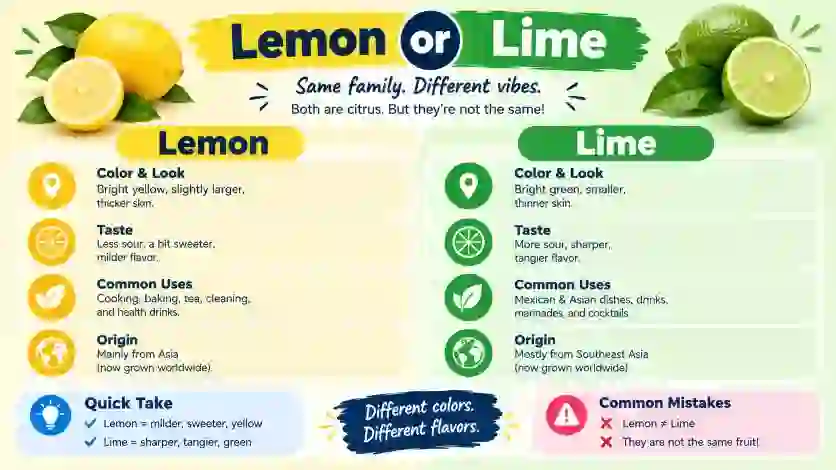
Lemon and lime are different citrus fruits, with lemons usually being larger and yellow while limes are smaller and commonly green. Both have a sharp, sour taste and are used in drinks, cooking, baking, and sauces.
People often search for lemon or lime because the two fruits look similar and can sometimes be used in the same recipes. This can make it hard to know which one to buy or use.
The difference is more than color. Lemons and limes have different flavors, sizes, aromas, and common uses. Their juice can also affect the taste of a dish or drink in different ways.
Lemons are often linked with lemonade, tea, baking, and many savory dishes. Limes are common in Mexican, Thai, Indian, and other cuisines. Lime juice is also popular in cocktails and fresh drinks.
In this guide, you will learn how lemons and limes differ, where their names come from, how they are used around the world, and when you should choose one over the other.
Lemon or Lime – Quick Answer
A lemon and a lime are both citrus fruits, but they are different fruits.
- Lemon: Usually yellow, larger, and mildly sweet with strong acidity.
- Lime: Usually green, smaller, and often more sharp or aromatic.
- Both: Used for juice, cooking, drinks, sauces, desserts, and flavoring.
For example:
- Use lemon for lemonade or lemon cake.
- Use lime for guacamole or many Mexican dishes.
- Use either when a recipe calls for a bright citrus flavor, if the flavor difference is acceptable.
Definition and Meaning of Lemon or Lime
What is a lemon?
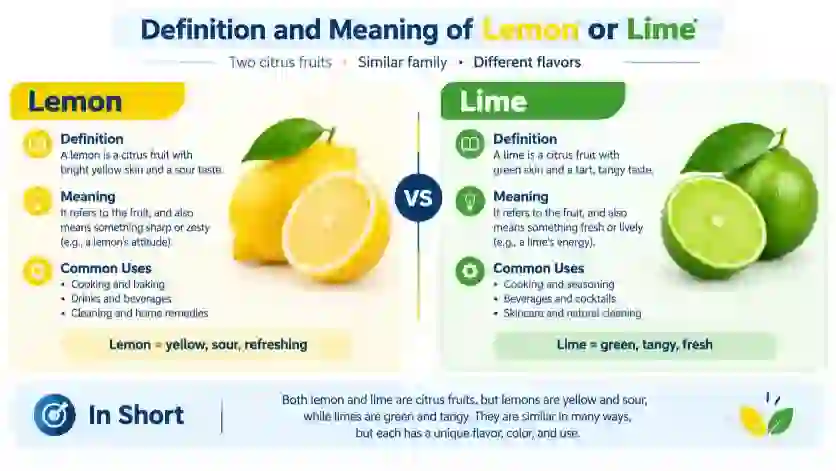
A lemon is a citrus fruit known for its yellow skin and acidic juice. The fruit is usually oval and has a bright, fresh flavor.
Lemons are widely used in:
- Lemonade
- Tea
- Cakes
- Salad dressings
- Sauces
- Marinades
- Seafood dishes
- Garnishes
The word lemon can also have informal meanings in English. In some contexts, a “lemon” can mean something that is defective or disappointing, especially a poorly working vehicle.
Example:
I bought a used car, but it turned out to be a lemon.
Here, lemon does not mean the fruit.
What is a lime?
A lime is another citrus fruit. Many common limes have green skin, although ripe limes can become yellowish.
Limes are usually smaller than lemons and have a strong, fresh, acidic flavor.
They are often used in:
- Limeade
- Cocktails
- Salsa
- Guacamole
- Curries
- Thai dishes
- Mexican dishes
- Desserts
- Salad dressings
The word lime can also have other meanings in English. It can refer to certain minerals or materials used in construction and other industries.
In the phrase lemon or lime, however, the meaning is usually the citrus fruits.
Are lemons and limes the same?
No. Lemons and limes are related citrus fruits, but they are not the same fruit.
They belong to the citrus group and share many traits, but they differ in appearance, flavor, size, and typical culinary uses.
The Origin of Lemon or Lime
Where does the word lemon come from?
The English word lemon came through languages including Middle French and Middle English and is ultimately connected to older words used for the citrus fruit in other languages.
The history of the fruit itself is also complex. Lemons are believed to have developed from citrus plants in Asia and later spread through trade and cultivation.
Over many centuries, lemons became common in Europe and other parts of the world.
Where does the word lime come from?
The English word lime, referring to the citrus fruit, also came into English through older European language forms. Its history is linked to words used for citrus fruits in languages such as Arabic and Persian.
Limes have also been grown and traded across many regions for centuries.
Why are lemons and limes different?
Their differences come from their different plant histories, varieties, and growing conditions.
There are also many types of lemons and limes. Not every lemon or lime looks exactly the same.
For example, some limes become yellow when fully ripe. This means green does not always mean lime, and yellow does not always mean lemon.
British English vs American English Spelling
Are lemon and lime spelled differently in British and American English?
No. Lemon and lime are spelled the same in British and American English.
Unlike words such as colour and color, these fruit names do not have a standard British-American spelling difference.
| British English | American English | Example |
| lemon | lemon | I added lemon juice. |
| lime | lime | I added lime juice. |
| lemons | lemons | The lemons are fresh. |
| limes | limes | The limes are green. |
| lemon juice | lemon juice | Lemon juice is acidic. |
| lime juice | lime juice | Lime juice is common in sauces. |
Regional usage
The names lemon and lime are widely understood in English-speaking countries.
The main differences are not spelling differences. They are more likely to involve local food traditions and which varieties are commonly sold.
For example, lime is especially common in many dishes from Mexico and Southeast Asia, while lemon is common in many European and Mediterranean recipes.
Which Spelling Should You Use?
United States
Use lemon and lime. Both are standard American English spellings.
United Kingdom
Use the same spellings: lemon and lime.
Canada
Canadian English also uses lemon and lime.
Australia
Australian English uses the same standard spellings.
International writing
For global readers, lemon and lime are clear and widely recognized.
If you are writing a recipe, name the fruit clearly rather than assuming that readers can substitute one for the other.
Academic and formal writing
Use the standard names lemon and lime. If the exact citrus species matters, use the scientific or botanical name when appropriate.
Business and food writing
Restaurants, food brands, recipe websites, and menus should name the fruit accurately.
For example:
Fresh lime juice gives this sauce a sharp citrus flavor.
This is clearer than simply saying:
Add citrus juice.
Common Mistakes with Lemon or Lime
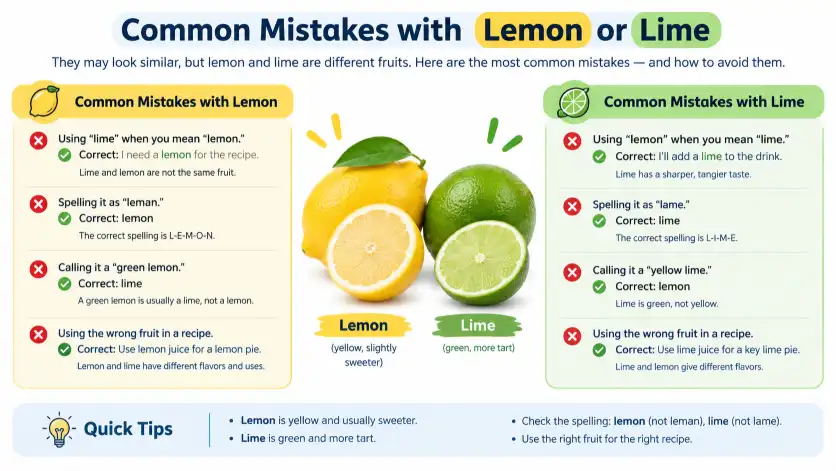
Mistake 1: Treating them as the same fruit
Incorrect: Lemon and lime are two names for the same fruit.
Correct: Lemons and limes are different citrus fruits.
They are related, but they have different characteristics.
Mistake 2: Assuming every green citrus fruit is a lime
Incorrect: If it is green, it must be a lime.
Correct: Color alone does not always identify the fruit.
Some limes can become yellow as they ripen.
Mistake 3: Assuming lemon can always replace lime
Incorrect: You can always replace lime with lemon.
Correct: Lemon can sometimes replace lime, but the flavor will change.
Lime often has a different aroma and sharper flavor.
Mistake 4: Using the wrong fruit in a recipe
A recipe may specifically call for lime because its flavor is important.
For example, replacing lime with lemon in guacamole may produce a different taste.
Memory tip
Remember:
Lemon is usually yellow. Lime is usually green. But taste and type matter too.
Lemon or Lime in Everyday Examples
Emails
In an email about food, you might write:
Please buy six lemons and four limes for the event.
Both names are clear and standard.
Business writing
Restaurants and food companies often use both words in menus and product descriptions.
Our drink contains fresh lime juice and mint.
News headlines
News and food articles may use phrases such as:
Lemon Prices Rise as Demand Increases
or:
Why Lime Is Popular in Summer Drinks
Blogs
Food bloggers commonly compare the two fruits when discussing recipes.
Can you use lemon instead of lime in this recipe?
This is a common substitution question.
Social media
People often use the words in short captions:
Fresh lime makes this salsa taste amazing!
Formal writing
A formal food or science article might say:
Lemon and lime are distinct citrus fruits with different characteristics.
Daily conversation
You might hear:
Do you want lemon or lime with your drink?
This is one of the most common everyday uses of the comparison.
Lemon or Lime – Google Trends & Usage Data
Searches for lemon or lime can have several meanings. Some people want to compare the fruits, while others are looking for cooking substitutions.
Common search questions include:
- Lemon or lime for water?
- Lemon or lime for cooking?
- Can I substitute lemon for lime?
- Which tastes better, lemon or lime?
- Are lemon and lime the same?
- What is the difference between lemon and lime?
- Which is more acidic?
- Lemon vs lime juice
Search interest can vary by country, season, food trends, and recipe habits.
Exact Google Trends numbers also change over time. Without a specific country and date range, it is better not to claim that one fruit is always more popular than the other.
Modern usage
Today, both fruits are common in global food culture.
Lemon is strongly associated with:
- Lemonade
- Tea
- Baking
- Seafood
- Mediterranean-style cooking
Lime is strongly associated with:
- Mexican food
- Thai food
- Salsa
- Guacamole
- Cocktails
- Fresh sauces
Their uses overlap, but their flavors can make a noticeable difference.
Quick Comparison Table
| Feature | Lemon | Lime |
| Typical color | Yellow | Green |
| Typical size | Larger | Smaller |
| Flavor | Sour and bright | Sour and often more aromatic |
| Common drinks | Lemonade, tea | Limeade, cocktails |
| Common foods | Cakes, seafood, sauces | Salsa, guacamole, curries |
| Juice | Lemon juice | Lime juice |
| Can they substitute? | Sometimes | Sometimes |
| Same fruit? | No | No |
Lemon or Lime: Which Should You Pick?
| If you are making… | Better choice | Why |
| Lemonade | Lemon | Classic lemon flavor |
| Guacamole | Lime | Common flavor pairing |
| Lemon cake | Lemon | Strong lemon taste |
| Salsa | Lime | Fresh, sharp citrus flavor |
| Lemon tea | Lemon | Traditional pairing |
| Many cocktails | Lime | Often used for its fresh acidity |
| Seafood | Either | Depends on the recipe |
| Salad dressing | Either | Both add acidity |
FAQs
1. Are lemon and lime the same fruit?
No. Lemon and lime are different citrus fruits. They are related but differ in size, color, flavor, and common culinary uses.
2. Which is more sour, lemon or lime?
Both are acidic and sour. The exact taste depends on the variety and ripeness, but lime often has a sharper and more aromatic flavor.
3. Can I use lemon instead of lime?
Sometimes. Lemon can replace lime in many recipes, but it may change the final flavor. Use the substitution when the exact lime flavor is not essential.
4. Can I use lime instead of lemon?
Yes, in some recipes. Lime can work well in drinks, sauces, and desserts, but its stronger flavor may change the taste of the dish.
5. Why are limes usually green?
Many common limes are harvested while green. Some limes can turn yellowish as they become fully ripe, so color alone is not a perfect way to identify them.
6. Which is better, lemon or lime?
Neither is always better. Lemon works well in lemonade, tea, baking, and many savory foods, while lime is excellent in salsa, guacamole, cocktails, and many Asian dishes.
7. Do lemon and lime have different flavors?
Yes. Both are sour, but their flavor profiles differ. Lemon usually has a bright, clean citrus taste, while lime often has a sharper, more aromatic character.
Conclusion
The answer to lemon or lime depends on what you are making. Lemons and limes are different citrus fruits, even though they look and taste similar in some ways.
Lemons are usually larger and yellow. They are popular in lemonade, tea, baking, seafood, sauces, and many everyday recipes. Limes are often smaller and green. They are widely used in salsa, guacamole, cocktails, curries, and many dishes from Mexican and Southeast Asian cuisines.
You can sometimes substitute one for the other. However, the flavor will not be exactly the same. If a recipe depends on the distinct taste of lime, using lemon may change the result.
There is also no British or American spelling difference. Lemon and lime are spelled the same in both varieties of English.
When choosing between them, think about the recipe and the flavor you want. For a classic bright citrus taste, lemon is often a good choice. For a sharper, aromatic citrus flavor, lime may be better.
Remember: lemons and limes are related, but they are not the same fruit.
Read more about!
- SUV or Truck: Which One Is Better for You?
- Fabric or Forge: What Is the Difference?
- SIG or Glock: What’s the Difference?

I’m Olivia Parker, a grammar and English writing enthusiast passionate about making English simple and easy to understand. Through Wordsblog, I share clear explanations, useful grammar tips, and practical writing guidance to help readers write with confidence. My goal is to make learning English easier, one word at a time.