Choosing between the words university or college can be confusing because their meanings change by country.
In the United States, “college” is often used as a general term for undergraduate higher education, while “university” usually refers to an institution that offers undergraduate and graduate programs. In the UK, however, the two words can describe different types of institutions and structures.
This is why learners often wonder if they should say “I go to college” or “I go to university,” and if one word is more correct than the other. The answer depends on the country, the type of institution, and the context.
In this guide, we will explain the difference between university and college, show how the words are used in American and British English, and give practical examples for students, writers, ESL learners, and professionals. By the end, you will know which term fits your sentence and audience.
University or College: Featured Snippet & AI Overview
University or college can both refer to higher education, but their meanings vary by region. In the US, “college” often means undergraduate higher education and can refer to a university. A university commonly offers undergraduate, graduate, and professional programs. In the UK, a college may provide further education or form part of a university.
University or College – Quick Answer
The main difference between university and college is that university usually describes a larger higher-education institution with undergraduate and postgraduate programs, while college can have several meanings depending on the country.
For example:
- US: “I am going to college” can mean attending a university.
- UK: “I am going to university” normally means studying at a university.
- UK: A college can provide further education, vocational training, or be part of a university.
- US: A college may be an independent four-year institution, a community college, or a division within a university.
Oxford notes that in North American English, “college” is often used to mean a university, especially when discussing undergraduate study. In British English, the distinction is usually clearer.
So, neither word is automatically “more correct.” The right choice depends on what you mean and where your audience is.
What Does University or College Mean?

What Does “University” Mean?
A university is an institution of higher education where students can study for degrees and, commonly, conduct research.
Universities often offer:
- Bachelor’s degrees
- Master’s degrees
- Doctoral degrees
- Professional programs
- Research programs
- Undergraduate courses
For example:
She studies biology at a university in California.
He is completing his master’s degree at the university.
Cambridge defines a university as a place where people study for undergraduate or higher-level degrees.
The exact structure varies between countries, so it is better to think of “university” as a broad institutional term rather than assuming every university works in exactly the same way.
What Does “College” Mean?
The word college has several meanings.
In American English, college often refers broadly to higher education after high school. Someone might say:
I am going to college next year.
That person could attend an institution officially called a college or a university.
In other contexts, a college can be a smaller higher-education institution, a community college, or a division within a university.
In British English, college may refer to an institution offering further education, a specialized institution, or one of the colleges that make up a university.
Oxford specifically notes that British universities such as Oxford and Cambridge contain separate colleges.
Why Are the Words Confusing?
The biggest problem is that “college” does not have one universal meaning.
In the US:
“Where did you go to college?”
may receive this answer:
“I went to Stanford University.”
In Britain, a speaker would normally say:
“Which university did you attend?”
The difference is therefore partly about language variety and educational systems, not simply grammar.
The Origin of University or College
The two words have different historical roots.
Origin of “University”
The word university comes through Old French and Medieval Latin from universitas. The Latin term was associated with a whole or collective body and was used for communities or corporations.
In medieval academic settings, it became associated with communities of teachers and scholars. The English word later developed into its modern meaning of an institution of higher education.
This history explains why “university” originally had more to do with a community or corporate body than with a particular campus building.
Origin of “College”
College comes through Old French from Latin collegium, meaning a community, association, or group.
Over time, the word became associated with groups of scholars and students and with educational institutions. .
In Britain, colleges became an important part of universities such as Oxford and Cambridge.
In North America, “college” developed additional meanings and became widely associated with higher education.
This history helps explain why college can mean a university, a part of a university, or a separate educational institution.
British English vs American English
The biggest difference appears in everyday usage.
| Meaning or Usage | British English | American English | Example |
| Higher education in general | Usually “university” | Often “college” | I am going to university/college. |
| Undergraduate study | University | College or university | She is studying biology. |
| Institution offering advanced degrees | University | Usually university | He attends a research university. |
| Further education institution | College | College can have other meanings | She attends a local college. |
| Part of Oxford or Cambridge | College | Less common in this specific sense | He is a member of a Cambridge college. |
| Community college | Less common system | Common term | She attends community college. |
| “At university” | Common | Not standard everyday usage | She is at university. |
| “In college” | Possible in some contexts | Very common | He is in college. |
Oxford specifically identifies the regional difference: North American speakers often use “college” for undergraduate university education, while British speakers commonly use “university” in that situation.
A Simple Example
British English:
My daughter is at university.
American English:
My daughter is in college.
Both sentences can communicate that the daughter is receiving higher education. The natural choice depends on the variety of English being used.
Which Version Should You Use?
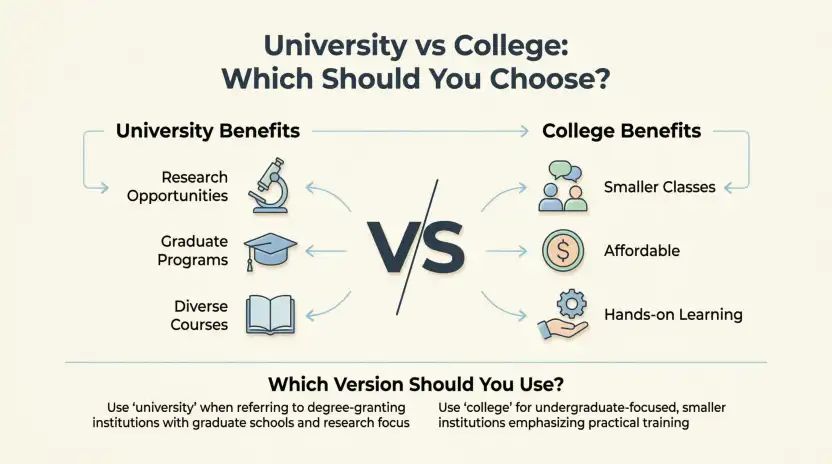
United States
Use college when talking generally about undergraduate higher education.
I am applying to college.
Use university when referring to a specific institution whose official name contains “University.”
I applied to the University of Michigan.
American English commonly uses “college” as a broad term even when the institution is officially a university.
United Kingdom
Use university when referring to university-level higher education.
She is going to university next year.
Use college when the institution is actually a college or when referring to a college within a university.
He studies at a college in London.
Canada
Canadian usage can overlap with both American and British patterns. “College” often refers to institutions that provide career-focused or technical education, while “university” commonly refers to institutions granting university degrees.
However, individual institutions have their own official names and structures.
Australia
Australian English generally uses university for university-level higher education. “College” can refer to other types of education or to residential colleges associated with universities.
International Writing
For an international audience, avoid assuming that everyone understands “college” in the American sense.
If precision matters, use a phrase such as:
She is studying at a university.
or:
He is enrolled in a higher-education institution.
Academic Writing
Academic writing should use the official name of the institution whenever possible.
For example:
She studies at Harvard University.
Do not replace an institution’s official name with “college” simply because the students are undergraduates.
Business Writing
In professional writing, clarity is more important than regional habit.
If your audience is international, specify the institution:
The candidate holds a bachelor’s degree from the University of Toronto.
This is clearer than relying on the broad American meaning of “college.”
Common Mistakes
Mistake 1: Assuming College Always Means a Smaller School
Incorrect assumption:
A college is always smaller than a university.
Better understanding:
College size and university size vary. “College” can refer to an independent institution, a university division, a community college, or a general term for higher education in American English.
Memory tip:
Think “college has multiple meanings.”
Mistake 2: Using “At College” for Every English Variety
Less natural in British English:
I am at college studying for my degree.
Depending on the intended meaning, British speakers may instead say:
I am at university studying for my degree.
Memory tip:
For general university study in British English, at university is the common phrase.
Mistake 3: Changing an Official Name
Incorrect:
She studies at Harvard College.
if you actually mean Harvard University as the institution.
Correct:
She studies at Harvard University.
Always check the institution’s official name.
Mistake 4: Thinking University Always Means Postgraduate Study
Incorrect assumption:
You go to university only for a master’s or PhD.
Correct understanding:
Universities commonly offer both undergraduate and postgraduate degrees. Cambridge defines university as a place where students can study for undergraduate or higher-level degrees.
Everyday Examples
Emails
American English:
I am currently in college and expect to graduate next year.
British English:
I am currently at university and expect to graduate next year.
Business Writing
Our new intern is a university student studying computer science.
This wording is clear for an international audience.
News Headlines
American-focused:
College Students Return to Campus
British-focused:
University Students Return to Campus
Both can be natural depending on the publication’s audience and style.
Blogs
Choosing the right college can be stressful for American students.
For a British audience:
Choosing the right university can be stressful for students.
Social Media
Starting college this fall! 🎓
This sounds natural in American English.
A British speaker might write:
Starting university this autumn! 🎓
Academic Writing
Participants were recruited from three universities.
This is clear and formal.
If the institutions are specifically colleges, use:
Participants were recruited from three colleges.
Daily Conversation
American:
Where did you go to college?
British:
Which university did you go to?
These differences are normal regional usage, not necessarily grammar mistakes. Oxford provides similar examples of the contrast.
Google Trends & Modern Usage
People search “university or college” because the two words overlap in meaning, especially when English learners encounter American and British sources.
Search interest can also come from students comparing educational systems. A student may see “college” on an American website but “university” on a British website and wonder if the words describe different levels of education.
Modern usage also depends heavily on location.
In American English, college is extremely common in everyday phrases such as:
- go to college
- college student
- college degree
- college campus
- college application
In British English, university is more common for general university-level study:
- go to university
- university student
- university degree
- university campus
- university application
Exact Google Trends popularity can change by country, date range, and search wording, so broad statements about which term is “more popular” should not be treated as universal statistics.
The important point is that regional usage patterns explain much of the search confusion.
Quick Comparison Table
| Version | Meaning | Correct? | Region | Example |
| University | Higher-education institution | Yes | International | She studies at a university. |
| College | General higher education | Yes | US especially | He is in college. |
| College | Further education or specialized education | Yes | UK and other regions | She attends a local college. |
| College | Part of a university | Yes | UK, especially Oxford/Cambridge | He belongs to a university college. |
| University | Undergraduate institution | Yes | International | She attends university. |
| College | University-level institution | Yes | US | I am applying to college. |
| Community college | Usually a two-year US institution | Yes | US | He attends community college. |
The same word can therefore refer to different educational structures. Context matters more than a simple “college = X” or “university = Y” rule.
Key Takeaways
- University generally refers to an institution of higher education offering degree programs.
- College has several meanings and varies by country.
- In the US, “college” often means undergraduate higher education in general.
- In British English, “university” is the usual term for university-level study.
- A college can be a separate institution or part of a university.
- Always use an institution’s official name in formal writing.
- For international readers, “university” can sometimes be clearer than the broad American use of “college.”
- Neither word is always better. Audience and context determine the natural choice.
FAQs About University or College
1. Is college the same as university?
Not always. In American English, “college” is often used broadly for higher education and may refer to a university. In other contexts, a college can be a separate institution or a division within a university. British English usually makes a clearer distinction between university and college.
2. Is it better to say university or college?
It depends on your audience and meaning. For American readers, “college” is very natural for general undergraduate study. For British readers, “university” is usually the natural term for university-level education. When writing internationally, use the institution’s official name when possible.
3. Can you go to college at a university?
Yes. In American English, people commonly say they are “going to college” even when they attend an institution officially called a university. A university may also contain individual colleges or schools, so the word “college” can describe both general higher education and a specific organizational unit.
4. Is university higher than college?
There is no universal rule that university is automatically “higher” than college. In the US, a college may award bachelor’s degrees, while universities often have undergraduate and graduate programs. But educational systems differ by country, so the institutional structure matters more than the word itself.
5. Do Americans say university or college?
Americans use both words. “College” is especially common when talking generally about undergraduate higher education. For example, an American may say, “I am going to college,” even if the school is officially named a university. “University” is common when identifying a specific institution.
6. Do British people say college or university?
British speakers commonly use “university” for university-level higher education. “College” has several other meanings, including further education institutions and colleges that form part of certain universities. Therefore, “I am at university” is a normal British expression.
7. Is college the same as university in American English?
Often, but not always. In everyday American English, “college” can mean higher education generally, including attendance at a university. However, colleges and universities can have different institutional structures, programs, and official names.
8. Which word is better for ESL learners?
ESL learners should learn both words because both are common. The key is to understand regional usage. Use “college” naturally in American contexts and “university” for general university study in British contexts. For formal international writing, be specific about the institution.
9. Can a university have colleges?
Yes. Some universities are organized into separate colleges or schools. Oxford and Cambridge are well-known examples where colleges form an important part of the university structure. A college may have its own community and organization while remaining part of the wider university.
10. Should I use university or college in formal writing?
Use the most precise term available. If you are naming an institution, use its official name. If you are discussing higher education generally, choose the term that fits your target variety of English. This approach reduces confusion for readers from different countries.
Conclusion
The difference between university or college is not simply a matter of one word being correct and the other being incorrect. The meanings depend heavily on country, educational system, and context.
In American English, college is often a broad everyday term for undergraduate higher education. A person can say “I am going to college” even when the institution’s official name includes “University.” In British English, university is the normal term for university-level study, while college can refer to further education, specialist education, or a college within a university.
For formal and international writing, clarity is the safest approach. Use the institution’s official name when possible, and consider your readers’ variety of English.
The easiest rule to remember is this: college and university overlap, but their meanings depend on where and how you use them.
When in doubt, focus on your audience, context, and the official name of the institution.
Read more about!
- SUV or Truck: Which One Is Better for You?
- Fabric or Forge: What Is the Difference?
- SIG or Glock: What’s the Difference?

I’m Olivia Parker, a grammar and English writing enthusiast passionate about making English simple and easy to understand. Through Wordsblog, I share clear explanations, useful grammar tips, and practical writing guidance to help readers write with confidence. My goal is to make learning English easier, one word at a time.