Ineligible is the correct and standard English spelling. It means not qualified, not allowed, or unable to meet the requirements for something. Uneligible is generally considered a nonstandard or incorrect spelling in modern English. For example, you should write, “She is ineligible for the scholarship,” rather than “She is uneligible for the scholarship.”
People often search for uneligible or ineligible because both words seem possible. The confusion comes from the prefixes un- and in-, which can both express a negative meaning. However, English does not use every prefix with every word. In this case, ineligible is the accepted form in standard writing.
If you are writing an application, discussing job requirements, explaining benefits, or preparing an official document, choosing the correct spelling makes your writing clearer and more professional. This guide explains the meaning of ineligible, why uneligible is incorrect, and how to use the word correctly in everyday English.
Quick Answer: Uneligible vs. Ineligible
- Ineligible: The correct standard spelling. It means not qualified or not entitled to something.
- Uneligible: A nonstandard spelling that should generally be avoided.
Correct example: He is ineligible for the position because he does not meet the requirements.
Incorrect in standard English: He is uneligible for the position.
Remember: Use ineligible whenever you mean that someone does not qualify for something.
What Does Ineligible Mean?
Ineligible is an adjective that describes someone or something that does not meet the necessary conditions for participation, selection, membership, or receiving a benefit.
It is commonly used in education, employment, competitions, insurance, government programs, and legal or administrative documents.
Examples of ineligible in sentences:
- She is ineligible for the scholarship.
- Applicants under 18 are ineligible for this program.
- He became ineligible to participate in the competition.
- The employee is ineligible for the additional benefits.
- Students who miss the deadline may be ineligible for admission.
In each example, ineligible means that a person does not meet the required conditions.
Synonyms of Ineligible
You can use several other words depending on the context.
| Synonym | Meaning |
| Unqualified | Lacking the required qualifications |
| Disqualified | Removed from eligibility or participation |
| Unfit | Not suitable for a particular purpose |
| Unentitled | Not having a right to something |
| Unsuitable | Not appropriate for a particular situation |
These words are not always interchangeable. Choose the one that best matches your sentence.
What Does Uneligible Mean?
Uneligible is a nonstandard spelling of ineligible. Although it may look grammatically possible because the prefix un- can make some adjectives negative, it is not the accepted form in standard modern English.
For example:
- Nonstandard: She is uneligible for the award.
- Standard: She is ineligible for the award.
The second sentence uses the recognized spelling.
Why Do People Write Uneligible?
People may write uneligible for several reasons:
- Prefix confusion: They know that un- can mean not and apply it to eligible.
- Spelling uncertainty: They are unsure which negative prefix belongs with eligible.
- Typing mistakes: They may type uneligible without checking the spelling.
- Word formation: They assume that adding un- to any adjective creates a correct opposite.
However, English prefixes do not follow one universal rule. The established word is ineligible, so that is the form you should use.
Ineligible vs. Uneligible: Key Differences
| Feature | Ineligible | Uneligible |
| Spelling | Correct | Nonstandard |
| Grammar | Standard adjective | Not recommended in standard English |
| Meaning | Not qualified or entitled | Intended to mean not qualified |
| Prefix | In- | Un- |
| Formal writing | Appropriate | Avoid |
| Example | He is ineligible for the job. | He is uneligible for the job. |
The main difference is that ineligible is the accepted spelling, while uneligible is generally treated as an incorrect alternative.
Why Is Ineligible the Correct Spelling?
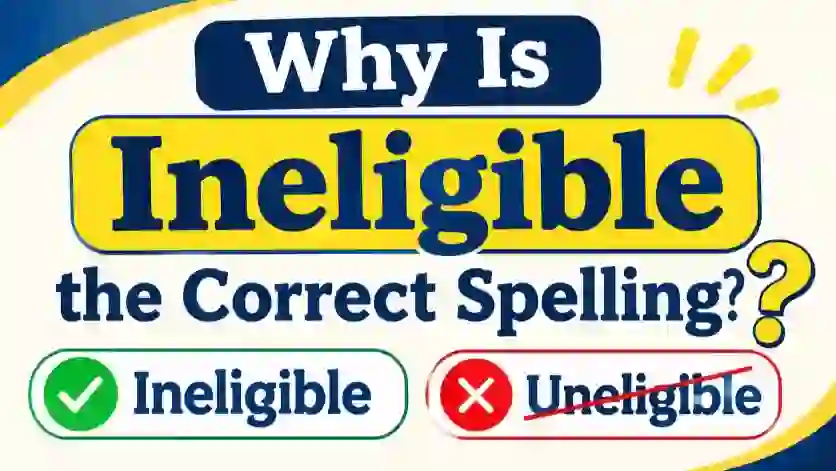
The word ineligible is formed from the negative prefix in- and the word eligible.
- In-: A prefix that can mean not.
- Eligible: Qualified or entitled to do or receive something.
- Ineligible: Not qualified or entitled.
The word has an established spelling in standard English dictionaries.
Although un- also creates negative adjectives, it is not the prefix used in the standard word ineligible.
Examples:
- Eligible: She is eligible for the position.
- Ineligible: She is ineligible for the position.
Adding the correct prefix changes the meaning while keeping the word grammatically standard.
How to Use Ineligible in Everyday Sentences
Ineligible is useful in many situations where someone does not meet specific requirements.
1. In Education
Schools, colleges, and universities may use ineligible when students do not meet admission or scholarship requirements.
Examples:
- He is ineligible for the scholarship.
- Students without the required grades are ineligible for admission.
- She became ineligible for the academic award.
2. In Employment
Employers may use ineligible to describe applicants who do not meet job requirements.
Examples:
- The applicant is ineligible for the position.
- He is ineligible for the employee benefit.
- Candidates without the required experience may be ineligible.
3. In Sports and Competitions
The word can describe someone who cannot participate in a competition because they do not meet its rules.
Examples:
- The player is ineligible for the tournament.
- He was declared ineligible to compete.
- The team used an ineligible player.
4. In Benefits and Applications
Organizations may use the word when someone does not qualify for a particular service or benefit.
Examples:
- You may be ineligible for financial assistance.
- The applicant is ineligible for the program.
- She is currently ineligible for the benefit.
Common Mistakes When Using Ineligible
Here are some spelling and usage mistakes to avoid.
| Incorrect | Correct | Explanation |
| Uneligible for admission | Ineligible for admission | Ineligible is the standard spelling. |
| He is uneligible for the job. | He is ineligible for the job. | Use the accepted adjective. |
| They are uneligible candidates. | They are ineligible candidates. | The correct prefix is in-. |
| She became uneligible. | She became ineligible. | Use ineligible to describe a lack of qualification. |
| The student is not uneligible. | The student is not ineligible. | Use the standard spelling, though the sentence may be clearer when rewritten. |
Writing tip: When you are unsure, remember the common pair: eligible and ineligible.
Eligible vs. Ineligible: Understanding Both Words
Eligible and ineligible are opposites. Understanding both words makes it easier to use them correctly.
| Word | Meaning | Example |
| Eligible | Qualified or entitled | She is eligible for the grant. |
| Ineligible | Not qualified or entitled | She is ineligible for the grant. |
Eligible examples:
- You are eligible to apply for the position.
- The student is eligible for financial aid.
- All eligible members can vote.
Ineligible examples:
- You are ineligible to apply for the position.
- The student is ineligible for financial aid.
- Ineligible members cannot participate.
Key Takeaways
- Ineligible is the correct standard English spelling.
- Uneligible is a nonstandard form and should generally be avoided.
- Ineligible means not qualified, not entitled, or not meeting the requirements.
- Eligible and ineligible are opposites.
- Use ineligible in formal writing, applications, school documents, and everyday communication.
- Remember the correct spelling: eligible → ineligible.
Frequently Asked Questions
1. Is uneligible a correct word?
Uneligible is generally considered a nonstandard spelling. In standard English, use ineligible.
2. Is ineligible one word or two?
Ineligible is one word. It should not be written as two separate words.
3. What does ineligible mean?
Ineligible means not qualified or not entitled to participate in something or receive a particular benefit.
4. What is the opposite of ineligible?
The opposite of ineligible is eligible, which means qualified or entitled to do or receive something.
5. Why is ineligible correct instead of uneligible?
Ineligible is the established standard spelling in English. Although un- can create negative words, it is not the accepted prefix in this particular word.
6. Is ineligible an adjective?
Yes. Ineligible is an adjective because it describes someone or something that does not meet certain requirements.
7. Can I use ineligible in formal writing?
Yes. Ineligible is appropriate for formal writing, including applications, academic documents, employment materials, and official communication.
8. What is an example of ineligible in a sentence?
“She is ineligible for the scholarship because she does not meet the academic requirements.”
9. What is the difference between ineligible and disqualified?
Ineligible means someone does not meet the requirements. Disqualified often means someone has been ruled out or removed from participation, sometimes because of breaking a rule.
10. How can I remember the correct spelling?
Remember the pair eligible and ineligible. When you want to express that someone does not qualify, use ineligible rather than uneligible.
Conclusion
The correct spelling is ineligible, not uneligible. Ineligible is an adjective that means someone does not meet the requirements or is not entitled to participate in something or receive a benefit.
Although uneligible may look reasonable because the prefix un- appears in many English words, it is not the standard form.
Use ineligible in everyday conversations, professional documents, academic writing, and official applications. A simple way to remember it is to learn the pair eligible and ineligible. Choosing the correct spelling will help you write more clearly and avoid a common English mistake.
Read more about!
- Jem or Gem: Which Spelling Is Correct?
- Adjective or Adverb: What’s the Difference?
- Chilly or Chilli: What’s the Difference?

I’m Olivia Parker, a grammar and English writing enthusiast passionate about making English simple and easy to understand. Through Wordsblog, I share clear explanations, useful grammar tips, and practical writing guidance to help readers write with confidence. My goal is to make learning English easier, one word at a time.

2 thoughts on “Uneligible or Ineligible: Which Spelling Is Correct?”