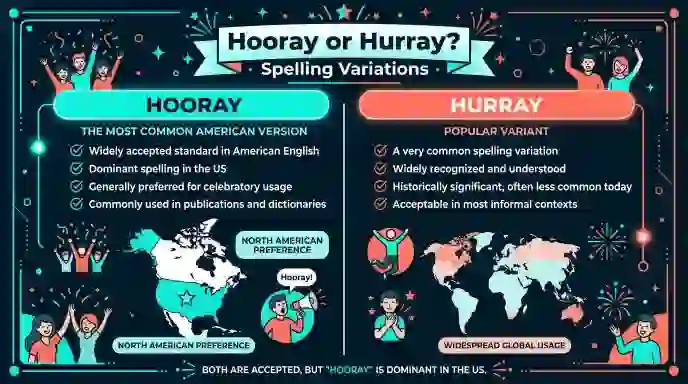
vHooray and hurray are both correct spellings, but “hooray” is the more common standard form in modern English. Both words are used as an exclamation to show joy, excitement, approval, or celebration. For example, you can say, “Hooray! We won the game!” or “Hurray! The project is finished!”
People often search for hooray or hurray because the two spellings sound almost the same and have the same basic meaning. This can make it hard to know which one to use in writing.
The difference is not like a typical spelling mistake such as definately versus definitely. Both hooray and hurray are recognized English words. However, they can differ in how often they appear and in personal or regional preference.
In this guide, you will learn what hooray and hurray mean, where they came from, how they are used in British and American English, and which spelling is best for different types of writing. You will also see simple examples and common mistakes.
Hooray or Hurray – Quick Answer
Hooray and hurray are both correct.
Generally is hooray the more common spelling, while hurray is an accepted variant.
Simple examples
- Hooray! We passed the exam.
- Hurray! The team won.
- Hooray for the winners!
Both spellings express excitement, happiness, approval, or celebration.
Quick rule
- Hooray = standard and widely used
- Hurray = correct variant
- Hurrah = another traditional form
If you want the safest choice for general modern writing, hooray is usually the best option.
Definition and Meaning of Hooray or Hurray
What does “hooray” mean?
Hooray is an exclamation used to express happiness, excitement, encouragement, or approval.
For example:
Hooray! We finally finished the work.
It can also be used before a person, group, or thing to show support.
Hooray for our new teacher!
The word is common in casual speech, celebrations, stories, and informal writing.
What does “hurray” mean?
Hurray has the same basic meaning as hooray.
For example:
Hurray! Our holiday starts tomorrow.
It can express joy, excitement, or approval.
The main difference is spelling and usage frequency, not meaning.
Is “hooray” an interjection?
Yes. Hooray is commonly classified as an interjection because it expresses a strong feeling or reaction.
Examples include:
- Hooray!
- Hooray for us!
- Hurray!
- Hurray for the team!
The exclamation mark is common because the word often expresses strong emotion.
Hooray vs hurray vs hurrah
You may also see hurrah.
| Word | Meaning | Usage |
| Hooray | Joy or celebration | Very common |
| Hurray | Joy or celebration | Accepted variant |
| Hurrah | Joy, approval, or celebration | Traditional variant |
All three can express celebration, but hooray is often the easiest modern choice.
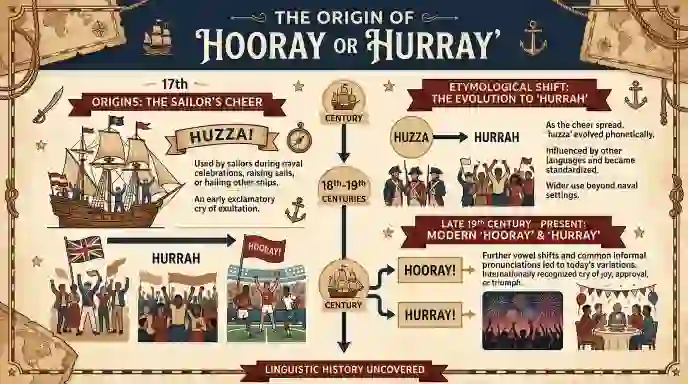
The Origin of Hooray or Hurray
Where did “hooray” come from?
The exact history of hooray is not completely certain. It belongs to a group of English cheering expressions that developed over time.
The related form hurrah has a long history in English and other European languages. Variants such as hooray, hurray, and hurrah have appeared in English usage.
These words are often linked with cheering and public celebration.
Why are there different spellings?
English has many words with spelling variants. This can happen when a word comes mainly from speech rather than from a fixed written form.
People may spell a spoken exclamation in different ways while keeping the same sound and meaning.
That helps explain why you can find:
- hooray
- hurray
- hurrah
The different forms developed through usage rather than through one simple spelling rule.
Did the meaning change?
The main meaning has stayed fairly stable.
These words have traditionally been used to show:
- Joy
- Approval
- Celebration
- Encouragement
- Excitement
Today, hooray is especially common in casual and enthusiastic writing.
British English vs American English Spelling
Are “hooray” and “hurray” different in British and American English?
Both spellings can be found in British and American English. Neither is limited strictly to one country.
However, usage frequency can vary between sources, publications, and speakers.
| Spelling | British English | American English | Meaning |
| hooray | Correct | Correct | Joy or celebration |
| hurray | Correct | Correct | Joy or celebration |
| hurrah | Correct | Correct | Joy or celebration |
There is no major grammar rule that makes hurray British and hooray American, or vice versa.
Which spelling is more common?
Hooray is generally the safer modern choice when you want one spelling for a broad English-speaking audience.
You may still see hurray in books, websites, messages, and other writing.
The spelling choice does not normally change the meaning.
Style and publishing preferences
Informal writing gives you more freedom.
For professional or edited content, choose one spelling and use it consistently.
If you are quoting someone, keep the original spelling.
Which Spelling Should You Use?
For US English
Use hooray when you want the most familiar modern form.
Hooray! We won!
For UK and Commonwealth English
Hooray is also a safe choice. Hurray is acceptable as a variant.
For global audiences
Choose hooray because it is easy to recognize and widely understood.
For academic writing
These words are usually informal. Avoid them unless you are discussing language, quoting speech, or writing about an expression.
For business writing
Use hooray only when the tone is friendly or informal.
For example:
Hooray! We reached our target.
In a formal report, a more neutral sentence may be better:
We have reached our target.
For social media
Both forms work, but hooray is a natural choice.
Hooray! It is finally Friday!
Common Mistakes with Hooray or Hurray
Mistake 1: Calling “hurray” incorrect
Incorrect idea:
“Hurray is always a spelling mistake.”
Correct:
“Hurray is an accepted spelling variant.”
Both hooray and hurray can be used as English exclamations.
Mistake 2: Thinking the words have different meanings
Incorrect idea:
“Hooray means happiness, but hurray means something else.”
Correct:
Both words can express joy, excitement, approval, or celebration.
Mistake 3: Using the word in very formal writing
Less suitable:
Hooray! The company achieved its annual goal.
More formal:
The company achieved its annual goal.
The word is not wrong. The issue is tone and context.
Mistake 4: Mixing spellings without reason
If you use hooray in an article, there is usually no reason to switch to hurray later unless you are discussing the variant.
Memory tip:
When in doubt, choose hooray for modern general writing.
Hooray or Hurray in Everyday Examples

In emails
Informal:
Hooray! The meeting has been canceled.
Friendly:
Hurray! Your order has arrived.
In business writing
A friendly company message might say:
Hooray! We have reached 10,000 customers.
For formal reports, use neutral language instead.
In news headlines
A light or entertainment-focused headline might use:
Hooray! The Festival Returns This Weekend
Traditional or formal news writing may use a more neutral headline.
In blogs
Blogs often use these words to create an upbeat tone.
Hooray! Summer is finally here.
On social media
They are common in celebratory posts.
Hooray! I got the job!
Hurray! We are going on vacation.
In academic writing
These words are uncommon in formal academic prose.
You might use them when analyzing an example of language or quoting a speaker.
In daily conversation
Both forms can appear in speech.
Hooray! We won!
Hurray! School is over!
In everyday communication, the choice is mostly a matter of spelling preference.
Hooray or Hurray – Google Trends & Usage Data
Which spelling gets more searches?
Search interest can change by country and over time. Without a specific Google Trends date range and location, it would be misleading to give exact popularity numbers.
In general usage, hooray is a strong modern form, while hurray remains a recognized variant.
Why do people search “hooray or hurray”?
People often search the phrase because:
- The words sound almost identical.
- The meanings are the same.
- Both spellings appear online.
- They want to know which form is standard.
- They may be unsure which spelling to use in professional writing.
Modern usage
Today, hooray commonly appears in:
- Social media
- Children’s writing
- Blogs
- Informal emails
- Celebratory messages
- Advertising
- Casual conversation
Hurray can appear in the same settings.
The main point is simple: seeing hurray does not automatically mean you have found a spelling error.
Hooray vs Hurray Comparison Table
| Spelling | Meaning | Correct? | Best Use | Example |
| Hooray | Joy or celebration | Yes | General modern English | Hooray! We won! |
| Hurray | Joy or celebration | Yes | General and informal English | Hurray! We finished! |
| Hurrah | Joy or approval | Yes | Traditional or expressive use | Hurrah for the team! |
Quick recommendation
| If you are writing for… | Best choice |
| General readers | Hooray |
| US audience | Hooray |
| UK audience | Hooray |
| International audience | Hooray |
| Social media | Hooray or hurray |
| Formal academic writing | Usually avoid |
| Formal business writing | Usually avoid |
FAQs
1. Is hooray or hurray correct?
Both hooray and hurray are correct English spellings. They have the same basic meaning and can express joy, excitement, approval, or celebration.
2. Is hooray more common than hurray?
Hooray is generally the more common modern spelling. Hurray is still accepted and understood, so using it is not automatically a spelling error.
3. Is hurray a real word?
Yes. Hurray is a recognized English variant of the celebratory exclamation. It can be used in the same general situations as hooray.
4. What is the difference between hooray and hurray?
There is no major difference in meaning. The main difference is spelling and usage frequency. Both words can show happiness, excitement, approval, or celebration.
5. Is hurrah also correct?
Yes. Hurrah is another established form of the same type of exclamation. It can sound more traditional or dramatic than hooray.
6. Should I use hooray in formal writing?
Usually, no. Hooray is an informal exclamation. In formal business or academic writing, a neutral statement is often more suitable.
7. Which is better for American English?
Hooray is a safe choice for American English. It is clear, familiar, and suitable for casual and friendly writing.
Conclusion
When choosing between hooray or hurray, you do not need to worry about one being completely wrong. Both are accepted English spellings, and both express joy, excitement, approval, or celebration.
For most modern readers, hooray is the safest choice. It is familiar and works well in casual writing, social media, blogs, friendly emails, and celebratory messages. Hurray is also correct, but it is better viewed as a spelling variant.
You may also come across hurrah, which is another established form with a similar meaning. These expressions are generally informal, so they should be used carefully in academic or formal business writing.
If you are writing for a US, UK, Canadian, Australian, or international audience, hooray is a reliable general choice. The most important point is to understand that hurray is not simply a spelling mistake.
Remember: hooray and hurray both celebrate, but hooray is usually the safer modern spelling.
Use the spelling that best fits your audience and tone, and keep your choice consistent throughout your writing.
Read more about!
- SUV or Truck: Which One Is Better for You?
- Fabric or Forge: What Is the Difference?
- SIG or Glock: What’s the Difference?

I’m Olivia Parker, a grammar and English writing enthusiast passionate about making English simple and easy to understand. Through Wordsblog, I share clear explanations, useful grammar tips, and practical writing guidance to help readers write with confidence. My goal is to make learning English easier, one word at a time.