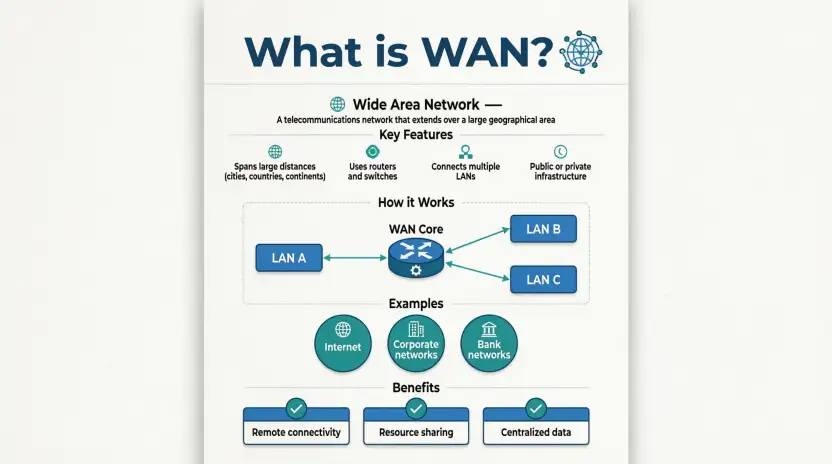
WAN and LAN are both computer networks, but a LAN covers a small local area while a WAN connects networks across larger distances. This is the key difference between WAN and LAN.
People often search for WAN or LAN because both terms describe networks, but they work on very different scales. A LAN may connect computers, phones, printers, and other devices inside a home, school, office, or building. A WAN can connect networks across cities, countries, or even continents.
For example, the network inside your home is usually a LAN. When many separate networks connect over long distances, they form part of a WAN. The internet is the largest familiar example of a WAN-like network.
Understanding WAN and LAN is useful for students, office workers, IT beginners, and anyone setting up a network. It also helps when choosing network equipment or explaining how devices connect.
In this guide, you will learn the simple meaning of WAN and LAN, their differences, common examples, mistakes, and when each type of network is used.
WAN or LAN – Quick Answer
A LAN (Local Area Network) connects devices in a small geographic area, while a WAN (Wide Area Network) connects networks across a much larger area.
LAN Example
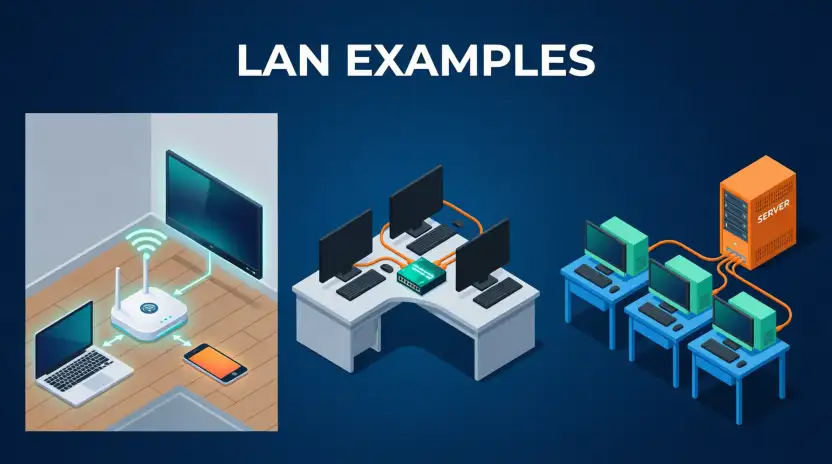
A home Wi-Fi network is a LAN.
It may connect:
- Laptops
- Smartphones
- Smart TVs
- Printers
- Security cameras
- Gaming consoles
WAN Example
A company with offices in New York, London, and Tokyo may use a WAN to connect its separate office networks.
Simple rule
LAN = Local and small
WAN = Wide and large
| Network | Full Form | Typical Area | Example |
| LAN | Local Area Network | Home, office, building | Home Wi-Fi |
| WAN | Wide Area Network | Cities, countries, continents | Corporate network |
Definition and Meaning of WAN or LAN
WAN and LAN are two common types of computer networks. Their main difference is the size of the area they cover and how they connect devices or smaller networks.
What Does LAN Mean?
LAN stands for Local Area Network.
A LAN connects devices within a limited area. This could be a house, classroom, office, computer lab, or building.
For example, when your laptop connects to your home router, it becomes part of your home LAN.
LANs are commonly used to share:
- Internet access
- Files
- Printers
- Applications
- Storage
- Other network resources
What Does WAN Mean?

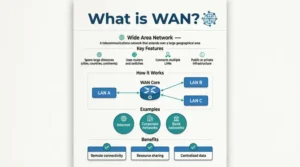
WAN stands for Wide Area Network.
A WAN connects networks over a large geographic area. It can link networks in different buildings, cities, countries, or regions.
A business may use a WAN to connect its offices in different cities. WAN connections can use technologies such as leased lines, fiber connections, cellular networks, or other long-distance communication services.
WAN vs LAN in Simple Terms
Think about a company with several offices.
The network inside one office is a LAN.
The connection that links that office to another office in a different city can be part of a WAN.
So, a WAN can connect multiple LANs.
Are WAN and LAN the Same?
No.
They are both computer networks, but they serve different geographic and organizational needs.
A LAN focuses on a local area. A WAN connects networks over a much wider area.
The Origin of WAN or LAN
The terms WAN and LAN were created as networking concepts developed and computer networks became more common.
Where Does LAN Come From?
LAN is short for Local Area Network.
The word “local” describes its limited geographic range. Early local networks were designed to connect computers and share resources within a relatively small location.
As businesses, schools, and homes adopted networking, LANs became common for sharing files, printers, applications, and other resources.
Where Does WAN Come From?
WAN means Wide Area Network.
The word “wide” refers to its larger geographic coverage. WAN technology developed to allow separate networks to communicate over long distances.
As telecommunications improved, organizations gained more ways to connect networks in different locations.
Why Are These Terms Still Used?
WAN and LAN remain useful because they describe two important levels of networking.
A LAN usually serves a local location.
A WAN can connect separate networks across a much larger area.
Modern networking has become more complex, but these basic terms remain common in IT education and professional networking.
British English vs American English Spelling
There is no major British versus American spelling difference between WAN and LAN.
Both terms are technical abbreviations, and their meanings remain the same in major English varieties.
| Term | British English | American English | Meaning |
| LAN | LAN | LAN | Local Area Network |
| WAN | WAN | WAN | Wide Area Network |
| Local Area Network | Local Area Network | Local Area Network | Small-area network |
| Wide Area Network | Wide Area Network | Wide Area Network | Large-area network |
Technical Writing
IT professionals in the United States, United Kingdom, Canada, Australia, and other English-speaking regions generally use LAN and WAN.
There is no need to change the abbreviations based on your audience.
Global Usage
For international readers, introduce the full term first:
A Local Area Network (LAN) connects devices in a limited area.
After that, you can simply use LAN.
This makes technical writing easier for beginners to follow.
Which Network Should You Use?
The choice between a LAN and WAN depends on the size and purpose of the network.
For a Home
A LAN is normally what you need for a home network.
Your router can connect computers, phones, TVs, printers, and other devices.
For a Small Office
A LAN can connect computers and shared devices within the office.
If the company has only one location, a local network may meet most internal needs.
For Multiple Offices
A business with offices in different cities may need a WAN or another wide-area networking solution.
This allows separate local networks to communicate.
For Schools
A school may have one or more LANs inside its buildings.
If different campuses need to communicate, a wider network connection can link them.
For International Businesses
Large companies may use wide-area networking technologies to connect offices and data centers across countries.
The exact solution depends on security, cost, performance, and business requirements.
For Global Writing
When explaining these terms to a general audience, use the simple distinction:
LAN connects devices locally. WAN connects networks over larger distances.
Common Mistakes with WAN or LAN
Many beginners confuse WAN and LAN because both are network terms.
Mistake 1: Thinking LAN Means Internet
A LAN is not the same thing as the internet.
A home LAN can provide local connections between devices. Your router may also connect that LAN to the internet.
Mistake 2: Thinking WAN Always Means the Internet
The internet is a huge interconnected network, but not every WAN is simply “the internet.”
Organizations can use private WAN connections to connect their locations.
Mistake 3: Saying WAN Is Always Faster
WAN does not automatically mean faster.
Performance depends on the technology, connection, distance, equipment, traffic, and service being used.
Mistake 4: Using LAN for a Whole Country
A network covering a country is not normally described as a LAN because LAN refers to a limited local area.
Mistake 5: Confusing Wi-Fi With LAN
Wi-Fi is a wireless networking technology.
A Wi-Fi network can be part of a LAN.
WAN or LAN in Everyday Examples
WAN and LAN may sound technical, but you use these concepts in everyday life.
Email Example
Imagine an employee working from home.
Their laptop may connect to their home LAN through Wi-Fi. The company may use a WAN to connect its offices and network resources.
Business Example
A company has offices in Chicago, Dallas, and Los Angeles.
Each office can have its own LAN. A WAN can connect the different office networks.
News Example
A technology article may say:
The company is expanding its WAN to connect new offices.
Here, WAN refers to a wide-area network connecting locations.
Social Media Example
A simple social media explanation might say:
Your home Wi-Fi is part of your local network, while large organizations may use WAN connections between offices.
Formal Writing Example
In an IT report:
The LAN connects devices within the building, while the WAN links the company’s regional offices.
Daily Conversation
Someone may say:
The printer is connected to our LAN.
Or:
Our company uses a WAN to connect its offices.
These are simple and correct uses of the terms.
WAN or LAN – Google Trends & Usage Data
People search for WAN or LAN, WAN vs LAN, and similar phrases because networking terms can be confusing for beginners.
Search interest often comes from:
- IT students
- Networking courses
- Computer certification study
- Home network setup
- Business networking
- Technical interviews
- Network troubleshooting
The exact popularity of these searches can change by country and time. Without a specific Google Trends date range, it would not be accurate to give fixed search-volume or popularity numbers.
Why People Search WAN vs LAN
The main confusion usually comes from the fact that both terms describe networks.
Users want to know:
- What does LAN mean?
- What does WAN mean?
- Is Wi-Fi a LAN?
- Is the internet a WAN?
- What is the difference between WAN and LAN?
- Which network is used in a home?
- What is WAN used for?
Modern Usage
WAN and LAN remain standard networking terms.
They are commonly discussed in networking education, business IT, routers, network architecture, and technical documentation.
WAN or LAN Comparison Table
| Feature | LAN | WAN |
| Full Name | Local Area Network | Wide Area Network |
| Coverage | Small area | Large area |
| Common Example | Home network | Multi-office corporate network |
| Connects | Local devices | Networks over distance |
| Typical Setting | Home, school, office | Cities, countries, regions |
| Main Purpose | Local communication | Long-distance connectivity |
| Common Technology | Ethernet, Wi-Fi | Fiber, leased connections, cellular, other WAN technologies |
| Management | Often local | Often involves multiple providers or network teams |
Simple Difference
If you connect your laptop, phone, and printer inside your home, you are using a LAN.
If a company connects its networks in several cities, it may use a WAN.
Key Takeaways
- LAN means Local Area Network.
- WAN means Wide Area Network.
- A LAN covers a smaller geographic area.
- A WAN covers a much larger area.
- A home network is commonly a LAN.
- A business can use a WAN to connect different office networks.
- A WAN can connect multiple LANs.
- WAN does not automatically mean faster or slower.
- Wi-Fi can be part of a LAN.
- WAN and LAN have the same meanings in British and American English.
FAQs About WAN or LAN
1. What is the main difference between WAN and LAN?
A LAN connects devices in a small local area, while a WAN connects networks across larger geographic distances.
2. Is home Wi-Fi a LAN or WAN?
A home Wi-Fi network is generally part of a LAN because it connects devices within a limited local area.
3. Is the internet a WAN?
The internet is a global network of interconnected networks. It shares the wide-area concept, but it is more accurate to describe the internet as a global network rather than simply calling it one WAN.
4. Which is bigger, LAN or WAN?
A WAN is larger than a LAN in geographic coverage. A WAN can connect multiple LANs across cities, countries, or other large areas.
5. What does LAN stand for?
LAN stands for Local Area Network. It connects devices within a limited area such as a home, school, office, or building.
6. What does WAN stand for?
WAN stands for Wide Area Network. It connects networks over a larger geographic area.
7. Can a WAN connect multiple LANs?
Yes. One common use of a WAN is connecting separate LANs located in different offices, buildings, cities, or regions.
Conclusion
The difference between WAN or LAN is mainly about network size and purpose. A LAN, or Local Area Network, connects devices within a limited area such as a home, school, or office. A WAN, or Wide Area Network, connects networks across much larger distances.
A simple home network is usually a LAN. A company with offices in different cities may use a WAN to connect those separate local networks.
Neither network type is automatically better. The right choice depends on what you need to connect and how far apart the locations are. LANs are useful for local communication and resource sharing. WANs are useful when separate networks need to communicate over long distances.
Remember the easiest rule: LAN is local, while WAN is wide. Once you understand this difference, most basic networking questions become much easier.
If you are learning computer networking, use the comparison table above as a quick study guide and remember that a WAN can connect multiple LANs.
LAN stays local. WAN goes wide.
Read more about!
- Equaling or Equalling: Which One Should You Use?
- TTF or OTF: Which Font Format Is Better?
- Emphasising or Emphasizing: Which Spelling Is Correct?
- Bacon or Sausage: Which One Should You Choose?

I’m Olivia Parker, a grammar and English writing enthusiast passionate about making English simple and easy to understand. Through Wordsblog, I share clear explanations, useful grammar tips, and practical writing guidance to help readers write with confidence. My goal is to make learning English easier, one word at a time.