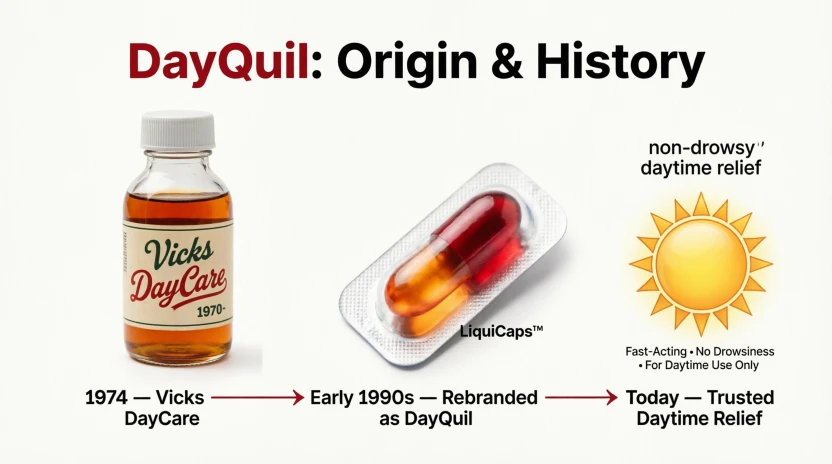
DayQuil or Mucinex? The better choice depends on your symptoms. DayQuil Cold & Flu is designed to relieve several cold and flu symptoms, such as fever, aches, cough, and nasal congestion. Regular Mucinex contains guaifenesin, which helps loosen thick mucus in your chest so you can cough it up more easily.
These medicines are not exactly the same. DayQuil is a product range with different formulas, while Mucinex also comes in several versions. Some Mucinex products contain only an expectorant, while others include additional ingredients for cough, congestion, or other symptoms.
This difference matters when you have a cold. You might need relief from a fever and headache, or you might mainly struggle with thick chest mucus. Choosing a medicine that matches your symptoms can help you avoid taking ingredients you do not need.
In this guide, you will learn how DayQuil and Mucinex differ, what their active ingredients do, if you can take them together, and which safety precautions matter. You will also find simple examples to help you understand the differences before choosing an over-the-counter medicine.
DayQuil or Mucinex: Quick Answer
DayQuil is generally better suited to relieving several cold and flu symptoms at once, while regular Mucinex is designed to loosen thick chest mucus.
Quil Cold & Flu commonly contains a pain and fever reliever, a cough suppressant, and a decongestant. Regular Mucinex contains guaifenesin, an expectorant that helps thin and loosen mucus.
The right choice depends on the exact product and your symptoms.
- Choose DayQuil Cold & Flu for consideration: When you have a combination of symptoms, such as fever, headache, body aches, and cough.
- Choose regular Mucinex for consideration: When thick chest mucus is your main problem and you need help coughing it up.
- Check combination products carefully: Some DayQuil and Mucinex versions contain overlapping ingredients or treat several symptoms.
These medicines relieve symptoms. They do not cure the common cold or flu.
What Does DayQuil or Mucinex Mean?
What Is DayQuil?
DayQuil is a brand of daytime cold and flu medicines sold in different formulations. It is designed to provide temporary relief from selected symptoms while helping people continue their daily activities.
A common DayQuil Cold & Flu formula contains three active ingredients:
- Acetaminophen: Helps relieve pain and reduce fever.
- Dextromethorphan: Suppresses coughing.
- Phenylephrine: Is included as a nasal decongestant in some US formulations.
Other DayQuil products may contain guaifenesin or additional ingredients. Therefore, do not assume that every DayQuil product has the same formula.
Check the package label to confirm which symptoms the particular product treats.
What Is Mucinex?
Mucinex is a brand of medicines used to relieve different respiratory symptoms. Regular Mucinex extended-release tablets contain guaifenesin, an expectorant.
An expectorant helps loosen phlegm, also called mucus, in the airways. This can make it easier to bring mucus up when you cough.
Regular Mucinex does not contain the same combination of ingredients as standard DayQuil Cold & Flu.
However, the Mucinex range includes combination products. Depending on the version, these may contain a cough suppressant, a decongestant, or other active ingredients.
The key difference is that regular Mucinex focuses on loosening mucus, while DayQuil Cold & Flu targets several cold symptoms at once.
The Origin of DayQuil and Mucinex
DayQuil and Mucinex are brand names, not alternative spellings of the same word. Their names identify different ranges of nonprescription medicines.
DayQuil is associated with daytime cold and flu relief. Its product range includes formulas intended to relieve symptoms that may interfere with daily activities.
Mucinex is associated with guaifenesin-based mucus relief, although its product range now includes other formulations.
Their different purposes explain why people often compare them when they develop a cough or cold. One brand may target several symptoms, while a particular product from the other brand may focus on mucus.
There is no spelling difference to explain between these names. The important distinction is the medicine’s active ingredients and intended use.
DayQuil vs. Mucinex: Main Differences
| Feature | DayQuil Cold & Flu | Regular Mucinex |
| Main purpose | Relief from several cold and flu symptoms | Loosens thick chest mucus |
| Common active ingredients | Acetaminophen, dextromethorphan, and phenylephrine in a common formula | Guaifenesin |
| Fever relief | Yes, if the formula contains acetaminophen | Not from guaifenesin alone |
| Headache and body aches | Yes, if the formula contains acetaminophen | Not from guaifenesin alone |
| Cough relief | Some formulas suppress cough | Helps make a mucus-producing cough more productive |
| Chest mucus | Only if the formula contains an expectorant such as guaifenesin | Main purpose |
| Formulations | Liquids, capsules, and other versions | Extended-release tablets and combination products |
| Best match | Several symptoms needing relief | Thick mucus as the main concern |
These descriptions apply to common formulations, not every product sold under either brand.
British English vs. American English
DayQuil and Mucinex are US medicine brands, so this comparison concerns product availability rather than spelling or grammar.
| British English market | American English market | Example |
| DayQuil may be unavailable or sold through limited channels | DayQuil products are marketed for daytime cold and flu relief | A shopper checks the local pharmacy |
| Mucinex availability and formulations can differ | Mucinex products include guaifenesin-based mucus relief | A shopper checks the active ingredients |
| Other brands or generic medicines may be used | US shoppers may find both brands on pharmacy shelves | A pharmacist compares equivalent ingredients |
In the United Kingdom, the exact US-branded product may not be available in every pharmacy. Local medicines can have different names, ingredients, strengths, and instructions.
Do not assume that a UK product is equivalent just because its packaging describes similar symptoms. Ask a pharmacist to compare the active ingredients.
For international, academic, or business writing, use the correct product name and describe its ingredients accurately. Follow the medicine label and the rules that apply in your country.
Which Version Should You Use?
The best approach is to match the medicine to your symptoms and check the active ingredients before taking it.
United States
If you have several cold symptoms, such as fever, headache, aches, and cough, a suitable DayQuil formulation may help relieve more than one symptom.
If thick chest mucus is your main concern, regular Mucinex may be more relevant. Read the Drug Facts label to make sure the product matches your needs.
United Kingdom
Check which products are available locally. A pharmacist can help you find a suitable medicine with the same intended effect without assuming the US brand is available or identical.
Canada
Check the Canadian product label and approved directions. Formulations and regulatory requirements may differ from those in the United States.
Australia
Ask a pharmacist about suitable local alternatives. Check the active ingredients and warnings rather than relying on the brand name alone.
International Use
Brand names, strengths, and ingredients can vary by country. Compare the active ingredients and intended use before choosing a medicine.
Academic Writing
Use the generic medicine names when explaining how the products work. For example, write “guaifenesin is an expectorant” rather than suggesting that all Mucinex products contain only guaifenesin.
Business and Health Communication
Avoid claiming that one product is always better. A more accurate statement is that DayQuil Cold & Flu may suit people who need relief from several symptoms, while regular Mucinex may suit people whose main concern is thick chest mucus.
Common Mistakes
Choosing cold medicine can be confusing when several products have similar names. These are common mistakes to avoid.
| Incorrect assumption | Correct information | Why it matters |
| All DayQuil products contain the same ingredients | DayQuil formulas vary | The wrong assumption can lead to unwanted or duplicate ingredients |
| All Mucinex products contain only guaifenesin | Some Mucinex products contain additional active ingredients | Combination products have different risks |
| Mucinex directly reduces fever | Regular guaifenesin alone does not treat fever | You may need a different treatment for that symptom |
| DayQuil cures the common cold | DayQuil provides temporary symptom relief | It does not eliminate the virus |
| Taking both medicines is always safe | Safety depends on their exact ingredients and your health | Ingredients may overlap |
| More medicine gives faster relief | Exceeding the recommended dose can cause harm | Always follow the product directions |
A Simple Memory Tip
Think of regular Mucinex as the mucus-loosening option. Think of DayQuil Cold & Flu as a multi-symptom option.
This is a useful starting point, but the product label always takes priority.
Everyday Examples
Here are practical examples of how the difference may apply.
1. Daily Life
You have a cold, a fever, a headache, and a cough. A suitable DayQuil formulation may help relieve several of these symptoms.
However, check if its ingredients are appropriate for you and if another medicine you take already contains acetaminophen.
2. Thick Chest Mucus
Your main problem is thick phlegm that is difficult to cough up. Regular Mucinex may be worth considering because guaifenesin helps loosen mucus.
Drink enough fluids unless a healthcare professional has told you to restrict them. Follow the label directions.
3. Dry Cough
You have a dry, irritating cough without much mucus. A cough suppressant may be more relevant than an expectorant.
Some DayQuil formulas contain dextromethorphan, which suppresses coughing. However, the cause of the cough matters, and not every cough should be suppressed.
4. Fever and Body Aches
Regular Mucinex containing only guaifenesin will not treat fever or body aches. A suitable product containing acetaminophen may help with these symptoms.
Do not take multiple products containing acetaminophen unless a healthcare professional has confirmed that the combination and total dose are safe.
5. Shopping at a Pharmacy
You see several DayQuil and Mucinex boxes on the shelf. Rather than choosing by brand name alone, compare their active ingredients, intended uses, age restrictions, and warnings.
A pharmacist can help you choose a product that addresses your symptoms without unnecessary duplication.
6. Health Articles and Blogs
A clear article should explain that DayQuil and Mucinex are not interchangeable in every situation. The right choice depends on the formulation, symptoms, other medicines, and personal health factors.
This is more accurate than claiming that one brand is always stronger or better.
Google Trends & Modern Usage
People search for “DayQuil or Mucinex” when they want a quick answer about which medicine may help their cold symptoms.
Common searches include:
- Is DayQuil or Mucinex better for a cough?
- Can you take DayQuil and Mucinex together?
- Does Mucinex help with chest congestion?
- Does DayQuil help loosen mucus?
- What is the difference between DayQuil and Mucinex?
These searches reflect a practical need: people want to know which symptoms each product treats and if the medicines can be combined safely.
There is no verified search-volume comparison presented here, so it would be misleading to claim that one search term is more popular than the other. Exact regional popularity should be checked using Google Trends for a defined country and time period.
The main source of confusion is that both brands sell cold-related medicines, and both ranges include multiple formulations. The brand name alone does not tell you everything about a product.
Quick Comparison Table
| Version | Meaning | Correct use? | Region | Example |
| DayQuil Cold & Flu | Multi-symptom daytime cold and flu relief | Yes, when suitable for your symptoms | Primarily the US market | Fever, aches, and cough |
| Regular Mucinex | Guaifenesin-based expectorant | Yes, when thick mucus is the main concern | Formulations vary by market | Thick chest phlegm |
| DayQuil with guaifenesin | A formulation that may target cough and mucus as well as other symptoms | Depends on the label and symptoms | Check local availability | Cough with mucus and other cold symptoms |
| Mucinex combination product | A formula containing guaifenesin and other active ingredients | Depends on the ingredients | Varies by product and country | Mucus plus another symptom |
Important: This table compares product types. It is not an individualized treatment recommendation.
Safety: Can You Take DayQuil and Mucinex Together?
Sometimes a healthcare professional may recommend products that address different symptoms, but you should not assume that every DayQuil and Mucinex combination is safe.
Some versions may share active ingredients or treat overlapping symptoms. For example, certain DayQuil formulas contain guaifenesin, while some Mucinex products contain a cough suppressant or other ingredients.
Before combining them:
- Read the active ingredients on both labels.
- Avoid taking more than one product containing acetaminophen unless a healthcare professional confirms the combination is safe.
- Check with a pharmacist if you take prescription medicines or have liver disease, high blood pressure, or another ongoing health condition.
- Ask a healthcare professional before use if you are pregnant or breastfeeding.
- Follow the age restrictions and dosage instructions on each package.
Acetaminophen overdose can cause serious liver damage. The US Food and Drug Administration advises consumers to check medicine labels carefully and avoid accidental duplication.
Seek medical advice for severe or worsening symptoms, breathing difficulties, chest pain, or a fever that persists. If you suspect an overdose, seek urgent medical or poison-control advice.
Key Takeaways
- DayQuil and Mucinex have different main purposes.
- DayQuil Cold & Flu may relieve several symptoms, including fever, aches, and cough.
- Regular Mucinex contains guaifenesin, which helps loosen thick chest mucus.
- Some DayQuil and Mucinex products contain additional or overlapping ingredients.
- Check the active ingredients instead of relying on the brand name.
- Do not double up on acetaminophen or other active ingredients.
- Ask a pharmacist if you are unsure if two products can be taken together.
FAQs
1. Is DayQuil or Mucinex better for a cold?
DayQuil Cold & Flu may be more suitable when you have several symptoms, such as fever, aches, headache, and cough. Regular Mucinex may be more suitable when thick chest mucus is your main concern. Neither medicine cures a cold. Your symptoms, other medicines, and the exact product formula should guide your choice.
2. Is DayQuil or Mucinex better for a cough?
It depends on the type of cough and the product. DayQuil formulas containing dextromethorphan suppress coughing, while regular Mucinex helps loosen mucus so you can cough it up. A dry cough and a mucus-producing cough may need different approaches. Check the label and ask a pharmacist if you are unsure.
3. Can you take DayQuil and Mucinex together?
Do not assume that combining them is safe. Some formulations contain overlapping ingredients, including cough medicines or guaifenesin. DayQuil products may also contain acetaminophen. Check both labels and ask a pharmacist or healthcare professional before combining them, especially if you take other medicines or have an ongoing health condition.
4. Does Mucinex help with a stuffy nose?
Regular Mucinex containing only guaifenesin is intended to loosen mucus in the airways. It is not a nasal decongestant. Some Mucinex combination products include ingredients intended for nasal congestion, so check the exact label before choosing a product for a blocked nose.
5. Does DayQuil loosen mucus?
Some DayQuil products contain guaifenesin, which helps loosen mucus. Other DayQuil Cold & Flu formulas do not contain it. Check the active ingredients on the package to see if your particular product is intended to help with chest congestion as well as other cold symptoms.
6. Does Mucinex reduce fever?
Regular Mucinex containing guaifenesin alone does not reduce fever. It is an expectorant that helps loosen mucus. A product containing acetaminophen may help reduce fever, but you should check the ingredients and follow the directions carefully to avoid taking too much acetaminophen.
7. Is DayQuil safe to take every day?
DayQuil is intended for temporary symptom relief, and the label limits how much you can take and how often. Do not exceed the recommended dose or continue using it longer than directed. If your symptoms persist or worsen, seek advice from a healthcare professional rather than relying on repeated doses.
8. Which is better for chest congestion, DayQuil or Mucinex?
Regular Mucinex may be a reasonable option when thick chest mucus is your main concern. Some DayQuil formulations also contain guaifenesin, so they may address mucus along with other symptoms. Compare the active ingredients and intended uses to find the product that matches your symptoms.
9. Can you take Mucinex on an empty stomach?
Instructions can vary by formulation. Follow the directions printed on your specific Mucinex package. If the medicine upsets your stomach or you are unsure if food affects how you should take it, ask a pharmacist. Do not crush or chew extended-release tablets unless the product instructions specifically allow it.
Conclusion
Choosing between DayQuil or Mucinex starts with understanding your symptoms. DayQuil Cold & Flu is designed to relieve several cold and flu symptoms at once, depending on its formula. Regular Mucinex focuses on loosening thick chest mucus, making it easier to cough up.
Neither product is automatically the better choice for everyone. If you have a fever, aches, and cough, a suitable DayQuil formula may offer broader symptom relief. Thick mucus is your main problem, regular Mucinex may be more relevant.
If you have several symptoms, compare the active ingredients carefully before choosing a combination product.
Safety matters just as much as symptom relief. Read the Drug Facts label, follow the recommended dose, and avoid taking duplicate ingredients. If you have a health condition, take other medicines, or are unsure if the products can be combined, ask a pharmacist or healthcare professional.
The best cold medicine is the one that safely matches the symptoms you actually have. Use this guide to understand the differences, and consult a qualified healthcare professional whenever you need advice for your specific situation.
Read more about!
- Delt or Dealt: Which Spelling Is Correct?
- Hybrid vs. Indica: What’s the Difference?
- Believes or Beliefs: Which Word Is Correct?

I’m Olivia Parker, a grammar and English writing enthusiast passionate about making English simple and easy to understand. Through Wordsblog, I share clear explanations, useful grammar tips, and practical writing guidance to help readers write with confidence. My goal is to make learning English easier, one word at a time.







2 thoughts on “DayQuil or Mucinex: Which One Works Better?”