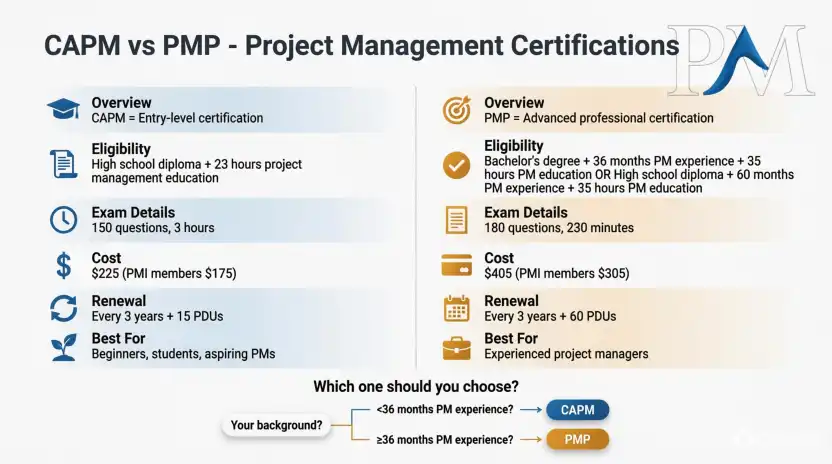
CAPM and PMP are both project management certifications from PMI, but CAPM is designed for people building foundational project management skills, while PMP is aimed at professionals with substantial project leadership experience.
Choosing between them depends mainly on your experience, career stage, and professional goals.
The confusion is common because both certifications cover project management and are recognized across many industries. Their names are also similar, yet they serve different purposes. CAPM stands for Certified Associate in Project Management, while PMP stands for Project Management Professional.
If you are a student, career changer, project coordinator, or someone new to project management, CAPM may be the more suitable starting point. If you already lead projects and meet the experience requirements, PMP may provide a stronger professional credential.
This guide explains CAPM vs PMP in simple terms. You will learn the key differences, eligibility requirements, exam structure, career uses, regional considerations, common mistakes, and how to decide which certification fits your situation.
CAPM vs PMP: Featured Snippet and AI Overview
CAPM is best for people who are starting or building a career in project management, while PMP is designed for experienced professionals who have led projects.
while PMP requires qualifying project leadership experience plus project management training or an active CAPM certification. Choose CAPM for a foundation and PMP for advanced professional recognition.
CAPM vs PMP: Quick Answer
The simplest way to understand CAPM vs PMP is this:
- CAPM: Entry-level or foundational project management certification.
- PMP: Professional certification for experienced project leaders.
- CAPM: Does not require professional project leadership experience.
- PMP: Requires qualifying project leadership experience.
- CAPM: A good choice for students, career changers, and new project professionals.
- PMP: A better fit for experienced project managers and professionals leading projects.
Example 1: A student
A university student wants to enter project management but has no professional project leadership experience.
CAPM is usually the better starting point.
Example 2: A project coordinator
A project coordinator has learned project management concepts and wants a recognized credential while building experience.
CAPM can help strengthen the foundation.
Example 3: An experienced project leader
A professional has several years of experience leading projects and wants an advanced project management credential.
PMP is likely the better choice if the eligibility requirements are met.
What Does CAPM vs PMP Mean?
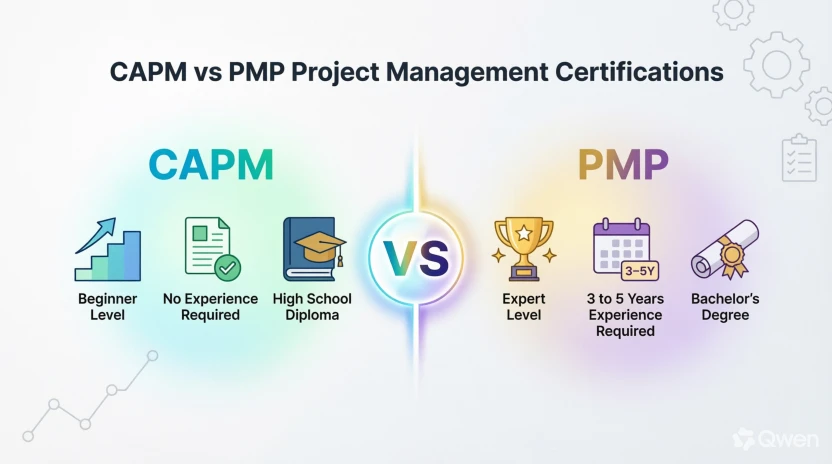
What is CAPM?
CAPM stands for Certified Associate in Project Management.
It is a PMI certification designed to demonstrate foundational knowledge of project management. It can be useful for people entering the field or developing their project management skills.
CAPM is especially relevant to people interested in roles such as:
- Project coordinator
- Junior project manager
- Project analyst
- Project support specialist
- Associate-level project roles
You do not need years of project leadership experience to pursue CAPM. You do need the required education and project management training.
What is PMP?
PMP stands for Project Management Professional.
It is designed for professionals who have already gained meaningful experience leading projects. The certification demonstrates knowledge and practical project leadership skills across different ways of working.
PMP can be relevant to professionals working in:
- Technology
- Construction
- Healthcare
- Finance
- Manufacturing
- Consulting
- Marketing
- Government
- Engineering
The important distinction is experience. CAPM can help you build your foundation, while PMP is intended to validate more advanced professional project leadership.
The Origin of CAPM and PMP
CAPM and PMP were developed by the Project Management Institute (PMI) as part of its professional certification system.
The two credentials developed to serve different stages of a project management career.
CAPM focuses on foundational project management knowledge. PMP focuses on the ability to apply project management knowledge while leading professional projects.
This difference explains why the certifications should not be viewed simply as two versions of the same qualification.
Think of them as two points on a career path:
CAPM → Build knowledge and enter the field → Gain project leadership experience → PMP
Having CAPM does not mean you must eventually earn PMP. However, an active CAPM can also satisfy the project management education requirement for PMP eligibility.
British English vs American English
CAPM and PMP are certification names, not British-versus-American spelling variants. The abbreviations remain the same in both forms of English.
| Term | British English | American English | Example |
| CAPM | CAPM | CAPM | She is preparing for the CAPM exam. |
| PMP | PMP | PMP | He earned his PMP certification. |
| Project management | Project management | Project management | Project management is used across industries. |
| Certification | Certification | Certification | The certification can support career development. |
| Program | Programme is sometimes used in general British English | Program | PMI certification terminology uses its official terminology. |
For official certification names, always follow PMI’s wording rather than changing terms based on regional spelling preferences.
Which Version Should You Use?
Because CAPM and PMP are certifications rather than spelling variants, the better choice depends on your career stage.
United States
If you are in the United States, choose based on experience rather than American English spelling.
- New to project management: consider CAPM.
- Experienced project leader: consider PMP.
- Already eligible for PMP: compare the value of going directly to PMP against earning CAPM first.
United Kingdom
The same basic principle applies in the UK.
Your location does not determine if CAPM or PMP is correct. Your education, project experience, career goals, and eligibility matter more.
Canada
Canadian professionals can use either certification depending on their career stage.
Consider the type of employers and project roles you want. Some organizations may value PMP more strongly for experienced project leadership positions.
Australia
The decision is also experience-based in Australia.
CAPM can provide foundational knowledge, while PMP may be more appropriate when you already have qualifying project leadership experience.
International Writing
When discussing the certifications internationally, use the official names:
- Certified Associate in Project Management (CAPM)
- Project Management Professional (PMP)
Do not translate or alter the certification names unless an official local PMI source does so.
Academic Writing
In academic writing, introduce the full certification name at first mention:
Certified Associate in Project Management (CAPM)
After that, CAPM is usually enough.
Do the same for Project Management Professional (PMP).
Business Writing
In resumes, LinkedIn profiles, emails, and business documents, use the credential exactly as awarded.
For example:
Jane Smith, PMP
or:
Jane Smith, CAPM
Avoid writing a person’s credential as though CAPM and PMP mean the same level of professional experience.
Common Mistakes
Mistake 1: Assuming CAPM and PMP are interchangeable
Incorrect:
“CAPM and PMP are basically the same certification.”
Correct:
“CAPM and PMP are different certifications designed for different career stages.”
Why:
CAPM focuses on foundational knowledge, while PMP requires qualifying project leadership experience.
Memory tip:
CAPM = foundation. PMP = professional experience.
Mistake 2: Thinking CAPM requires years of experience
Incorrect:
“You need several years of project management experience before you can take CAPM.”
Correct:
“CAPM does not require the professional project leadership experience required for PMP.”
Why:
CAPM is designed to support people who are building their project management foundation.
Mistake 3: Assuming everyone should start with CAPM
Incorrect:
“Everyone should earn CAPM before PMP.”
Correct:
“If you already meet PMP eligibility requirements, you may be able to apply directly for PMP.”
Why:
CAPM is not necessarily a required stepping stone to PMP.
Mistake 4: Choosing a certification only because it sounds more advanced
A higher-level credential is not automatically the right first step.
Your certification should match your current experience and career objective.
Everyday Examples
Emails
CAPM example:
I am preparing for the CAPM certification to strengthen my project management foundation.
PMP example:
I recently completed my PMP certification after several years of project leadership experience.
Business Writing
The team is considering CAPM preparation for employees who are new to project management.
The organization prefers PMP-certified professionals for some senior project leadership roles.
News Headlines
CAPM vs PMP: Which Project Management Certification Is Right for You?
Blogs
If you are new to project management, CAPM may provide a useful starting point. Experienced project leaders may want to consider PMP.
Social Media
Thinking about a project management career? Compare CAPM and PMP before choosing your certification path.
Academic Writing
PMI offers both CAPM and PMP certifications, which serve different levels of project management experience.
Daily Conversation
“Should I take CAPM or PMP?”
“If you are new to project management, look at CAPM. If you already have qualifying project leadership experience, check the PMP requirements.”
Google Trends & Modern Usage
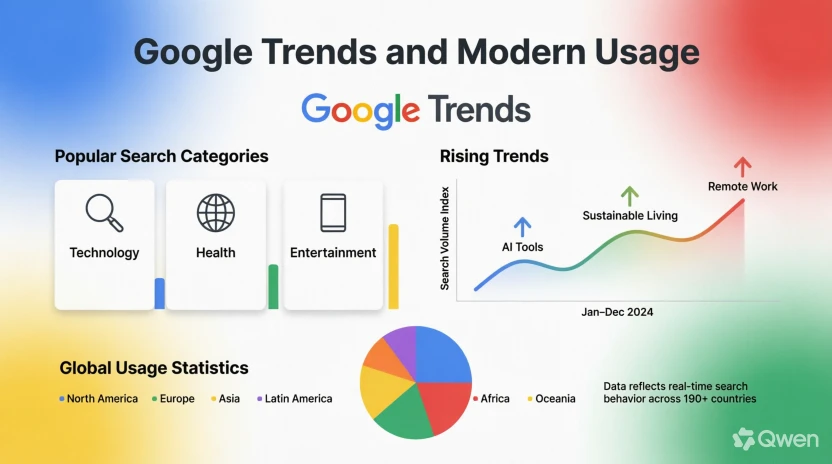
Searches for CAPM or PMP are driven by a practical question: people want to know which certification is worth pursuing for their current career stage.
The two terms often appear together because people compare:
- CAPM vs PMP
- PMP vs CAPM
- CAPM or PMP for beginners
- CAPM or PMP salary
- CAPM or PMP requirements
- CAPM or PMP difficulty
- CAPM or PMP career path
- Is CAPM worth it?
- Is PMP worth it?
Modern project management also spans predictive, agile, and hybrid approaches. This makes certification comparisons more complex than simply asking which exam is harder.
Search interest can also change as PMI updates its certification requirements and exam content. For this reason, candidates should check current PMI information before applying.
Rather than relying on a single trend number or online opinion, look at your own eligibility, experience, target roles, employer expectations, and career plans.
Quick Comparison Table
| Version | Meaning | Correct? | Region | Example |
| CAPM | Certified Associate in Project Management | Yes | International | I am preparing for CAPM. |
| PMP | Project Management Professional | Yes | International | She earned her PMP. |
| CAPM or PMP | Comparison of two PMI certifications | Yes | International | Should I choose CAPM or PMP? |
| PMP or CAPM | Same comparison in reverse order | Yes | International | PMP or CAPM may depend on experience. |
CAPM vs PMP at a Glance
| Factor | CAPM | PMP |
| Full name | Certified Associate in Project Management | Project Management Professional |
| Career stage | Foundational | Experienced professional |
| Professional project leadership experience | Not required | Required |
| Education/training | 23 hours of project management education | 35 hours of project management training, with an active CAPM also satisfying this training requirement |
| Best for | Students, beginners, career changers, project support roles | Experienced project leaders |
| Exam | 150 questions, 180 minutes | 180 questions, 240 minutes |
| Main goal | Build and demonstrate project management knowledge | Demonstrate professional project leadership |
| Certification provider | PMI | PMI |
Key Takeaways
- CAPM and PMP are not the same certification.
- CAPM is designed for people developing foundational project management knowledge.
- PMP is designed for professionals with qualifying project leadership experience.
- CAPM does not require the professional project leadership experience required for PMP.
- An active CAPM can satisfy the project management training requirement for PMP eligibility.
- You do not necessarily need CAPM before applying for PMP.
- Students and beginners may find CAPM more appropriate.
- Experienced project leaders should examine PMP eligibility.
- Always check current PMI requirements before submitting an application.
- The best certification is the one that matches your current career stage.
FAQs
Is CAPM or PMP better?
Neither certification is automatically better for everyone. CAPM is better suited to people building foundational project management knowledge, while PMP is intended for professionals with qualifying project leadership experience.
If you already meet PMP requirements, going directly to PMP may make more sense. If you are new to the field, CAPM can provide a structured starting point.
Is CAPM easier than PMP?
CAPM is generally positioned as a foundational certification, while PMP tests professional project leadership knowledge and requires qualifying experience.
However, “easier” depends on your background, preparation, and familiarity with project management concepts. The two exams also have different structures and eligibility requirements, so difficulty should not be judged by exam length alone.
Can I get PMP without CAPM?
Yes. CAPM is not a mandatory prerequisite for PMP. If you meet one of PMI’s current PMP eligibility paths and satisfy the required training condition, you can apply for PMP directly. An active CAPM can fulfill the PMP project management education requirement, but you do not have to earn CAPM first.
Can CAPM help me get a project management job?
CAPM can help demonstrate that you understand project management concepts, especially when you have limited professional experience.
It may be useful for students, career changers, project coordinators, and people seeking entry-level project roles. However, certification alone does not guarantee employment. Practical skills, communication, education, and work experience also matter.
Do I need project management experience for CAPM?
You do not need the professional project leadership experience required for PMP to qualify for CAPM. PMI requires a secondary degree or global equivalent and project management education. This makes CAPM more accessible to people who are still building professional project experience.
How much project experience is needed for PMP?
PMP eligibility depends on your educational background and professional project leadership experience.
Current PMI pathways include different experience requirements for secondary education, qualifying post-secondary credentials, bachelor’s-level education, and PMI GAC-accredited programs. Because PMI requirements can change, candidates should verify their specific eligibility directly with PMI before applying.
Does CAPM count toward PMP?
An active CAPM certification can satisfy the project management education or training requirement for PMP eligibility. However, CAPM does not replace the professional project leadership experience required for PMP. You still need to meet the applicable PMP experience pathway before you can apply.
Which is better for students, CAPM or PMP?
For most students who do not yet have the professional project leadership experience required for PMP, CAPM is the more realistic option. It can help build project management knowledge and demonstrate interest in the field. After gaining qualifying experience, the student can later consider PMP if it matches their career goals.
Is PMP worth it after CAPM?
It can be. CAPM and PMP serve different stages of a project management career. After earning CAPM, gaining real project leadership experience can make PMP a logical next step. If PMP is worth pursuing depends on your target role, employer expectations, career goals, experience, and the value the credential provides in your industry.
Should I choose CAPM or PMP in 2026?
Choose based on your current eligibility rather than simply choosing the certification with the stronger name. If you are building foundational knowledge and do not have the required PMP experience, CAPM may fit better. If you already have qualifying project leadership experience, review the current PMP requirements and consider applying directly.
Conclusion
CAPM and PMP are both respected PMI certifications, but they are built for different stages of a project management career.
CAPM is a strong option for students, beginners, career changers, and professionals who want to demonstrate foundational project management knowledge. PMP is designed for professionals who already have qualifying experience leading projects.
The biggest difference is not simply the exam. It is the experience behind the credential. CAPM can help you build knowledge and establish a foundation, while PMP is intended to demonstrate professional project leadership.
If you are deciding between CAPM or PMP, start by checking your current education, project experience, career goals, and target job requirements. Do not choose a certification only because it sounds more advanced.
The best project management certification is the one that matches where you are now and where you want your career to go. Before applying, always verify the latest requirements directly with PMI.
Read more about!

I’m Olivia Parker, a grammar and English writing enthusiast passionate about making English simple and easy to understand. Through Wordsblog, I share clear explanations, useful grammar tips, and practical writing guidance to help readers write with confidence. My goal is to make learning English easier, one word at a time.




1 thought on “CAPM vs PMP: Which Project Management Certification Wins?”