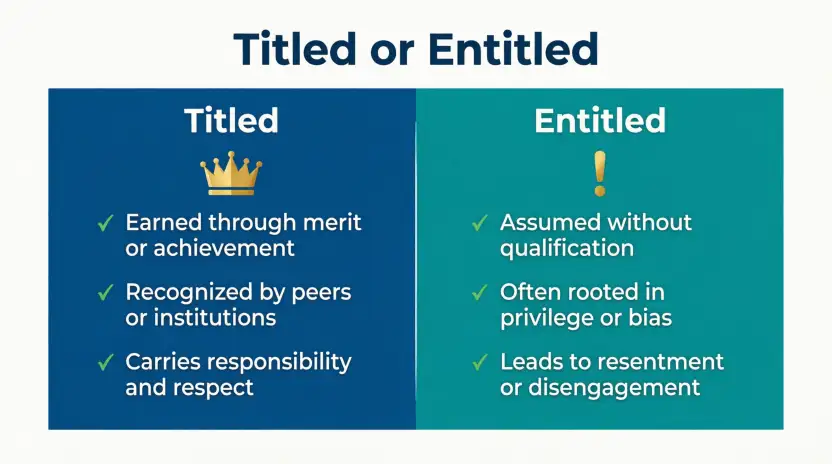
The short answer is: use “titled” when you mean that something has a particular name, and use “entitled” when you mean that someone has a right or claim to something. For example, “She wrote a book titled The Silent Lake” names a book, while “She is entitled to a refund” describes a right.
However, entitled can also mean “given the title of,” so the two words can overlap in some contexts.
The confusion happens because titled and entitled share the same historical root and both can appear before the name of a book, article, film, speech, or song. Modern style guides often recommend titled for clarity, especially in professional and academic writing. Chicago, however, says both are correct when referring to a work’s title.
In this guide, you will learn the difference between titled and entitled, their meanings and origins, regional usage, common mistakes, and how to choose the right word in everyday and formal writing.
Titled or Entitled: Quick Answer
If you are unsure which word to use, this simple rule will help:
- Titled = given a name or title
- Entitled = having a right or claim
- Entitled can also mean “given a title,” but this use may create confusion.
- In most modern professional writing, titled is the safer choice when naming a work.
Examples
Naming a book:
She wrote a novel titled The Last Garden.
Naming an article:
I read an article titled “How to Improve Your Writing.”
Showing a right:
Employees are entitled to paid leave.
Showing a legal or personal claim:
The winner is entitled to the prize.
The key is to look at the meaning, not just the spelling.
What Does Titled or Entitled Mean?
What does “titled” mean?
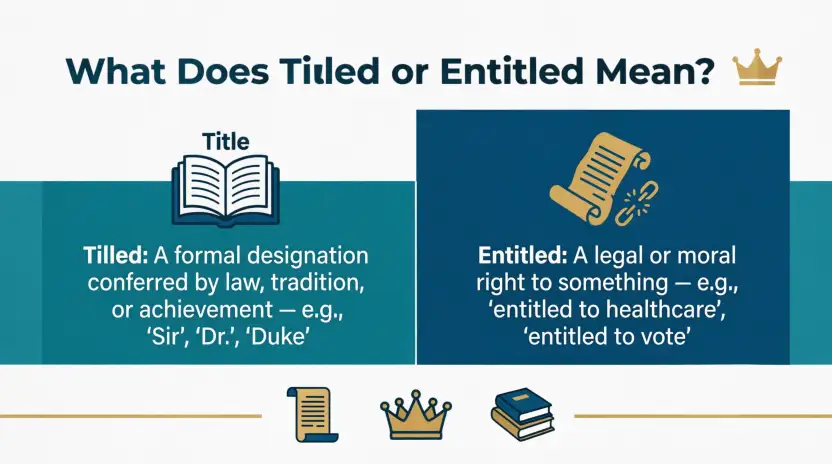
Titled is the past tense and past participle of title. It commonly means that something has been given a particular title or name.
For example:
She published a book titled The Power of Words.
Here, titled tells us the name of the book.
You can use it with:
- Books
- Articles
- Films
- Songs
- Plays
- Speeches
- Lectures
- Research papers
- Paintings
- Other creative or academic works
Examples:
He wrote a paper titled “Climate Change and Cities.”
The documentary is titled Life in the Desert.
What does “entitled” mean?
Entitled has several meanings.
The most common modern meaning is having a right or claim to something.
You are entitled to a refund.
Students are entitled to certain academic services.
She was entitled to receive the payment.
Cambridge lists both major senses of entitle: giving someone a right and giving a title to a book, film, or similar work.
There is also another modern meaning of entitled. It can describe someone who behaves as if they deserve special treatment.
He sounds entitled and expects everyone to help him.
That meaning has nothing to do with the title of a book or article.
Why do they cause confusion?
The confusion comes from the fact that entitle has historically been used to mean “give a title to.” Therefore, sentences such as these can both be found:
The book is titled The Great Journey.
The book is entitled The Great Journey.
Chicago Manual of Style considers both forms correct in this context, but recommends titled as the straightforward choice.
The Origin of Titled or Entitled
The history of these words explains why they look so similar.
The word title entered English through Old French and Latin. The Latin word titulus referred to an inscription, label, heading, or title. The English word title later developed meanings connected with the name of a work, a rank, and a legal claim.
Entitle developed from Anglo-French and ultimately Late Latin intitulare, meaning roughly “to give a title or name to.” The word later developed another important meaning: giving someone a right or claim to something.
This produced two major modern uses:
- To give a title to something
- To give someone a right or claim
That second meaning is why we commonly say:
You are entitled to compensation.
The historical connection explains why entitled can sometimes introduce the title of a work. But modern readers may immediately associate entitled with rights, privileges, or a sense of deserving special treatment.
For that reason, titled is often clearer when you simply want to identify the name of a work.
British English vs American English
There is no major British-versus-American spelling difference between titled and entitled. The main issue is usage and style preference, not spelling.
| Context | British English | American English | Example |
| Name of a book | titled preferred | titled preferred | A book titled The Long Road |
| Name of an article | titled preferred | titled preferred | An article titled “Modern English” |
| Right or claim | entitled | entitled | She is entitled to payment |
| Legal right | entitled | entitled | He is entitled to compensation |
| Acting as if deserving special treatment | entitled | entitled | He seems entitled |
| Naming a creative work | titled is clearer | titled is clearer | A film titled The Journey |
Some British and international publications may still use entitled before the name of a work. Cambridge recognizes this meaning.
At the same time, many American university and editorial style guides specifically recommend titled for works and reserve entitled for rights or claims.
So the safest modern choice is simple: use titled for names and entitled for rights.
Which Version Should You Use?
United States
For American English, titled is usually the best choice when naming a book, article, movie, song, or other work.
She published an article titled “The Future of Education.”
Several U.S. editorial style guides explicitly recommend this distinction.
United Kingdom
British English also accepts entitled in the sense of “given the title of,” but titled is clear and natural.
The novel is titled The Winter Garden.
Canada
For Canadian readers, titled is a safe choice in professional and academic writing.
The report is titled “Economic Growth and Housing.”
Australia
Australian readers will understand both words when entitled is used to mean “given the title of.” Still, titled avoids the possible confusion with rights and privileges.
International Writing
For an international audience, choose titled when you mean “called by this title.”
This makes the sentence easy to understand for ESL learners and readers from different English-speaking regions.
Academic Writing
Titled is especially useful in academic writing:
The study, titled “Language and Social Change,” examines modern communication.
Many university style guides recommend this distinction.
Business Writing
Use titled when naming a report, presentation, proposal, or document:
Please review the report titled “Annual Sales Review.”
Use entitled when describing a benefit or right:
Employees are entitled to annual leave.
Common Mistakes
| Incorrect or Confusing Example | Better Example | Explanation | Memory Tip |
| She is titled to a refund. | She is entitled to a refund. | A refund is a right or claim. | Rights = entitled |
| I read a book entitled Blue Sky. | I read a book titled Blue Sky. | Titled is clearer for a work’s name. | Names = titled |
| The article was titled, “Modern Work.” | The article was titled “Modern Work.” | A comma is normally unnecessary before the title. | No comma after titled |
| He is titled to compensation. | He is entitled to compensation. | Titled to is not the normal expression for a right. | Use “entitled to” |
| The movie was entitled The Journey. | The movie was titled The Journey. | Entitled can work, but titled is clearer. | Prefer clarity |
One especially common mistake is adding a comma after titled:
❌ She wrote a book titled, The Lost City.
✅ She wrote a book titled The Lost City.
Chicago specifically advises omitting that comma.
Everyday Examples
Emails
Please read the attached document titled “Project Guidelines.”
You are entitled to a full refund under the policy.
Business Writing
We received a proposal titled “New Market Strategy.”
Customers are entitled to a replacement if the product is defective.
News Headlines
Author Releases New Book Titled The Hidden World
Workers Entitled to New Benefits Under Agreement
The meanings are very different. The first describes a name. The second describes a right.
Blogs
I recently read a blog post titled “Five Easy Grammar Tips.”
Social Media
Check out my new video titled “How to Study Smarter.”
Academic Writing
The researchers published a paper titled “Language Change in Digital Media.”
Daily Conversation
In casual speech, called is often even more natural:
What is the movie called?
The book is called The Secret Garden.
But titled works well when you want a slightly more formal style.
Google Trends & Modern Usage
People search for “titled or entitled” because both words can appear before the name of a work. This creates a genuine usage question, especially for students, bloggers, editors, and ESL learners.
Modern usage generally favors titled when the goal is simply to identify the name of a book, article, film, speech, or similar work. Dictionary.com notes that titled has become more common for this purpose, while entitled is strongly associated with rights and claims.
However, it would be inaccurate to say that entitled is always grammatically wrong before a title. Cambridge recognizes “give a title to” as a meaning of entitle, and Chicago explicitly says both titled and entitled are correct in this context.
The practical lesson is more useful than a strict “right or wrong” rule:
If you are naming a work, choose “titled” for maximum clarity. If you are talking about a right or claim, use “entitled.”
Quick Comparison Table
| Version | Meaning | Correct? | Region | Example |
| Titled | Given a particular name or title | Yes | All major English varieties | A book titled The River |
| Entitled | Having a right or claim | Yes | All major English varieties | She is entitled to a refund |
| Entitled | Given the title of a work | Yes, but often less clear | International | A novel entitled The River |
| Entitled | Acting as if deserving special treatment | Yes | Modern English | He sounds entitled |
| Titled to | Having a right to something | No, in standard modern usage | All | ❌ Titled to a refund |
The most useful shortcut is:
Titled = title/name.
Entitled = right/claim.
Key Takeaways
- Titled usually means given a particular name or title.
- Entitled most commonly means having a right or claim to something.
- Entitled can also mean “given a title,” so it is not always grammatically wrong before a work’s name.
- Titled is usually clearer when introducing a book, article, film, song, speech, or paper.
- Use the phrase entitled to for rights, benefits, payments, or privileges.
- Do not normally put a comma after titled before the work’s name.
- In academic and business writing, titled is the safer choice for naming a work.
- When speaking casually, called can often replace titled.
FAQs
1. Is “titled” or “entitled” correct for a book?
Titled is the clearest and safest choice when referring to the name of a book. For example, “She wrote a book titled The Lost Garden.” Entitled can also mean “given the title of,” and some dictionaries and style authorities accept it, but titled avoids confusion with the more common meaning of entitled: having a right or claim.
2. Is it correct to say “a book entitled”?
Yes. Entitled can mean “given the title of,” so “a book entitled The Lost Garden” is grammatically possible. However, many modern editors prefer titled because entitled is strongly associated with rights and claims. If you want the clearest wording, especially in academic or business writing, choose titled.
3. What is the difference between titled and entitled?
Titled normally refers to the name given to a work. Entitled most commonly refers to having a right, benefit, or claim. For example, “a film titled Sunrise” names a film, while “She is entitled to compensation” describes a right. The words overlap in one dictionary sense, but their everyday uses are different.
4. Should I say “the article is titled” or “the article is entitled”?
The article is titled is the better general choice. It is direct, clear, and widely recommended by editorial style guides. The article is entitled is not necessarily ungrammatical because entitle can mean “give a title to,” but it can distract readers because entitled usually suggests a right or privilege.
5. Is “entitled to” always about a right?
Usually, yes. Entitled to means that someone has a right, claim, or legitimate expectation to receive or do something. For example, “Employees are entitled to paid leave.” It can refer to legal rights, contractual benefits, or other recognized claims. This is different from using entitled before the name of a book or film.
6. Can “entitled” be used for a movie or song?
Yes. Dictionaries recognize entitled as meaning “given a title,” so “a movie entitled The Journey” can be grammatically correct. However, titled is usually the clearer modern choice: “a movie titled The Journey.” This is especially useful when you want to avoid any possible confusion with the rights-related meaning of entitled.
7. Should there be a comma after “titled”?
Usually, no comma is needed before the title. Write “She wrote a book titled The Silent Lake,” not “She wrote a book titled, The Silent Lake.” Chicago Manual of Style specifically addresses this issue and recommends leaving out the comma in this construction.
8. Is “titled to” correct English?
Not when you mean that someone has a right to something. The standard expression is entitled to. For example, write “You are entitled to a refund,” not “You are titled to a refund.” Titled is normally connected with names or titles, while entitled to expresses a right or claim.
9. Which is better for academic writing, titled or entitled?
Titled is generally the better choice for academic writing when introducing the name of a paper, study, lecture, book, or article. It is concise and clear. Many university style guides recommend this distinction, although Chicago accepts both words when they mean “given a title.”
10. What is an easy way to remember titled vs entitled?
Remember this simple rule: titles are titled, rights are entitled. If you are naming something, use titled. If someone has a right to something, use entitled. For example, “a report titled Annual Results” but “employees are entitled to benefits.” This rule will solve most everyday usage questions.
Conclusion
The difference between titled or entitled is easier once you focus on meaning. Titled is the clearest choice when you are naming a book, article, film, song, speech, research paper, or other work. Entitled is most often used when someone has a right, claim, benefit, or privilege.
There is one important detail: entitled is not always wrong before a title. Dictionaries recognize its older and continuing meaning of “given a title,” and the Chicago Manual of Style accepts both titled and entitled in that context. Still, many modern style guides prefer titled because it removes ambiguity.
For general, academic, business, and online writing, the safest approach is simple. Write “a book titled…” when you are naming a work, and “someone is entitled to…” when you are describing a right.
Remember: when you mean a name, choose “titled”; when you mean a right, choose “entitled.”
Read more about!
- Triple or Tripple: Which Spelling Is Correct?
- Trailor or Trailer: Which Spelling Is Correct?
- Mucinex or Robitussin: Which Is Better?

I’m Olivia Parker, a grammar and English writing enthusiast passionate about making English simple and easy to understand. Through Wordsblog, I share clear explanations, useful grammar tips, and practical writing guidance to help readers write with confidence. My goal is to make learning English easier, one word at a time.




3 thoughts on “Titled or Entitled: Which Word Should You Use?”