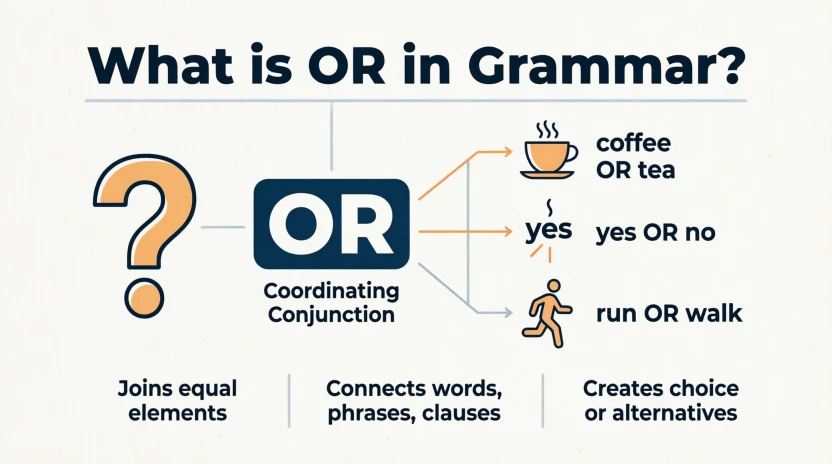
The word “or” is a conjunction used to show a choice, an alternative, or another possibility. For example, in the sentence “Would you like tea or coffee?” the word “or” connects two choices. Understanding what “or” means can help you write clearer sentences and avoid common grammar mistakes.
People often search for “whats an or” because they want to understand the meaning of “or,” how to use it in a sentence, or how it differs from other connecting words. The word looks simple, but it can express several ideas. It can offer a choice, present an alternative, or introduce a possible result.
In English grammar, “or” belongs to a group of words called conjunctions. These words connect words, phrases, and clauses. The word “or” is especially useful when you want to give someone options or explain that one of two possibilities may happen.
In this guide, you will learn what “or” means, where it comes from, how to use it in British and American English, and which mistakes to avoid. You will also find clear examples for everyday conversations, emails, academic writing, and business communication.
What’s an “Or” in Grammar? Quick Answer
The word “or” is a coordinating conjunction that connects two or more words, phrases, or clauses to express a choice or alternative. For example, “You can walk or take the bus.” It can also show possibilities, as in “Hurry up, or you will miss the train.” Its exact meaning depends on the sentence.
“Or” Meaning: A Simple Explanation
The word “or” usually introduces another option or possibility. It helps readers understand that a choice exists between two or more things.
Here are three common examples:
- Choice: Would you like coffee or tea?
- Alternative: You can call me or send an email.
- Possible consequence: Leave now, or you may be late.
In each sentence, “or” connects ideas. However, the relationship between those ideas changes with the context.
What Is the Definition of “Or”?
In English grammar, “or” is a coordinating conjunction. A coordinating conjunction joins words, phrases, or clauses that have a similar grammatical role.
The main coordinating conjunctions are often remembered through the acronym FANBOYS:
- For
- And
- Nor
- But
- Or
- Yet
- So
The word “or” generally presents an alternative. Depending on the sentence, it can mean one option, another option, or a possible outcome.
The Three Main Uses of “Or”
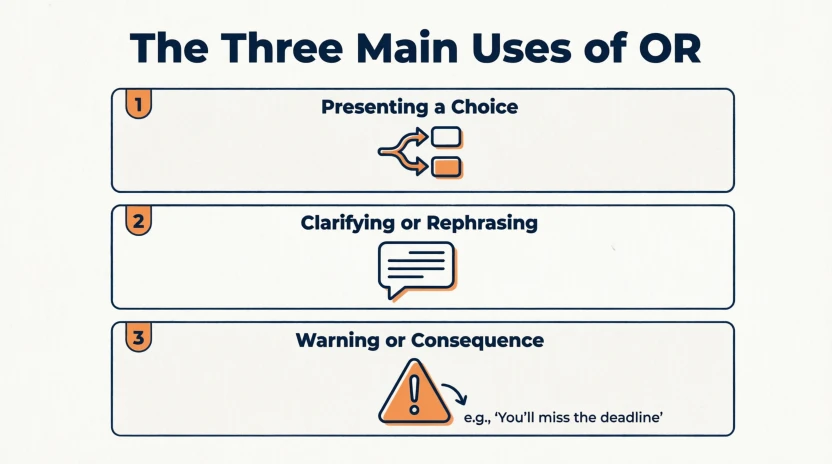
1. To offer a choice
Use “or” when someone must choose between options.
Example: You can have rice or potatoes with your meal.
2. To present an alternative
Use “or” when one action or possibility can replace another.
Example: Please email the form or bring a printed copy.
3. To show a warning or possible result
Use “or” to connect an action with a possible consequence.
Example: Wear a coat, or you might get cold.
The context tells the reader how to understand the connection.
The Origin of the Word “Or”
The word “or” has a long history in English. It developed from older forms of the language and has been used to express alternatives for centuries.
The English word comes from Old English othþe, also written in related forms such as oþþe, which meant “or” or “either.” Its history is connected to older Germanic languages.
Over time, the spelling and form changed as English developed. The modern word “or” became the standard form used in present-day English.
The word’s basic purpose has remained much the same: it helps people express alternatives and choices.
It is important to distinguish the history of “or” from the modern abbreviation “OR.” The abbreviation may have a different meaning depending on the subject. For example, in a hospital, OR commonly stands for “operating room.” In grammar, however, “or” is a conjunction.
British English vs. American English
There is no important spelling difference between the conjunction “or” in British English and American English. Both varieties use the same word with the same basic meaning.
| Feature | British English | American English | Example |
| Spelling | or | or | Tea or coffee? |
| Grammar | Coordinating conjunction | Coordinating conjunction | Read or write. |
| Basic meaning | Choice or alternative | Choice or alternative | Bus or train? |
| Formal writing | Standard | Standard | Contact us by phone or email. |
| Punctuation | Depends on sentence structure and style | Depends on sentence structure and style | Apples, pears, or grapes. |
Is “Or” Used Differently in British and American English?
The word itself does not change between the two varieties. Differences may appear in punctuation, sentence style, or the vocabulary surrounding it.
For example:
- British English: Would you like a biscuit or a cake?
- American English: Would you like a cookie or a cake?
The word “or” works the same way in both examples. The difference is in the regional vocabulary.
Should You Use a Comma Before “Or”?
A comma before “or” is not always necessary.
When “or” connects two short words or phrases, a comma is usually unnecessary.
Example: You can choose red or blue.
When it connects two independent clauses, a comma is often appropriate.
Example: You can take the train, or you can drive.
When listing three or more items, the final comma before “or” is called the Oxford comma or serial comma.
Example: We offer tea, coffee, or juice.
British and American style guides differ in their preferences for the serial comma. Follow the style guide required by your school, publisher, or workplace.
Which Version Should You Use?
Because “or” is the standard spelling in English, you do not need to choose between British and American versions. The main task is to use it correctly in the sentence.
United States
Use “or” in everyday writing, professional communication, schoolwork, and formal documents.
Example: Please select a payment method: card or bank transfer.
United Kingdom
Use “or” in the same way. British spelling does not replace “or” with another form.
Example: Would you prefer a train or a coach?
Canada
Canadian English also uses “or.” Follow the punctuation and spelling conventions required by your organization or publication.
Example: You can submit the application online or by post.
Australia
Australian English uses “or” to express choices and alternatives.
Example: Bring your own lunch or buy something nearby.
International Writing
Use “or” when writing for readers from different countries. It is a standard English word and is easy for most English readers to understand.
When your audience speaks English as a second language, keep the sentence short and make the available choices clear.
Academic Writing
Use “or” to describe alternatives, research methods, categories, and possible explanations.
Example: Participants could complete the survey online or on paper.
In academic writing, make sure your use of “or” does not create ambiguity. If you mean that both options are allowed, explain that clearly.
Business Writing
Use “or” to explain options, deadlines, services, and procedures.
Example: Please contact the support team by phone or email.
For contracts and policies, be precise about if the choices are exclusive or if multiple options are permitted.
Common Mistakes When Using “Or”
The word “or” is simple, but some sentence structures can confuse readers. Here are common mistakes and ways to correct them.
| Incorrect Example | Correct Example | Explanation |
| Would you like tea and coffee? (when offering one choice) | Would you like tea or coffee? | Use “or” when offering alternatives. |
| You can either call and email me. | You can either call or email me. | The usual paired structure is “either … or.” |
| Neither John or Mary attended. | Neither John nor Mary attended. | Use “neither … nor” in standard paired constructions. |
| Hurry, and you will miss the bus. (when warning someone to hurry) | Hurry, or you will miss the bus. | “Or” introduces the unwanted possible result. |
| Do you want apples, oranges or? | Do you want apples, oranges, or bananas? | Complete the list of options. |
Mistake 1: Confusing “And” With “Or”
“And” usually adds information, while “or” presents alternatives.
- And: I bought bread and milk.
- Or: Would you like bread or milk?
Memory tip: Think of “and” as adding and “or” as offering options.
Mistake 2: Using “Either” Without “Or”
In standard paired constructions, “either” is usually followed by “or.”
Incorrect: You can either stay here.
Better: You can either stay here or come with us.
The word “either” can also be used independently in other sentence patterns, but when presenting two paired choices, “either … or” is the usual structure.
Mistake 3: Confusing “Or” With “Nor”
“Or” presents alternatives. “Nor” is commonly used after “neither” to connect negative alternatives.
Example: Neither the manager nor the assistant was available.
Memory tip: Remember the pair “either … or” and the pair “neither … nor.”
Mistake 4: Making the Meaning Unclear
A sentence can be grammatically correct but still leave readers unsure about their options.
Unclear: You can choose a notebook or a pen and pencil.
Clearer: You can choose a notebook or a set containing a pen and pencil.
Make sure readers can identify exactly what each option includes.
Everyday Examples of “Or”
The best way to understand “or” is to see how people use it in different situations.
1. Daily Conversation
- Would you like water or juice?
- Should we walk or take a taxi?
- Is your appointment today or tomorrow?
These sentences offer choices in ordinary conversation.
2. Emails
- Please reply by email or phone.
- Would you prefer Monday or Tuesday for the meeting?
- You can attach the document or share a link.
In emails, “or” helps explain available actions without adding unnecessary words.
3. Business Writing
- Customers can pay by card or bank transfer.
- Contact the sales team or customer support.
- Submit the report by Friday, or request an extension.
The final example uses “or” to show a possible alternative involving a deadline.
4. News Headlines
- City Council to Approve or Reject New Housing Plan
- Rain or Sunshine Expected This Weekend
- Team Must Win or Face Elimination
Headlines often omit words to save space. The conjunction “or” still presents alternatives.
5. Blogs
- Learn the Difference Between Affect or Effect
- Should You Choose a Laptop or a Tablet?
- Read Our Guide or Ask an Expert
For grammar and writing articles, remember that “affect or effect” may be useful as a search phrase, but the full sentence must still be grammatically correct.
6. Social Media
- Coffee or tea? Tell us your choice.
- Summer or winter? Which season do you prefer?
- Comment below or send us a message.
The word makes questions and calls to action short and clear.
7. Academic Writing
- The results may reflect age or income differences.
- Students may submit a written report or give a presentation.
- The pattern could be explained by chance or by a measurement error.
In academic writing, use “or” carefully when the distinction between options affects the meaning of your argument.
Google Trends and Modern Usage
The phrase “whats an or” may reflect a reader’s attempt to ask what the word “or” means. However, the phrase can also refer to “OR” as an abbreviation in a specific subject.
It is important not to assume that every search containing “OR” has the same meaning.
Why Do People Search for “What’s an Or”?
There are several possible reasons:
- They want a simple definition of “or.”
- They are learning English grammar.
- They want examples of conjunctions.
- They have seen “OR” in a medical, technical, or professional context.
- They are unsure how “or” differs from “and,” “either,” or “nor.”
These are plausible explanations based on the phrase and common language questions. They are not verified search-volume findings.
Is “Or” Common in Modern English?
Yes. “Or” is a standard, everyday English conjunction used in speech and writing.
It appears in questions, instructions, lists, advertisements, academic papers, and business communication. It is not limited to a particular country or age group.
Exact regional search popularity for the phrase “whats an or” would need to be checked using Google Trends or another keyword research tool. Without that data, it would be misleading to claim that one region searches for it more than another.
Why Does Capitalization Matter?
The lowercase word “or” usually functions as a conjunction in a sentence.
The uppercase form “OR” can be an abbreviation or a technical term. Its meaning depends on the context.
For example:
- Grammar: Do you want tea or coffee?
- Medicine: The patient was taken to the OR, meaning the operating room.
- Computing: OR is a logical operator used to combine conditions.
When a reader searches for “what’s an OR,” the subject may help identify the intended meaning.
Quick Comparison Table
| Version | Meaning | Correct? | Region | Example |
| or | A conjunction expressing an alternative | Yes | All major English varieties | Tea or coffee? |
| and | A conjunction that usually adds information | Yes, when addition is intended | All major English varieties | Tea and coffee |
| either … or | A paired construction presenting alternatives | Yes | All major English varieties | Either call or email |
| neither … nor | A paired construction presenting two negative alternatives | Yes | All major English varieties | Neither rain nor snow |
| OR | An abbreviation or technical term | Yes, when the context supports it | Depends on the field | The operating room |
The main distinction is that “or” is a normal English word, while “OR” may have a specialized meaning when written in capital letters.
Key Takeaways
- “Or” is a coordinating conjunction.
- It usually expresses a choice, alternative, or possible result.
- It connects words, phrases, and clauses.
- British, American, Canadian, and Australian English all use “or.”
- “Either … or” is a common structure for presenting alternatives.
- “Neither … nor” is the usual paired construction for negative alternatives.
- Use “or” instead of “and” when you mean to offer a choice.
- The capitalized form “OR” can have a specialized meaning, such as “operating room” in medicine.
FAQs About “Or”
1. What does “or” mean in English?
“Or” is a conjunction that usually introduces a choice or alternative. For example, “Would you like tea or coffee?” asks someone to choose between two drinks. It can also connect possibilities or introduce a possible consequence, as in “Hurry, or you will miss the bus.”
2. Is “or” a conjunction?
Yes. “Or” is a coordinating conjunction. It connects words, phrases, or clauses that have a similar grammatical role. For example, in “You can read or write,” the word connects two verbs. In “Would you like tea or coffee?” it connects two nouns.
3. What is an example of “or” in a sentence?
An example is “You can take the bus or walk to school.” The word “or” presents two possible ways to travel. Another example is “Call me, or send me a message.” Here, it presents two ways to contact someone.
4. What is the difference between “and” and “or”?
“And” usually adds things together, while “or” usually presents alternatives. For example, “I bought bread and milk” means both items were bought. “Would you like bread or milk?” offers a choice. The exact meaning depends on the context, but this distinction works for most everyday sentences.
5. Is “or” the same in British and American English?
Yes. The word “or” has the same spelling and basic grammatical function in British and American English. Differences may appear in surrounding vocabulary or punctuation preferences, such as the use of the Oxford comma in lists. The conjunction itself does not change between the two varieties.
6. What is the difference between “either or” and “neither nor”?
“Either … or” presents alternatives, while “neither … nor” connects two negative alternatives. For example, “You can either stay or leave” presents two options. “Neither John nor Sarah attended” means that John and Sarah both did not attend.
7. Can “or” start a sentence?
Yes. A sentence can begin with “Or” when it connects naturally to an idea in the previous sentence or introduces another possibility. For example: “We could take the train. Or we could drive.” This is common in informal and conversational writing. In formal writing, make sure the connection between sentences is clear.
8. Should there be a comma before “or”?
It depends on the sentence. A comma is generally not needed when “or” connects two short words, as in “tea or coffee.” A comma is often used when it joins two independent clauses, as in “You can call me, or you can send an email.” Follow your required style guide.
9. What does “OR” mean in a hospital?
In a hospital, “OR” commonly stands for “operating room,” the room where surgical procedures take place. This is different from the lowercase conjunction “or” used in grammar. Capitalization and context help readers understand which meaning is intended.
10. Is “or” a preposition or a conjunction?
“Or” is a conjunction, not a preposition. A conjunction connects words, phrases, or clauses. A preposition typically expresses a relationship involving a noun or pronoun, such as “in,” “under,” or “with.” In “Would you like tea or coffee?” the word “or” connects two nouns.
Conclusion
The word “or” is a small but important part of English grammar. It is a coordinating conjunction that connects words, phrases, and clauses to express choices, alternatives, and possible outcomes. You can use it in everyday conversation, emails, business documents, academic writing, and many other forms of communication.
The most important rule is to understand the relationship between the ideas you are connecting. Use “or” when presenting alternatives, “and” when adding information, and “neither … nor” when connecting negative alternatives. In paired constructions, “either … or” is also a useful pattern.
The word is spelled and used in the same basic way in British, American, Canadian, and Australian English. However, capitalized “OR” can have a separate meaning in fields such as medicine and computing, so context matters.
For clear writing, keep your options easy to understand and use punctuation that fits the sentence. If you want to improve your English grammar, explore more word meanings and practical examples on Wordsblog.
Remember: “And” adds, while “or” offers an alternative.
Read more about!
- Vizio vs. TCL: Which TV Brand Is Better?
- Goedert or Kincaid: Who Should You Start in 2026?
- Sudafed or DayQuil: Which Is Better for a Cold?

I’m Olivia Parker, a grammar and English writing enthusiast passionate about making English simple and easy to understand. Through Wordsblog, I share clear explanations, useful grammar tips, and practical writing guidance to help readers write with confidence. My goal is to make learning English easier, one word at a time.