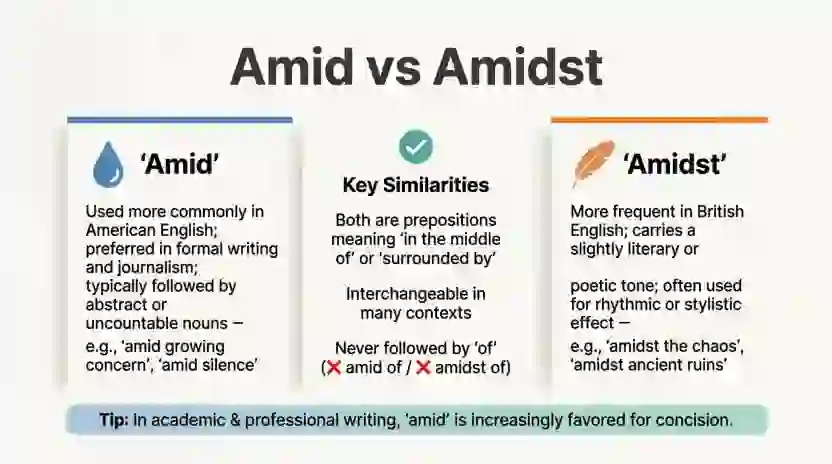
Amid and amidst have almost the same meaning, and both are correct English words. They mean “in the middle of,” “surrounded by,” or “during” something. The main difference is style: amid is shorter and often preferred in modern writing, while amidst can sound more formal, traditional, or literary.
Many people search for “amidst or amid” because they are unsure which word to use in an email, school assignment, news article, or everyday conversation. Some writers believe that amidst is British English and amid is American English. However, this is not a strict rule. Both forms are used in British and American English.
Choosing between them is usually a matter of tone and personal preference, not grammar. For example, you can write “amid the confusion” or “amidst the confusion” without changing the basic meaning.
In this guide, you will learn what each word means, where the words came from, how writers use them, and which form works best in different situations. You will also see practical examples, common mistakes, and simple tips to help you choose the right word.
Amidst or Amid: Quick Answer
Both amid and amidst are correct. You can use either word when describing something happening during an event or surrounded by people, objects, or circumstances.
Examples:
- Amid: The team remained calm amid the crisis.
- Amidst: The team remained calm amidst the crisis.
- Amid: She found peace amid the noise.
The meaning stays almost the same in all three sentences.
Here is a simple way to remember the difference:
- Use amid for concise, straightforward writing.
- Use amidst when you prefer a more traditional or literary tone.
- Use either word in British or American English.
You do not need to memorize two separate definitions. The important thing is to understand the context and choose the word that sounds natural in your sentence.
What Does Amid Mean?
Amid is a preposition. It describes something that happens in the middle of an event, situation, or group, or something surrounded by other things.
It can refer to physical surroundings, emotions, events, or difficult circumstances.
1. Amid Meaning and Definition
The word amid generally means:
- In the middle of something.
- Surrounded by something.
- During a particular event or situation.
For example:
“The children played amid the flowers.”
This means the children played among the flowers or were surrounded by them.
Another example is:
“The company continued to grow amid economic uncertainty.”
Here, amid means that the company continued to grow during a period of economic uncertainty.
2. How to Use Amid in a Sentence
Use amid before a noun or noun phrase.
Examples:
- The announcement came amid growing concerns.
- She stayed focused amid the distractions.
- The town remained peaceful amid the storm.
- He smiled amid the celebrations.
In each sentence, amid connects an action or situation with its surrounding conditions.
3. Is Amid Formal or Informal?
Amid works well in formal and neutral writing. You will often see it in news reports, business articles, academic discussions, and everyday written English.
It is also useful when you want to keep a sentence short and clear.
For example:
“The decision was made amid public criticism.”
This sentence sounds natural in a news report or business document.
What Does Amidst Mean?
Amidst is also a preposition. It has almost the same meaning as amid and can replace it in most sentences without changing the message.
The main difference is tone. Some readers find amidst more traditional, expressive, or literary.
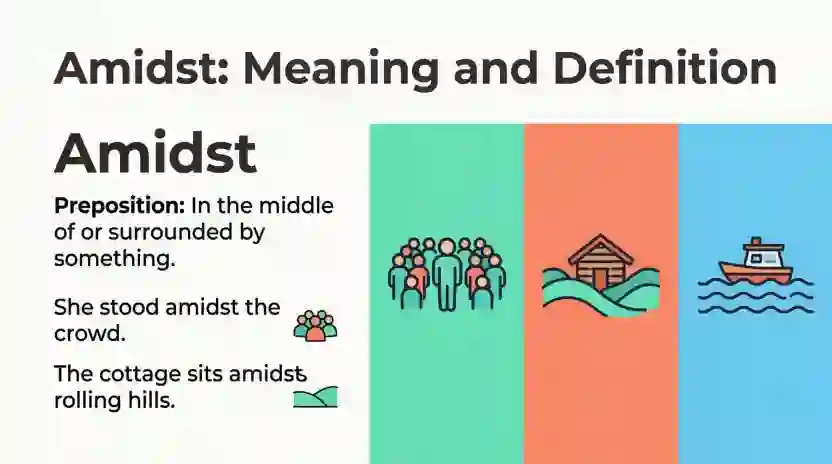
1. Amidst Meaning and Definition
The word amidst means:
- In the middle of something.
- Surrounded by something.
- During a particular situation or event.
For example:
“She stood amidst the crowd.”
This means she stood among or was surrounded by the crowd.
You could write “She stood amid the crowd” instead. Both sentences are correct.
2. How to Use Amidst in a Sentence
Like amid, amidst usually comes before a noun or noun phrase.
Examples:
- The village rested amidst green hills.
- He remained hopeful amidst the difficulties.
- The singer performed amidst loud applause.
- The family gathered amidst the holiday decorations.
These examples show that amidst can describe physical surroundings, emotions, and events.
3. Is Amidst More Formal?
Amidst can sound more formal or literary to some readers, but it is not limited to formal writing.
You may use it in creative writing, descriptive passages, personal essays, and ordinary sentences.
For example:
“Amidst the silence, she heard a distant bell.”
This sentence has a slightly literary feel. However, “Amid the silence” is equally correct.
Choose amidst when it fits your voice, not because you believe it is required for good writing.
The Origin of Amid and Amidst
The history of amid and amidst helps explain why the words look and sound so similar.
Where Did Amid Come From?
Amid developed from earlier English forms associated with the idea of being in the middle of something. Its history is connected to the word mid, which refers to the middle.
Over time, amid became an established preposition used to describe position, surroundings, and circumstances.
Today, it appears in expressions such as:
- Amid the debate
- Amid the crowd
- Amid growing concerns
- Amid the celebrations
These phrases show how the word can describe both physical surroundings and events.
Where Did Amidst Come From?
Amidst developed as a variant of amid, with the ending -st appearing in older English forms.
Similar endings occur in other English words, such as amongst and whilst. These forms have remained in use, although their popularity and style may vary by region and context.
The ending does not give amidst a separate meaning. Both words still express the idea of being in the middle of something or surrounded by something.
Why Are Both Words Still Used?
English often keeps multiple words with similar meanings. Some become more common in everyday speech, while others remain popular in particular styles or expressions.
That is why both amid and amidst remain correct today.
The choice is mainly about tone, rhythm, and preference rather than a difference in grammar.
British English vs American English
Both amid and amidst are accepted in British and American English. It is inaccurate to say that one belongs exclusively to the United Kingdom and the other exclusively to the United States.
| British English | American English | Example |
| Amid is correct | Amid is correct | The decision came amid controversy. |
| Amidst is correct | Amidst is correct | The decision came amidst controversy. |
| Both forms are used | Both forms are used | She remained calm amid the confusion. |
| Either form may suit formal writing | Either form may suit formal writing | The event took place amidst uncertainty. |
Regional Differences
In both countries, amid is a familiar choice in news reporting and concise prose. Amidst also appears in published writing, especially when the writer prefers a more traditional or descriptive tone.
Individual preferences vary. The subject, publication, and sentence often matter more than the writer’s country.
What Do Style Guides Recommend?
There is no universal rule requiring writers to choose amid or amidst based on nationality.
Many editorial decisions focus on consistency, clarity, and the publication’s preferred style. If your school, employer, or publisher has a house style guide, follow it.
If no rule exists, amid is a practical default for concise modern writing. However, you should not automatically change amidst when it fits your sentence.
Which Version Should You Use?
The best choice depends on your audience, purpose, and preferred writing style. Here are practical recommendations for different settings.
United States
Use either amid or amidst. For straightforward articles, reports, and business writing, amid is a useful default because it is concise.
Example: “The company announced changes amid rising costs.”
United Kingdom
Both forms are correct in British English. You can use amid for direct writing and amidst when you prefer a more traditional or descriptive tone.
Example: “The village lay amidst rolling hills.”
Canada
Canadian writers can use either form. Choose the word that suits the publication’s style and use it consistently.
Example: “The agreement was reached amid lengthy negotiations.”
Australia
Both forms are acceptable in Australian English. In professional writing, clarity matters more than choosing one form over the other.
Example: “The project continued amid delays.”
International Writing
For international audiences, amid is a practical choice because it is short and widely understood.
Example: “The school remained open amid the disruption.”
However, amidst is also understandable and correct.
Academic Writing
In academic writing, choose the word that makes your sentence clear and fits your discipline’s style.
Example: “The findings emerged amid ongoing debate.”
Avoid changing words simply to make a sentence sound more complicated. Simple, precise language is often more effective.
Business Writing
Use amid as a convenient default in reports, emails, proposals, and company updates.
Example: “The business introduced new policies amid market uncertainty.”
You may still use amidst if it matches your company’s established style. The key is to keep the message professional and easy to understand.
Common Mistakes With Amid and Amidst
Although both words are correct, writers sometimes misunderstand their meanings or use them in awkward sentences.
| Incorrect or awkward example | Correct example | Explanation |
| The team amid the crisis. | The team worked amid the crisis. | The sentence needs a complete thought. |
| She felt happy amidst of the chaos. | She felt happy amidst the chaos. | Do not add “of” after amidst. |
| He remained calm amid of the noise. | He remained calm amid the noise. | Amid does not need “of.” |
| Amidst to the storm, they left. | Amid the storm, they left. | Use a noun phrase after the preposition. |
| Amid and amidst have completely different meanings. | Amid and amidst have nearly the same meaning. | Their meanings substantially overlap. |
Mistake 1: Adding “Of”
A common error is writing “amid of” or “amidst of.”
Both forms are incorrect in standard English.
Write:
- Amid the noise
- Amidst the noise
Do not write “amid of the noise.”
Mistake 2: Thinking One Word Is Wrong
Some writers believe amidst is outdated or that amid is incorrect in British English. Neither belief is a reliable grammar rule.
Both words remain valid. Your choice should depend on the sentence and the style you want.
Mistake 3: Using the Wrong Sentence Structure
Amid and amidst are prepositions. They normally introduce a noun or noun phrase.
Correct: “She remained confident amid the uncertainty.”
Incorrect: “She remained confident amidst she was uncertain.”
A better alternative is: “She remained confident even though the future was uncertain.”
Memory Tip
Remember this simple rule: Amid and amidst mean nearly the same thing, and neither needs “of” after it.
If you are unsure, try replacing the word with “during” or “surrounded by.” If the sentence still makes sense, your choice may be correct.
Everyday Examples of Amid and Amidst
These examples show how both words work in different situations.
| Context | Example with amid | Example with amidst |
| Emails | The meeting was rescheduled amid staff shortages. | The meeting was rescheduled amidst staff shortages. |
| Business writing | The firm expanded amid market uncertainty. | The firm expanded amidst market uncertainty. |
| News headlines | Leaders meet amid growing tensions. | Leaders meet amidst growing tensions. |
| Blogs | Find calm amid your busy routine. | Find calm amidst your busy routine. |
| Social media | Staying positive amid the chaos. | Staying positive amidst the chaos. |
| Academic writing | The results appeared amid ongoing debate. | The results appeared amidst ongoing debate. |
| Daily conversation | We talked amid the noise. | We talked amidst the noise. |
Examples in Emails
“Thank you for your patience amid the recent changes.”
This sounds professional and direct. You could use amidst instead without changing the meaning.
Examples in Business Writing
“The company maintained its service amid supply chain delays.”
This sentence explains what happened during a difficult period.
Examples in News Headlines
“New Policy Announced Amid Public Debate”
News headlines often favor short wording. Amid works well because it is concise, although amidst is also grammatically correct.
Examples in Blogs
“Five Ways to Stay Focused Amid Daily Distractions”
This heading is direct and easy to scan. It also shows how amid can connect an action with the circumstances surrounding it.
Examples in Social Media
“Finding joy amidst the little things.”
This sentence uses amidst in a descriptive, personal style. It is suitable for a caption or reflective post.
Examples in Academic Writing
“The researchers collected responses amid growing public interest.”
This construction describes the circumstances in which the research took place.
Examples in Daily Conversation
“I could barely hear you amid all that noise.”
This is a natural sentence. You could also say “amidst all that noise,” though some speakers may find amid more conversational.
Google Trends and Modern Usage
People search for “amidst or amid” because the two words look different but have nearly identical meanings. They may want to know if one is incorrect, if British and American English use different forms, or which version sounds more natural.
Which Word Is More Popular?
Amid is a practical choice in much contemporary news and professional writing because it is concise. Amidst remains in use, particularly in descriptive and literary contexts.
However, these observations do not establish exact search volumes or a measured difference in popularity.
Without checking current Google Trends data for a defined region and period, it would be misleading to claim that one word has a specific percentage advantage or a precise search-volume lead.
Why Do People Search for This Difference?
The main reasons include:
- Uncertainty about if both words are grammatically correct.
- Confusion about British and American spelling or usage.
- Questions about formal and informal writing.
- A desire to improve sentence flow.
- The belief that the extra -st changes the meaning.
The final point is especially important: amidst does not normally communicate a different meaning from amid.
What Should Modern Writers Choose?
For most general writing, amid is a safe default. It is short, clear, and suitable for professional and everyday contexts.
Use amidst when you prefer its sound or when it suits a descriptive passage. Do not treat the choice as a strict grammar test.
Quick Comparison Table
| Version | Meaning | Correct? | Region | Example |
| Amid | In the middle of; during | Yes | British and American English | She stayed calm amid the confusion. |
| Amidst | In the middle of; during | Yes | British and American English | She stayed calm amidst the confusion. |
| Amid of | Intended to mean “in the middle of” | No | Not standard English | Write “amid the confusion.” |
| Amidst of | Intended to mean “in the middle of” | No | Not standard English | Write “amidst the confusion.” |
Key Takeaways
- Amid and amidst are both correct English words.
- Both mean “in the middle of,” “surrounded by,” or “during.”
- Neither word is exclusive to British or American English.
- Amid is a useful choice for concise, modern writing.
- Amidst may sound more traditional, descriptive, or literary.
- Do not write “amid of” or “amidst of” in standard English.
- Both words normally come before a noun or noun phrase.
- Choose the word that sounds natural and follow your publication’s style guide.
FAQs About Amidst or Amid
1. Is Amidst or Amid Correct?
Both amidst and amid are correct in standard English. They have nearly identical meanings and can replace each other in most sentences. The choice is usually stylistic rather than grammatical. Use amid for concise wording or amidst when you prefer its more traditional or literary tone.
2. What Is the Main Difference Between Amid and Amidst?
The main difference is style, not meaning. Both words describe something happening during an event or surrounded by something. Amid is often a convenient choice in concise writing, while amidst can sound more traditional or expressive. Neither word is inherently more correct than the other.
3. Is Amid American English and Amidst British English?
No. Both words are used in British and American English. Although individual writers and publications may prefer one form, there is no strict rule assigning amid to the United States and amidst to the United Kingdom. Choose the form that suits your audience and writing style.
4. Is Amid More Formal Than Amidst?
Not necessarily. Both words can appear in formal writing. Amid often sounds direct and concise, while amidst may sound more traditional or literary to some readers. The formality of a sentence depends on the full context, not just this one word.
5. Can I Use Amidst in Academic Writing?
Yes. Amidst is grammatically acceptable in academic writing when it fits the sentence. However, amid may be a simpler choice in concise academic prose. Follow your institution’s or publisher’s style guide if it specifies a preference. Above all, make sure your wording is clear and precise.
6. Is Amidst Outdated English?
No. Amidst is still used in modern English. Some readers associate it with traditional or literary writing, but that does not make it incorrect or obsolete. You can use it in contemporary writing whenever it sounds natural and suits your intended tone.
7. Should I Use Amid or Amidst in a Sentence?
Use either word if it fits the sentence. For example, “The team continued working amid the delays” and “The team continued working amidst the delays” are both correct. If you want a simple default for general and professional writing, choose amid.
8. Can I Say “Amid of” or “Amidst of”?
No. In standard English, write amid the storm or amidst the storm, without “of.” Both words already express the relationship between an event and its surrounding circumstances. Adding “of” creates an incorrect construction in this context.
9. Do Amid and Amidst Have the Same Meaning?
Yes, in most everyday contexts. Both can mean “in the middle of,” “surrounded by,” or “during.” For example, “amid the celebrations” and “amidst the celebrations” express essentially the same idea. Any difference usually comes from tone, rhythm, or personal preference.
10. Which Word Is Better for SEO Content?
Either word can work in SEO content. Choose the version that best matches the reader’s query and write naturally. For clear, concise articles, amid is a sensible default. Avoid repeating both forms unnecessarily just to target keywords. Helpful explanations, accurate examples, and clear headings matter more than keyword repetition.
Conclusion
Choosing between amidst and amid is simple once you understand that both words are correct. They mean nearly the same thing and describe something that happens in the middle of an event, during a situation, or surrounded by other things.
The main difference is the tone. Amid is concise and works well in modern articles, business reports, academic writing, and everyday communication. Amidst can sound more traditional or literary, making it useful when you want a slightly different rhythm or feel.
Neither word belongs exclusively to British or American English. You can use both in either variety, provided the sentence is grammatically sound. Remember not to add “of” after either word, and use a noun or noun phrase to complete the construction.
For most general writing, choose amid when you want a short, clear, and natural sentence. Use amidst whenever it better suits your voice. Consistency and clarity are more important than choosing one form every time.
Keep this simple rule in mind: both words are correct, so let your sentence guide your choice. Explore more word comparisons on Wordsblog to make your English clearer and more confident.
Read more about!
- Jynx or Jinx: Which Spelling Is Correct?
- DayQuil or Mucinex: Which One Works Better?
- T568A or B: Which Ethernet Wiring Standard Is Best?

I’m Olivia Parker, a grammar and English writing enthusiast passionate about making English simple and easy to understand. Through Wordsblog, I share clear explanations, useful grammar tips, and practical writing guidance to help readers write with confidence. My goal is to make learning English easier, one word at a time.








1 thought on “Amidst or Amid: What’s the Difference?”