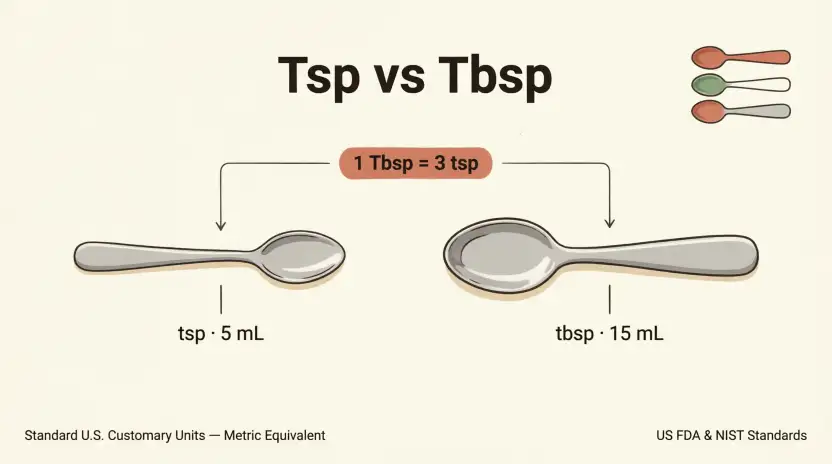
When a recipe says tsp or tbsp, using the wrong one can change the amount of an ingredient and affect the final result. Tsp means teaspoon, while tbsp means tablespoon. A tablespoon is usually three times the volume of a teaspoon, but exact measurements can vary by country.
This simple difference often causes confusion because recipes use these abbreviations instead of writing the full words. A small typo or a quick glance can also turn “1 tsp” into “1 tbsp,” which is a much larger amount.
Knowing the difference between tsp and tbsp is useful when cooking, baking, following a recipe, measuring medicine or reading food instructions. It is especially important when an ingredient is strong, such as salt, baking soda, spices or extracts.
In this guide, you will learn what tsp and tbsp mean, how their measurements compare, where the abbreviations come from, how different countries use them, and how to avoid common measurement mistakes.
Tsp or Tbsp: Quick Answer
Tsp stands for teaspoon.
Tbsp stands for tablespoon.
The basic relationship is:
- 1 tbsp = 3 tsp in common US and metric cooking measurements.
- 1 tsp = about 5 mL.
- 1 US tbsp = about 15 mL.
- 3 tsp = about 1 tbsp.
Simple examples
If a recipe asks for:
- 1 tsp of salt, use one teaspoon.
- 1 tbsp of olive oil, use one tablespoon.
- 2 tsp of sugar, use two teaspoons.
- 1 tbsp of lemon juice, use one tablespoon.
The easiest way to remember the difference is that a tablespoon is larger than a teaspoon.
However, do not assume that every country uses exactly the same tablespoon size. Australian recipes, for example, commonly use a 20 mL tablespoon, which is different from the 15 mL tablespoon used in many US and metric recipes.
What Does Tsp or Tbsp Mean?
What does tsp mean?
Tsp is the standard cooking abbreviation for teaspoon.
A teaspoon is a small unit commonly used for measuring ingredients such as:
- Salt
- Sugar
- Spices
- Vanilla extract
- Baking powder
- Baking soda
- Sauces
In many modern recipes, one teaspoon is approximately 5 mL.
For example:
Add 1 tsp of vanilla extract.
This means:
Add 1 teaspoon of vanilla extract.
What does tbsp mean?
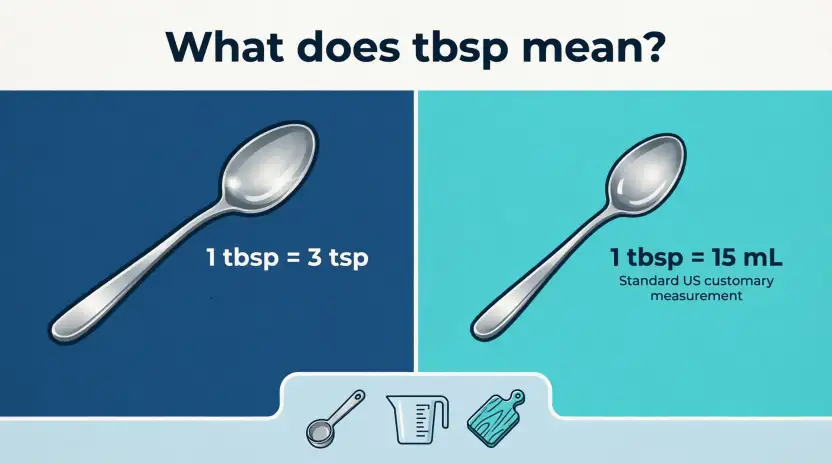
Tbsp is commonly used as an abbreviation for tablespoon.
A tablespoon is larger than a teaspoon and is often used for ingredients needed in greater amounts.
Examples include:
- Cooking oil
- Vinegar
- Honey
- Milk
- Soy sauce
- Lemon juice
- Peanut butter
In many US and metric recipes:
1 tbsp = 3 tsp
So:
2 tbsp = 6 tsp
and:
½ tbsp = 1½ tsp
Why do recipes use abbreviations?
Recipes use abbreviations because they save space and make ingredient lists easier to scan.
For example:
2 tbsp olive oil
1 tsp salt
½ tsp black pepper
is shorter and easier to read than:
2 tablespoons olive oil
1 teaspoon salt
½ teaspoon black pepper
The Origin of Tsp and Tbsp
The words teaspoon and tablespoon developed from everyday serving and measuring practices.
A teaspoon originally referred to a small spoon used for tea. A tablespoon referred to a larger spoon associated with serving food at the table.
Over time, these words became useful as standardized cooking measurements.
The abbreviations tsp and tbsp are modern shorthand forms used in recipes, cookbooks, food labels and cooking instructions.
The important point is that the physical size of ordinary household spoons is not always the same as a standardized measuring spoon. A spoon from your kitchen drawer may hold more or less than an actual measuring teaspoon or tablespoon.
That is why measuring spoons are more reliable when accuracy matters.
British English vs American English
The terms teaspoon and tablespoon are used in both British and American English. The main issue is not the vocabulary. It is the measurement system used by the recipe.
| Term | British English | American English | Example |
| Teaspoon | Commonly about 5 mL in modern recipes | About 4.93 mL | 1 tsp salt |
| Tablespoon | Commonly 15 mL in modern metric recipes | About 14.79 mL | 1 tbsp oil |
| Common ratio | 1 tbsp = 3 tsp | 1 tbsp = 3 tsp | 3 tsp = 1 tbsp |
| Abbreviation | tsp / tbsp | tsp / tbsp | 2 tbsp sugar |
Modern UK recipes often use metric measurements, while US recipes commonly use customary measurements.
The small difference between a US teaspoon and a 5 mL metric teaspoon usually does not matter for many everyday recipes. But it can matter when a recipe requires high precision.
A special case: Australia
Australia commonly uses a 20 mL tablespoon.
That means:
1 Australian tbsp = 4 Australian tsp
This is an important exception to the common 3-to-1 relationship.
If you are using an Australian recipe, check the recipe’s measurement system before converting tablespoons to teaspoons.
Which Version Should You Use?
There is no single abbreviation that is better for every country. The correct choice depends on the recipe and its measurement system.
United States
For US recipes:
- tsp = teaspoon
- tbsp = tablespoon
- 1 tbsp = 3 tsp
- 1 US tbsp ≈ 14.8 mL
Use standard measuring spoons when possible.
United Kingdom
UK recipes commonly use metric measurements.
A tablespoon is commonly treated as 15 mL, and a teaspoon as 5 mL in modern recipes.
Always follow the recipe’s stated measurement system if one is provided.
Canada
Canadian recipes may use a mix of metric and other measurement conventions. Check if the recipe gives measurements in milliliters, teaspoons or tablespoons.
Australia
Be especially careful with Australian recipes.
An Australian tablespoon is commonly 20 mL, while a teaspoon is 5 mL.
Therefore:
1 Australian tbsp = 4 tsp
International writing
For an international audience, writing the measurement in milliliters can reduce confusion.
For example:
1 tbsp (15 mL) olive oil
This is clearer than relying only on the abbreviation.
Academic writing
Academic or technical writing should favor clarity over casual shorthand.
If measurements are important, define the measurement system and use consistent units.
Business writing
Food businesses, recipe publishers and product instructions should make measurements easy to understand.
For international readers, including both the abbreviation and milliliter value can be useful.
Common Mistakes
Mistake 1: Confusing tsp with tbsp
Incorrect:
Add 1 tbsp of salt when the recipe calls for 1 tsp.
Correct:
Add 1 tsp of salt.
Explanation: A tablespoon is larger than a teaspoon. Using a tablespoon instead of a teaspoon can add roughly three times as much in common US and metric measurements.
Memory tip: Think T in tbsp as the larger tablespoon.
Mistake 2: Assuming a kitchen spoon is a measuring spoon
Incorrect:
Use any small spoon for 1 tsp.
Correct:
Use a standardized measuring teaspoon.
Explanation: Everyday spoons can have different capacities.
Memory tip: When accuracy matters, use measuring spoons.
Mistake 3: Assuming every tablespoon equals 15 mL
Incorrect:
Every tablespoon everywhere equals 15 mL.
Correct:
Many recipes use a 15 mL tablespoon, but some countries use different tablespoon sizes.
Explanation: Australian tablespoons are commonly 20 mL.
Memory tip: Check the recipe’s country or measurement system.
Mistake 4: Reading tsp as tbsp
Incorrect:
The recipe says 1 tsp, so I used 1 tbsp.
Correct:
Follow the abbreviation exactly as written.
Explanation: The difference can significantly affect the amount of an ingredient.
Memory tip: tsp = teaspoon = smaller measurement.
Everyday Examples
Emails
A recipe shared by email might say:
Add 2 tbsp of olive oil and 1 tsp of salt.
The abbreviations keep the ingredient list short and easy to scan.
Business Writing
Food companies may write:
Mix 1 tbsp of sauce with 2 tsp of vinegar.
For international customers, adding milliliter values can make the instructions clearer.
News Headlines
A food article may use words rather than abbreviations:
How to Measure a Teaspoon and Tablespoon Correctly
News and general-interest writing often spells out terms when the audience may not know the abbreviations.
Blogs
Food blogs commonly use both forms:
1 tbsp honey
2 tsp cinnamon
The abbreviations are especially useful in ingredient lists.
Social Media
Short-form recipes often use:
1 tbsp butter
½ tsp pepper
This format saves space and is easy to read on a phone.
Academic Writing
A scientific or educational text may prefer:
5 mL
instead of relying only on “1 tsp,” especially when precise measurement is important.
Daily Conversation
Someone might say:
Add a teaspoon of sugar.
In conversation, people usually say teaspoon or tablespoon rather than the abbreviations.
Google Trends & Modern Usage
People searching for tsp or tbsp are usually trying to solve a practical measurement problem. They may be following a recipe, converting measurements, checking an abbreviation or wondering if tsp and tbsp mean the same thing.
Searches such as these are common forms of the same question:
- What does tsp mean?
- What does tbsp mean?
- Is tbsp bigger than tsp?
- How many tsp are in a tbsp?
- How much is 1 tbsp in tsp?
- Is a teaspoon the same as a tablespoon?
- How many mL is a tablespoon?
- How many mL is a teaspoon?
Modern recipe websites continue to use tsp and tbsp because the abbreviations are compact and familiar to many readers.
However, international recipes can create confusion because measurement conventions differ. This is why recipes aimed at a global audience often include milliliter values alongside teaspoons and tablespoons.
Exact search-volume or Google Trends figures should not be assumed without checking current Google Trends data. The usage discussion here is based on common recipe and measurement conventions rather than invented statistics.
Quick Comparison Table
| Version | Meaning | Correct? | Region | Example |
| tsp | Teaspoon | Yes | Widely used | 1 tsp salt |
| tbsp | Tablespoon | Yes | Widely used | 1 tbsp oil |
| 1 tbsp | 3 tsp in common US/metric recipes | Yes | US and many metric recipes | 1 tbsp = 3 tsp |
| 1 Australian tbsp | 4 tsp | Yes | Australia | 20 mL |
| Tsp | Teaspoon | Usually clear, but capitalization varies by style | General | 1 tsp sugar |
| Tbsp | Tablespoon | Usually clear, but capitalization varies by style | General | 1 tbsp honey |
The key is to identify the measurement system before converting.
Key Takeaways
- Tsp means teaspoon.
- Tbsp means tablespoon.
- A tablespoon is larger than a teaspoon.
- In common US and metric recipes, 1 tbsp = 3 tsp.
- A US tablespoon is about 15 mL.
- A teaspoon is commonly about 5 mL.
- Australian recipes commonly use a 20 mL tablespoon, equal to 4 teaspoons.
- Use measuring spoons when accuracy matters.
- For international recipes, check the stated measurement system.
- When in doubt, use the milliliter value provided by the recipe.
FAQs
1. Is tsp the same as tbsp?
No. Tsp means teaspoon, while tbsp means tablespoon. A tablespoon is larger. In common US and metric cooking measurements, 1 tablespoon equals 3 teaspoons. For example, 1 tbsp of oil is equivalent to 3 tsp of oil in those measurement systems.
2. How many teaspoons are in one tablespoon?
In common US and metric recipes, 1 tablespoon equals 3 teaspoons. So, 2 tablespoons equal 6 teaspoons, and ½ tablespoon equals 1½ teaspoons. Be aware that Australian recipes commonly use a 20 mL tablespoon, which equals 4 teaspoons.
3. What does tsp mean in a recipe?
Tsp means teaspoon. It is a common recipe abbreviation used for smaller amounts of ingredients such as salt, spices, sugar, vanilla extract and baking powder. When a recipe says “1 tsp,” use a standardized measuring teaspoon rather than an ordinary household spoon.
4. What does tbsp mean in cooking?
Tbsp means tablespoon. It is used for larger ingredient measurements than a teaspoon. Recipes may call for tablespoons of oil, vinegar, honey, sauces or other ingredients. In many US and metric recipes, 1 tbsp equals 3 tsp.
5. Is 1 tsp equal to 5 mL?
A teaspoon is commonly treated as 5 mL in metric cooking measurements. A US teaspoon is technically about 4.93 mL. For most everyday recipes, the difference is small, but precise recipes may specify the exact volume.
6. Is 1 tbsp equal to 15 mL?
In many US and metric recipes, 1 tablespoon is about 15 mL. A US tablespoon is technically about 14.79 mL. However, tablespoon sizes can differ by country. Australian recipes commonly use a 20 mL tablespoon.
7. Which is bigger, tsp or tbsp?
Tbsp is bigger than tsp. In common US and metric measurements, one tablespoon contains three teaspoons. A simple way to remember this is that a teaspoon measures a smaller amount, while a tablespoon measures a larger amount.
8. Can I use a regular spoon instead of a teaspoon?
You can, but it may not be accurate. Household spoons can vary in size, while measuring spoons are designed to hold standardized amounts. For recipes where precise measurements matter, use an actual measuring teaspoon or tablespoon.
9. Does Australia use the same tablespoon measurement?
Not always. Australia commonly uses a 20 mL tablespoon, while many US and metric recipes use a tablespoon of about 15 mL. An Australian tablespoon is therefore commonly equal to 4 teaspoons rather than 3.
10. Should I write tsp or teaspoon?
Both can be correct depending on the context. Tsp is convenient in recipes and ingredient lists, while teaspoon is clearer in normal prose. For international readers, writing “1 tsp (5 mL)” can provide extra clarity.
Conclusion
Understanding tsp or tbsp is simple once you remember that tsp means teaspoon and tbsp means tablespoon. The tablespoon is the larger measurement, and in common US and metric recipes, 1 tbsp equals 3 tsp.
The main challenge is that measurement systems are not identical everywhere. A US tablespoon is about 15 mL, while an Australian tablespoon is commonly 20 mL. Teaspoons are generally around 5 mL in metric cooking.
For everyday recipes, standardized measuring spoons are the safest choice. If you are reading an international recipe, check its country or measurement system before converting the amounts.
For recipe writers and food bloggers, adding milliliter values can make instructions clearer for readers around the world.
The easiest rule to remember is: tsp is smaller, tbsp is larger, and the recipe’s measurement system always matters.
Use this guide whenever you need to check a recipe, convert a measurement or explain the difference to someone else.
Read more about!
- Apologising or Apologizing: Which Spelling Is Correct?
- Performa or Proforma: Which Spelling Is Correct?
- Inspite or Despite: The Correct Spelling Explained

I’m Olivia Parker, a grammar and English writing enthusiast passionate about making English simple and easy to understand. Through Wordsblog, I share clear explanations, useful grammar tips, and practical writing guidance to help readers write with confidence. My goal is to make learning English easier, one word at a time.